Tag Archives: Artificial Intelligence

Science: Endometriosis Insights, Deep Learning That Predicts RNA Folding

News Intern Rachel Fritts talks with host Sarah Crespi about a new way to think about endometriosis—a painful condition found in one in 10 women in which tissue that normally lines the uterus grows on the outside of the uterus and can bind to other organs.

Next, Raphael Townshend, founder and CEO of Atomic AI, talks about predicting RNA folding using deep learning—a machine learning approach that relies on very few examples and limited data.

Finally, in this month’s edition of our limited series on race and science, guest host and journalist Angela Saini is joined by author Lundy Braun, professor of pathology and laboratory medicine and Africana studies at Brown University, to discuss her book: Breathing Race into the Machine: The Surprising Career of the Spirometer from Plantation to Genetics.

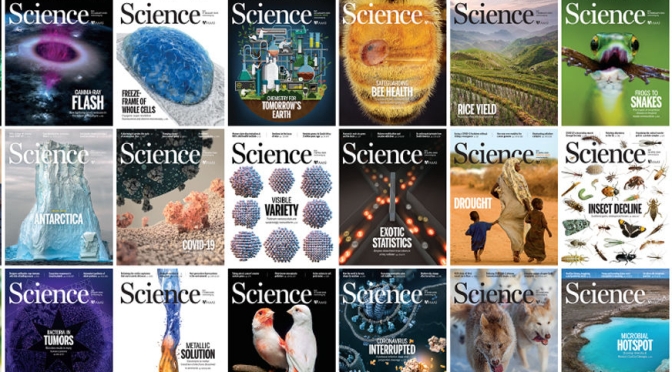
Front Covers: Science Magazine – August 27

Medicine: ‘AI’ Can Predict Rheumatoid Arthritis

Medicine: The Future Of ‘MR Technology’ (Video)

We’re already integrating Adaptive Intelligence-powered applications into our MR systems, improving workflow and patient comfort, increasing diagnostic confidence, and increasing speed.

We’re already integrating Adaptive Intelligence-powered applications into our MR systems, improving workflow and patient comfort, increasing diagnostic confidence, and increasing speed.

Our Ingenia digital MR portfolio integrates Adaptive Intelligence-driven SmartExam analytics for automatic planning, scanning and processing of exams, helping improve the entire MR workflow, from image acquisition to reading preference.

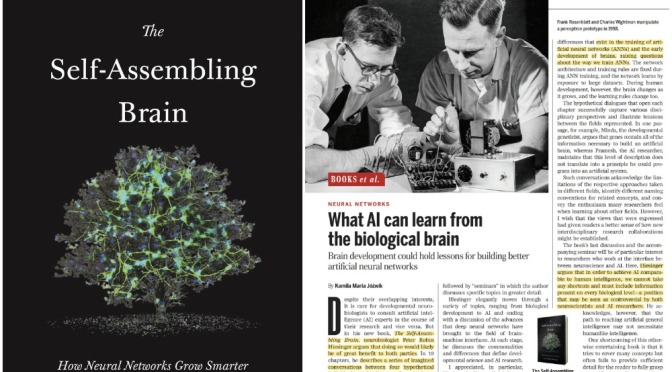
Book Reviews: ‘The Self-Assembling Brain’ – The Future Benefits For AI

As Peter Robin Hiesinger argues, “the information problem” underlies both fields, motivating the questions driving forward the frontiers of research. How does genetic information unfold during the years-long process of human brain development―and is there a quicker path to creating human-level artificial intelligence? Is the biological brain just messy hardware, which scientists can improve upon by running learning algorithms on computers? Can AI bypass the evolutionary programming of “grown” networks? Through a series of fictional discussions between researchers across disciplines, complemented by in-depth seminars, Hiesinger explores these tightly linked questions, highlighting the challenges facing scientists, their different disciplinary perspectives and approaches, as well as the common ground shared by those interested in the development of biological brains and AI systems. In the end, Hiesinger contends that the information content of biological and artificial neural networks must unfold in an algorithmic process requiring time and energy. There is no genome and no blueprint that depicts the final product. The self-assembling brain knows no shortcuts.

Read book review here

Interview: ‘GENIUS MAKERS’ Author Cade Metz On Artificial Intelligence From A Human Perspective

How Cade got access to the stories behind some of the biggest advancements in AI, and the dynamic playing out between leaders at companies like Google, Microsoft, and Facebook.

Cade Metz is a New York Times reporter covering artificial intelligence, driverless cars, robotics, virtual reality, and other emerging areas. Previously, he was a senior staff writer with Wired magazine and the U.S. editor of The Register, one of Britain’s leading science and technology news sites. His first book, “Genius Makers”, tells the stories of the pioneers behind AI.

Topics discussed: 0:00​ Sneak peek, intro 3:25​ Who is “Genius Makers” for and about? 7:18​ *Spoiler alert!* Artificial General Intelligence (AGI) 11:01​ How the story continues after the book ends 17:31​ Overinflated claims in AGI 23:12​ Deep Mind, OpenAI, and AGI 29:02​ Outsider perspectives 34:35​ Early adopters of ML 38:34​ Who gets credit for what? 42:45​ Dealing with bias 46:38​ Aligning technology with nee

Read more

Science: Computer AI That Debates, Sea Slugs Regrow Entire Bodies (Podcast)

A computer that can participate in live debates against human opponents.

In this episode:

00:43 AI Debater

After thousands of years of human practise, it’s still not clear what makes a good argument. Despite this, researchers have been developing computer programs that can find and process arguments. And this week, researchers at IBM are publishing details of an artificial intelligence that is capable of debating with humans.

Research Article: Slonim et al.

News and Views: Argument technology for debating with humans

10:30 Research Highlights

The sea slugs that can regrow their whole body from their severed head, and evidence of high status women in ancient Europe.

Research Highlight: Now that’s using your head: a sea slug’s severed noggin sprouts a new body

Research Highlight: A breathtaking treasure reveals the power of the woman buried with it

12:56 Briefing Chat

We discuss some highlights from the Nature Briefing. This time, the next generation of gravitational wave detectors, and why 2020 was a record-breaking year for near-Earth asteroids.