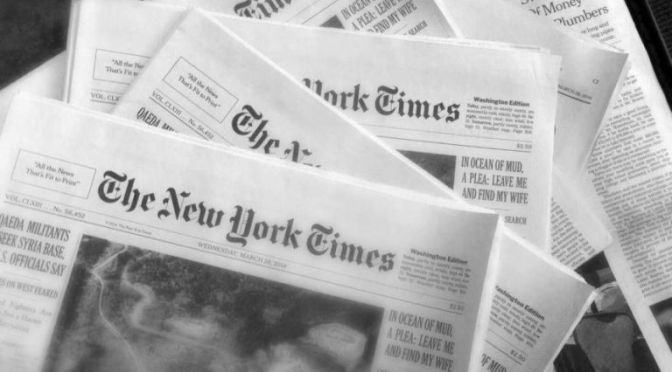
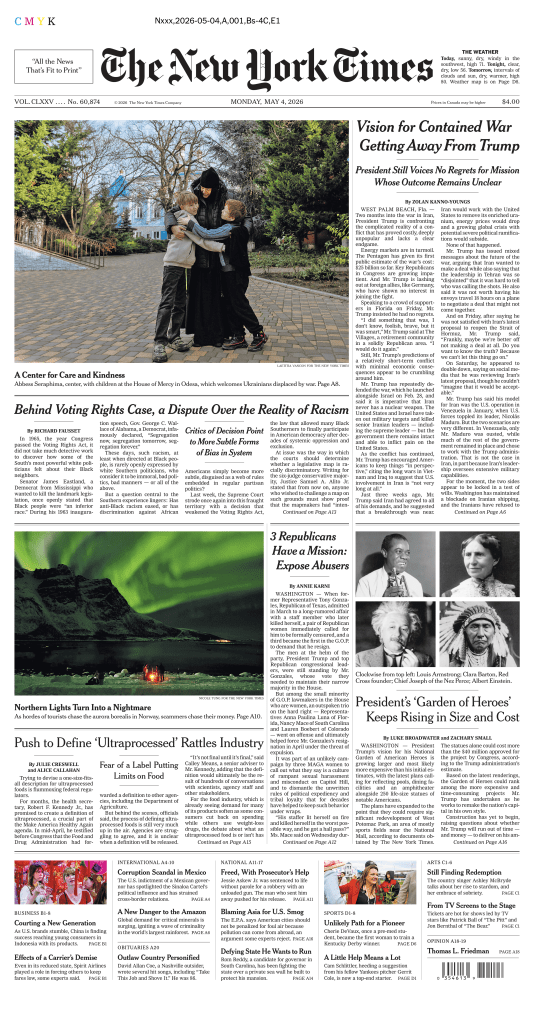
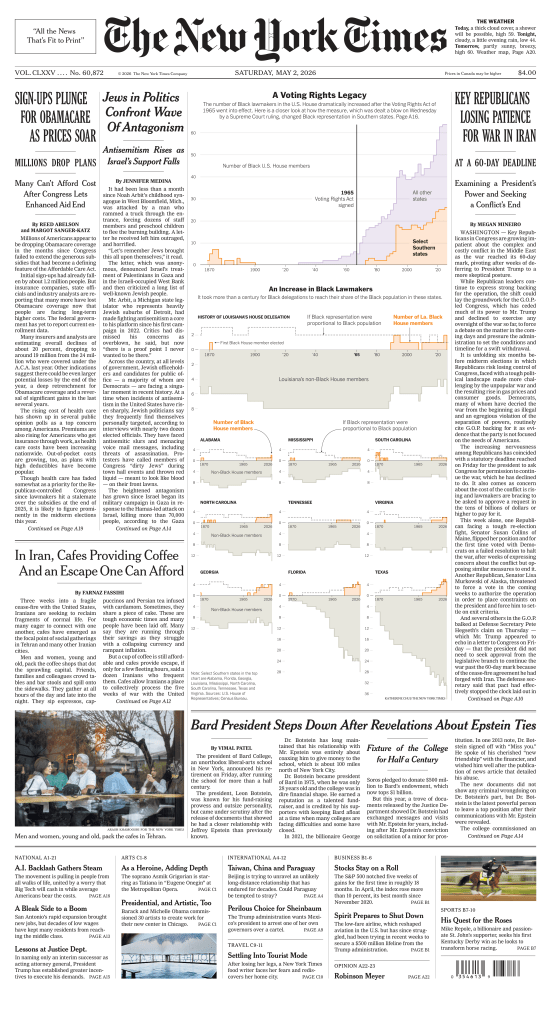
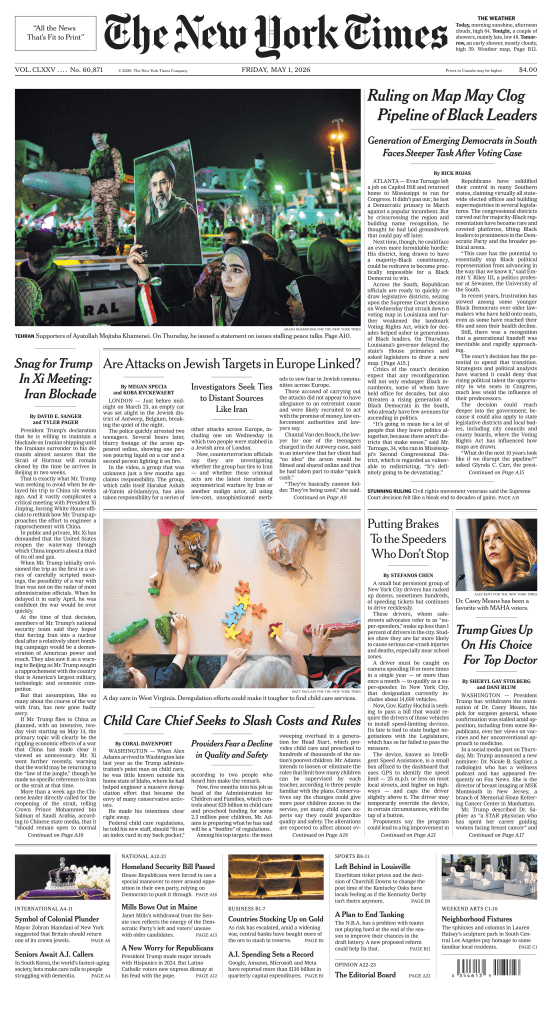
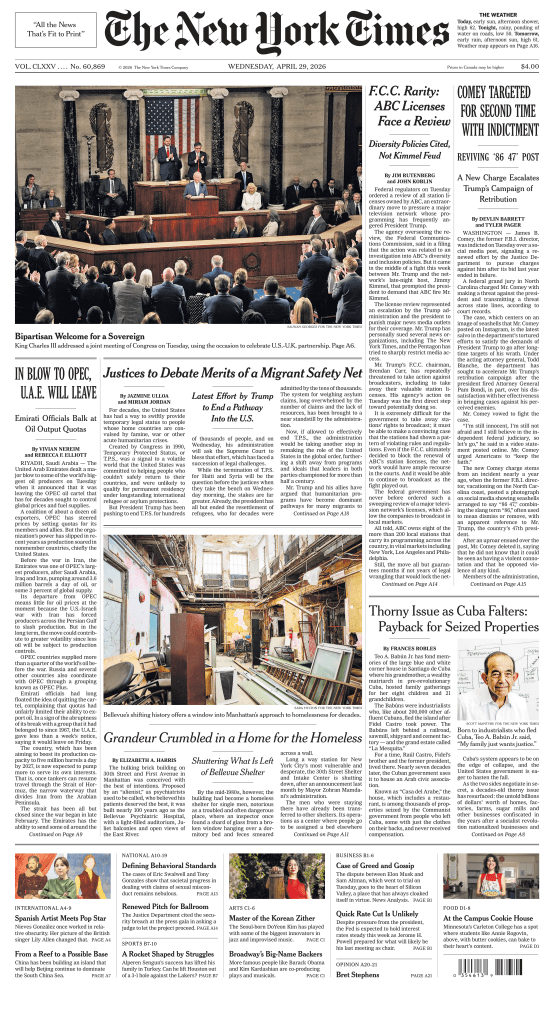
President Trump said the U.S. would help stranded ships leave the Strait of Hormuz. Iran threatened to attack vessels traveling through the waterway without its permission.
With President Trump’s visit to Beijing looming, China is pushing Iran to negotiate even as its companies export material that could be used by Iran’s military.
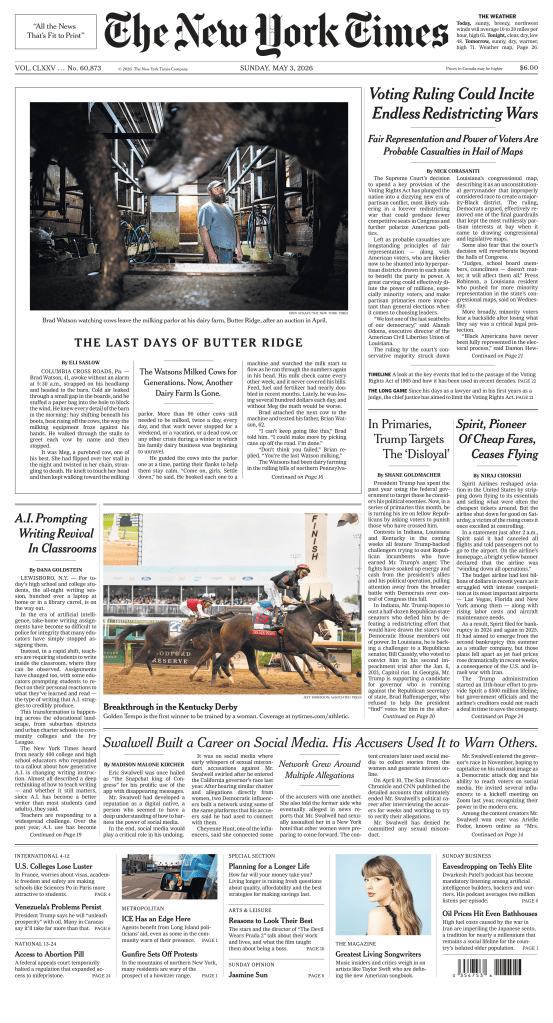
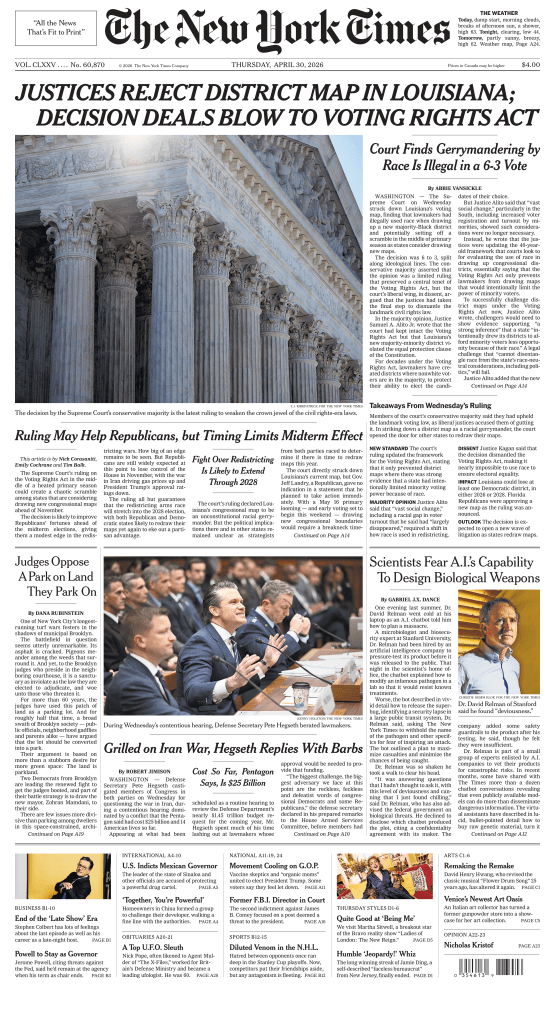
The election on Tuesday will test the influence of President Trump, who endorsed challengers to state senators who scuttled his push to redraw political maps.
The U.S. indictment of a Mexican governor has spotlighted cartel corruption, strained cross-border relations and handed President Claudia Sheinbaum a thorny choice.
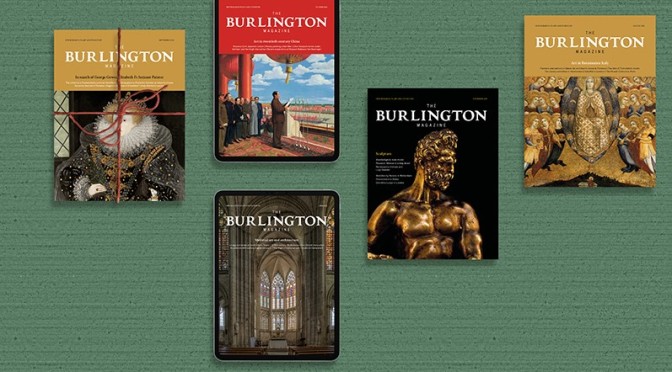
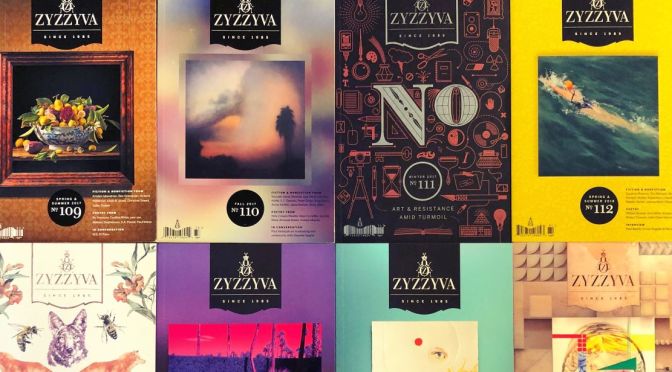
“The Consolidation of Collections: New Light on the 18th-Century British Art Market” An in-depth study by the editorial team and guest contributors exploring how major British estates restructured their private galleries during the mid-1700s. The article utilizes newly discovered ledger books to trace the provenance of several key Italian Baroque works.
“Paolo Veneziano and the International Gothic in Venice” Following the research trends seen in the early part of the year, this feature provides a technical analysis of recently restored altarpieces attributed to Veneziano, focusing on the use of ultramarine and gold leaf techniques that defined the Venetian style in the 14th century.
“Nicholas Lanier and the ‘Star’ Drawings: New Discoveries” Building on recent scholarship (featured in related symposiums), this article identifies several previously unrecognized drawings from the collection of Nicholas Lanier (1588–1666). It specifically examines the “star-shaped marks” used by Lanier and his uncle Jerome to catalog their sixteenth-century Italian acquisitions.
Editorial and Shorter Notices Editorial: “The Future of Art History in the Digital Age” Editor Christopher Baker discusses the balance between traditional archival research and the integration of AI and digital imaging in art historical authentication.
Object in Focus: “George Frederic Watts’s Satan (1847)” A specialized notice providing a new interpretation of Watts’s massive canvas. The author argues that the figure’s pose was inspired by the Monte Cavallo Horse Tamers in Rome rather than the Apollo Belvedere, as previously thought.
Exhibition and Book Reviews The Farnese Gallery Drawings (Musée du Louvre, Paris): A critical review by Ketty Gottardo on the exhibition focusing on the Carracci brothers’ preparatory works.
Studio Prints: A History, 1968–2011: A review of the new publication by Paul Holberton Publishing, detailing the impact of the London workshop on 20th-century printmaking.
Modernizing the Catalog: A review of the Patek Philippe exhibition and the intersection of fine horology with decorative arts history.
President Trump’s push to punish political enemies in his party will play a starring role in a series of Republican primaries in which he’s backed challengers.
Three representatives who had a hand in forcing the resignations of lawmakers accused of sexual misconduct said they were out to name and shame more offenders.
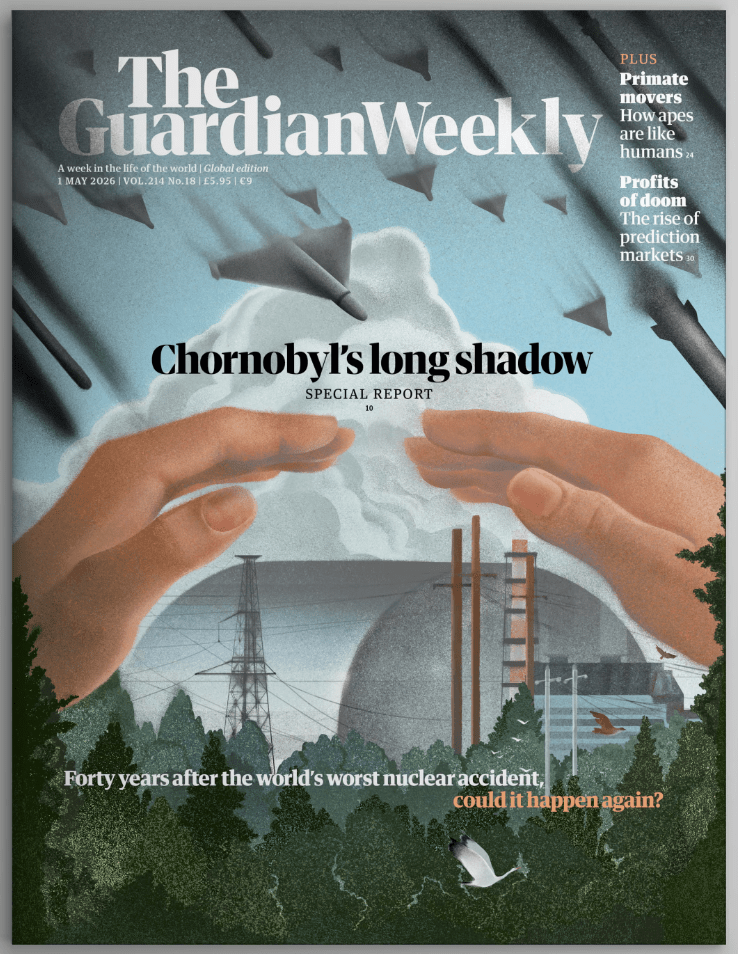
In March 2022, soon after the full-scale Russian invasion of Ukraine began, Kyiv-based illustrator Masha Foya produced what I think is one of the Guardian Weekly’s most powerful covers on the war, concerning the devastation of Mariupol. So it’s a pleasure to feature Masha’s work again for the current edition, this time marking 40 years since the Chornobyl nuclear disaster.
“Since childhood, the story of Chornobyl has always made me feel a strange dissonance – such a tragedy occurring on a beautiful spring day in April,” explains Masha on the thought process behind her design, in which seasonal greens fade away into ominous skies.
It also reflects present-day anxieties. For a special report, Pjotr Sauer visits the site of the world’s worst nuclear accident and sees up close how the giant containment structure around the failed reactor is in urgent need of costly repairs after a Russian drone strike, as fears grow of a possible new catastrophe.
Five essential reads in this week’s edition
Environment | Why apes are more like us than we ever thought Imagination, reason and ability to recognise faces from the past are not the sole preserve of humans, studies show. Gloria Dickie reports
Finance | The wagering of war Once largely siloed to sporting events, betting has now spread to include contracts on news events where insider information could pay handsomely. With over $1bn in perfectly timed bets on the Iran war having recently been seen, Lauren Aratani explores what exactly is going on
Feature | The big game hunters who believe they can save Africa’s wildlife One way to pay for wildlife conservation is to allow the rich to bag a few animals for high prices. But critics see this approach as an exercise in neocolonialism. Cal Flynwent in pursuit of answers
Opinion | Starmer’s listless government shows zombie politics is the new norm Distracted, listless and unambitious – the British PM’s true form has finally emerged. But whatever comes next must end this ruinous cycle for the country, argues Nesrine Malik
Culture | Iron Maiden on 50 years of heavy metal madness As a career-spanning documentary hits cinemas, the legendary rock band revisit their path from pubs to stadiums over half a century of headbanging hits. Harry Sword buckles up
Oil prices surged above $120 a barrel before pulling back in volatile trading on concerns that the war could escalate. Gasoline in the U.S. hit $4.30 a gallon.
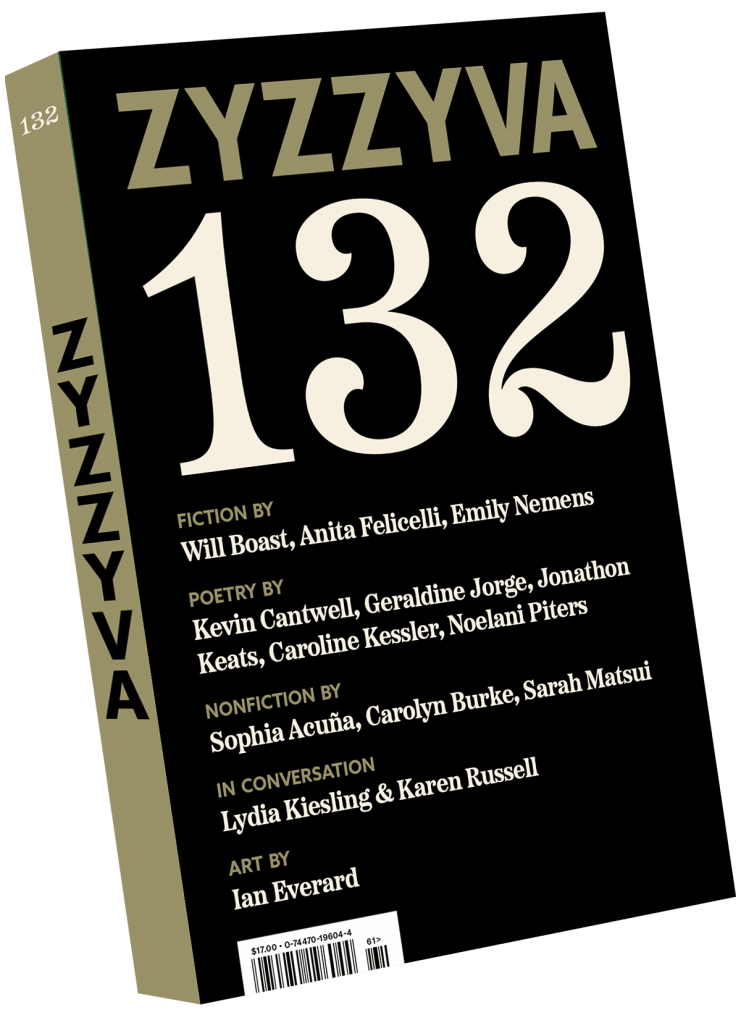
“Saguaro in the Sea” by Sophia Acuña: on surfing and indigeneity in Southern California, told through collage.
“Care Directive” by Sarah Matsui: a daughter’s attempt to keep her aging father in Hawaii from all sorts of calamity, but having to monitor him from the mainland.
“Triptych: A Biographer’s Sketchbook” by Carolyn Burke: “The Baroness was lively, curious, and still blond at eighty-five. She received me in a flurry of franglais, the mingling of two languages in which we would converse, and put us at ease with pink champagne, her favorite.”
Fiction
“Decoys” by Will Boast: goofing around working at the town supermarket, burning through the days till it all comes to head.
“Lilac Mud” by Anita Felicelli: A Bay Area artist in Amsterdam is approached one night by a man claiming to be a former student, leading to a crisis of identity and purpose.
“Grote geplumaceerde” by Emily Nemens: “Afterward, staring hard at her phone, which was her radio, which was the bearer of bad news, she wondered what mattered at all.”
Poetry
Kevin Cantwell, Geraldine Jorge, Jonathon Keats, Caroline Kessler, and Noelani Piters.
In Conversation
Lydia Kiesling talks to acclaimed author Karen Russell about Russell’s latest novel, The Antidote, and about Russell’s “fascination with foundational myths, the things we choose to know, and the things we choose to ignore or forget.”
The Trump administration wants to terminate humanitarian protections known as Temporary Protected Status for hundreds of thousands of migrants from Haiti and Syria.
Jeffrey Epstein’s messages cast light on an unusual building on his private island and show how his connections helped him secure tapestries from Mecca for it.
Mr. Musk’s lawsuit against Mr. Altman and OpenAI, which went to trial this week, makes the case that all-encompassing greed is Silicon Valley’s defining feature.
News, Views and Reviews For The Intellectually Curious




 Boomers Daily