
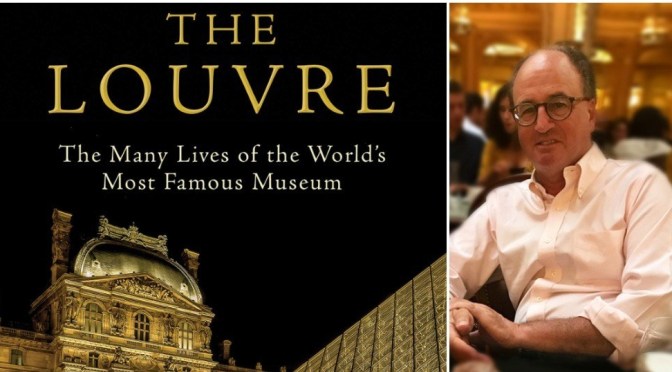
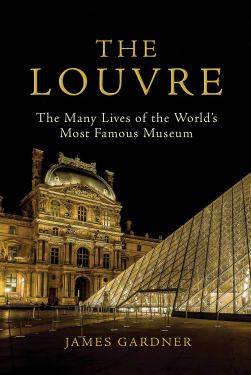
 The fascinating and little-known story of the Louvre, from its inception as a humble fortress to its transformation into the palatial residence of the kings of France and then into the world’s greatest art museum.
Some ten million people from all over the world flock to the Louvre each year to enjoy its incomparable art collection. Yet few of them are aware of the remarkable history of that place and of the buildings themselves―a fascinating story that historian James Gardner elegantly chronicles in the first full-length history of the Louvre in English.
More than 7,000 years ago, men and women camped on a spot called le Louvre for reasons unknown; a clay quarry and a vineyard supported a society there in the first centuries AD. A thousand years later, King Philippe Auguste of France constructed a fortress there in 1191, just outside the walls of a city far smaller than the Paris we know today. Intended to protect the capital against English soldiers stationed in Normandy, the fortress became a royal residence under Charles V two centuries later, and then the monarchy’s principal residence under the great Renaissance king François I in 1546.
It remained so until 1682, when Louis XIV moved his entire court to Versailles. Thereafter the fortunes of the Louvre languished until the tumultuous days of the French Revolution when, during the Reign of Terror in 1793, it first opened its doors to display the nation’s treasures. Ever since―through the Napoleonic era, the Commune, two World Wars, to the present―the Louvre has been a witness to French history, and expanded to become home to a legendary collection, including such masterpieces as the Mona Lisa and Venus de Milo, whose often-complicated and mysterious origins form a spectacular narrative that rivals the building’s grand stature.
James Gardner
James Gardner is an American art critic and literary critic based in New York and Buenos Aires. He is the author of six books, including Buenos Aires: The Biography of a City. His writings have appeared in the New York Times, the Wall Street Journal, the New Republic, and the British Spectator. He was the art critic at the New York Post and wrote architecture criticism for the New York Observer, before serving as the architecture critic at the New York Sun. He is now a contributing editor at The Magazine Antiques.




 In “Unto This Last and Other Essays on Art and Political Economy” (1860), which gives the exhibition its title, Ruskin “sees” interconnected social injustices. He attacks economic inequality. Later, he sets out to establish a utopian community in working-class Sheffield, England. In one gallery we see his influence on “progressive thinkers worldwide.” Gandhi said that reading “Unto This Last” in 1904 transformed his life and ideas.
 ‘If you can paint one leaf,” John Ruskin once declared, “you can paint the world.” And in “Unto This Last: Two Hundred Years of John Ruskin”—the hypnotically potent (though flawed) exhibition at the Yale Center for British Art marking the bicentennial of his birth—we see how wonderfully he kept trying.
 Boomers Daily