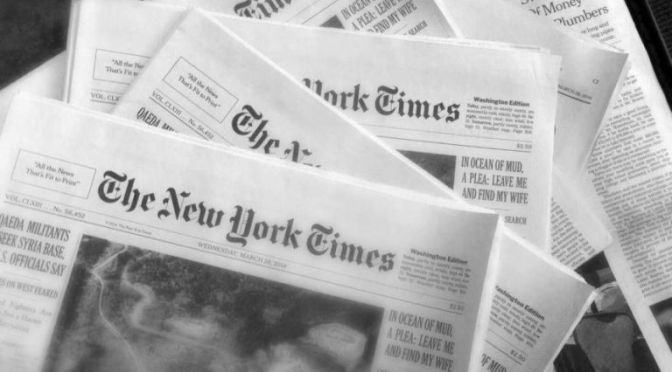
THE NEW YORK TIMES – TUESDAY, AUGUST 26, 2025

Seeking to Control Fed, Trump Risks Upending a Pillar of the Global Economy

President Trump’s attempt to fire Lisa Cook, a Fed governor, will set off a long legal battle and could lead to higher inflation and government borrowing costs.

Judge Dismisses Trump Administration Suit Against Federal Bench in Maryland

The judge took President Trump and some of his top aides to task for having repeatedly attacked other judges who have dared to rule against the White House.

Israel Faces Growing Pressure Over Hostages and Gaza Offensive

As rallies spread, the country’s security cabinet was to meet for the first time since Hamas agreed to a new cease-fire proposal, officials said.

Trump Wants Europe to Stop Regulating Big Tech. Will It Bend?

The White House suggested that countries with regulations restricting U.S. tech companies could face penalties.

The Envelope of Democracy

How a practice born on Civil War battlefields became the latest front in America’s fight over trust, law, and the vote.

By Michael Cummins, Editor, August 23, 2025

On a raw November morning in 1864, somewhere in a Union encampment in Virginia, soldiers bent over makeshift tables to mark their ballots. The war was not yet won; Grant’s men were still grinding through the trenches around Petersburg. Yet Abraham Lincoln insisted that these men, scattered across muddy fields and far from home, should not be denied the right to vote. Their ballots were gathered, sealed, and carried by courier and rail to their home states, where clerks would tally them beside those cast in person. For the first time in American history, large numbers of citizens voted from a distance—an innovation spread across 19 Union states by hasty wartime statutes and improvised procedures (National Park ServiceSmithsonian).

Lincoln understood the stakes. After the votes were counted, he marveled that “a people’s government can sustain a national election, in the midst of a great civil war” (Library of Congress). To deny soldiers their ballots was to deny the Union the very legitimacy for which it fought. Then, as now, critics fretted about fraud and undue influence: Democrats accused Republicans of manufacturing ballots in the field; rumors spread of generals pressuring soldiers to vote for Lincoln. Newspapers thundered warnings about the dilution of the franchise. But the republic held. Soldiers voted, the ballots were counted, and Lincoln was re-elected.

A century and a half later, the envelope has become a battlefield again. Donald Trump has promised to “end mail-in ballots” and scrap voting machines, declaring them corrupt, even while bipartisan experts explain that nearly all U.S. ballots are already paper, with machines used only for tabulation and auditing (APBipartisan Policy Center). The paradox is striking: modern tabulators are faster and more accurate than human tallies, while hand counts are prone to fatigue and error (Time).

But how did a practice with Civil War pedigree come to be portrayed as a threat to democracy itself? What, at root, do Americans fear when they fear the mailed ballot?

In a Phoenix suburb not long ago, a first-time voter—call her Teresa—dropped her ballot at a post office with pride. She liked the ritual: filling it out at her kitchen table, checking the boxes twice, signing carefully. Weeks later, she learned her ballot had been rejected for a signature mismatch with an old ID on file. She had, without knowing it, missed the deadline to “cure” her ballot. “It felt like I didn’t exist,” one young Arizonan told NPR, voicing the frustration of many. Across the country, younger and minority voters are disproportionately likely to have their mail ballots rejected for administrative reasons such as missing signatures or late arrival. If fraud by mail is vanishingly rare, disenfranchisement by process is not.

Meanwhile, on the factory floor of American vote-by-mail, the ordinary hum of democratic labor continues. Oregon has conducted its elections almost entirely by mail for a quarter century, with consistently high participation and confidence (Oregon Secretary of State). Colorado followed with its own all-mail model, paired with automatic registration, ballot tracking, and risk-limiting audits (Colorado Secretary of State). Washington and Utah have joined in similar fashion. Election officials talk about the efficiency of central counting centers, the ease of auditing paper ballots, the increased access for rural and working-class voters. One clerk described her office during election week as “a warehouse of democracy,” envelopes stacked in trays, staff bent over machines that scan and sort. In one corner, a team compares signatures with the care of art historians verifying provenance. The scene is not sinister but oddly moving: democracy reduced to thousands of small acts of faith, each envelope a declaration that one voice counts.

And yet suspicion lingers. Part of it is ritual. The image of democracy for generations has been the polling place: chalkboard schedules, folding booths, poll books fat with names. The mailed ballot decentralizes the ceremony. It moves civic action into kitchens and break rooms, onto couches and barracks bunks. For some, invisibility breeds mistrust; for others, it is the genius of the thing—citizenship woven into home life, not just performed in public.

Part of the anxiety is legal. The Constitution’s Elections Clause gives the states authority over the “Times, Places and Manner” of congressional elections but empowers Congress to “make or alter such Regulations” (Constitution Annotated). Presidents have no such power. The White House cannot ban absentee ballots by decree. Congress could attempt to standardize or limit the use of mail ballots in federal elections—though any sweeping restriction would run headlong into litigation from voters who cannot be present on Election Day, from soldiers on deployment to homebound citizens.

And we have seen how precarious counting can be when law and logistics collide. In 2000, Florida’s election—and the presidency—turned not on fraud but on ballots: “hanging chads,” the ambiguous punch-card remnants that confounded machines and humans alike. The Supreme Court’s decision in Bush v. Gore halted a chaotic recount and left many Americans convinced that the true count would forever be unknowable (Oyez). The lesson was not that ballots are fraudulent, mailed or otherwise, but that the process of counting and verifying them is fragile, and that the legitimacy of outcomes depends on rules agreed to before the tally begins.

It is tempting, in moments of panic, to look abroad for calibration. In the United Kingdom, postal ballots are an ordinary convenience governed by clear rules (UK Electoral Commission). Canadians deploy a “special ballot” system that lets voters cast by post from the Yukon to Kandahar (Elections Canada). The Swiss have made postal voting a workaday part of civic life (Swiss Confederation). Fraud exists everywhere—but serious cases are exceptional, detected, and punished.

Back home, the research is blunt. The Brennan Center for Justice finds that fraud in mail balloting is “virtually nonexistent.” A Stanford–MIT study found that universal vote-by-mail programs in California, Utah, and Washington had no partisan effect—undercutting claims that the method “rigs” outcomes rather than simply broadening access. And those claims that machines slow results? Election administrators, backed by Wisconsin Watch, explain that hand counts tend to be slower and less accurate, while scanners paired with paper ballots and audits deliver both speed and verifiability.

Still, mistrust metastasizes, not from facts but from fear. A rumor in Georgia about “suitcases of ballots,” long debunked, lingers as a meme. A Michigan voter insists he saw a neighbor mail five envelopes, unaware they were for a household of five registered voters. Conspiracy thrives in the gap between visibility and imagination.

Yet even as the mailed ballot feels embattled, the next frontier is already under debate. In recent years, pilot projects have tested whether citizens might someday cast votes on their phones or laptops, secured not by envelopes but by cryptographic ledgers. The mobile voting platform Voatz, used experimentally in West Virginia and a few municipal elections, drew headlines for its promise of accessibility but also for its flaws: researchers at MIT found vulnerabilities tied to third-party cloud storage and weak authentication, prompting urgent warnings (MIT Technology Review). GoatBytes’ 2023 review noted that blockchain frameworks like Hyperledger Sawtooth and Fabric might one day offer stronger, verifiable digital ballots, and even the U.S. Postal Service has patented a blockchain-based mobile voting system (USPTO Patent). Capitol Technology University traced this shift as the latest stage in the long evolution from paper to punch cards to optical scanners, with AI now assisting ballot tabulation (Capitol Tech University). For proponents, mobile systems are less about novelty than necessity: the disabled veteran, the soldier abroad, the homebound elder—all could vote with a tap.

But here, too, the fault lines are visible. The American Bar Association recently cautioned that while blockchain and smartphone voting might expand access, they raise thorny questions about privacy, coercion, and verification—how to ensure a vote cast on a personal device is both secret and authentic. TIME Magazine spotlighted the allure of digital voting for those long underserved by the system, even as groups like Verified Voting warned that premature adoption could expose elections to risks far graver than those posed by paper mail ballots (TIME). In this telling, technology is Janus-faced: a path to broaden democracy’s reach, and a Pandora’s box of new vulnerabilities. If the mailed envelope embodies trust carried by hand, the mobile ballot would ask citizens to entrust their franchise to lines of code. Whether Americans are ready to make that leap remains an open question.

If there is a flaw to worry about, it is not the specter of rampant fraud, but the small, fixable frictions that disenfranchise well-meaning voters: needlessly strict signature-match policies, short cure windows, postal delays for ballots requested late, confusing instructions, and uneven funding for local election offices. The remedy comes not from abolishing the envelope, but from investing in the infrastructure around it: clear statewide standards for verification and cure; robust voter education about deadlines; modernized voter registration databases; secure drop boxes; and the budget lines that let county clerks hire and train staff.

In the end, the mailed ballot is less a departure from American tradition than a continuation of it. The ritual has changed—less courthouse, more kitchen table—but the bargain is the same. When a soldier in 1864 dropped his folded ballot into a wooden box, he entrusted strangers to carry it home. When a modern voter seals an envelope in Denver or Tacoma, she entrusts a chain of clerks, scanners, and auditors. Trust, not spectacle, is the beating heart of the system.

And perhaps that is why the envelope matters so much now. To defend it is not merely to defend convenience; it is to defend a vision of democracy capacious enough to reach the absent, the disabled, the far-flung, the over-scheduled—our fellow citizens whose lives do not always bend to a Tuesday line at a nearby gym. To reject it is to narrow the franchise to those who can appear on command.

Imagine Lincoln again, weary at the White House in the fall of 1864, reading dispatches about alleged fraud in soldier ballots and still insisting the votes be counted. Imagine a first-time voter in Phoenix who lost her chance over a mismatched squiggle, and the next one who won’t because the state clarified its cure rules. Imagine the county clerk who will never trend on social media, but who builds public confidence day by day with plain procedures and paper trails.

At the end of the day, American democracy may still come down to envelopes—white, yellow, blue—carried in postal bins, stacked in counting rooms, marked by the smudges of human hands. They are fragile, yes, but they are resilient too. The Civil War ballots survived trains and rivers; today’s ballots survive disinformation and delay. The act is the same: a citizen marks a choice, seals it, and sends it forth with faith that it will be received. If democracy is government of, by, and for the people, then every envelope is its emissary.

What would we lose if we tore that emissary up? Not only the votes of those who cannot stand in line, but the habit of trust that keeps the republic breathing. Better, then, to do what we have done at our best moments—to keep counting, keep auditing, keep improving, keep faith. The mailed ballot is not a relic of pandemic panic; it is a tested tool of a sprawling republic that has always asked its citizens to speak from wherever they are.

THIS ESSAY WAS WRITTEN AND EDITED UTILIZING AI

THE REPUBLIC OF VOICES

At the height of its power in 1364, Venice was a republic where eloquence was currency and every piazza a stage.

By Michael Cummins, Editor, August 24, 2025

The bells began before sunrise. Their iron tongues tolled across the lagoon, vibrating against the damp November air, carrying from the Campanile of San Marco to the Arsenal’s yards and into the canals of Cannaregio. This was Venice in 1364—at the height of its power, its fleets unrivaled in the Mediterranean, its markets setting the prices of silk and spice across Europe. The city sat at the hinge of East and West, commanding trade routes between Byzantium, the Mamluk Sultanate, and Western Christendom. Venetian galleys, sleek and maneuverable, patrolled waters thick with pirates, their timbers assembled in the Arsenale di Venezia, a proto-industrial marvel capable of producing a galley in a single day. Venice was wood, stone, and gold, but above all, it was sound. “The city is never silent,” one German pilgrim marveled, “every tongue of Christendom and beyond seems to shout at once.”

Venice’s supremacy was not abstract. Its colonies in Crete and Cyprus served as staging posts; its consulates dotted the Dalmatian coast. In Constantinople and Alexandria, Venetians lived in fortified fondaci—walled compounds where merchants traded under their own laws. The wealth of Murano’s glassmakers, Rialto’s bankers, and San Polo’s textile dyers depended on this vast maritime lattice. Even the Doge—Venice’s elected head of state, chosen for life from among the patrician class, part monarch, part magistrate but hemmed in by councils—was more merchant than monarch. Venetian nobility was not feudal but commercial: a patrician might chair the Senate one year and finance a convoy to the Levant the next. Bills of exchange, maritime insurance, joint-stock ventures—all pioneered here—reduced risk and turned uncertainty into empire.

Yet the republic was also built on voices. Speech was its second currency, flowing through churches, palaces, markets, and courts. Treaties were sealed with words before they were inked; rumors shifted markets as much as cargoes; sermons inflamed consciences long before decrees reached the streets.

In San Marco, the Basilica of mosaics and incense, the preacher’s voice dominated. On feast days friars addressed audiences that blurred patrician and plebeian, women and sailors, artisans and merchants. A Franciscan, recalling the Black Death, likened Venetian greed to “a contagion that spreads from house to house.” Andrea Dandolo, the Doge who also wrote a chronicle of his age, noted the murmurs of unease that followed. A parable about false shepherds might by nightfall become tavern gossip, retooled as an attack on patrician governors.

In 1364, Venice granted Petrarch a palazzo on the Riva degli Schiavoni in exchange for his library, a collection that would become the foundation of the Biblioteca Marciana. Known as the father of Humanism and now often called the father of the Italian Renaissance, he was among Europe’s most influential figures—poet of the Canzoniere, rediscoverer of Cicero’s letters, and advocate for the revival of classical eloquence. From his Venetian residence, he praised the city as “a republic not only of ships and laws, but of eloquence itself, where voices, raised in harmony or dissent, bind the state together.” For him, Venice was not only a naval empire but also a theater of speech.

Across the piazza in the Doge’s Palace, words carried a different weight. The cavernous Sala del Maggior Consiglio could hold a thousand patricians, their decisions shaping treaties and wars. The Doge spoke little, his ritual response to petitions—“Si vedrà”, “It will be seen”—an eloquence of restraint. More dramatic were the relazioni, oral reports of ambassadors returning from Constantinople or Cairo. Though later transcribed, in the fourteenth century they were performances. An envoy describing the Byzantine emperor’s throne gestured so vividly that senators felt transported to the imperial court.

Yet it was in the Rialto that Venice’s speech was most raw, where chatter became commerce and gossip became power. By day, the wooden bridge creaked under merchants and beggars, its planks worn smooth by boots from every corner of Europe. Below, spices from Alexandria, silk from Cathay, and pepper from India changed hands, but so too did stories. “The Rialto is a world itself,” wrote the chronicler Marino Sanudo, “where the news of all Christendom and beyond is traded swifter than spices.” Rumors of Ottoman fleets could shift the price of cinnamon. Satirical verses, recited sotto voce, mocked the deafness of patricians: “A house of nodding heads, deaf to its people.”

And when night fell, the Rialto became something else entirely. Carnival transformed it into a stage where anonymity and satire thrived. Masked singers, some of them patrician youths disguised as artisans, improvised verses lampooning senators and guild leaders. One chronicler described young nobles in Greek disguise singing ballads about the Senate’s obsession with ceremony. The laughter echoed across the Grand Canal, tolerated because, as Venetians said, “the republic breathes satire as easily as air.”

The Grand Canal itself was Venice’s liquid stage. By day it was an artery of commerce, alive with the slap of oars, the curses of gondoliers, the hammering of crates. By dusk the atmosphere shifted. Lanterns swayed from boats, their reflections shimmering across the black water. Gondoliers sang what would one day evolve into the barcarolle. Noble families staged boat processions with lutes and trumpets, music drifting across the canal in competing layers of sound. Commerce by day, serenade by night—the same canal a bazaar and a ballroom.

And then there was the Piazza San Marco, the great stage of the republic. On feast days, choirs filled the basilica, their plainsong swelling into polyphony that ricocheted off Byzantine domes. Trumpeters announced the Doge, banners unfurled, and processions wound through the square until, as Dandolo wrote, “the piazza shone with gold and sounded with voices and trumpets.” During Carnival, the sacred gave way to the profane: jugglers, acrobats, and improvisatori recited comic verses in dialect. A fire-breather might draw crowds near the bronze horses while a masked singer mocked senators. It was noisy, unruly, profoundly Venetian—a place where art, politics, and voice collided.

Artisans, too, had their stages. The scuole, confraternities of tradesmen, were gatherings where chants gave way to orations. Statutes might be inscribed, but obligations were enforced aloud. A shoemakers’ statute from 1360 commanded that “each master shall stand and speak before his fellows, giving account not only of his work but of his conduct.” Eloquence was honor; to falter was to risk shame.

The courts offered a harsher stage. Justice, too, was spoken. The Statuta Veneta emphasized testimony over parchment: “testimony is judged not by parchment but by voice.” In 1362, a fisherman accused of theft protested, “Non rubai, ma trovai.”—“I did not steal, I found.” His trembling voice, the notary observed, betrayed him. Eloquence could acquit; faltering speech could condemn.

And words could also damn. After the plague, prophets thundered in piazzas, sailors cursed saints in taverns, women repeated visions too vividly. One inquisitorial record recalls a woman accused of declaring, “the plague is God’s punishment for the pride of merchants.” Whether prophecy or lament, her words were evidence of heresy.

To live in Venice was to live in a polyphony of languages. From Dalmatia to Crete, Cyprus to Trebizond, the city’s empire infused it with voices. The pilgrim Ludolf of Sudheim marveled that in one square he heard “Latin, Greek, Saracen, and Hebrew, all arguing.” Translators ferried not only goods but ideas—fragments of Averroes, Byzantine theology, Jewish philosophy. Did a spice-seller at the Rialto know he was transmitting the seeds of the Renaissance?

In patrician libraries and monastic scriptoria, another kind of voice was taking shape: Aristotle and Thomas Aquinas, arriving in Latin translation, read aloud in candlelit chambers. By 1364, copies of Aristotle’s Politics and Nicomachean Ethics were circulating among patricians. What did it mean to live a life of virtue? Could the common good outweigh private interest? Such debates mattered in a republic balancing mercantile ambition with civic restraint.

Thomas Aquinas, too, was debated in Dominican houses. His Summa Theologica offered a scaffolding that united reason and faith. Did divine law supersede human law, or did the latter participate in the former? A friar might thunder against usury on Sunday while echoing Aquinas’s careful distinctions on just exchange.

What is striking is that these scholastic voices did not remain confined to cloisters. They mingled with guild disputations, senatorial deliberations, carnival satire. And just beyond the horizon, Humanism was stirring. Petrarch, uneasy yet pivotal, urged Venetians to recover eloquence from Cicero and Livy. The republic was poised between worlds: the scholastic synthesis of Aquinas and the humanist insistence that civic life could be ennobled by rhetoric and classical virtue. Venice in 1364 was thus not only a theater of speech but also a laboratory of ideas.

At dusk, the bells tolled once more. Gondoliers sang across the black canal, masked youths mocked senators in the Rialto, choirs rehearsed in San Marco. Senators lingered in debate, artisans rehearsed speeches, children recited prayers before sleep. Venice in 1364 was not only a republic of ships, coins, and statutes. It was a republic of voices. Andrea Dandolo wrote that “our city is a harmony of voices, discordant yet united, a choir upon the waters.”

Perhaps that is the truest way to understand the city at its zenith. Its power lay not only in fleets or treaties, but in the ceaseless interplay of sound and sense: the preacher stirring unease, the envoy swaying senators, the gondolier echoing Aristotle, the satirist mocking the elite. The same city that hammered out galleys in the Arsenale was also hammering out philosophies in its libraries, rhythms in its shipyards, and laughter in its carnivals. To live in Venice in 1364 was to inhabit a world where speech, spectacle, and speculation were indivisible, where every bridge or piazza might become a stage. The republic endured not because it silenced discord but because it orchestrated it—turning sermon, satire, and song into the polyphony of civic life. Venice was, and remains, a choir upon the waters.

THIS ESSAY WAS WRITTEN AND EDITED UTILIZING AI

THE NEW YORKER MAGAZINE – SEPT. 1 & 8, 2025 PREVIEW

A GIF switching the profiles of the dandy Eustace Tilley and the artist Condy Sherman.

THE NEW YORKER MAGAZINE: The latest cover features ‘Cindy Sherman’s and Rea Irvin’s Eustace Tilley – A special nod to celebrate a centenary of cultural coverage.

The Trump Administration’s Efforts to Reshape America’s Past

Ahead of next year’s two-hundred-and-fiftieth anniversary of the Declaration of Independence, the White House has issued a directive to the Smithsonian. By Jill Lepore

A.I. Is Coming for Culture

We’re used to algorithms guiding our choices. When machines can effortlessly generate the content we consume, though, what’s left for the human imagination? By Joshua Rothman

How a Billionaire Owner Brought Turmoil and Trouble to Sotheby’s

Patrick Drahi made a fortune through debt-fuelled telecommunications companies. Now he’s bringing his methods to the art market. By Sam Knight

THE NEW YORK TIMES – MONDAY, AUGUST 25, 2025

Kilmar Abrego Garcia Is Detained by Immigration Authorities, Lawyer Says

Kilmar Armando Abrego Garcia, the immigrant who was wrongfully deported to El Salvador, had arrived for an immigration check-in and was taken into ICE custody, according to his lawyer.

FEMA Employees Warn That Trump Is Gutting Disaster Response

After Hurricane Katrina, Congress passed a law to strengthen the nation’s disaster response. FEMA employees say the Trump administration has reversed that progress.

Trump Relies on Personal Diplomacy With Putin. The Result Is a Strategic Muddle.

More than a week after President Trump met with Russia’s leader in Alaska, progress toward ending the war in Ukraine appears to have ground to a stop.

How China Influences Elections in America’s Biggest City

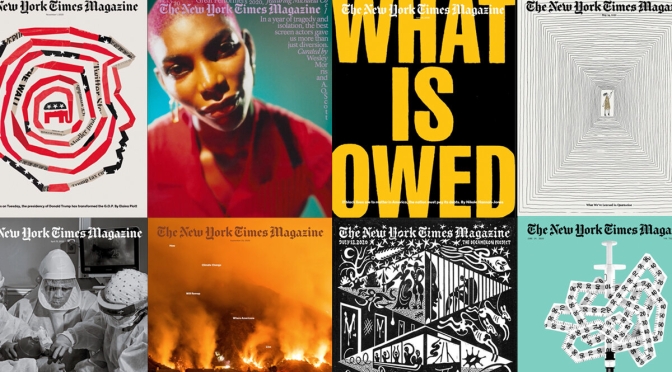
THE NEW YORK TIMES MAGAZINE – August 24, 2025

Current cover

THE NEW YORK TIMES MAGAZINE: The 8.24.25 Issue features Shane Bauer writes about the disappeared children of Syria; Lauren Larson on the difficulties of setting a Guinness World Record in the modern era, Linda Kinstler on why wars no longer end; David Marchese interviews the negotiation expert Chris Voss; and more.

How Georgia Went From the Vanguard of Democracy to the Front Lines of Autocracy

Two decades after the Rose Revolution, the former Soviet satellite is turning away from the West and back toward Russia. What happened?

They Were Treated Like Orphans. But They Knew the Truth.

In Syria, the Assad regime took hundreds of children away from their parents. A Times investigation reveals the workings of the operation — and how one family fought to reunite. By Shane Bauer and Jim Huylebroek

Wholesome, Noble Superheroes Are Back. (A Wholesome, Noble World Is Not.)

This summer’s blockbusters leave behind the era of dark, “edgy” champions for heroes who can’t help but listen to their consciences. By Mike Mariani

THE NEW YORK TIMES – SUNDAY, AUGUST 24, 2025

Reframing Jan. 6: After the Pardons, the Purge

The Trump Justice Department has fired or demoted more than two dozen Jan. 6 prosecutors, even as those they sent to prison walk free.

Fed Officials Try to Keep Focus on Economy as Trump Intensifies Attacks

President Trump’s pressure campaign for lower borrowing costs created an inescapable distraction at this year’s Jackson Hole conference.

Peace Talks in Ukraine All Lead to the Donbas

The contested region is where Russia’s war in Ukraine began a decade ago. Scores of Ukrainian soldiers have died defending it. Would Ukraine give it up now?

Why Haven’t Sanctions on Russia Stopped the War? The Money Is Still Flowing.

For decades, companies feared being on the wrong side of U.S. sanctions. That’s not always true anymore.

BARRON’S MAGAZINE – AUGUST 25, 2025 PREVIEW

BARRON’S MAGAZINE: The latest issue features ‘Private Equity Is Headed for Your 401(k). The Industry Is Celebrating. Should You?’

Private Equity Is Headed for Your 401(k). The Industry Is Celebrating. Should You?

The Trump administration is taking the handcuffs off the private-market industry. The outcome for retirement savers will be complicated.

Walmart and Other Retailers Have Eaten the Cost of Tariffs. Now It Is the Consumer’s Turn.

While last quarter’s sales were strong, price increases could be felt starting now.

Want to Work Fewer Hours? How to Ask Without Sabotaging Your Career.

Be ready to hear “no,” and more tips from financial advisors and an HR manager.

Tariffs Won’t Break the Economy. Corporate Shakedowns Might.

An economy as large and as diversified as the U.S. can handle tariffs. The president’s other actions pose a bigger risk.

THE NEW YORK TIMES – SATURDAY, AUGUST 23, 2025

Corporate America’s Newest Activist Investor: Donald Trump

The president is demanding government stakes in U.S. companies. Experts see some similarities to state-managed capitalism in other parts of the world.

Intel Agrees to Sell U.S. a 10% Stake in Its Business

The deal is among the largest government interventions in a U.S. company since the rescue of the auto industry after the 2008 financial crisis.

In Trump’s Second Term, Far-Right Agenda Enters the Mainstream

President Trump has embraced an array of far-right views and talking points in ways that have delighted many activists who have long supported those ideas.

After Gaza Famine Report, U.S. Is Mostly Silent and Israel Defiant

The White House has not commented on a report that found famine in Gaza. Analysts say that without U.S. pressure, Israel’s war is not likely to change course.

Cervantes in the Cave — The Art of Illusion

From Lepanto to Algiers to Seville, he recast Plato’s cave: instead of fleeing, he trimmed the wick—using comedy and narrative to make honest light out of shadow.

By Michael Cummins, Editor, August 22, 2025

In a cave in Argamasilla de Alba, Spain, a man sits hunched over a manuscript. The air is damp; the light keeps deciding what to keep. He writes not with the flourish of a court poet but with the urgency of someone who has known confinement—who has lived among shadows and learned to speak their language. The man is Miguel de Cervantes. The cave, according to local legend, is where he began Don Quixote. Whether the story is true hardly matters. The image endures: Cervantes, imprisoned, wounded, obscure, writing the book that would fracture the very idea of literary realism.

He breaks the silence first, as if talking to the walls. “Engendrado en una cárcel, donde toda incomodidad tiene su asiento,” he says—begotten in a prison, where every discomfort keeps its chair. He smiles at his own choice of verb. Begotten. It gives hardship hands.

A foot scuffs the threshold. Mateo steps into the half-light, a fellow freed captive from a life the two men still carry like a watermark. He takes the cave in at a glance—the whitewash, the barred slit of window, the stone bench that knows the shape of a tired back.

“You write in the dark, Miguel,” Mateo says. “Still chasing shadows?”

“Not chasing,” Cervantes replies, without looking up. “Refracting. These shadows are more honest than the sunlit lies of court and empire.”

Plato’s prisoners mistook flicker for fact. Cervantes has no such innocence; he knows exactly what light can do and what it cannot. In Algiers he learned the cost of sunlight and the uses of a candle. “We invented stories to survive,” he says. “We imagined rescue. We became authors of unreality. And in doing so, we learned how unreality works.”

He had boarded a homeward ship in 1575 and sailed straight into a profession he did not apply for. Corsairs took the vessel. Letters of recommendation—ironically the very proof of his merit—made him valuable. Algiers swallowed him for five years. Four escape attempts, each with its choreography of bribes, whispers, and night boats, failed in turn; punishments followed with bureaucratic punctuality. In the baños he organized fellow captives, staged plays that felt like oxygen rations, and discovered a kind of command that requires neither rank nor drumrolls. The lesson was not transcendence. It was texture. Captivity did not reveal some pure, sunlit truth; it revealed illusion’s machinery: how shadows are cast, how they persuade, how they can be turned from weapon into instrument.

“So you believe captivity reveals truth?” Mateo asks.

“No,” Cervantes says. “It reveals illusion. But if you know you’re in a cave, illusion can be honest about itself.”

He speaks like a man who has balanced too many ledgers and decided to keep one for the soul. In his prologue to the Exemplary Novels he would boast with a craftsman’s pride: mías propias, no imitadas ni hurtadas—my own pieces, not imitated or stolen. After a life in which other people held the keys, authorship felt like a kind of lawful possession. He is not naïve about it; theft will come in a thousand copies. Still, he plants his flag in sentences.

Mateo lowers himself onto the bench. The cave keeps its cool.

“Begin earlier,” Mateo says softly. “Begin with the wound.”

Cervantes nods, as if paging back. “Lepanto,” he says. “Two shots to the chest, one to the hand. El mayor bien que me vino. The greatest favor that came to me.”

Mateo laughs—a short, incredulous bark. “Favor?”

“A hand is a tool,” Cervantes says, flexing his right, letting the left sleeve fall into its gentle emptiness. “So is a story. One broke and taught the other its work. I learned that honor is not trumpets; it is the bruise that stays after the sound goes.”

“What did it smell like—the battle?” Mateo asks, because some questions insist.

“Oak and salt and a fire that wandered,” Cervantes says. “The sea keeps bad accounts—always debits, never balance. We threw our bodies at its ledger and called it glory. I got a bill I could live with.”

The cave changes its mind about brightness by a single shade. Light climbs a little higher on the wall, as if memory has a temperature.

“After Algiers,” Mateo says, “you came home to paper.”

“To paper and suspicion,” Cervantes answers. “Spain wanted receipts more than epics.” He became a purchasing agent, then a tax collector—the sort of work that presses humility into a man’s pockets and takes the lint besides. A banker fell in Seville and the ground gave way beneath him. Jail happened the way weather happens. Bureaucracy, he discovered, is a prison with nicer pens.

He thumps the palm of his right hand on the bench, a quiet imitation of a ledger closing. “Always the same sum,” he says. “Loyalty plus wounds equals suspicion.”

“That arithmetic,” Mateo says, “taught you comedy.”

“It taught me instruments,” Cervantes corrects gently. “Comedy is a surgeon’s knife you can carry in public.”

He had tried other rooms. La Galatea (1585), a pastoral romance, sighs under painted trees and speaks expertly in a fashionable voice—too expertly for a man who had learned to breathe in iron. “A ceiling too low for the lungs,” he says. Failure did not embarrass him; it emancipated him. “I loved what books promised. I wrote the promise’s correction.”

“And then you choose another cave,” Mateo says, looking around.

“This time I brought the candle.” Cervantes nods at the stub trembling in its dish. “The cave is not a prison if you know you’re inside it. Fiction is not delusion if you wield it knowingly.”

“Is that freedom?” Mateo asks. “To live in fiction?”

Cervantes answers with a line he will later put in a knight’s mouth because knights carry sentences farther than taxmen do. “La libertad, Sancho, es uno de los más preciosos dones…” Freedom, Sancho, is one of the most precious gifts. He lets the clause hang and then adds the counterweight: captivity is the greatest evil. “But there is a third thing,” he says. “The discipline of the wick. Not everyone reaches the sun. Many of us live by hearth-light. So make the hearth honest.”

He laughs, not kindly but not unkindly, at the memory of a barber’s basin mistaken for a helmet. “A basin can be a helmet,” he says, “if the story is honest about the trick.” The joke is not cruelty; it’s consent. Illusions that confess their wages are allowed to work.

“You sound like Plato’s least obedient pupil,” Mateo says. “He wants the prisoner out of the cave. You stay.”

“Plato had less practice with caves,” Cervantes says. “I stay and trim the wick.”

The man who stays in the cave can tell you about the cost of zeal. He knows what happens when mercy runs faster than attention: chaos dresses up as freedom. He has written a scene in which a knight frees a chain gang of galley slaves with a fine speech and a flash of temper, and the liberated—unbriefed on narrative responsibility—repay the favor with stones. “Pity without comprehension,” he says, “is a door swinging in a storm. Freedom without narrative becomes a mess that lets tyrants say, ‘You see? Chains keep order.’”

Mateo’s eyes drift toward a wooden head in the corner, painted eyes arrested mid-glance. “Master Pedro,” Cervantes says, amused at the prop the cave has supplied. He tells the story of a puppet theater, a knight who cannot bear strings, a sword that corrects an illusion into splinters. Even illusions keep accounts, he reminds Mateo. Someone pays for the pleasure. “In that scene,” he says, “I taxed zeal. I sent the bill to laughter.”

“So your book is a theater?” Mateo asks.

“A theater that shows its ropes,” Cervantes says. “A historian with a wink in his ink. A narrator who argues with me, and I with him. A false sequel enters the room, and I absorb him into the play. If illusion is a crime, let the evidence be visible. If it is a craft, let the strings show and the audience decide.”

He keeps his quotes short and to the point, letting them behave like tools rather than trophies. “Yo sé quién soy,” he says, not to boast but to set a boundary—I know who I am. “And I know what I am not. I am not the sun. I am a candle with a good memory.”

Memory is a troublesome servant. “¡Oh memoria, enemiga mortal de mi descanso!,” he mutters with theatrical exasperation—Oh memory, mortal enemy of my rest—knowing full well he cannot do without her. In the deepest fold of the book he is writing, he lowers his knight into the Cave of Montesinos and gives him a private vision no one can verify. Minutes pass in the world; days unfold in the cave. Readers will fight about that descent for centuries: lie or parable? He shrugs. The rope held. The telling is what matters.

“What about truth?” Mateo asks. “You dodge it like a matador.”

“Truth is errant,” Cervantes says. “Like my knight. It wanders, stumbles, reinvents itself. La verdad adelgaza y no quiebra—truth thins but does not break. It lives in the flicker between shadow and flame.” He aims for a truth you can sit with, not a blaze you must worship. Even now, when the cave dims or brightens by a breath, he adjusts nothing in his voice. He trusts the room to keep up.

The room has heard other versions of this life. Soldier, captive, clerk, failed author—the catalogue is accurate and useless until you give it breath. He has learned that a life of refusals and humiliations can be rearranged into a lamp. “El que lee mucho y anda mucho, ve mucho y sabe mucho,” he says with a grin—he who reads much and travels much sees much and knows much—and Mateos’s chuckle bounces off the whitewash and returns as agreement.

If the cave is a theater, it is also a workshop. He places three objects on the bench as if laying out tools: a frayed rope (failed escape; lesson kept), a ledger (bureaucracy’s Bible, now a prop for comedy), and the puppet head (illusion, demystified and retained). He sets the rope across the ledger like a sash and props the puppet against both like a child asleep between two patient adults.

“You’re staging your own life,” Mateo says.

“Everything I own appears in my books,” Cervantes answers. “Better to put them to work than let them gather dust.”

He will put even injury to work. He has already done it. “There is no book so bad that it does not have something good,” he says—No hay libro tan malo que no tenga algo bueno—and he means, among other things, his own early efforts. He tried the fashion and failed; he learned to write beyond it. The failure cleared the room.

“And the counterfeit?” Mateo asks. “The other Quixote?”

“I made room,” Cervantes says, not quite happily. He doesn’t bother to call the rival by name. “I let the counterfeit into Part II and gave him the dignity of being wrong on the page. It is the politest way to win.”

Outside, late afternoon arranges itself. Inside, the candle practices its small weather. The conversation acquires the unhurried gravity of men who have been forced to wait before and know that waiting can be made useful. They speak of the Información de Argel—the sworn testimonies that stitched a biography out of scars and courage; of the petition to the Council of the Indies that asked for four possible offices across the ocean and delivered no; of Seville’s auditoriums of suspicion where a man could do arithmetic all day and still owe.

“You turned all that into a style,” Mateo says.

“I turned it into a temperament,” Cervantes corrects. Style is the residue. The temperament is the choice: to stay in the cave and make the light adjustable; to refuse the panic of transcendence in favor of the patience of attention; to let laughter be a form of moral accounting. “I wanted a book in which the strings show,” he says. “So when someone pulls, we know who is moving what.”

He reaches for the candle with wetted fingers and trims the wick. The flame tightens, steadies, sharpens the edges of the room with a surgeon’s manners. The gesture is mundane and feels like a thesis.

“Why not flee?” Mateo asks one last time, because some questions return until answered in the body.

“Because someone must tend the flame,” Cervantes says. “Because most people live by hearth-light. Because the cave tells the truth about limits, and I prefer honest rooms to lying palaces.”

He stands, and the bench acknowledges the change with a creak that has learned both complaint and loyalty. He touches the stone with the backs of his fingers, as one does a sleeping child. The puppet keeps its round attention. The rope adopts its length. The ledger decides to be heavy again.

“Begin,” Mateo says, suddenly shy of making a ceremony of it.

“I did,” Cervantes answers, and returns to his page.

He writes the opening lines of Don Quixote as the candle throws a peninsula of light bordered by ink. A poor gentleman with a head full of books starts out into a world that will bruise him into philosophy. A squire with a sack of proverbs learns to spend them one by one, after listening. Windmills declare their innocence; a basin negotiates a new title. Dukes turn out to be children who have learned cruelty by playing. Priests explain themselves into farce. Puppets are freed to their ruin, then repaired by a writer who has learned to apologize with laughter.

Cervantes does not flee illusion; he illuminates it. He does not reject reality; he reframes it. He does not promise truth; he escorts it, errant and sturdy, through rooms with honest walls. He turns shadows into stories and stories into a way of seeing that does not blind. He has stayed where Plato urged ascension and found, by staying, a different kind of ascent: the climb of attention, the charity of proportion, the courage to let strings show and still believe in the show.

Unlike Plato’s prisoner, Cervantes remains in the cave. He writes. He refracts. He talks to the walls and to the future, and both answer. His broken hand, his captive mind, his errant knight—everything he survived and everything he invented—gathers in the small weather of a candle and becomes, against all instruction, a form of daylight.

THIS ESSAY WAS WRITTEN AND EDITED UTILIZING AI

News, Views and Reviews For The Intellectually Curious