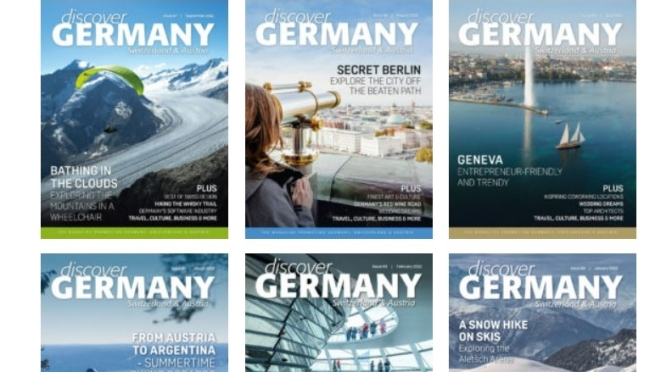
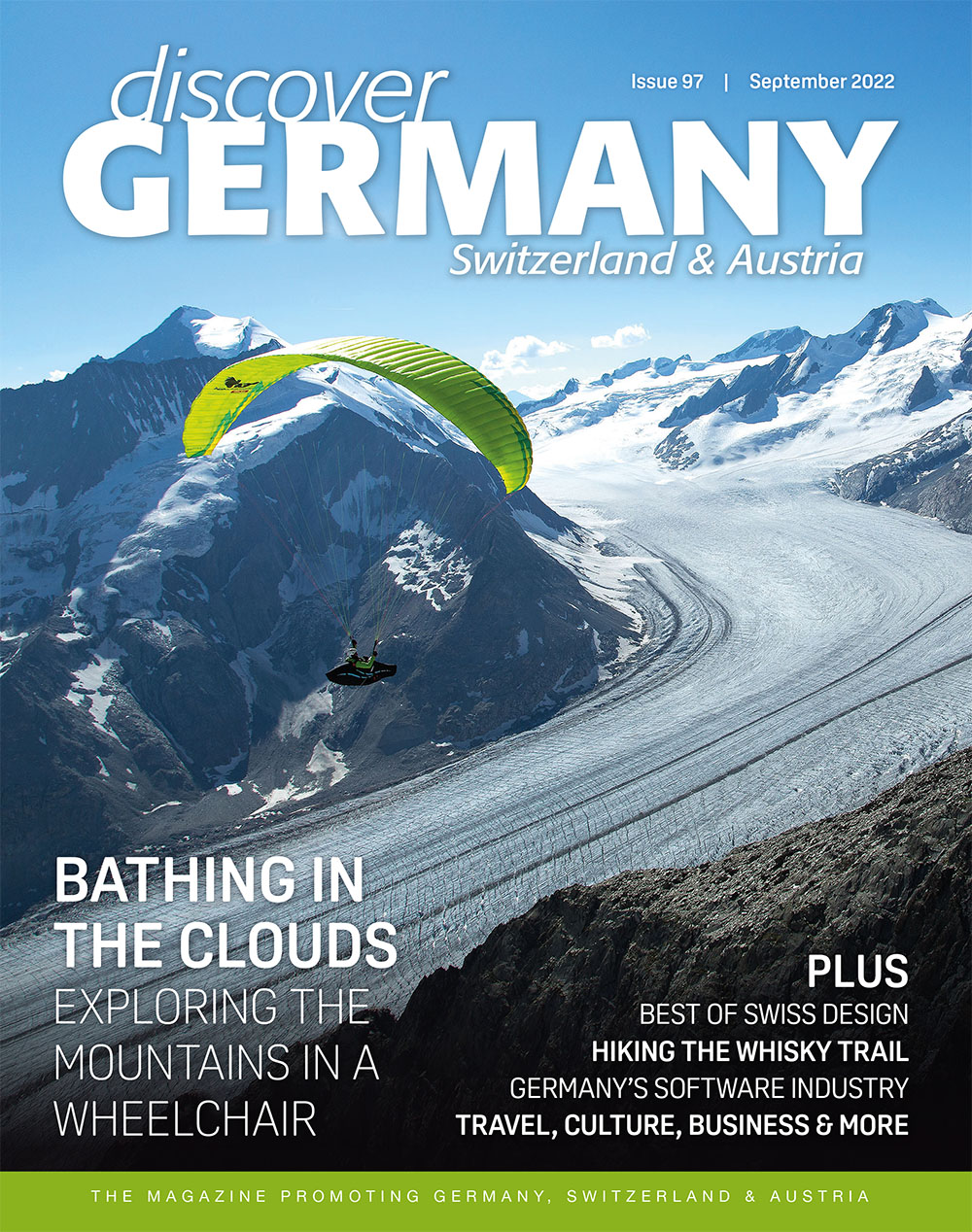
The September issue of Discover Germany, Austria & Switzerland starts off with a special focus on exploring the mountains in a wheelchair. It further includes a feature about Switzerland’s Whisky Trail, a whisky hiking trail that winds and weaves its way through scenic Alpine terrain, while exploring the warming drink. Further topics covered in our brand-new September issue are a focus on caravanning holidays through the eyes of actor Simon Böer, great products made in Switzerland, a focus on mindfulness, a look at Germany’s software industry, top travel tips, hotel recommendations, and much more.
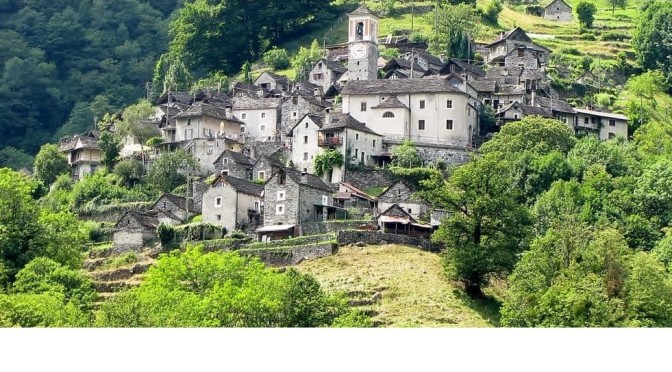
In the Swiss canton of Tessin, a young family is transforming an entire village into a hotel. The abandoned houses of Corippo are being turned into guest rooms, the narrow lanes are becoming the hotel’s corridors. More and more villages in the Alps are dying out, young people are choosing to move to the cities.
At the northern end of artificial lake Lago di Vogorno, Corippo is about 12 kilometers from Locarno. You’ll probably see Corippo on the way to Lavertezzo. Italy is only 20 kilometers away.
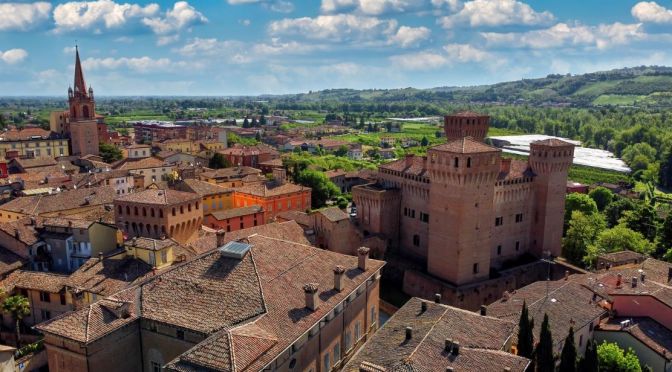
Modena and the surrounding area is extremely rich in historic and cultural treasures like these. In their unparalleled beauty, within each castle’s walls lies a special story.
The castles of the Modena area date to a range of historical periods but together make up an invaluable legacy. They remain today—just as they were when they were built—important cultural landmarks for local community residents.
First stop – Palazzo Pio Carpi – Palazzo Pio in Carpi is an imposing and complex structure that comprises fortifications, towers, courtyards, and buildings constructed between the fourteenth and seventeenth centuries. The Palazzo looks out onto Piazza dei Martiri, one of Italy’s most beautiful piazzas, to breathtaking effect. Starting in 1300 and for most of the following two centuries, Palazzo Pio was the residence of the Pio family. The Pio Prince Alberto III, nephew of the famous Pico della Mirandola, transformed the fortress into a splendid Renaissance palace whose rooms were decorated with frescoes by court painters.Today, the town of Carpi has adapted the palazzo for use as a world-class cultural center that houses the Palazzo Pio Museum; the Municipal Museum; the Castello dei Ragazzi, a children’s art and recreation center; and the fascinating Museum and Monument to Political and Racial Deportees.
Second stop – Calcagnini Fortress Formigine – The ravishing Rocca Calcagnini Fortress stands in the heart ofFormigine, a symbol of the local community and a center for collective historical memories. Built in 1201 by the city of Modena as a defense against attacks by the rival city of Reggio Emilia and to secure its control of the territory, beginning in 1300 the Rocca Calcagnini Fortress was passed among various local noble families until it became property of the Pio family of Carpi, the Estes, and finally the Calcagninis.Around 1400, when the fortress was under the control of the Pios, it was turned into a castle-residence that appears today much as it did then, with a marquis’s palazzo and grounds encircled by a wall with four corner towers and a guardhouse.During the Second World War, the fortress was irreparably damaged in a ferocious bombardment in which virtually the entire Calcagnini family was lost. In 1946, it became the property of the town government and was rebuilt and transformed for use as the city hall.Today the castle houses municipal offices on its ground floor (the city council chambers and a venue for wedding ceremonies) with reception halls located in the northeast tower.To make your visit to the Rocca Calcagnini Fortress extra special, don’t miss the Multimedia Museum of Archaeology. Beautiful and innovative multimedia displays tell the story of the fortress and of the Calcagnini nobility.The Calcagnini Fortress is Formigine’s sparkling “living room.” In addition to housing a restaurant and a wine cellar, each year the castle hosts events of all kinds—music, theater, and much more.
Third stop – Spezzano Castle Fiorano Modenese – The origins of Spezzano Castle date to the Middle Ages. The castle was transformed into a noble family residence by the Pios of Savoia in 1529.Today, Spezzano Castle is an elegant country residence surrounded by grounds landscaped in the 19th-century—a lovely place to relax or perhaps have lunch in one of the designated picnic areas.The splendid porticoed courtyard dates to the Renaissance, and the Sala delle Vedute, with its splendid frescoes of towns, towers, and castles of Sassuolo’s feudal period, is especially striking.Its pentagonal tower, at one time a prison, today houses the Municipal Vinegar Cellar and the Fiorano Museum of Ceramics, dedicated to the local history of ceramics, one of the area’s most admired products.
Fourth stop – Vignola Fortress Vignola – The VignolaFortress has also become a symbol—in this case, of Italy’s cherry capital. Its towers, drawbridge, and moat provide one of the most fascinating examples of defensive architecture in the entire Emilia-Romagna Region.The Vignola Fortress was built in the eighth century by the abbot of Nonantola to defend the abbey’s lands. After passing through the hands of several noble families, in 1401 it was ceded by the Este family of Ferrara to Uguccione Contrari who transformed it into a sumptuous noble home and filled the residence with frescoes and precious objets d’art.Vignola’s picturesque city center provides the perfect setting for the imposing and well-preserved Vignola Fortress. The four-sided structure contains five floors and has three square towers. The internal courtyard is magnificent and, on the left side, the “Rocchetta” (the “little fortress”) and the Contrari and Grassoni halls are located. One of the most beautiful structures is the frescoed chapel, a rare gem of “International Gothic” style.
Fifth stop – Montecuccoli Castle in Pavullo Pavullo nel – FrignanoMontecuccoli Castle is perched on a spur of rock that overlooks the Scoltenna-Panaro River Valley, three kilometers from the center of Pavullo in the heart of the Frignano area.After briefly being governed by Modena, the surrounding area was ruled by the Montecuccoli family, the powerful lords of Frignano, until the arrival of the House of Este in the mid-fourteenth century. In these ancient times, the Montecuccoli Castle was the residence and military center of the Montecuccoli family, who built dozens of attached towers and fortresses to keep watch over the roads to Tuscany. At the highest point of this point of rock is the original castle keep, which is surrounded by other structures and three rings of walls, constructed over time.Below the castle and through a Gothic portal lies a beautiful medieval village, where the Palazzo del Podestà and the fifteenth-century Church of San Lorenzo are especially noteworthy.Starting in the 1960s, the castle became the property of the town, which restored it and built the Montecuccoli Museum Complex. The Complex contains the Frignano Botanical Museum; Raffaele Biolchini’s “Donazione,” a sculpture gallery featuring works in marble, wood, terracotta, and other materials by one of Modena’s preeminent modern sculptors; and Gino Covili’s “Paese Ritrovato,” a cycle of paintings and drawings dedicated to the work, lives, and history of the people of Frignagno.
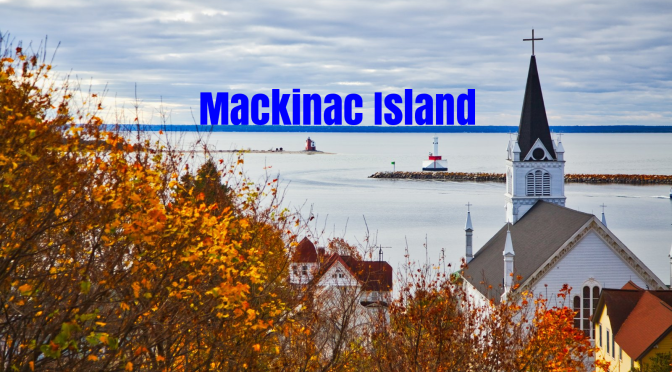
Mackinac Island sits in Lake Huron, between Michigan’s Upper and Lower peninsulas. Mackinac Island State Park, with trails, woods and the limestone Arch Rock formation, covers most of the island. Founded in 1780, Fort Mackinac is a walled cluster of military buildings on a coastal bluff. The Richard and Jane Manoogian Mackinac Art Museum has local works, including Native American art, maps and 19th-century photos.
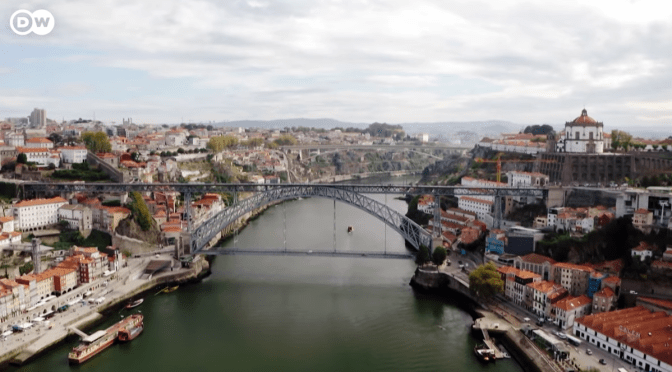
Porto is a coastal city in northwest Portugal known for its stately bridges and port wine production. In the medieval Ribeira (riverside) district, narrow cobbled streets wind past merchants’ houses and cafes. São Francisco Church is known for its lavish baroque interior with ornate gilded carvings. The palatial 19th-century Palácio de Bolsa, formerly a stock market, was built to impress potential European investors.
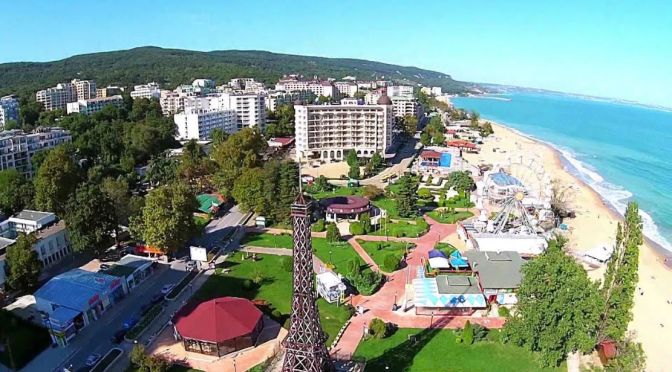
For many Germans, Golden Sands near the town of Varna in Bulgaria is a more affordable alternative to the Spanish vacation island of Mallorca. Loud music, packed beaches and plenty of cheap booze – an irresistible combo for primarily young tourist revellers. But what’s it really like to holiday on the Black Sea, with the war in Ukraine raging across the water to the north? And is the war having an impact on tourism in Bulgaria? DW’s Lukas Stege asked around. But he also found time to party – and said it felt like home.
Golden Sands is a major seaside resort town on the northern Bulgarian Black Sea Coast, adjacent to a national park of the same name in the municipality of Varna. Located 17 km north of downtown Varna, it is virtually connected to the city by a continuous swath of resorts and villa communities.
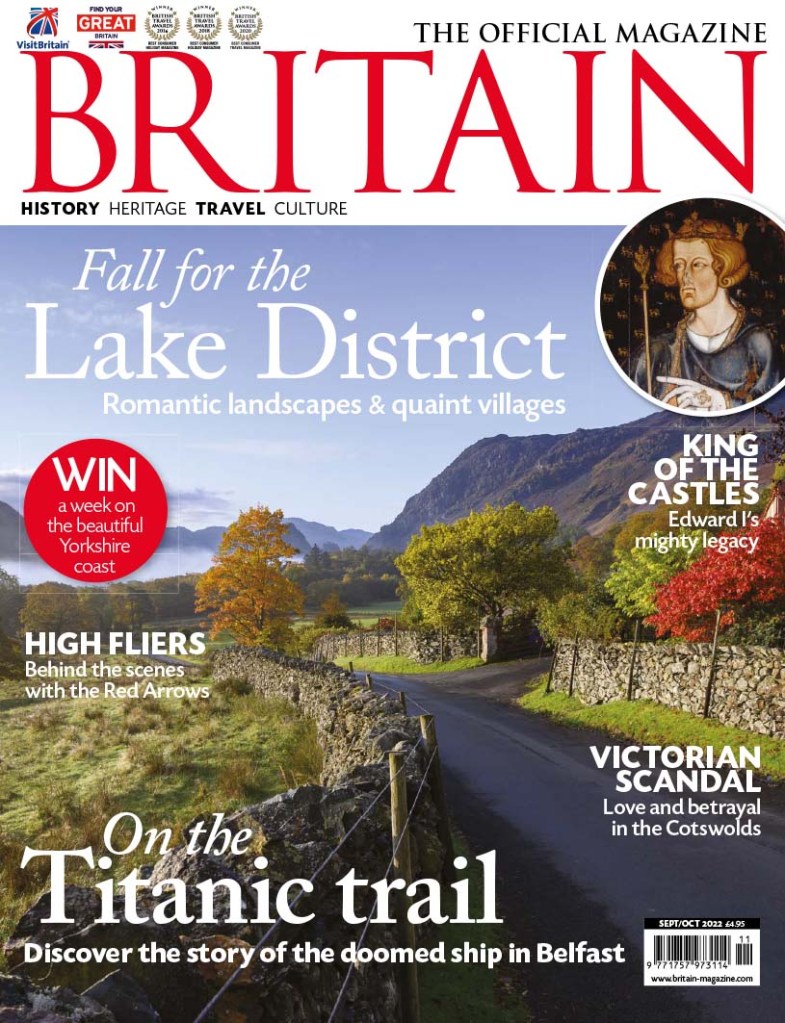
There’s something about the Lake District – something that sparks the imagination and soothes the soul. A picture-perfect expanse of rugged peaks, placid waters and rolling farmland, neatly divided by dry-stone walls and dotted with stone-built villages, northwest England’s Lake District has the double accolade of being both a UNESCO World Heritage Site and a National Park.
Keen runners seeking more inspirational landscapes can join a new tour by CMH Heli-Skiing & Summer Adventures to discover the wild beauty of the Bugaboos in the heart of the Canadian wilderness. Soar over verdant forest trails, rugged mountain tops and granite spires in a helicopter before being dropped on a summit. Runners will revel in the sunny skies, breathtaking panoramas and plenty of breaks, often in crystal-clear glaciated lakes. The day ends back at base camp, a spacious fly-in backcountry luxury lodge where guests can relax with a massage, sauna or a soak in a hot tub.
Where to stay: CMH Bugaboos log-hewn lodge at the base of Bugaboo Glacier offers gourmet dining, swimming and a rooftop hot tub. From $3,025 (£1,926) for three nights/four days including meals, helicopter flights, guide, equipment and local transfers.
2. Heli-biking in New Zealand
Cycle far from the crowds in the Wanaka region past glaciers and lakes on gentle high-country trails and tricky single tracks that combine easy free-wheeling with adrenaline pumping fun. For seasoned cyclists, the four-hour Mount Burke trail is the holy grail of mountain bike trips with riders ferried to the top by chopper to avoid the uphill grind. Soak up the scenery at 4,593ft before braving the epic downhill descent through scenic valleys and farmland to the glassy waters of Lake Wanaka and Lake Hawea for a gourmet picnic.
Where to stay: Minaret Station, an off-grid lavish four-chalet lodge accessible by only helicopter or boat, located at 7,000ft with a valley to one side and Lake Wanaka to the other. Five nights from £5,250pp, including four nights’ full-board at Minaret Station with return helicopter transfers, excluding international flights, with Black Tomato.
Preparing to go heli-biking in New Zealand.
PHOTOGRAPH BY FREDRIK LARSSON
3. Glacier hiking in France
Head to Saint Martin de Belleville to traverse the Glacier de Chavière and conquer not one, but three cols, or mountain paths, at altitudes of around 10,000ft. Set off at dawn, after learning how to use an ice axe and crampons, to begin an energetic climb attached by a rope to an expert guide. Enjoy incredible views of snow-covered ridges, steep couloirs and rock towers, but take care where you place your feet as some narrow paths come dangerously close to crevices with sheer drops. After reaching the three cols — Col de Thorens, Col Pierre Lory and Col du Bouchet — return to Val Thorens in the early afternoon for a leisurely lunch.
Where to stay: The renovated four-star Hotel Lodji at the base of Saint Martin with cosy bar, restaurant, sunny terrace and spa. Rooms from €150 (£129) a night.
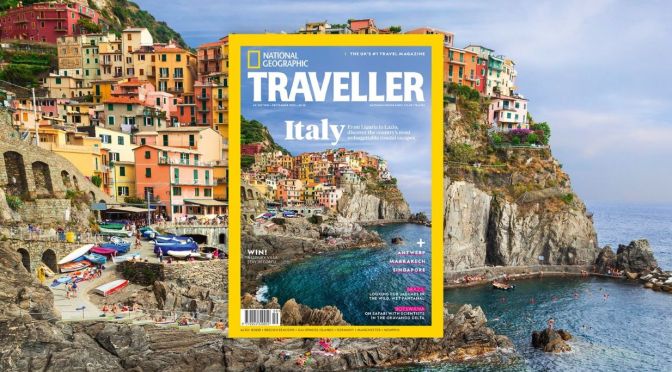
The September issue of National Geographic Traveller (UK) is out now. The cover story this month focuses on the Italian coast, which encapsulates the very best of the country.
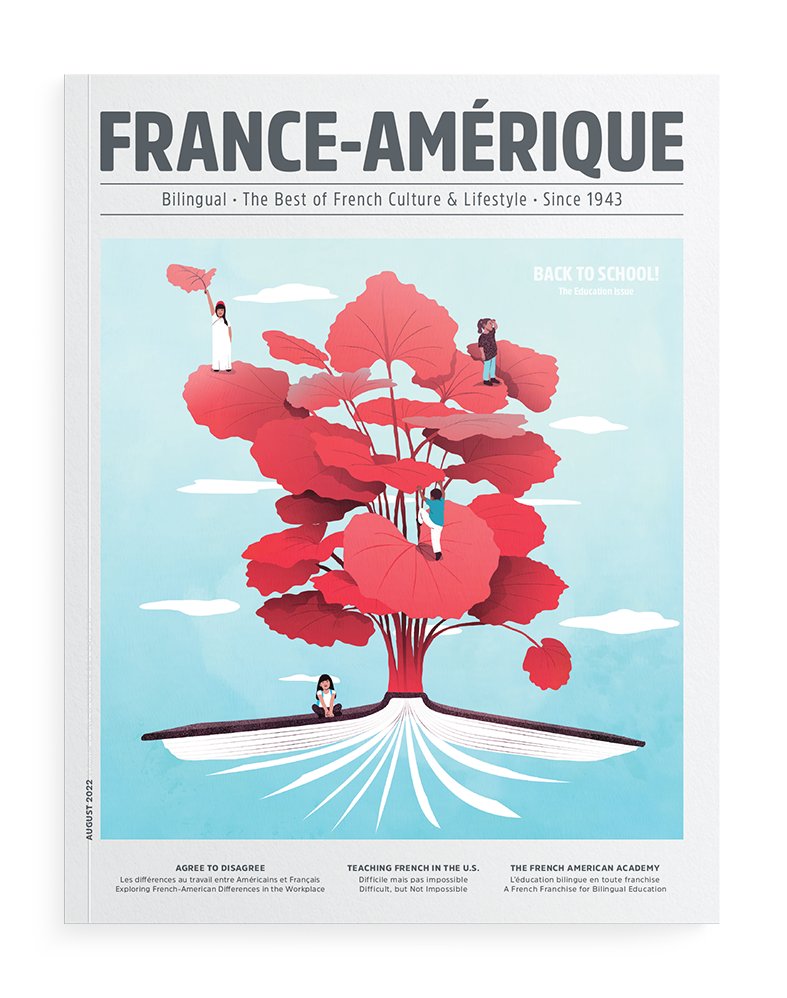
France-Amérique Magazine, August 2022 – This month, we celebrate French education in all its diversity. Read our investigation on how to become a professeur de français in the United States (Spoiler: It’s difficult, but not impossible); meet the French couple behind the first franchise for bilingual education in North America; and discover the latest edition of our French Education Guide, a comprehensive state-by-state directory of French dual-language programs in the United States. And because summer is not over yet, visit the Hôtel Les Roches Blanches, a hotspot for Art Deco enthusiasts on the Mediterranean coast; read all about les espadrilles; and meet American pastry chef Amanda Bankert, the donut queen of Paris!
News, Views and Reviews For The Intellectually Curious






 Boomers Daily