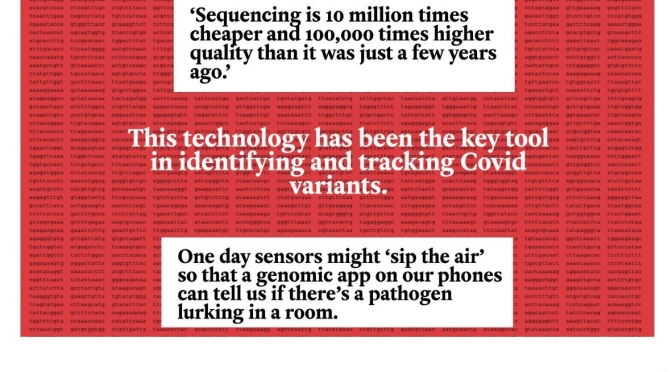
The advent of commercial genome sequencing has recently, and credibly, been compared to the invention of the microscope, a claim that led me to wonder whether this new, still relatively obscure technology, humming away in well-equipped labs around the world, would prove to be the most important innovation of the 21st century.
And unexpectedly, Covid-19 has proved to be the catalyst. “What the pandemic has done is accelerate the adoption of genomics into infectious disease by several years,” says deSouza, the Illumina chief executive. He also told me he believes that the pandemic has accelerated the adoption of genomics into society more broadly — suggesting that quietly, in the midst of chaos and a global catastrophe, the age of cheap, rapid sequencing has arrived.
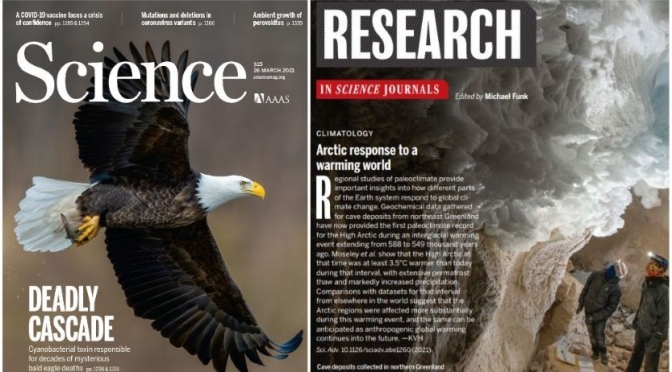
Most research on aging has been done on model organisms with limited life spans, such as flies and worms. Host Meagan Cantwell talks to science writer Yao-Hua Law about how long-living social insects—some of which survive for up to 30 years—can provide new insights into aging.
Also in this episode, host Sarah Crespi talks with Noshir Contractor, the Jane S. & William J. White Professor of Behavioral Sciences at Northwestern University, about his AAAS session on keeping humans in harmony during long space missions and how mock missions on Earth are being applied to plans for a crewed mission to Mars.
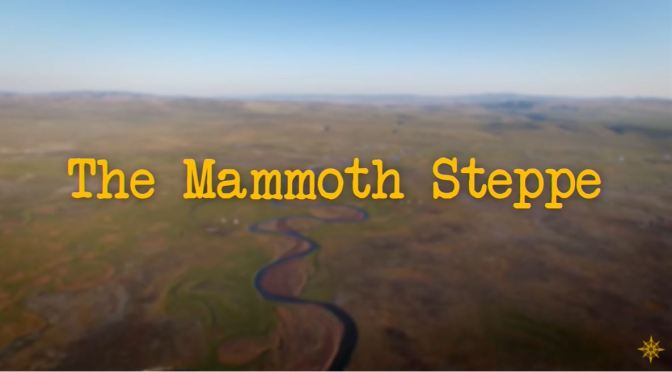
Deep in the frozen north of Russia’s Sakha Republic lies a place where time is being reversed and a once extinct environment is being brought back to life. How is something like this possible and what impact could it have on our world?
A web of three optical atomic clocks show incredibly accurate measurements of time, and the trailblazing astronomer who found hints of dark matter.
In this episode:
00:44 Optical clock network
Optical atomic clocks have the potential to reach new levels of accuracy and redefine how scientists measure time. However, this would require a worldwide system of connected clocks. Now researchers have shown that a network of three optical clocks is possible and confirm high levels of accuracy.
Vera Rubin was an astronomer whose observations were among the first to show evidence of dark matter. At the time, female astronomers were a rarity, but Vera blazed the trial for future women in science.
We discuss some highlights from the Nature Briefing. This time, carbon cost of bottom trawling, and the fictional French researcher confounding metrics.
The Lawrence Lab? The Berkeley Lab? Lawrence Livermore Berkeley Lab? Luther Burbank Laboratory? Berkeley Countrywide Laboratory? Nope. Not quite. We’re Lawrence Berkeley National Laboratory, or Berkeley Lab for short. But we do understand the confusion — it’s hard to remember names, especially when so many sound alike! So we jammed 90 years of history into less than 3 minutes to help you get it right.
The Lawrence Berkeley National Laboratory, commonly referred to as Berkeley Lab, is a United States national laboratory that conducts scientific research on behalf of the Department of Energy. Located in the hills of Berkeley, California, the lab overlooks the campus of the University of California, Berkeley.
How Cade got access to the stories behind some of the biggest advancements in AI, and the dynamic playing out between leaders at companies like Google, Microsoft, and Facebook.
Cade Metz is a New York Times reporter covering artificial intelligence, driverless cars, robotics, virtual reality, and other emerging areas. Previously, he was a senior staff writer with Wired magazine and the U.S. editor of The Register, one of Britain’s leading science and technology news sites. His first book, “Genius Makers”, tells the stories of the pioneers behind AI.
Topics discussed: 0:00 Sneak peek, intro 3:25 Who is “Genius Makers” for and about? 7:18 *Spoiler alert!* Artificial General Intelligence (AGI) 11:01 How the story continues after the book ends 17:31 Overinflated claims in AGI 23:12 Deep Mind, OpenAI, and AGI 29:02 Outsider perspectives 34:35 Early adopters of ML 38:34 Who gets credit for what? 42:45 Dealing with bias 46:38 Aligning technology with nee
Sarah also talks with Wesley Reinhart, of Pennsylvania State University’s Department of Materials Science and Engineering and Institute for Computational and Data Science, about why we should be building smart cities from smart materials, such as metamaterials that help solar panels chase the Sun, and living materials like self-healing concrete that keep buildings in good shape.
News, Views and Reviews For The Intellectually Curious











 Boomers Daily