
Category Archives: Economics

Opinion: Germany Falters In EU, China’s Bitter Youth, Language Lessens With AI

‘Editor’s Picks’ Podcast (August 21, 2023) Three essential articles read aloud from the latest issue of The Economist. This week,  is Germany once again the sick man of Europe? Also, China’s disillusioned youth  (10:50) and why AI could make it less necessary to learn foreign languages (17:35).

Opinion: China’s Youth Has Sacrificed Freedoms, Now Learn To “Eat Bitterness”

For generations, the Chinese Communist Party has held on to power partly through an implicit bargain with its citizenry: Sacrifice your freedoms, and in exchange, we’ll guarantee ever-rising living standards.
That deal has not held up for today’s youths.
Opinion | Ignatius, Summers, Rampell, more discuss China's economy in  turmoil - The Washington Post

Until quite recently, China’s young people seemed poised to take on the world — and many of them appeared to believe they would. They’ve shown a streak of hyper-nationalism, stoked by the country’s leadership and reinforced by China’s growing economic and geopolitical strength.

China’s Gen Z came of age, after all, in the wake of the country’s accession to the World Trade Organization and amid a rapid rise in incomes.

President Xi Jinping has said young people must learn to “eat bitterness” (an idiom that roughly means to toughen up by enduring hardship). Today’s youths, leaders say, are not too good for manual labor or moving to the countryside — experiences Xi and his generation once had to endure.

China’s resilience after the financial crisis, particularly relative to the sluggish recovery across most of the West, suggested China and its citizens had nowhere to go but up. Political dysfunction in many of those same Western democracies, expertly exploited by Chinese propaganda, reinforced this perception.

READ MORE

Previews: The Economist Magazine – August 19, 2023

The Economist Magazine (August 19, 2023): This week’s issue features Why are China’s young people so disillusioned?; China’s defeated youth – When Xi Jinping plays down their individual aspirations in favour of the collective interest, he adds to their gloom.

Why are China’s young people so disillusioned?

Xi Jinping wants them to focus on the party’s goals. Many cannot see why they should

The crowd did not seem excited to see George Michael and Andrew Ridgeley. When Wham! became the first Western pop group to perform in Communist China, the audience was instructed to stay in their seats. It was 1985 and, despite appearances, the young people in attendance were in fact joyous. The country around them was by no means free, but it was starting to reform and open up. Over the next three decades the economy would grow at a rapid pace, producing new opportunities.

China’s defeated youth

Young Chinese have little hope for the future. Xi Jinping wants them to toughen up

A worker tests parts for e-cigarettes on a production line

In the southern city of Huizhou an electronics factory is hiring. The monthly salary on offer is between 4,500 and 6,000 yuan (or $620 and $830), enough to pay for food and essentials, but not much else. The advertisement says new employees are expected to “work hard and endure hardship”. The message might have resonated with Chinese of an older generation, many of whom worked long hours in poor conditions to give their children a brighter future. But many of those children now face similar drudgery—and are unwilling to endure it. “I can’t sit on an assembly line,” says Zhang, a 20-something barista with dyed-red hair at a local tea shop. He scoffs at the idea of making such sacrifices for so little gain. The job at the tea shop pays just 4,000 yuan a month, but he enjoys chatting up customers.

Opinion: The Biden China Strategy, Saudi Arabia’s Sports Push, Green EV’s?

‘Editor’s Picks’ Podcast (August 14, 2023) Three essential articles read aloud from the latest issue of The Economist. This week, why Biden’s China strategy isn’t working, Saudi Arabia’s plan to dominate global sport (10:20) and how green is your electric vehicle, really? (17:55).

Previews: The Economist Magazine – August 12, 2023

Costly and dangerous: Why Biden’s China strategy isn’t working

The Economist Magazine (August 12, 2023 issue): Why Biden’s China strategy is not working; Saudi Arabia upends sport; The attack on universal values; Twitternomics lives on; How green is your EV and more…

Costly and dangerous: Why Biden’s China strategy isn’t working

Liam Eisenberg

Supply chains are becoming more tangled and opaque

On august 9th President Joe Biden unveiled his latest weapon in America’s economic war with China. New rules will police investments made abroad by the private sector, and those into the most sensitive technologies in China will be banned. The use of such curbs by the world’s strongest champion of capitalism is the latest sign of the profound shift in America’s economic policy as it contends with the rise of an increasingly assertive and threatening rival.

How America is failing to break up with China

The countries’ economic ties are more profound than they appear

A briefcase being handed from one person to another with their hands handcuffed together
image: alberto miranda

When it comes to tracing the geography of global supply chains, few companies provide a better map than Foxconn, the world’s largest contract manufacturer. This year the Taiwanese giant has built or expanded factories in India, Mexico, Thailand and Vietnam. The Chinese production sites once loved by Western companies are firmly out of fashion. Souring relations between the governments in Washington and Beijing have made businesses increasingly fretful about geopolitical risks. As a consequence, in the first half of the year, America traded more with Mexico and Canada than it did with China for the first time in almost two decades. The map of global trade is being redrawn.

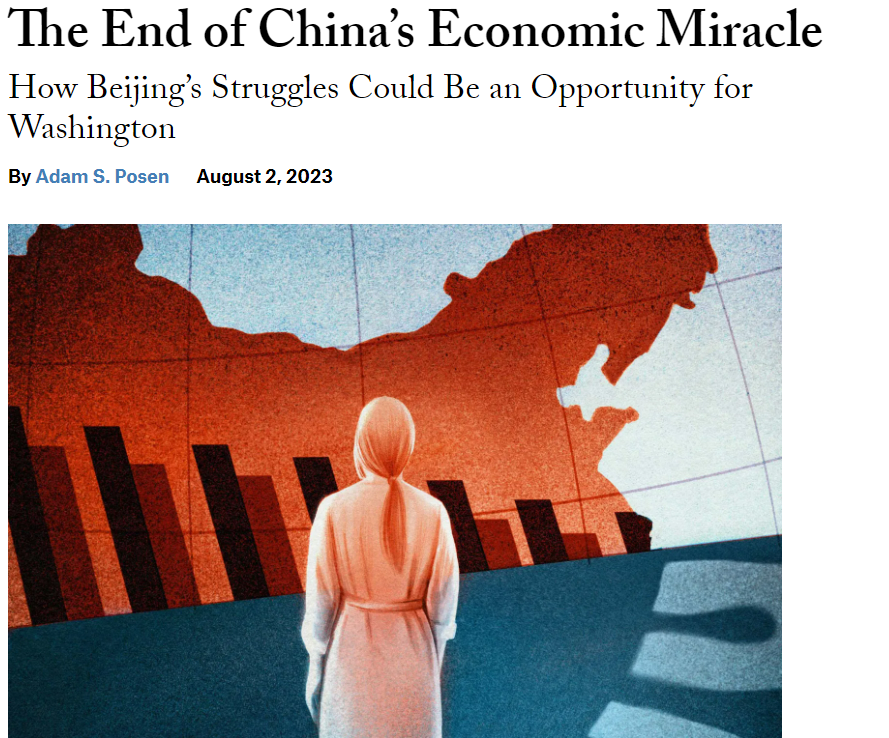
ESSAYS: CHINA’S ‘ECONOMIC MIRACLE’ HAS NOW ENDED

Image

Foreign Affairs (August 2, 2023) – As 2022 came to an end, hopes were rising that China’s economy—and, consequently, the global economy—was poised for a surge. After three years of stringent restrictions on movement, mandatory mass testing, and interminable lockdowns, the Chinese government had suddenly decided to abandon its “zero COVID” policy, which had suppressed demand, hampered manufacturing, roiled supply lines, and produced the most significant slowdown that the country’s economy had seen since pro-market reforms began in the late 1970s.

Economic long COVID will likely plague the Chinese economy for years.

In the weeks following the policy change, global prices of oil, copper, and other commodities rose on expectations that Chinese demand would surge. In March, then Chinese Premier Li Keqiang announced a target for real GDP growth of around five percent, and many external analysts predicted it would go far higher.

READ MORE

Opinion: Burdens Of CEOs, Weather Guesses, The Gen Z Guerrillas Of Myanmar

‘Editor’s Picks’ Podcast (July 31, 2023) Three essential articles read aloud from the latest issue of The Economist. This week:  what to do about overstretched CEOs, how to better predict the weather (9:00) and we meet Myanmar’s Gen Z guerrillas (15:00).

Previews: The Economist Magazine – July 29, 2023

The overstretched CEO | Jul 29th 2023 | The Economist

The Economist Magazine (July 29, 2023 issue): The overstretched CEO; Larry Fink demonised – All he wanted to do was save the planet while making his firm a fortune. Henry Tricks meets the face of woke capitalism; The greatest bank heist ever – Criminals stole $2.5bn from Iraq’s largest state bank in broad daylight. Nicolas Pelham follows their trail, and more…

The overstretched CEO

Companies are increasingly caught up in governments’ competing aims. What to do?

The world should not let Vladimir Putin abandon the grain deal

Here is how to get him to sign up again

Israel has lurched closer to constitutional chaos

But there are still ways to step back from the brink

Opinion: Technology Of Babymaking, Overly-Rosy Economics, Barbenheimer

‘Editor’s Picks’ Podcast (July 24, 2023) Three essential articles read aloud from the latest issue of The Economist. This week:  a report on the technology behind babymaking, why optimism about the world economy might be premature (10:30), and what the hype over Barbenheimer says about the movie industry (16:17).

Previews: The Economist Magazine – July 22, 2023

Image

The Economist Magazine- July 22, 2023 issue: Making babymaking better – A special report on the future of fertility; How Cities can respond to Extreme Heat; The World Economy is still in danger, and more…

IVF is failing most women. But new research holds out hope

Fertility is still poorly understood

A smiling fetus with it's thumb up

After louise brown was born in Manchester in July 1978, her parents’ neighbours were surprised to see that the world’s first “test-tube baby” was “normal”: two eyes, ten fingers, ten toes. In the 45 years since, in vitro fertilisation has become the main treatment for infertility around the world. At least 12m people have been conceived in glassware. An ivf baby takes its first gulp of air roughly every 45 seconds. ivf babies are just as healthy and unremarkable as any others. Yet to their parents, most of whom struggle with infertility for months or years, they are nothing short of miraculous.

How cities can respond to extreme heat

Officials from Beijing to Phoenix are grappling with unbearable temperatures

A man pours water on his head to cool off amid searing heat in Phoenix, Arizona.

The best thing that has happened in Phoenix, Arizona, since the beginning of July is that the electricity grid has kept functioning.

This has meant that during a record-breaking run of daily maximum temperatures above 43°C (110°F), still in progress as The Economist went to press, the houses, indoor workplaces and publicly accessible “cooling stations” in the city have been air-conditioned. There have been deaths from heat stroke and there will be more; there has been a lot of suffering; and there will have been real economic losses. But if Arizona’s grid had gone out, according to an academic quoted in “The Heat Will Kill You First”, a new book, America would have seen “the Hurricane Katrina of extreme heat”.