
Director: Natalie Labarre
Agency: Oberland
Production Co: Hornet
Executive Producer: Hana Shimizu
Development Producer: Kristin Labriola
Producer: Matt Creeden
Editor: Anita Chao
Production Coordinator: Riley Spencer

The Leukemia and Lymphoma Society (LLS) and creative agency Oberland approached Hornet to create a 45-second spot detailing how LLS can help people come to terms with the earth-shattering news of a cancer diagnosis. Hornet’s own Natalie Labarre directed the spot. In her words, it was supposed to be “a visual representation of what it’s like to have your life fall apart.” So, she made it literally fall apart with an unraveling of structures around the characters, a blurry focus, and a swirl of levitating objects. The message is that once LLS comes into the picture, these characters feel grounded again. Ultimately, the film is a heartfelt, soothing, beautifully-illustrated 2D animation that has a heavy, yet hopeful, tone.
Website: https://www.lls.org/
 You may have seen the aftermath of a landslide, driving along a twisty mountain road—a scattering of rocks and scree impinging on the pavement. And up until now, that’s pretty much how scientists have tracked landslides—roadside observations and spotty satellite images. Now, researchers are hoping to track landslides systematically by instrumenting an entire
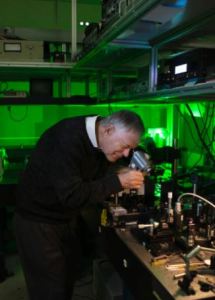 Byer also helped develop the quietest, most stable laser in the world, called the diode-pumped YAG laser. YAG lasers are today found in everything from communications satellites to green handheld laser pointers, which Byer co-developed with two of his graduate students and cites as one of his favorite inventions (he had joined Stanford in 1969). YAG lasers also form the main beams of the gravitational wave-detecting instrument, LIGO, which in 2015 achieved the most precise measurement ever made by humans when its antenna detected the tenuous spacetime fluctuations generated by two colliding black holes 1.3 billion light-years away.
 One summer morning in 1964, Byer drove the hour from Berkeley down to Mountain View for a job interview at a California company called Spectra Physics. He walked in to find an empty lobby but could hear clapping and cheering in the back of the building. After politely waiting for several minutes, he followed the commotion to a darkened room filled with men whose jubilant faces were illuminated by a rod of red-orange light that seemed to float above an instrument-strewn table
 A SELECTION of three essential articles read aloud from the latest issue of The Economist. This week, Hong Kong is not the only part of China’s periphery to resent

 In this artist’s book of 120 iPhone and iPad drawings,

 Democratic presidential contenders backed the Donald Trump impeachment inquiry during the fifth televised debate on Wednesday, saying his efforts to press Ukraine to investigate the former vice-president Joe Biden was an example of his administration’s corruption. The debate came hours after a senior US diplomat gave explosive testimony that directly implicated the president in a quid pro quo deal with Ukraine.
 The VillageMD primary care clinic, called Village Medical at Walgreens, is the first of five sites to open in Houston. Four more clinics are slated to open by the end of the year. The Village Medical clinics are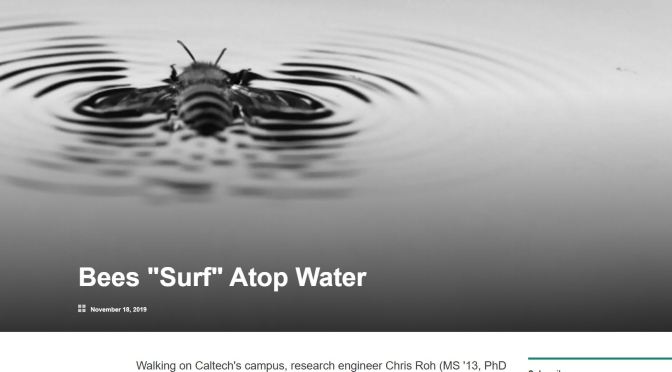
 When a bee lands on water, the water sticks to its wings, robbing it of the ability to fly. However, that stickiness allows the bee to drag water, creating waves that propel it forward. In the lab, Roh and Gharib noted that the generated wave pattern is symmetrical from left to right. A strong, large-amplitude wave with an interference pattern is generated in the water at the rear of the bee, while the surface in front of the bee lacks the large wave and interference. This asymmetry propels the bees forward with the slightest of force—about 20 millionths of a Newton.
 An audio spy adventure based on a series of internationally bestselling books (published in 19 languages) by James Leasor, ‘Passport to Oblivion’ features an all-star cast that also includes Glynis Barber, Nickolas Grace, Michael Brandon and Terence Stamp as ‘C’ the Head of MI6.
 Boomers Daily