

From a Wall Street Journal Magazine online interview:
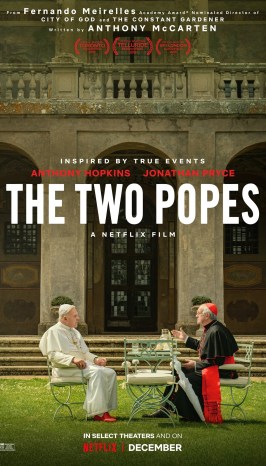 “The script is about questioning the nature of existence. I think about that every day of life. What is the purpose of life? As I get older, I look back on my own life as if it’s a novel written by someone else. To me it’s all a mystery. I started out over 60 years ago. My first job was, my God, 62 years ago and here I am. I don’t understand any of it. They gave me work, and I continued to work. It’s only just recently looking back, I thought, ‘My goodness, who designed this life? I certainly didn’t.’ I don’t know what’s life or destiny or kismet or God. I don’t want to get too philosophical about it. I’m fascinated about the mystery of life, about how we get through it, how we survive. I have no answers and I can’t take credit for any of it.”
Anthony Hopkins, who plays Pope Benedict XVI in this month’s Netflix movie The Two Popes, has a personal philosophy of not taking anything too seriously. “When I was younger, I was much more intense,” he says. “I got to a certain age, maybe 10 years ago, and thought, ‘Come on, just relax. Have some fun with it. Let’s have a ball!’” Hopkins’s surprising approach to playing the pope was to be as laid back as the actor, 81, appears on his lively Instagram account: He captures himself singing, dancing in his Thor costume and playing the piano with his cat perched on his lap.
To read more: https://www.wsj.com/articles/why-anthony-hopkins-doesnt-research-his-roles-11574343089?mod=read_more

 Every possible step is done online, and for most meals customers must reserve—and often pay—in advance, essentially buying tickets through a service called Tock that’s mostly used only by high-end restaurants. This means no host manning a podium, no reservation or PR teams, no extra staff on a slow night, almost no food waste, and better guest communications. It also allowed them to go from 20 employees to four full-time and three part-time workers.

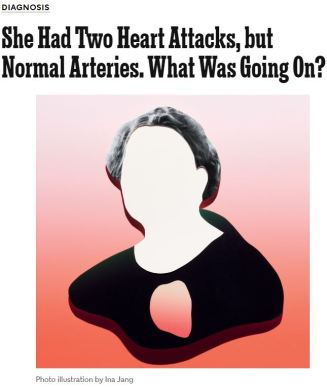 It was all horribly familiar — a rerun of an episode 15 months earlier, when she was with her family in River Vale, N.J. Back then, the burning pressure sent her to the emergency department, and she was told the same thing: She was having a heart attack. Immediately the cardiologist looked for blockages in the coronary arteries, which feed blood and oxygen to the hardworking muscles of her heart. That was the cause of most heart attacks. But they found no blockage.
 Indeed, that was the clue that led the rheumatologist to a likely diagnosis: Behcet’s disease. It’s an unusual inflammatory disorder characterized by joint pains, muscle pains and recurrent ulcers in mucus membranes throughout the body. Almost any part of the body can be involved — the eyes, the nose and lungs, the brain, the blood vessels, even the heart. Behcet’s was named after a Turkish dermatologist who in 1937 described a triad of clinical findings including canker sores (medically known as aphthous ulcers), genital ulcers and an inflammatory condition of the eye.



 A third of the nurses who took the survey are baby boomers and 20% of survey takers said they planned to retire in the next five years. More than a quarter, 27%, said they were unlikely to be working at their current job in a year.

 The idea for this ADU was conceived in the wake of the 2018 Woolsey Fire, as a way to help families reinhabit their properties while rebuilding their primary residence. All “BUD” designs provide beautiful living spaces that can be delivered quickly and enjoyed for generations as a valuable addition to almost any property.

 One of the most impressive aspects of the book is the wealth of contextual material, which never feels digressional but illuminatingly sets the scene for Hilliard’s remarkable life and achievement. His early life in Exeter; the family networks of goldsmiths in Devon and London; the political, religious and cultural worlds he would have encountered in London, Geneva, Paris and also – usually overlooked – in Wesel and Frankfurt; all make for compelling reading. This book is not just the definitive biography of Hilliard but essential reading for anyone interested in late 16th- and early 17th-century England.


 Boomers Daily