THE GHOST IN THE SYNTAX

Why Shakespeare’s lines demand intention, not imitation—and why machines can only echo sound.

By Michael Cummins, Editor, September 3, 2025

The rehearsal room was cold enough that the young actor’s breath lingered in the air. He stood on the stage with a copy of Macbeth, its pages soft from use, and whispered the line under his breath before daring it aloud: Tomorrow, and tomorrow, and tomorrow. The words fell flat the first time. Too rehearsed. Too conscious. He shook his head, tried again, letting the syllables drag as if they themselves were weary from carrying time. Creeps in this petty pace from day to day… The repetition was not just fatalism; it was the sound of a man unraveling, his will eroded by grief and futility. The rhythm itself had to ache.

A machine could, of course, manage the cadence. A program could be tuned to repeat the word “tomorrow” with perfect solemnity, to stretch the vowels just so. Google’s WaveNet system can produce uncanny variations of stress, hesitation, even sighs—digital sighs—at precisely calculated intervals. DeepMind’s recent work on “expressive TTS” allows a line to be rendered in tones of grief, anger, joy, or boredom. There are demo reels online where Shakespeare is fed through these systems, and the result is surprisingly competent. But competency is not intention. What the young actor does—searching for futility in his own chest, summoning weariness from his own private reservoir—cannot be coded. Intent is not in the sound of the line; it’s in the act of dying a little as you speak it.

This is what Shakespeare demands, again and again: not just language, but will. His characters live on the knife-edge of consequence, their words pressed out by motive. Romeo, stumbling over Tybalt’s body, gasps, O, I am fortune’s fool! He has just killed his wife’s cousin, wrecked his future, and tasted blood he never meant to spill. It isn’t just regret—it’s horror, the shock of realizing you’ve become the villain in your own love story. No algorithm can know the sting of unintended consequence. An AI might shout the words, might even deliver them with trembling emphasis, but the cry comes from a boy watching his own destiny collapse. The line does not live without that recognition.

The experiment has been tried. In 2022, an AI-generated voice performed Romeo’s balcony scene at a conference in Vienna. Listeners were impressed—some even moved. But when the line O, I am fortune’s fool! rang out, the room chuckled. It wasn’t just that the intonation was slightly off; it was that the cry lacked stakes. It was Romeo without a pulse, Romeo without a body to bear the guilt. The line did not fall short technically—it fell short existentially.

Hamlet’s soliloquies are the most treacherous test. In Act II he marvels and recoils at the same time: What a piece of work is man… How noble in reason, how infinite in faculty. It sounds like admiration, but it isn’t pure. The words turn over themselves—what ought to inspire awe instead curdles into disgust. He sees hypocrisy in every supposed nobility, futility in every faculty. An actor must carry the irony in his voice, lacing admiration with loathing, as though the words taste bitter even as they sound grand. An AI might deliver a clean, almost clinical balance—“admiration” followed by “disgust”—like toggling sliders on a mixing board. But irony is not a switch. It’s a wound dressed in velvet.

When DeepMind released an expressive model that could generate “sarcasm,” the tech press hailed it as proof that machines could finally do subtlety. Yet what we heard was not a fractured human voice, but a pristine and empty performance. The algorithm delivered a raised-eyebrow cadence, the verbal equivalent of a painted-on smile—a gesture without the impulse to conceal. This is the core of the paradox: sarcasm and irony are built on a bedrock of paradox—they require a speaker to mean two things at once, to hold a contradictory feeling in their voice and body. A computer cannot hold a contradiction. It can only cycle between two different outputs. It cannot fracture its own will; it can only mask its lack of will with a calculated pose. It’s a perfect pantomime of motive, but it is not the thing itself.

John Barton, co-founder of the Royal Shakespeare Company, once said that “Shakespeare is inexhaustible because he leaves space for the actor’s choice. Every pause, every stress opens a door.” The line is telling: it is choice that keeps the plays alive, not just rhythm. Machines can render a pause, but they cannot choose it. They have no sense of opening a door.

Brook went further. In The Empty Space, he wrote: “A word, a movement, a gesture is empty until it is filled with the life of the actor who chooses it in the moment. That life cannot be faked.” Brook believed theatre was only alive because of its fragility—the possibility of collapse at any instant. An AI-generated Lear might roar flawlessly through every line, but the roar would lack the pulse of possible failure. For Brook, this pulse was theatre itself.

The question of intention extends far beyond Shakespeare. What of a writer like Samuel Beckett, whose characters mutter their way through a landscape of despair? Molloy, in his absurdist journey, seems driven by nothing but habit. Yet even his rambling, fragmented speech is an act of will. He confesses, he tries to make sense, he fails. The very act of muttering is a defiant choice against silence and nonexistence. The words tumble out of him not because of a calculation of probability, but because he is compelled by the fundamental, human need to bear witness to his own suffering. He wants to be heard, even if he doesn’t know why. The machine, by contrast, cannot be propelled by such need; it does not hunger or fear silence.

Borges provides another mirror. In “Pierre Menard, Author of the Quixote,” he imagines a modern writer who painstakingly rewrites Don Quixote word for word—identical to Cervantes, yet different in meaning because of intention. The same words in a different century become charged with irony. Borges understood that words are never just words; they are vessels for will, for history, for desire. An AI could reproduce Shakespeare endlessly, but reproduction is not creation. The ghost of intent makes the difference.

Shakespeare writes as if to test whether a human voice can hold the charge of intention. Lear’s roar against the storm is the most elemental: Blow, winds, and crack your cheeks! It is not just noise; it is betrayal breaking loose. A father disowned, a king humiliated, Lear rages not only at the storm but at the cosmos for his madness and grief. It is a voice already fractured, demanding nature itself collapse. A machine can roar, yes. It can pump bass through speakers, crack like thunder. But it cannot bleed. To speak Lear’s line without the tremor of betrayal is to strip it bare of meaning.

The theater knows this well. In 2019, the Royal Shakespeare Company tested an AI-generated “co-performer” in an experimental production. The system generated lines in response to actors’ improvisations, its voice projected from a disembodied orb above the stage. The critics were fascinated, but they noted the same flaw: the AI could surprise, but it could not intend. The actors on stage carried the burden of consequence; the machine was a clever ghost.

Harold Bloom once wrote that Shakespeare “invented the human as we know it.” What he meant was not that Shakespeare created humanity, but that he revealed in language the contradictions, desires, and paradoxes that shape us. Bloom’s point makes the AI test more daunting: if Shakespeare gave us the map of interiority, then any performance that lacks interiority—any performance without stakes—is not merely deficient, but disqualified.

And then there is Portia, standing in the court of The Merchant of Venice, her voice softening into moral persuasion: The quality of mercy is not strained… It droppeth as the gentle rain from heaven. Here intent is everything. Portia is not just lawyering; she is pleading with the very idea of justice, urging her audience to see mercy as divine, inexhaustible. Her belief must be palpable. A machine could roll the syllables like pearls, but eloquence without conviction is nothing but polish. What gives the line its power is the speaker’s faith that mercy belongs to the order of heaven. Without that belief, it’s rhetoric without heart.

Here the cultural anecdote is darker: in 2021, an AI-generated voice was used in a court training exercise to deliver witness testimony. The experiment was intended to test jurors’ susceptibility to persuasion by machine voices. The results were mixed: some jurors reported being swayed, others reported discomfort. What unsettled them was not the quality of the performance but the absence of belief behind it. To be persuaded by words without will felt like manipulation, not argument. One legal scholar described the prospect as “trial by ventriloquism”—justice bent not by human persuasion, but by hollow eloquence.

The ghost in the syntax grows clearest here. Machines can offer us form—eloquence, cadence, even dramatic surprise. What they cannot provide is risk. An actor saying The quality of mercy risks hypocrisy if he fails to embody belief. The line costs him something. A machine, by contrast, cannot fail. Every performance is safe, repeatable, consequence-free. And it is precisely consequence that makes Shakespeare’s words ache.

The paradox is that we, as listeners, are complicit. We project intention onto anything that speaks. We hear a chatbot offer sympathy, and we feel soothed. We hear an AI-generated sonnet, and we marvel at its poignancy. We want to find meaning. We bring the ghost with us. The ELIZA effect—named for one of the earliest chatbots—was discovered in the 1960s: people poured out their souls to a crude program that only echoed their words back. If we can believe that, we can certainly believe in an AI Lear. But the belief is ours, not the machine’s.

Could AI ever cross the threshold? Some technologists argue that with enough layers, enough feedback loops, emergent properties might arise that resemble motive. Perhaps one day a synthetic voice will “choose” to pause differently, to inflect a line with bitterness not because a human trained it so, but because its internal processes made that choice inevitable. If so, would that be intent—or the perfect illusion of intent? The philosophers divide: John Searle insists that no simulation, however perfect, ever achieves the thing itself; Daniel Dennett argues that if behavior is indistinguishable from intent, the distinction may not matter. The stage, however, resists the reduction. A pause can be “indistinguishable” only if we do not ask what it costs the speaker to pause.

The Royal Shakespeare Company, now experimenting with immersive technologies, has been clear-eyed about the limits. Sarah Ellis, their director of digital development, called the company’s work with Intel’s motion capture in The Tempest “21st-century puppetry.” She explained: “The actor is always driving the performance. The technology amplifies, but it cannot replace.” The line could have been written as a manifesto for the AI age: amplification without intention is echo, not expression.

Back in the rehearsal room, the young actor stumbles. His voice cracks slightly on a word, a small imperfection that carries more meaning than a perfect rendition ever could. The director, sitting at the edge of the stage, leans forward, attentive. The line is not flawless, but it is alive. The risk of failure is what makes the moment vibrate.

A machine could reproduce the monologue flawlessly. It could echo a thousand performances until the averages smoothed every edge. But what it could never offer is that tremor. The possibility of failure. The risk that gives intention its bite. For intention is always wager, always consequence, always stake. Without it, words are only words, no matter how well they trip on the tongue.

And that is Shakespeare’s test. Could AI ever deliver his lines with intent? Not unless it learns to bleed, to risk, to believe. Until then, it will remain what it is: syntax without a ghost. We may listen, we may marvel, we may even project a soul into the sound. But when the storm clears, when Romeo cries out, when Portia pleads, it will not be the machine we hear. It will be ourselves, searching for meaning where none was meant.

THIS ESSAY WAS WRITTEN AND EDITED UTILIZING AI

LONDON REVIEW OF BOOKS – SEPTEMBER 11, 2025 PREVIEW

LONDON REVIEW OF BOOKS: The latest issue features ‘Why we need Dorothy Parker’; Biography of a Biography; David Lynch’s Gee-Wizardry


Ellmann’s Joyce: The Biography of a Masterpiece and Its Maker 
by Zachary Leader

Constant Reader: The New Yorker Columns 1927-28 by Dorothy Parker

Dorothy Parker: Poems by Dorothy Parker

Dorothy Parker in Hollywood by Gail Crowther

David Lynch’s American Dreamscape: Music, Literature, Cinema by Mike Miley

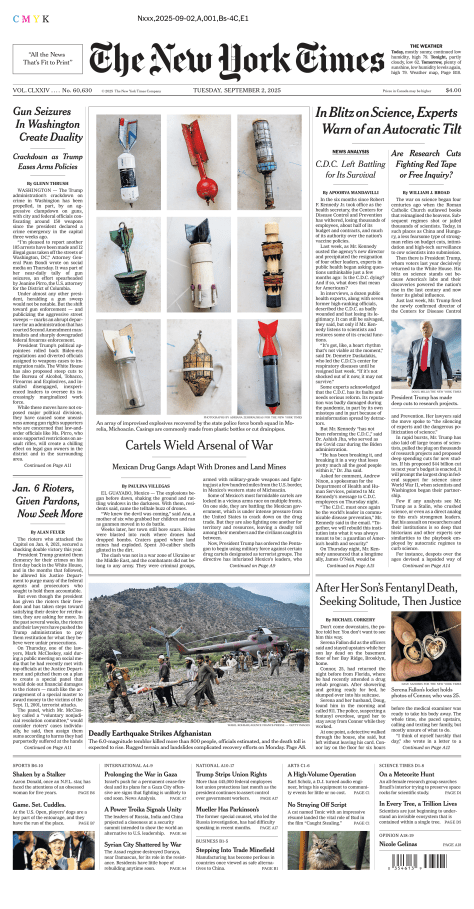
THE NEW YORK TIMES – WEDNESDAY, SEPT. 3, 2025

Appeals Court Blocks Deportations Under Alien Enemies Act

The ruling on the 18th-century wartime law was a setback for President Trump’s immigration crackdown. The case is almost certainly headed to the Supreme Court.

Here’s How Legal Battles Over the Alien Enemies Act Have Played Out

As Rubio Visits Mexico, Its President Walks a Political Tightrope

U.S. pressure to crack down on corrupt politicians has squeezed President Claudia Sheinbaum ahead of her meeting with Secretary of State Marco Rubio.

Trump Says U.S. Attacked Boat Carrying Venezuelan Gang Members, Killing 11

Xi Parades Firepower to Signal That China Won’t Be Bullied Again

The parade, attended by the leaders of Russia and North Korea, had a defiant message. President Trump weighed in.

Kim Jong-un Brings a Guest to Beijing: His Daughter and Potential Heir

THE CAFÉ OF ECHOES

At Caffè Florian, a poet rehearses silence, quarrels with Ruskin, and dines with memory.

By Michael Cummins, Editor, September 2, 2025

In the autumn of 1883, Robert Browning arrived in Venice not as a poet seeking inspiration, but as a man rehearsing his own silence. He was seventy-one, celebrated in England yet still dogged by the charge of obscurity, more famous abroad for Elizabeth’s immortal sonnets than for his own labyrinths. This essay is not fact but speculation, not history but atmosphere: Browning imagined at his table in Caffè Florian, where mirrors, velvet, and silence conspired with memory to become his final stage.

The boat nudged the dock like a hesitant thought. Browning stepped off with the stiffness of age and the grace of habit. The air smelled of brine and stone, of centuries folded into mist. He paused, cane in hand, and looked toward the dome of the Salute—its silhouette a question mark against the morning haze. Seventy-one years weighted his shoulders, but he stood upright, as though irony itself were a brace. The vaporetto pulled away, its wake dissolving into green silk. He had no luggage beyond a notebook and the ghosts already crowding his mind.

The fog is not weather—it is thought. It thickens, withdraws, curls back upon itself. Even in this cup before me it lingers: caffè corretto, black cut with brandy, bitter and sweet as a line half-finished. Florian is dim at this hour, its velvet walls inhaling the echoes of centuries. Mirrors multiply the room into infinity. Each reflection a fragment of me: old, young, diminished, fractured. A poet made a kaleidoscope.

Byron once sat here, Goethe scribbled here, conspirators whispered “Viva San Marco!” in the Sala del Senato. Today I sit, ordering polenta e schie—shrimp fried in brine—and the taste is lagoon, memory, salt. A plate of amaretti arrives, sugared consolation. The waiter suggests biscotti di mandorla as well, almonds crushed into sweetness. I chew slowly. The polenta is soft, golden, humble—like memory softened by time. The schie, tiny survivors of the lagoon, taste of endurance. Amaretti crumble like old letters, sugared on the outside, hollow at the core. The coffee, thick as ink, stains the tongue with bitterness and clarity. Florian does not serve meals; it serves metaphors.

Across the square, Quadri blazes with chandeliers, an operatic stage flattering the surface. Florian is darker, more inward. Its light is borrowed, its silences long. Quadri is performance for an audience. Florian is monologue.

I open my notebook: Ruskin, copied lines from The Stones of Venice. His voice has been my reluctant companion for thirty years. “We may live without her, and worship without her, but we cannot remember without her.” John, always the preacher. He carved morality into marble, turned buttresses into sermons. For him, Venice’s decline was sin. For me, decline is theatre. To remember is not to repent but to perform again. Memory is rehearsal.

The waiter refills my cup. The brandy sharpens thought, steadies irony. I recall my own lines from A Toccata of Galuppi’s:

As for Venice and her people, merely born to bloom and drop,
Here on earth they bore their fruitage, mirth and folly were the crop.

I scolded them then. How Puritan I was. Sitting now at Florian, I envy them. Folly is not failure; it is fruit. Who begrudges the bloom because it falls?

A German couple at the next table mutter Goethe. Their syllables stumble in Venetian air. A waiter tells a French traveler that Byron loved their zabaglione. A young woman sketches the gilded lamp above the doorway, her graphite smudged. She glances at me: “Are you a writer?” “No,” I reply, “a reader of ruins.” She frowns, puzzled. Youth believes silence means emptiness.

Elizabeth drifts through the mirrors. Her eyes catch mine across the velvet gloom. She wrote of Florence in Casa Guidi Windows, calling for liberty. She saw windows; I see walls. She opened; I enclosed. She is remembered for love, I for irony.

Her voice returns in my By the Fire-Side:

Oh, moment one and infinite!
The water slips o’er stock and stone;
The West is tender, yet the night
So soon must veil it, mine alone.

The water slips even now beneath the piazza stones. Tenderness yields to night. And yet—even absence is mine.

I once watched her read Petrarch aloud at Casa Guidi, her voice trembling with belief. She said poetry must lift. I said it must dig. We never resolved it. But in Venice, I hear her voice lifting still, even as I dig. I imagine writing a letter to her, one I will never send: My dearest Ba, Florian multiplies us in its mirrors. You see eternity; I see fragments. You spoke love; I speak echoes. And still, together, we wrote scaffolding for survival.

Ruskin appears across the table, severe, ascetic, with eyes that drill into conscience. He clears his throat: “The first cause of the fall of Venice was her falsehood.” He gestures to Florian’s mirrors. “Deceit multiplied.”

I answer: “John, is not poetry falsehood? Have I not spoken through murderers and monks, adulterers and judges? Masks, every one. But tell me—was the mask less true than the face?”

He insists: “Gothic is the expression of a Christian people, the confession of their faith in the work of their hands.”

I sip. “Faith, carved into cornices, labor engraved in stone. And what has it left us? Ruins. Whereas the Renaissance, with all its duplicity, left us colour, flourish, theatre. I prefer a glowing lie to a tedious truth.”

Ruskin frowns: “The Lamp of Truth must burn in every arch.”

“Truth burns, yes,” I reply, “but it also blinds. Give me the lamp of illusion, John. It casts longer shadows.”

I remember reading Ruskin aloud to Elizabeth once, in Florence, when his Seven Lamps of Architecture was still fresh. She had shaken her head. “He sees sermons in stone,” she said. “I see spirit in breath.” We argued half the night, she quoting Casa Guidi Windows, I muttering that breath is nothing without scaffolding. And here I sit now, scaffolding without breath.

The waiter brings another plate, sets down biscotti di mandorla. Ruskin fades into the mirror. I smile. I have won the debate by eating.

But another ghost sidles into Florian: Byron, lounging with rakish ease, boots muddy from some clandestine canal adventure. He leans back, laughing: “Browning, you scold folly, yet you envy it. Admit it—you envy me.” I do. I envied him once, his thunder, his immediate grip on the world. Venice loved his scandal, his Don Juan verses written between embraces. I admired the music, the power, the theatricality, even as I recoiled from his flamboyance. He used Venice as a symbol of faded grandeur, of moral ambiguity. And have I not done the same, though with less applause? “You were lightning,” I tell him. “I am only the echo.” He winks. “Echoes last longer than thunder.”

And Shelley, gentler, spectral, drifts in too. He never lodged here long—only passed through—but his lyricism breathed Italy. I remember writing Pauline, my first confession of a poet’s soul, under his influence. Shelley gave me metaphysics tuned to music, ideals sung into air. I once wrote a short poem, Memorabilia, about shaking hands with a man who had known him. Imagine—that thrill of proximity! Shelley’s ghost leans toward me now, whispering: “Poetry must lift, Robert, even from ruins.” His words tremble like a lyre string.

I admire Shelley still, though I turned away from his idealism. He lifted; I dug. He soared; I performed. And yet, I cannot deny: his fusion of thought and song shaped me as much as Byron’s theatre. Byron gave me thunder, Shelley gave me music. Elizabeth gave me breath. Ruskin gave me quarrel. And Venice—Venice gives me echo.

I recall In a Gondola, my youthful play with passion:

The soul of music slumbers in the shell
Till waked and kindled by the master’s spell.

How earnest I was. I believed love eternal, dramatised into permanence. Now I know better. Love is architectural. It leaves ruins. One walks among them—not grateful for permanence, but for echo.

The young artist glances at me again, and this time she sketches my hand—gnarled, ink-stained, resting on the cup. I wonder what she sees. Not the poet, surely. Perhaps only a ruin worth recording. Perhaps only another relic of Venice.

Florian’s velvet breathes of centuries. The Sala del Senato still hums with 1848, Daniele Manin declaring the Republic of San Marco. I imagine their whispers lingering, “Viva San Marco!” clinging to the mirrors. Byron’s laughter, Shelley’s sighs, Casanova’s schemes, Goldoni’s wit—all still staged. The velvet absorbs nothing; it amplifies.

Outside, the piazza fills with orchestras. From Florian, a waltz in minor key, introspective, precise, like Strauss slowed by melancholy. From Quadri across the stones, a polka, bright, frivolous, Offenbach reborn in defiance. The melodies clash above San Marco. Venice plays both scores at once, refusing to choose between tragedy and farce.

I attempt a stanza in my head to match their duel, half-jesting, half-serious:

One side mourns with violins, one side laughs with brass,
Yet both belong to Venice, as shadow and mirror pass.
I sit between the melodies, cane planted, glass in hand,
Hearing waltz and polka argue what I cannot command.

The waiter sets down another caffè corretto. I trace the rim of the cup, whisper fragments that may form another book. A line half aloud:

One who never turned his back but marched breast forward,
Never doubted clouds would break…

I know better. Clouds often do not break. Yet I say it still. Faith is not in triumph, but in endurance.

Elizabeth’s ghost leans across the table, chiding gently. She opened windows, I enclosed walls. She gave hope; I gave puzzles. She left sonnets; I left monologues. She is love’s voice; I am irony’s echo. Together we were scaffold and soul. Alone, I am scaffold only.

The German couple departs, their voices swallowed by velvet. The gondolier outside cries a Byron line again, misremembered. The young woman finishes her sketch, closes her notebook. I scribble a note in Ruskin’s margin: “Dear Mr. Ruskin, Gothic is faith hewn in stone. Renaissance is theatre. And theatre endures longer than sermons.”

I close the notebook, order one last plate—polenta e schie again, salt and brine against the tongue. Outside, gondolas drift like commas in an endless sentence. Mirrors scatter me into fragments. Florian holds me like a stage.

Ruskin’s voice returns from memory: “When we build, let us think that we build for ever.” Poor John. Nothing lasts forever. Not fresco, not marble, not even love. But echoes last. And echo is all art requires.

Tomorrow I depart. The fog will remain. And somewhere in it, a voice—hers, mine, ours—will echo still.

They will read me in fragments, quote me in footnotes, misunderstand me in classrooms. That is the fate of poets. But if one reader hears the echo—hears Elizabeth’s breath in my silence, hears Venice in my irony, hears Byron’s thunder subdued into cadence, hears Shelley’s song distilled into thought—then I have not vanished. I have rehearsed eternity.

And when I return, as I surely shall, though not by will but by death’s courtesy, they will bring my coffin to the Salute. Bells will toll, gondolas will line the water, poets will compose their elegies. They will call me Venice’s last guest, though I was only ever her reader of ruins. Elizabeth will not be there, but I will hear her still, in the fog, in the echo, in the silence.

For art does not conclude. It endures. Like Venice herself, it is scaffolding and soul, ruin and flame, silence and applause. And in the hush that follows, I hear my own final stanza rehearsed already by this city—Ruskin’s stones, Elizabeth’s voice, Byron’s thunder, Shelley’s song, Galuppi’s chords, my reluctant cadence—echoing forever across the water.

THIS ESSAY WAS WRITTEN AND EDITED UTILIZING AI

LITERARY REVIEW – SEPTEMBER 2025

LITERARY REVIEW : The latest issue features ‘Mysteries of Marlowe’

Dark Renaissance: The Dangerous Times and Fatal Genius of Shakespeare’s Greatest Rival, Christopher Marlowe By Stephen Greenblatt
The Boundless Deep: Young Tennyson, Science, and the Crisis of Belief By Richard Holmes
A Scandal in Königsberg, 1835–1842 By Christopher Clark

THE NEW YORK TIMES – TUESDAY, SEPTEMBER 2, 2025

Judge Says Trump’s L.A. Troop Deployment Was Illegal

A federal judge said President Trump had violated the law with his deployment of thousands of Marines and National Guard troops to Los Angeles in June.

White House Counsel Eases Trump’s Path on Aggressive Agenda

David Warrington, the top lawyer inside the West Wing, focuses on “the art of the possible,” as one adviser to President Trump said.

Ukraine Pursues a Weapons Buildup More Potent Than Any Security Guarantee

Kyiv sees a well-equipped army as a stronger deterrent to Moscow than Western pledges to defend it. It is working to attract billions to buy more arms.

Putin and Xi Invoke Wartime Unity as They Hail Ties in Beijing

The Russian and Chinese leaders drew on a shared view of their countries’ roles in World War II to cast their current partnership as a challenge to the West.

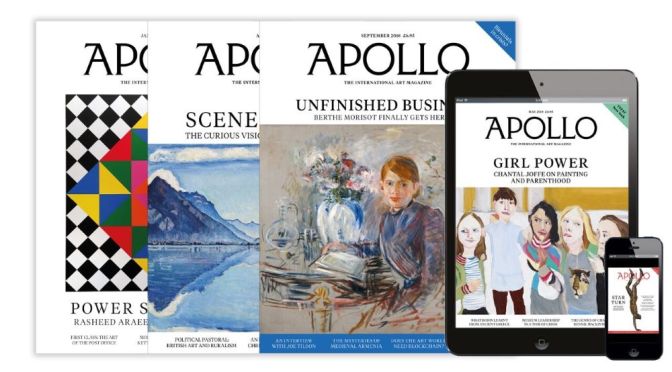
APOLLO MAGAZINE – SEPTEMBER 2025

September 2025

APOLLO MAGAZINE: The latest issue features The singular art of Georges de La Tour | Britain’s place in the soft-power race | Alec Cobbe’s masterful collecting | the Mona Lisa of medieval manuscripts

When American modernism planted its flag in London

Eero Saarinen’s US embassy building in Mayfair has long been undervalued, but its conversion into a luxury hotel may help revive its reputation

When British sculpture became modern

Henry Moore and Barbara Hepworth are ever in demand, but the market for their lesser-known contemporaries is growing too


Élisabeth Vigée Le Brun’s Roman holiday

While exiled in the city, Marie Antoinette’s favourite artist stuck up a close friendship with her own idol, Angelica Kauffman

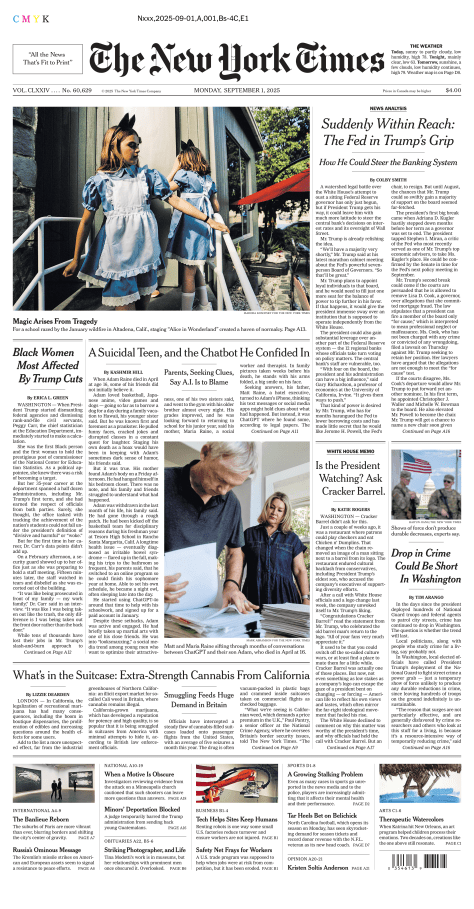
THE NEW YORK TIMES – MONDAY, SEPTEMBER 1, 2025

Xi, Modi and Putin Clasp Hands in a Rare Show of Unity

At a summit, the leaders of China, India and Russia projected an alternative to U.S. global leadership, even as serious differences among them remain.

India Was the Economic Alternative to China. Trump Ended That.

A lurch in policy has shaken the India-U.S. economic alliance against China, leaving India little choice but to consider reversing its own strategy.

Earthquake in Afghanistan Leaves More Than 800 Dead

The quake, near the border with Pakistan, injured more than 2,500 people, the authorities said. The death toll was expected to rise.

What to Know About the Earthquake

With Drones and I.E.D.s, Mexico’s Cartels Adopt Arms of Modern War

Under pressure from the government and each other, some of Mexico’s most powerful criminal groups are amassing homemade mortars, land mines, rocket-propelled grenades and bomber drones.