
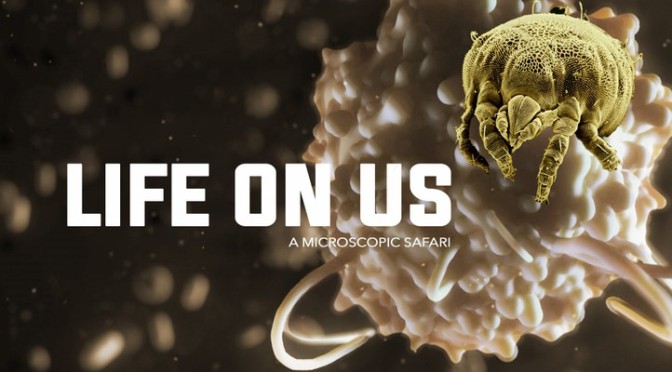
Among the unknown worlds in the universe, we can count our very own bodies. Like planet earth, each of us is made up of fascinating landscapes that are home to all kinds of wildlife.
The film takes the viewer on a unique microscopic safari, where we encounter some of the myriad creatures that live, thrive, compete, feed, are born and die on or inside our bodies. In fact, microscopic creatures play a more powerful role than we know: These life forms impact our health, our life expectancy, our physique and even our behavior.
The film renders these hidden worlds visible with the help of special effects: Combining cinematic electron microscopy with a super macro film technique. The documentary explains cutting-edge scientific findings, by turns surprising, enlightening and amazing. It raises questions about who we are, and how we exist in the unexplored, complex ecosystems that help constitute us.
We are born 100% human, but will die 90% microbial. Between these two points in our lives lies the unexplored terrain of ‘Life on Us’.



 This week’s Nature podcast looks at how skin’s unusual response to stretching is finally explained, a coronavirus update and the latest in a huge effort to map DNA.
 “There’s an aging population, and there’s a lot of skin out there,” said Dr. Isaacs. “One in five people in the country develop skin cancer, but there is a plethora of benign skin conditions that also require the expertise of the dermatologist. So, you have increasing demand and a limited supply of dermatologists.”
 This week, Nature looks at a new method to grow hairy skin in a dish, and new research takes aim at the RNA world hypothesis.
 On this week’s show, freelance writer Christa Lesté-Lasserre talks with host Sarah Crespi about the scientists working on the restoration of Notre Dame, from testing the changing weight of wet limestone, to how to remove lead contamination from four-story stained glass windows.
 …a new
  Boomers Daily