
W

W
 Staff Writer Jon Cohen joins host Sarah Crespi to talk about using monoclonal antibodies to treat or prevent infection by SARS-CoV-2. Many companies and researchers are rushing to design and test this type of treatment, which proved effective in combating Ebola last year.
 See all of our News coverage of the pandemic here, and all of our Research and Editorials here. And Karen Holl, a professor of environmental studies at the University of California, Santa Cruz, joins Sarah to discuss the proper planning of tree-planting campaigns. It turns out that just putting a tree in the ground is not enough to stop climate change and reforest the planet.
 This week, a new way to study elusive subatomic particles – pions, and the story of Galileo remains relevant in a time of modern science denialism.
In this episode:
00:46 Probing pions
Pions are incredibly unstable and difficult-to-study subatomic particles. Now researchers have come up with a clever way to examine them – by sticking them into helium atoms. Research Article: Hori et al.
08:28 Research Highlights
A colourful way to cool buildings, and the rapid expansion of cities. Research Highlight: A rainbow of layered paints could help buildings to keep their cool; Research Highlight: Urban sprawl overspreads Earth at an unprecedented speed
10:46 The life of Galileo
A new biography of Galileo Galilei examines some of the myths about his life and draws parallels with problems facing scientists today. Books and Arts: Galileo’s story is always relevant
16:42 Pick of the Briefing
We pick our highlights from the Nature Briefing, including botanical graffiti, and rock-eating bacteria. The Guardian: ‘Not just weeds’: how rebel botanists are using graffiti to name forgotten flora; Scientific American: Scientists Waited Two and a Half Years to See whether Bacteria Can Eat Rock
 Staff Writer Jocelyn Kaiser joins Sarah to talk about a recent Science paper describing the results of a large study on a blood test for multiple types of cancer. The trial’s results suggest such a blood test combined with follow-up scans may help detect cancers early, but there is a danger of too many false positives.
 And postdoctoral researcher Timo Reinhold of the Max Planck Institute for Solar System Research joins Sarah to talk about his paper on how the Sun is a lot less variable in its magnetic activity compared with similar stars—what does it mean that our Sun is a little bit boring?
This week, how the ‘sniff-response’ can help clinicians determine a patient’s state of consciousness, and how vaccines could help drive down antibiotic use.In this episode:
00:45 Sniffing out consciousness
Researchers have found that the sniff reflex can indicate whether a patient is in a vegetative state, and even the likelihood that they will recover consciousness. Research Article: Arzi et al.
08:37 Research Highlights
The stupefying effect of carbon dioxide, and a chameleon gemstone that tricks your eyes. Research Highlight: Rising carbon dioxide levels will make us stupider; Research Highlight: How a chameleon gemstone changes from red to green
11:12 Vaccination and antibiotic usage
Looking at data from low- and middle-income countries, researchers have determined that vaccination could prevent millions of infections currently treated by antibiotics. Research Article: Lewnard et al.
16:49 Pick of the Briefing
We pick our highlights from the Nature Briefing, including the forgotten mother of climate change science, and a new global study on insect declines. Chemistry World: Eunice Foote: the mother of climate change; Science: Meta-analysis reveals declines in terrestrial but increases in freshwater insect abundances
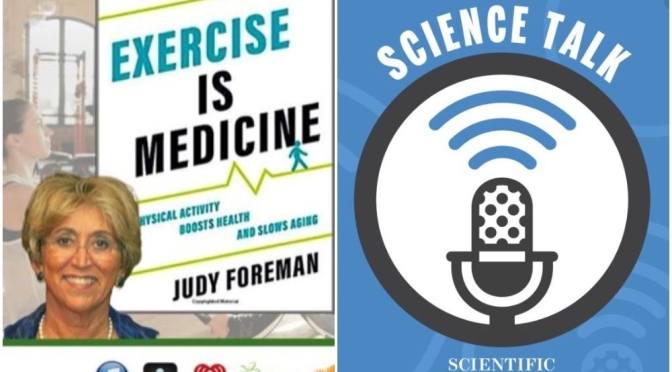
 Health journalist Judy Foreman talks about her new book Exercise Is Medicine: How Physical Activity Boosts Health and Slows Aging
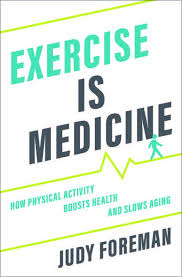 This is Scientific American’s Science Talk, posted on April 24th, 2020. I’m Steve Mirsky. And under our current, often locked-down situation, it’s still really important to try to get some exercise. Judy Foreman is the author of the new book Exercise is Medicine: How Physical Activity Boosts Health and Slows Aging. She’s a former nationally syndicated health columnist for the Boston Globe, LA times, Baltimore Sun and other places, and an author for the Oxford University Press.
She graduated Phi Beta Kappa from Wellesley College and has a Master’s from the Harvard Graduate School of Education. She was a Lecturer on Medicine at Harvard Medical School, a Fellow in Medical Ethics at Harvard Medical School and a Knight Science Journalism Fellow at the Massachusetts Institute of Technology. She spent six months as a guest reporter for The Times of London. She was also a Senior Fellow at the Schuster Institute for Investigative Journalism at Brandeis University. She was also host of a live, weekly call-in radio show on Healthtalk.com.
Judy has won more than 50 journalism awards, including a 1998 George Foster Peabody award for co-writing a video documentary about a young woman dying of breast cancer and the 2015 Science in Society award from the National Association of Science Writers.
Coronavirus affects far more than just the lungs, and doctors and researchers in the midst of the pandemic are trying to catalog—and understand—the virus’ impact on our bodies. Staff Writer Meredith Wadman joins host Sarah Crespi to discuss what we know about how COVID-19 kills. See all of our News coverage of the pandemic here, and all of our Research and Editorials here.
Also this week, Staff Writer Paul Voosen talks with Sarah about quantum diamond microscopes. These new devices are able to detect minute traces of magnetism, giving insight into the earliest movements of Earth’s tectonic plates and even ancient paleomagnetic events in space.

 Boomers Daily