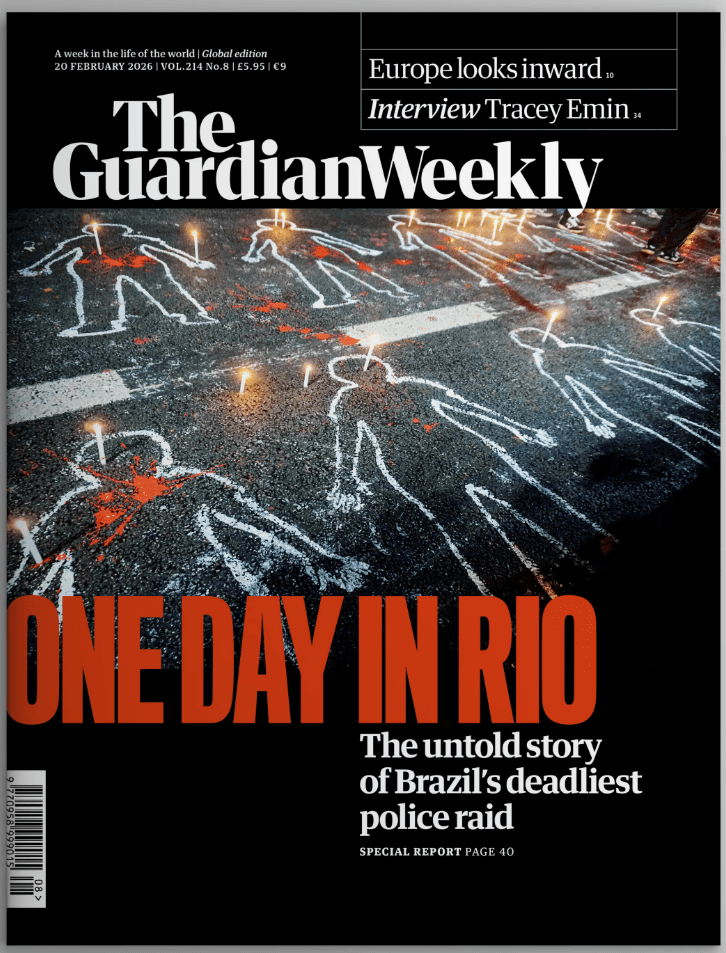
The first shots of an infamous day were fired in Rio’s Complexo da Penha favela at 4.30am. It was 28 October 2025 and the deadliest police raid in Brazil’s history had just begun. By the end of the day, 122 people, including five police, were dead.
The raid, nicknamed Operation Containment, was intended to apprehend members of one of the country’s most powerful organised crime groups, the Red Command – and in particular its kingpin, Edgar Alves de Andrade, who is also known as “the Bear”.
But the list of 100 arrest warrants justifying the operation featured none of the 117 people killed, and at least one of the dead was not involved in organised crime at all. The Bear, meanwhile, remains at large. Activists, security experts and even Brazil’s president, Luiz Inácio Lula da Silva, have described the operation as a futile massacre.
Now, in a forensic investigation encompassing interviews with community leaders, lawyers, security specialists and bereaved relatives, the Guardian’s South America correspondents Tom Phillips and Thiago Rogero have pieced together the full, previously untold story of what happened.
The big story | Continental drift in Munich Europe’s leaders met to discuss the continent’s future safety at the Munich Security Conference, a gathering characterised by mistrust of the US Trump administration and divisions over Ukraine. Patrick Wintour was there
Spotlight | Pressure mounts for Andrew to talk to police As calls for the former prince to cooperate with the investigation become deafening, this may be the reckoning the British king’s brother cannot escape. Caroline DaviesandAlexandra Topping investigate
Interview | Tracey Emin on reputation and radical honesty She scandalised the art world in the 1990s with her unmade bed, partied hard in the 2000s – then a brush with death turned the artist’s life upside down. Now Tracey Emin is as frank as ever, as Charlotte Higgins discovered
Opinion | Iran’s 1979 revolution offers some present-day pointers The similarities between Iran’s current crisis and events preceding the shah’s exile are striking. The radical clerics benefited then – but, asks Jason Burke, who would prevail this time?
Culture | Thundercat on funk, lost friends and being fired by Snoop Dogg The genre-hopping bass virtuoso has backed Ariana Grande and Herbie Hancock, appeared in Star Wars and become a boxer. Stephen Bruner explains his polymath mindset to Alexis Petridis
The latest tranche of the Jeffrey Epstein files have been in the public domain for less than two weeks, but already their contents have sent shock waves around the world.
Nowhere is this more true than in Britain, where the fallout has come to the door of Keir Starmer over his appointment of Peter Mandelson as UK ambassador to Washington, amid questions about how much the prime minister knew of his former envoy’s links to Epstein.
Starmer looks to have weathered the immediate pressure to resign this week, despite having lost his influential chief of staff, Morgan McSweeney, over the scandal. But the vultures are still circling and it seems a matter of when, rather than if, the prime minister will go. Kiran Stacey weighs up the possible challengers from within the Labour party, while Oliver Holmes and Chris Michael consider why the scandal hit home so hard in the UK.
Spotlight | The last post for press freedom in the US? Jeff Bezos’s axing of more than 300 jobs at the Washington Post has renewed fears about the resilience of America’s democracy to withstand Donald Trump’s attacks. Ed Pilkington and Jeremy Barr report
Technology | The continuing risks and rewards of AI As policymakers and tech executives prepare for the next global AI summit in India, an annual safety report highlights the issues that will be at stake, writes Dan Milmo
Interview | Can Zack Polanski pull off a green revolution in the UK? With polls and membership at an all-time high, the UK Green party is having a moment – and it’s largely down to the party’s charismatic (if slightly cheesy) new leader. Simon Hattenstone went on the road with him
Opinion | What links UK politics and Epstein? A thick seam of contempt We’re often told the British prime minister, Keir Starmer, is a ‘decent’ man. But in appointing Peter Mandelson he chose political convenience over doing right, argues Nesrine Malik
Culture | The sign language of Margaret Calvert Airports, road signs, typefaces … the design legend revolutionised how Britain looked and her brilliantly clear designs are still used today. Catherine Slessor met her
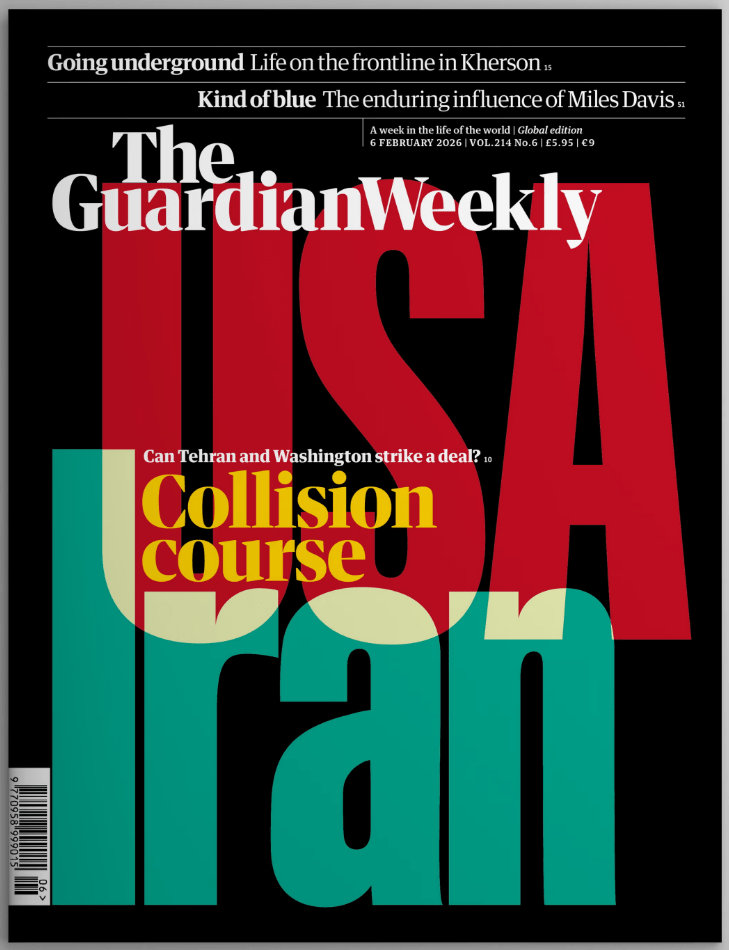
Have Donald Trump’s hard talk and the arrival of a strike-ready flotilla finally made Tehran blink? It certainly seemed so by Monday evening, when Iran said it was willing to talk. A week of trading threats turned to strong indications that Steve Witkoff, Trump’s envoy, and Abbas Araghchi, Iran’s minister for foreign affairs, were readying to meet in Istanbul on Friday. In this week’s big story, Ashifa Kassam and Andrew Roth chart how momentum to war slowed and fears of a wider regional conflict eased, albeit marginally.
The background to Trump’s war of words against Tehran was the huge protests that rocked Iran last month, until they were brutally repressed by the regime. Analysts suggest a fragile domestic security situation prompted the Iranian government’s softening towards US demands. Our diplomatic editor and longtime Iran watcher, Patrick Wintour, explains that while the streets are now quiet, a shift in the balance of power between the people and the government has emboldened domestic demands for a full investigation of the killing and imprisonment of protesters.
Spotlight | The Epstein files, part two Daniel Boffey details the biggest bombshell among the 3m newly released documents: disgraced former minister Peter Mandelson’s deep and compromising relationship with the convicted paedophile
Environment | Nature runs wild in Fukushima Free of human habitation after the 2011 earthquake, tsunami and nuclear meltdown, Fukushima is now teeming with wildlife. But this haven could vanish if people come back, finds Justin McCurry
Features | From hope to despair The postwar new town of Newton Aycliffe with its boarded up shops is a symbol of the Britain’s economic gloom – and a warning for Labour as it battles the rise of Reform UK, reports Josh Halliday
Opinion | Art, groceries, Greenland – thieves are everywhere Jonathan Liew reflects on how we all seem to live in a world defined by petty theft and no one, whether it’s the pickpocket or the big AI company, seems to get punished
Culture | Small acts of magic Mackenzie Crook tells Zoe Williams how his approach to comedy has mellowed with age. Gone is the nervous, awkward energy of Gareth from The Office, to be replaced by the gentle curiosity that animates his new series Small Prophets
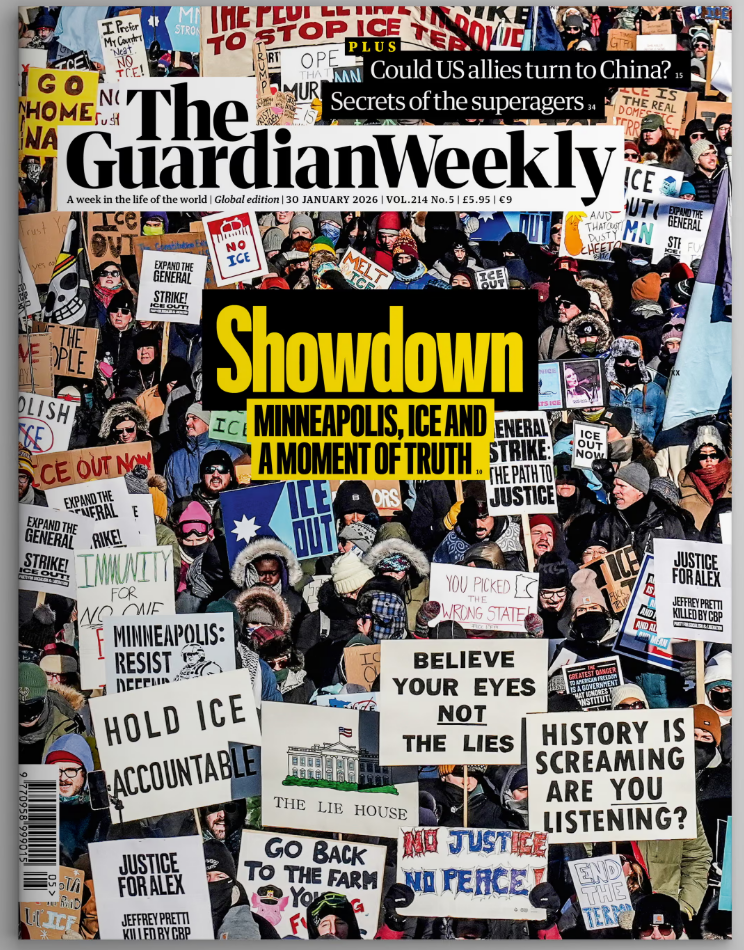
Is the worm turning against Trump? Last week saw a concerted pushback against the US president by western allies over Greenland. This week, it is on the domestic front where the Trump administration seems to be buckling – this time under intense criticism after the killing of another American citizen by federal agents in Minneapolis.
The massive winter storm that swept across North America last weekend could not obscure from the nation video footage of an ICE agent shooting dead Alex Pretti, an intensive care nurse and father of three who was seemingly rushing to protect a woman as she was pepper-sprayed by Border Patrol personnel.
As our Washington bureau chief David Smith writes in this week’s big story, the events were seen by many as clear evidence of fascistic overreach and a potential moment of reckoning for Trump in the US. A wave of condemnation from politicians across the political spectrum led to a swift softening of tone from the White House, though not before leading administration figures had wrongly tried to pin the blame on the victim.
From Minneapolis, Rachel Leingang reports on the sense of shock and fury in the city, while in a stark commentary, Francine Prose voices her fears that the US may be on the brink of an authoritarian takeover.
Spotlight | Are Trump’s tantrums pushing America’s allies closer to China? After a week of diplomatic turmoil, some western nations are turning to a country that many in Washington see as an existential threat. Amy Hawkins reports
Science | Fly me to the moon, again Nasa is readying its most powerful Artemis II rocket for a new, 1.1 million km lunar circumnavigation flight – and lift-off could come as soon as next week. Science editor Ian Sample sets the scene
Feature | Secrets of the superagers Why do some people age better than others? Five extraordinary individuals – who scientists are studying – share their tips with Isabelle Aron
Opinion | It’s now clear. Labour needs a new leader – and quickly UK prime minister Keir Starmer’s dismal decision to block likely leadership challenger Andy Burnham from standing in a byelection has bought him time, but it won’t change his fate, says Polly Toynbee
Culture | Has Netflix killed our attention spans? Matt Damon has got it right, argues Stuart Heritage: the streaming giant knows we all just watch TV with one hand gripping our smartphones, which is why we need plotlines explaining to us over and over again
The dystopian nightmare of 2026 continued apace this week with Donald Trump seemingly hell-bent on taking over Greenland, either by purchase or military force if necessary, while potentially collapsing the entire western security alliance in the process.
Updates were delivered by the US president to European leaders in a trademark stream of social media insults and invective. As ever with Trump, it’s hard to tell if it all should be read as maximalist positioning ahead of a negotiation, or a genuine precursor to a military attack. But as Patrick Wintour and Jennifer Rankin write in this week’s Big Story, the damage among fellow Nato members already looks to have been done.
Melting sea ice has much to do with Greenland’s increasing strategic desirability. With the help of some great graphics, visuals editor Ashley Kirk explains what’s changing in the Arctic and who lays claim to what.
Spotlight | The man who trusted Trump – and paid with his life Many Iranian protesters believed a US president would – for the first time – rescue them, but now people can only despair after mass arrests and brutality. Deepa ParentandWilliam Christou report
Environment | Where have all Thailand’s dugongs gone?
The Andaman coast was one of few places in the world with a viable population of the marine mammals, but then dead ones began washing up. Now half have gone. Gloria Dickie reports from Phuket
Feature | Cuba edges closer to collapse Disillusioned with the revolution after 68 years of US sanctions and a shattered economy, one in four Cubans have left in recent years. Can the regime, and country, survive? ByAndrei Netto in Havana
Opinion | Take a lesson from the past, and light the way forward As Martin Kettle writes his last regular column for the Guardian, his thoughts turn to the examples and hope we can take from history
Culture | Michael Sheen on launching Welsh National Theatre As the newly founded national company’s first show comes to the stage, the proudly Welsh actor tells Kate Wyver about his plan to bring big productions back to his homeland
News, Views and Reviews For The Intellectually Curious









 Boomers Daily