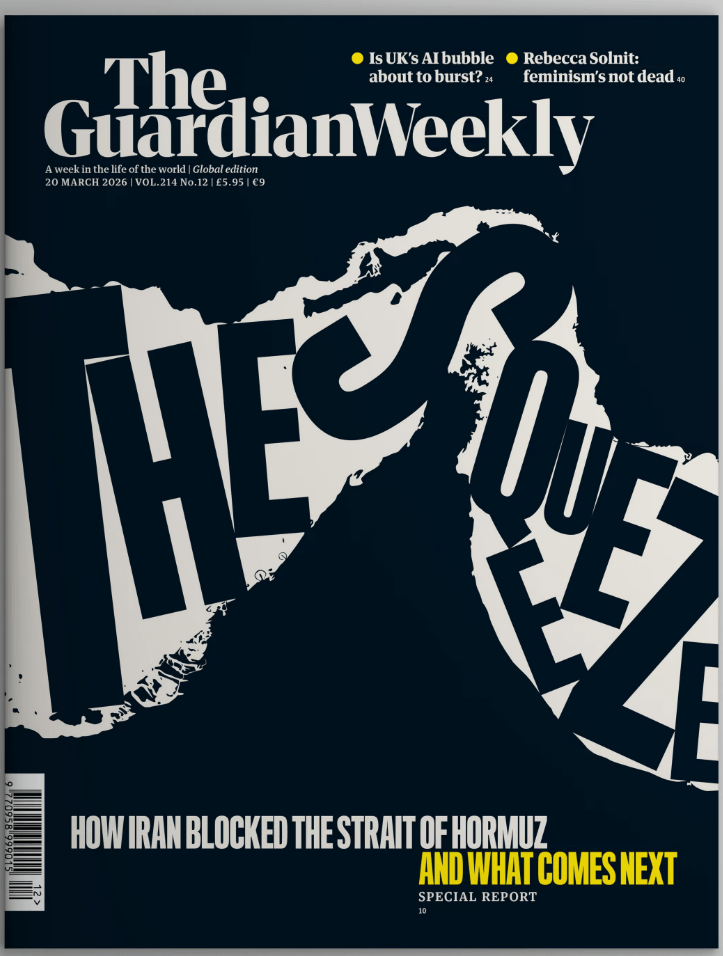
As fighting in the Middle East entered its third week, focus has shifted to Tehran’s closure of a key maritime passage, and the potentially huge global economic impact.
For our big story this week, Jillian Ambrose explains how the war in Iran has effectively blocked the Gulf states from exporting a fifth of the world’s oil supply through the strait of Hormuz. Peter Beaumont sets out the significance of the route and the possible options to counter the blockade, while Hannah Ellis-Petersen reports on the building anger and resentment in the region over being dragged into a war they did not start and had diplomatically tried to prevent.
Peter also looks at “the escalation trap” that lies ahead for both sides in the conflict, and we have on-the-ground reports from Jason Burke in northern Israel and William Christou in southern Lebanon, as well as a stark account of day-to-day life from inside Tehran.
Spotlight | ‘Extraordinary cruelty’ Kaamil Ahmed and Alex Clark examine the evidence that starvation is being used as a weapon of war in Sudan
Technology | Star fruit As Apple reaches its half-century, Chris Stokel-Walker rounds up its biggest triumphs and flops
Feature | Feminism’s not dead! In a stirring riposte to all those who have declared the death of the women’s movement, Rebecca Solnit outlines the advances that have been made and argues it’s no time to give up the fight
Opinion | The British right’s Maga obsession UK conservatives were once hostile to the US, but now are keen to emphasise loyalty to Trump above all else, writesKojo Koram
Culture | One win after another After 11 nominations without a single win, film-maker Paul Thomas Anderson deservedly struck gold at the Oscars with One Battle After Another, says Xan Brooks
When news breaks that dominates the agenda to the extent of the US-Israeli attack on Iran, one challenge for the Guardian Weekly team is how to keep the magazine’s covers feeling fresh, week after week, while remaining focused on the same story.
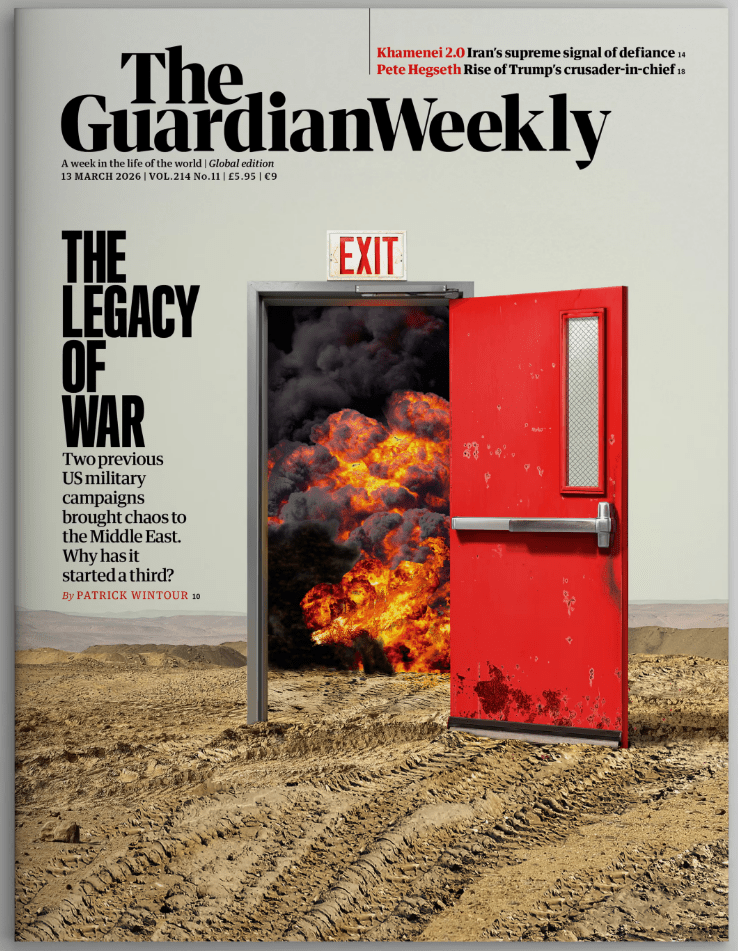
For this week’s edition, in response to Patrick Wintour’s must-read essay on how the US has ignored the lessons of two previous Gulf wars, we asked illustrator Doug Chayka to play with the idea of a Middle East that the US either cannot, or refuses to, see. Doug’s artwork neatly captures the dilemma of a Trump administration that now finds its Iran exit strategy – assuming there was one – cut off by chaos.
Spotlight | War losses mount in rural Russia Residents of a remote village in Komi Republic say dozens have left to fight in Ukraine, leaving behind grieving families and labour shortages. Pjotr Sauer reports
Science | Is the passion for taxonomy in danger of dying out? Insect taxonomist Art Borkent fears his field of science is fading, despite millions of insects, fungi and other organisms waiting to be discovered, he tells Patrick Greenfield
Feature | The miraculous survival of Nada Itrab After a nine-year-old girl was kidnapped and taken from Spain to Bolivia, authorities feared the worst. They found her in the rainforest nine months later – but that wasn’t the end of her ordeal. Giles Tremlett picks up the story
Opinion |In this war, Britain’s enemy now is Donald Trump As the Iran disaster escalates, Simon Tisdall argues that Starmer should treat the US president as someone whose actions threaten the lawful, democratic way of life everywhere
Interview | Corinne Bailey Rae The English singer and songwriter was riding high with a hit album when her husband died tragically young. She discusses grief, fame and rebuilding her life with Simon Hattenstone
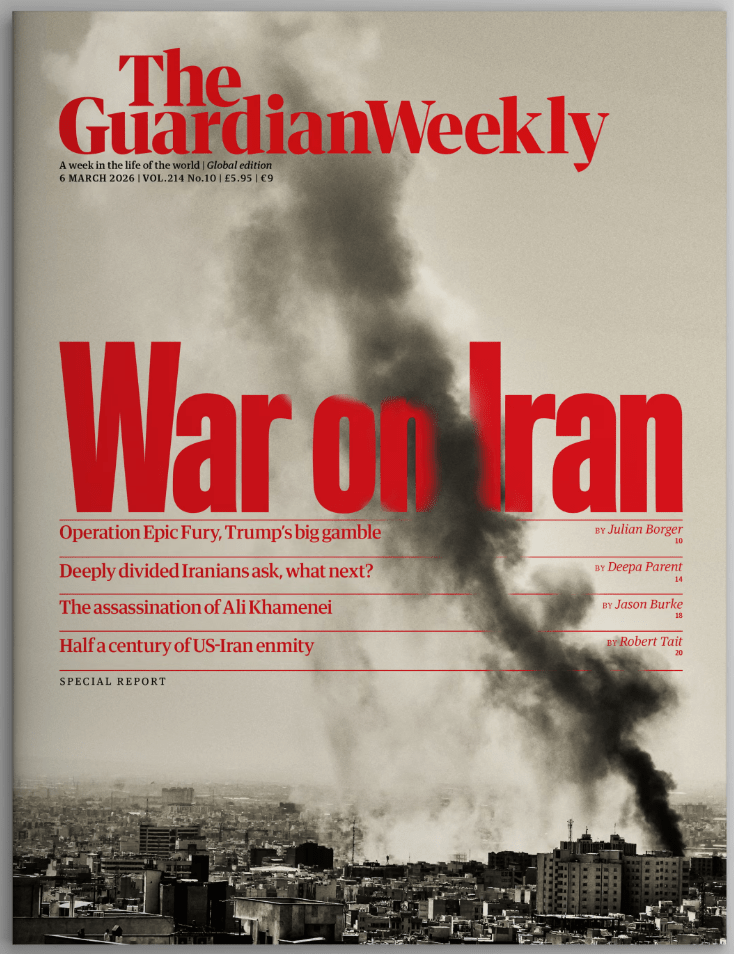
Some weeks I head out of the office on a Friday afternoon with an uneasy feeling that our best-laid plans for next week’s Guardian Weekly might not look quite the same by Monday. This was one of those weeks.
While the scope and power of the US-Israel attack on Iran – not least the successful targeting of Ayatollah Ali Khamenei and several other senior leaders – took many by surprise, the drums of war had been building for a while. With hindsight, last week’s failed nuclear talks may simply have been cover for what was to come.
As war unfurled dramatically across the Middle East, it was impossible to predict the consequences on a range of fronts, from the likelihood of regime change in Iran to the impact on America’s regional allies under attack, or the ripple effect on global energy prices and disruption to international travel.
Spotlight | Can the Louvre rediscover its joie de vivre? After a heist and the departure of its boss, the famous Paris museum is wrestling with repairs, strikes and a criticised renovation plan, reports Jon Henley
Science | Do lizards hold the key to how nature works? The emergence of a new group of common wall lizards offers an insight into how variety within nature can help conserve species, writes Roberto García-Roa
Interview | The world according to Gavin Newsom He’s the Democratic politician with movie-star looks, dogged by accusations of being a smooth‑talking elitist. But Gavin Newsom may just win the most powerful office in the world.Jonathan Freedlandfinds out why
Opinion | Labour needs to wake up to the dawning of a new political era After last week’s disastrous showing in a byelection, the government must accept voters no longer want two-party politics, argues John Harris
Culture | The wild and witty paintings of Rose Wylie Roaring into her 90s, the rebellious artistis now sought after by galleries worldwide and her works fetch huge sums. Melissa Denes visited her studio
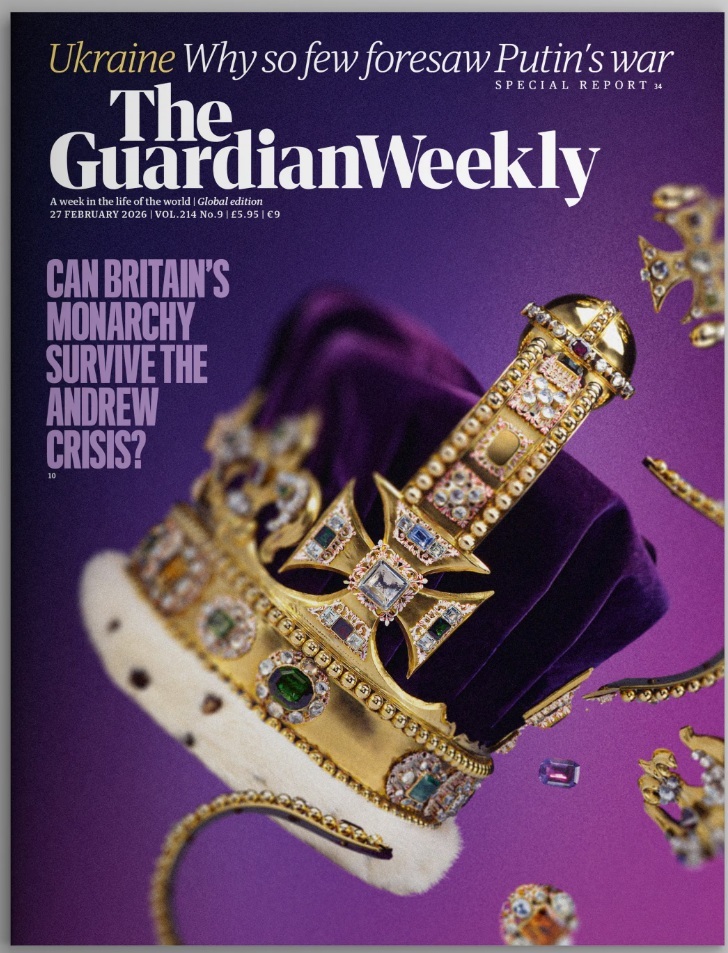
The arrest of Andrew Mountbatten-Windsor last week, after allegations he had shared confidential information with the late US sex offender Jeffrey Epstein, sent shock waves around the world.
What happens next is unclear, but the ramifications will go far beyond the former prince, who has consistently denied any wrongdoing related to Epstein. It was one of the most consequential days for Britain’s monarchy in generations, shattering the traditional aura of royal mystique and raising questions of accountability, deference and whether the royal family should have acted sooner.
In a powerful essay for our big story this week, Stephen Bates asks whether the royal family can survive the unfolding scandal.
Spotlight | The limits to the supreme court’s assent Last week’s declaration by the conservative-heavy court that Trump’s sweeping tariffs are unlawful is a major setback for the president, writes Ed Pilkington
Health | Why big pharma stands to gain from weight-loss pills Oral tablets could bring obesity treatment into the mainstream, with the sector predicted to be worth $200bn by the end of the decade. Julia Kollewe reports
Special report | The road to war in Ukraine In a remarkably detailed piece drawing on more than 100 interviews with senior intelligence officials and other insiders, Shaun Walker explains how the CIA and MI6 got hold of Putin’s Ukraine plans – and why nobody believed them
Opinion | A degree? A trade? Every rung for young people is a trap Is it to be a degree and heavy debt when graduate jobs are shrinking? Or forgoing a degree, knowing society still worships them? Confused, angry: who wouldn’t be, asks Jason Okundaye
Culture | Big in Beijing (but less so in Blackpool) James Balmont’s band, Swim Deep, plays to crowds of hundreds across the UK – but in China, they perform in front of tens of thousands. And they’re not the only ones
News, Views and Reviews For The Intellectually Curious









 Boomers Daily