A headbashing relative gives insights into giraffe evolution – How the giraffe got its long neck is a longstanding question in science. One possibility is that giraffes evolved longer necks for sexual competition, with males engaging in violent neck-swinging fights.
Now, a team have described fossils of an ancient giraffoid species with a thick headpiece adapted for fighting, which could add weight to this hypothesis.
05:18 A wave of resignations signals discontent in academia
Around the world, the ‘great resignation’ has seen huge numbers of workers re-evaluating their careers and lifestyles and choosing to leave their jobs following the pandemic. Academia is no exception, with many scientists deciding to leave the sector in the face of increased workloads, systemic biases and pressure to publish.
Earlier this year, NASA’s MAVEN spacecraft, which has been orbiting Mars since 2014, developed some serious equipment issues that prevented it from keeping its correct orientation in space. In a race against time, a team on Earth fixed the problem by developing a system that allowed the spacecraft to navigate by the stars.
14:28 The Perseverance rovers continues its rock collection
NASA’s Perseverance rover has arrived at an ancient Martian river delta where it will spend the next few months exploring, while scientists assess where to drill and extract rock samples. It’s thought that rocks from this region have the best chance of containing evidence of Martian life, and plans are being developed to return them to Earth in the future.
The Casarabe people lived in southwest Amazonia around AD 500–1400, but understanding of this culture has been limited because the archaeological remains are covered in dense forest. In this week’s issue, Heiko Prümers and his colleagues reveal the discovery of new Casarabe settlements in the Bolivian Amazon. The researchers used lidar to scan the forest, revealing 2 large settlements (each covering more than 100 hectares) and 24 smaller sites, 15 of which had previously been known to exist.
The cover image shows Cotoca, one of the two large settlements, in which earthen mounds (one more than 20 metres high) and long causeways can clearly be seen. The team suggests that these results are the first evidence of agrarian-based, low-density urbanism in western Amazonia. They conclude that the region was not as sparsely populated in pre-Hispanic times as was previously thought.
Vulnerability to heart disease can be projected before symptoms occur, Mayo Clinic discovered in preclinical research. This proof-of-concept study revealed that heart muscle changes indicate who is vulnerable to disease later in life. These changes can be detected from blood samples through comprehensive protein and metabolite profiling. This exploratory mapping, conducted in the Marriott Family Comprehensive Cardiac Regenerative Program within Mayo Clinic’s Center for Regenerative Medicine, is published in Scientific Reports.
“The team implemented state-of-the-art technologies to predict who is vulnerable and who is protected from heart disease,” says Andre Terzic, M.D., Ph.D., a Mayo Clinic cardiologist and the senior author. “In this era of post-genomic medicine, the acquired foundational knowledge provides guidance for development of curative solutions targeted to correct the disease-causing maladaptation.” Dr. Terzic is the Marriott Family Director, Comprehensive Cardiac Regenerative Medicine, for the Center for Regenerative Medicine and the Marriott Family Professor of Cardiovascular Research.
The historic Maya anchored their calendars and rituals to celestial events, and their astronomical knowledge is now coming into sharper focus thanks to new analyses of archaeological relics and insights from today’s Maya.
— Science Magazine (@ScienceMagazine) June 2, 2022
Science Magazine – June 3, 2022: A 10th-century Maya structure at Chichen Itza, Mexico, is often called the Observatory for its expansive view of the sky and a design seemingly guided by key positions of the Sun, Moon, and planets. The historic Maya anchored their calendars and rituals to celestial events, and their astronomical knowledge is now coming into sharper focus thanks to new analyses of archaeological relics and insights from today’s Maya.
With six sets of chromosomes, the hexaploid cultivated oat (Avena sativa L.) has a complex evolutionary history. In this week’s issue, Nick Sirijovski and his colleagues present a high-quality reference genome for A. sativa alongside those for its close relatives the diploid Avena longiglumis and the tetraploid Avena insularis. By examining the three genomes, the researchers were able to trace genomic reorganizations in the crop’s evolution. They were also able to map the genes for important agronomic traits, highlighting gene families linked to human health and nutrition. With health and sustainability high on global agendas, the team hopes this new resource will bolster genomics-assisted breeding and trait studies to address these challenges and more.
Can the aging process be reversed – or even halted, altogether? If we manage to decode this final mystery of our human biology, we might soon be able to eradicate age-related illnesses like cancer, dementia and heart problems. The race to invent the miracle pill is well underway.
Today, international researchers are getting astonishingly close to realizing humanity’s dream of immortality. The hunt for immortality gained traction with the discovery of Costa Rica’s so-called “Blue Zone,” by Luis Rosero-Bixby. In the “Blue Zone,” on the Nicoya Peninsular, he found a remarkable number of centenarians.
Here, male life expectancy is the highest in the world. Their healthy lifestyle is one factor, but the promise of longevity is probably also because their telomeres – sections of DNA found at the end of chromosomes – are longer than those of the average person. It’s a field of research currently being explored by Maria Blasco in Madrid.
But this is just one of many possible factors influencing the process of aging. Senescent cells may also play a key role. Also known as “zombie cells”, these attack our body in old age and flood it with alarm signals until, at some point, we collapse under their weight. That’s a theory proposed by another researcher in Spain, Manuel Serrano. A billion-dollar industry is already knocking impatiently at the lab doors.
The first to market the miracle pill is guaranteed incredible wealth. That’s why investors are sponsoring young bio-startups in Hong Kong. Keen not be left out, US Big Tech is vying for the world’s best scientists. Alex Zhavoronkov has secured a slice of that pie, with a cash injection of more than 250 million dollars for his company’s work on aging research. Whereas some pioneers’ visions burst like bubbles, others rush to get other, rather more dubious products onto the market. But their efficacy is now measurable.
The epigenetic clock devised by Steve Horvath can measure our biological age, regardless of our actual age in years. With his research on the thymus gland, California’s Greg Fahy managed to not only decelerate the aging process, but reverse it. His initial study on humans showed that a particular drug cocktail took an average two-and-a-half years off their age.
Young biohackers like Nina Khera from Boston want everyone to benefit from this research. Together with friends, she’s working on the “epigenetic clock for all”. But while we’re busy trying to counter the aging process and all the illnesses it entails, fundamental questions arise: Should we be messing with nature like this? Are we about to overwhelm the planet with more and more people? Criminal biologist Mark Benecke in Cologne says that these questions are coming far too late.
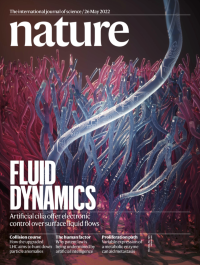
Cilia are characterized by slender, threadlike projections, which are used by biological organisms to control fluid flows at the microscale. Attempts to mimic these structures and engineer cilia-like systems to have broad applications have proved problematic. In this week’s issue, Wei Wang and colleagues present electronically controlled artificial cilia that can be used to create flow patterns in near-surface liquids. The researchers use surface-mounted platinum strips, each about 50 micrometres long, 5 micrometres wide and 10 nanometres thick, and capped on one side with titanium. Applying an oscillating potential with an amplitude of around 1 volt to the cilia drives ions on to and off of the exposed platinum surface. These ions create asymmetric forces that generate a beating pattern that can be used to pump surface liquids in various flow geometries. The cover shows an artist’s impression of the artificial cilia in action.
News, Views and Reviews For The Intellectually Curious











 Boomers Daily