


The Painted Protest
How politics destroyed contemporary art by Dean Kissick
In the Rockets’ Red Glare
The past and future of hot-rodding in America by Rachel Kushner
After the Deluge
A small town faces down climate disaster by Gary Greenberg

How politics destroyed contemporary art by Dean Kissick
The past and future of hot-rodding in America by Rachel Kushner
A small town faces down climate disaster by Gary Greenberg

The GOP’s identity crisis by Lauren Oyler
On minor characters and human possibility by Yiyun Li
From Mysticism, which was published last month by New York Review Books. by Simon Critchley
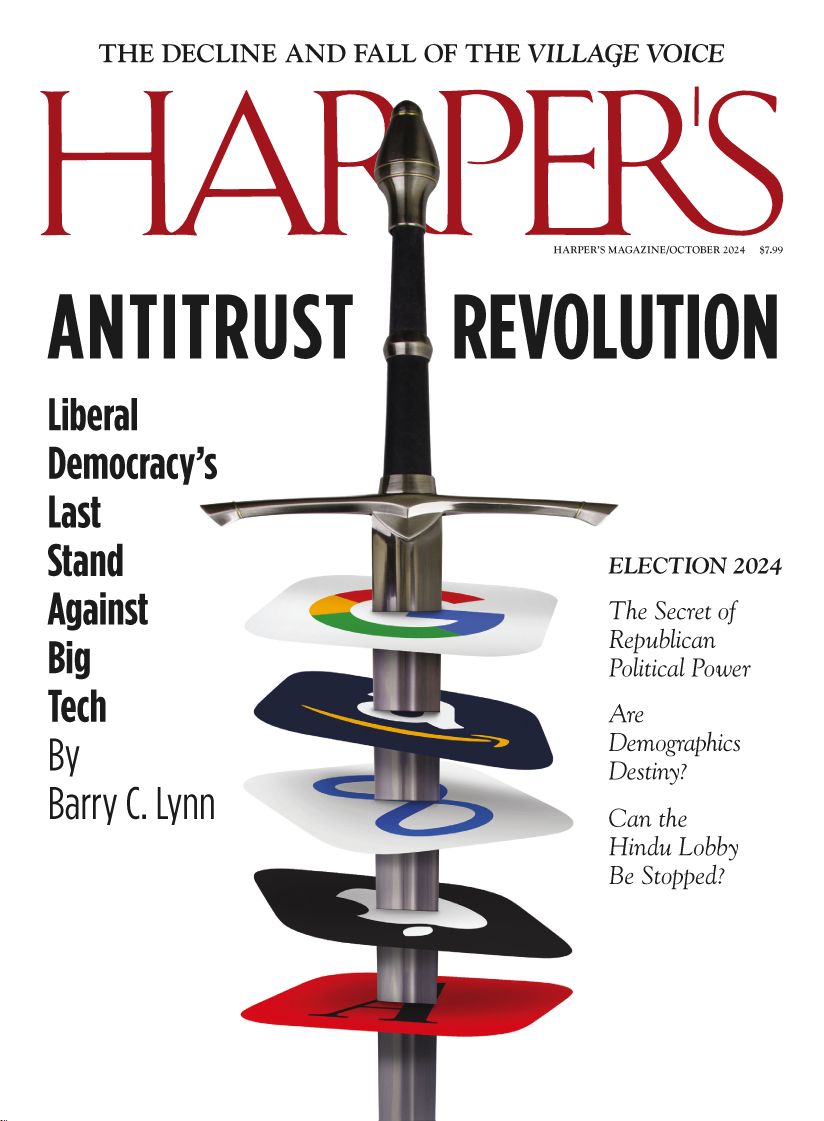
Liberal democracy’s last stand against Big Tech by Barry C. Lynn
In 1609, James I lectured the English people on his rights and responsibilities as king. It was his duty to “make and unmake” them, he said. Kings have the “power of raising and casting down, of life and of death; judges over all their subjects, and in all causes.”
On the plight of environmental-illness refugees
How Hindu nationalism spreads in America
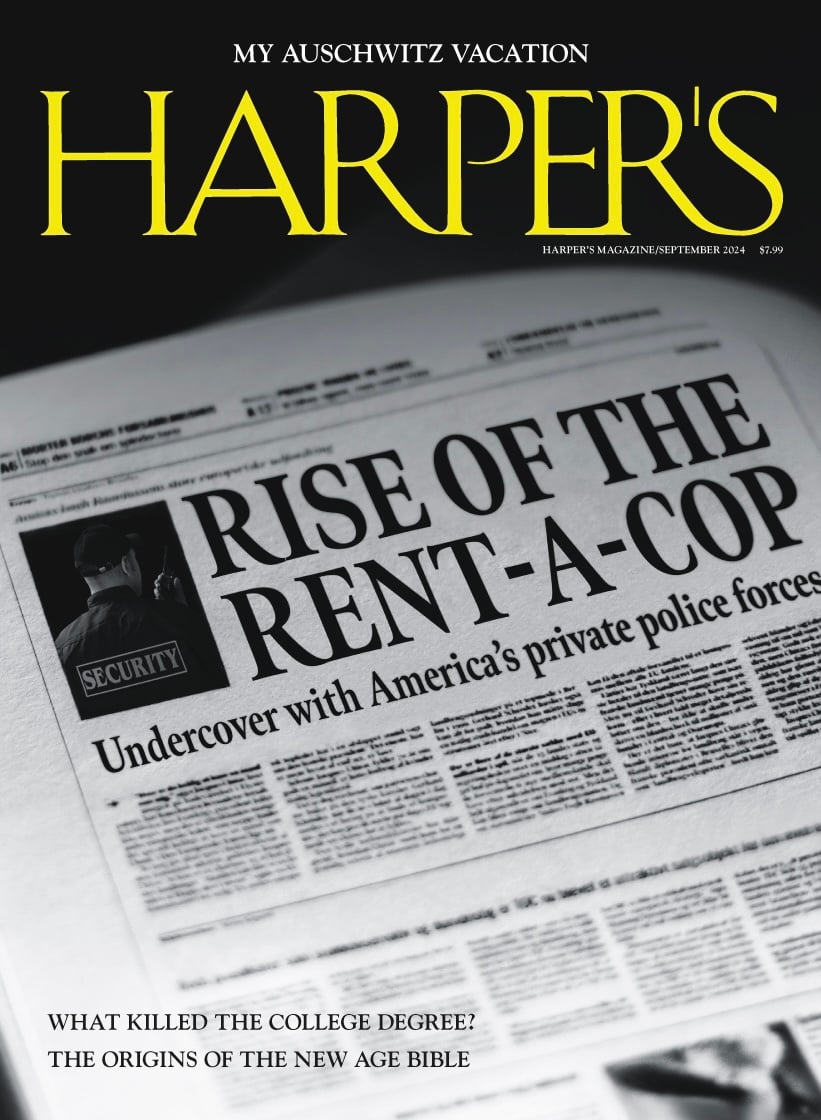
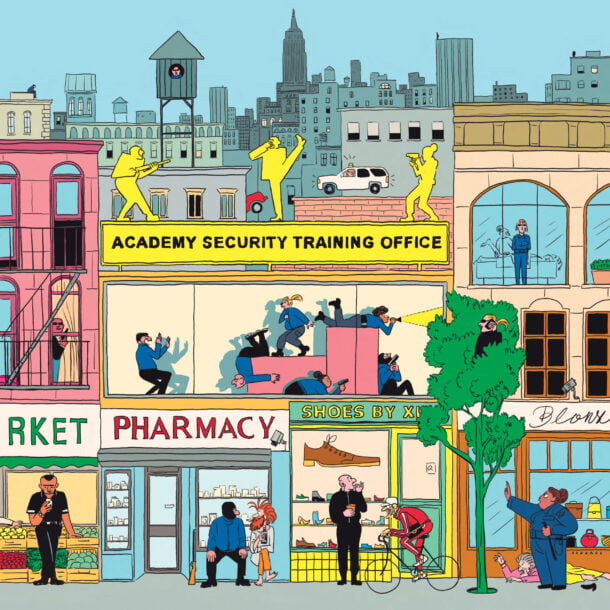
The dubious rise of the private-security industry by Jasper Craven
For millennia, the figure of the guard has inspired as much derision as demand. An early antecedent to the modern security guard can be found in ancient Egypt. Nobles employed “doorkeepers” to protect palaces and tombs. The performance of such duties was accorded a measure of reverence even as guards were often cast as apathetic or incompetent. Some hieroglyphs depict doorkeepers as those “who ward off all evil ones”; others show them as sleepy, drunk, or blind.
Many still believe in this image of guards as feckless agents in spaces not in need of protecting. And yet, in a moment of peculiarly American volatility, certain places that guards patrol—like schools, bars, grocery stores, and retail outlets—are increasingly prone to seeing outbursts of violence. These trends might justify a guard’s usefulness if not for the fact that most guards lack the training or legal authority to do much of anything.
From Burdened: Student Debt and the Making of an American Crisis, which will be published this month by Dey Street. by Ryann Liebenthal
From L’instant précis où Monet entre dans l’atelier, which was published in 2022 by Éditions de Minuit. Translated from the French in May by Pauline Cochran. by Jean-Philippe Toussaint
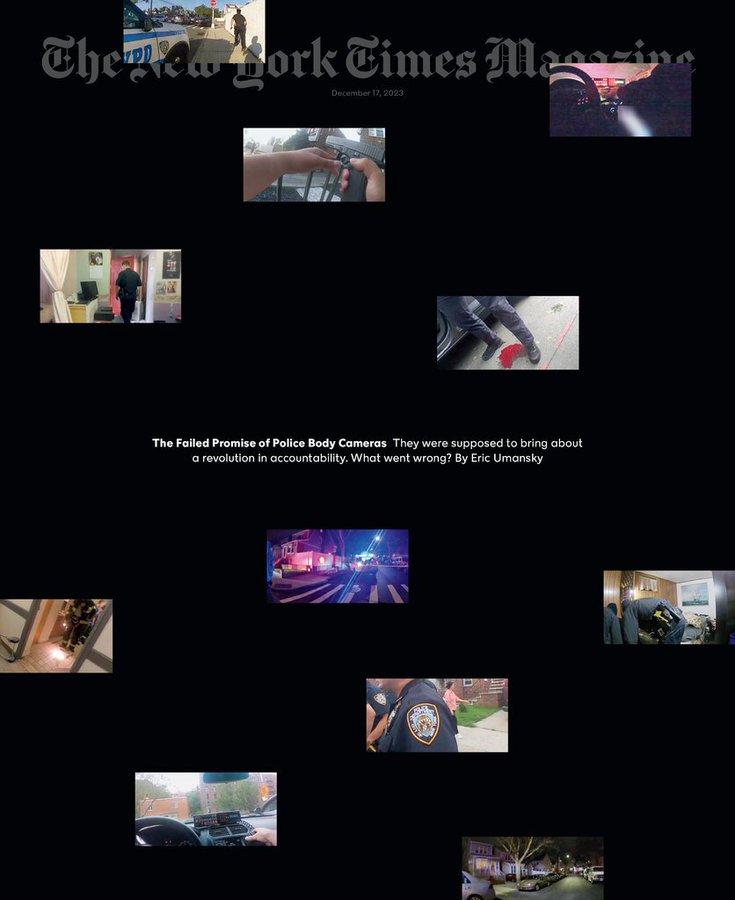

THE NEW YORK TIMES MAGAZINE (December 15, 2023):
U.S. taxpayers spent millions to fund what was supposed to be a revolution in accountability. What went wrong?

After an awkward MeToo hiatus, ‘May December’ and other films are showing intimacy in messy, complicated ways again.
By ALEXANDRA KLEEMAN

How two “grown dirtbags” are reshaping men’s wear.
By T.M. BROWN


The New York Times Book Review – April 23, 2023:

The author’s latest book, “The Wager,” investigates the mysteries surrounding an 18th-century maritime disaster off Cape Horn.
There were multiple moments while reading David Grann’s new book, “The Wager,” about an 18th-century shipwreck, when it occurred to me that the kind of nonfiction narratives The New Yorker writer has become known for share something essential with a sturdy ship.

Catherine Lacey’s new novel follows a polarizing artist through a fractured country.
The narrator of “Biography of X,” the new Catherine Lacey novel, is a journalist named C.M. Lucca who worked for a Village Voice-like newspaper in New York City during the 1980s. C.M. has a cool tone and a lonely intelligence; she’s a solitary spirit.

In “Walk the Walk,” Neil Gross profiles three departments around the country experimenting with genuine reform.
WALK THE WALK: How Three Police Chiefs Defied the Odds and Changed Cop Culture, by Neil Gross
President Biden took a preemptive victory lap yesterday over his massive $1 trillion+ infrastructure package, touting a bipartisan agreement he says he’s brokered.
Plus, Minneapolis prepares for Derek Chauvin’s sentencing.
And, why many Pride parades have banned uniformed police officers.
New York Times columnist David Brooks and Washington Post columnist Jonathan Capehart join Judy Woodruff to discuss the week in politics, including the president’s ambitious climate goals. policing in America, and investigations into the capitol riot.
More than 80% of calls to 911 come from a cellphone and often from a high-rise. But the over 5,000 locally run 911 centers, or public safety answering points (PSAP) aren’t easily able to track those callers. Fixing the system could save more than 10,000 lives and $97 billion per year according to the FCC.
Major companies like Apple, Google, Motorola and startups like RapidSOS have tried to fill the technology gap, but so far, that’s not enough. Watch the video to understand the conundrum of a large and fragmented national system that is run and funded locally, and how the federal government may be its only hope for a complete overhaul. “We’re talking about diversity of equipment connecting across these IP networks in a very complex manner,” said Capt. Mel Maier of the Oakland County Sheriff’s Office in Michigan.
“And if there are proprietary interfaces anywhere in between there, they’re not going to be able to talk. … Our technology is continually trying to catch up and playing catch up.” A number of companies including Apple, Motorola and start-ups are trying to fill the technology gap. RapidSOS is a data integration platform that has been adopted free of charge in about 4,800 PSAPs. According to the company, it covers about 92% of the country and assists in 150 million emergencies per year.
“We’re just scratching the surface of the amount of data that we could be using,” said Michael Martin, CEO of RapidSOS. “We’re passing precise location for most 911 calls now. But you can imagine all the capabilities, like in a fire if your building could talk or if your device could detect a heart attack and immediately transmit that through.” According to Maier, who is also chairman of the Public Safety Next Generation 9-1-1 Coalition, the tech industry can’t do it on its own.
He says carriers also have a responsibility, especially when it comes to addressing the altitude problem. But in the end, he says, the federal government is needed. He’s hoping Congress will pass legislation for $15 billion toward a complete overhaul. In July, a $1.5 trillion infrastructure bill that included $12 billion toward 911 passed the House but stalled in the Senate.
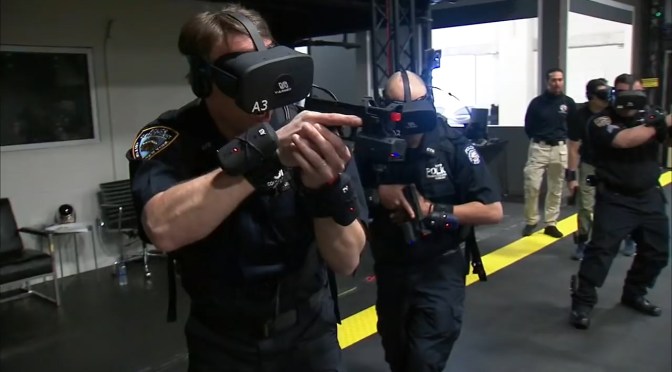
 In recent weeks, protests have erupted in response to police violence against citizens – specifically communities of color – forcing departments to reconsider how officers do their jobs. Police forces have been using tech – like Tasers and body cameras – to try and reduce the use of lethal force and improve accountability.
In this episode, we’ll explore how emerging technology – like virtual reality training – could improve police training by boosting empathy and tackling racial bias.





 Boomers Daily