




Times Literary Supplement (September 18, 2024): The latest issue features ‘Autumn Fiction’ – Rachel Kushner, Olga Tokarczuk, László Krasznahorkai and Sally Rooney; Craig Brown on The Queen; A very Yorkshire horror; China’s Britain complex and The Looting of America…





James Schuyler on Frank O’Hara: “I still can see Frank, standing on that street corner outside a pastry shop, holding a neatly tied-up box of God knows what—éclairs, perhaps.”
James Schuyler was born in Chicago in 1923, grew up in Washington, D.C., and East Aurora, New York, and spent most of his adult years in New York City and Southampton, Long Island. Although he is perhaps less widely known than the fellow New York School poets with whom he is associated, John Ashbery, Frank O’Hara, Barbara Guest, and Kenneth Koch, he published six full-length books of poetry during his lifetime—beginning with Freely Espousing, published by Doubleday and Paris Review Editions in 1969—as well as two novels, and a third written in collaboration with Ashbery. In 1981 he won the Pulitzer Prize for his collection The Morning of the Poem (1980). Mental illness plagued him intermittently, and there were times when his life threatened to veer out of control, but friends repeatedly rallied around him, and the years before his death in 1991 were happy and productive.
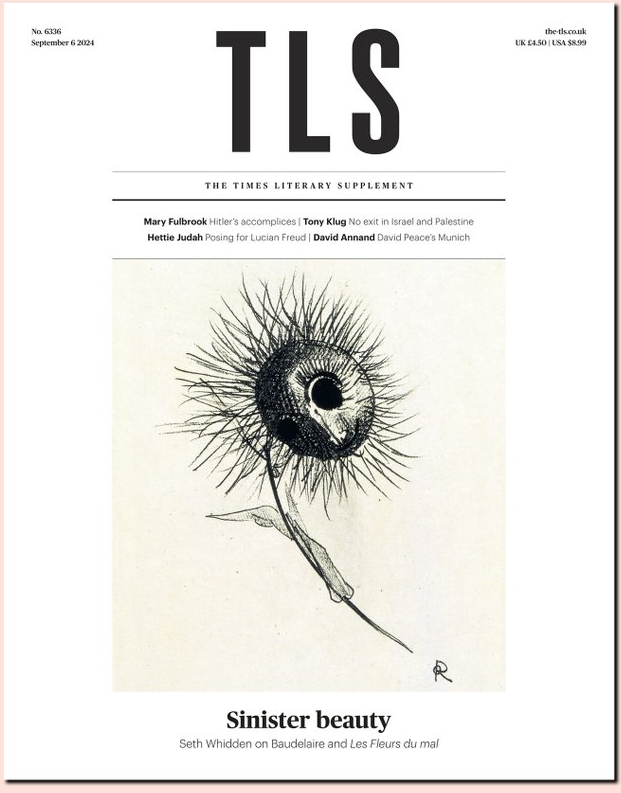
Times Literary Supplement (September 4, 2024): The latest issue features ‘Sinister Beauty’ – Baudelaire and Les Fleurs du Mal; Hitler’s accomplices; No exit in Israel and Palestine; Posing for Lucian Freud and David Peace’s Munich…


Literary Review – September 3, 2024: The latest issue features @claire_harman on female detectives; @WomackPhilip on childhood reading; Georgina Adam on art market scandal; @dannykellywords on ageing rockstars and @mathewparris3 on the Queen
‘If there is an occupation for which women are utterly unfitted, it is that of the detective,’ claimed the Manchester Weekly Times in 1888 – already behind the times, it seems, as women had been acting the part for years, albeit invisibly. They had started to feature in detective fiction too. It was studying the burgeoning market in ‘lady detective’ stories post-1860 that led Sara Lodge to wonder who the fantasy sleuths were modelled on, and why the Victorians found them so disturbing and alluring.
It is hard to think of a person more qualified to write this book. In addition to being an art historian, a prolific writer, a lecturer and a broadcaster, James Stourton is also a former chairman of Sotheby’s UK. He joined the auction house in 1979 and left in 2012 to become a senior fellow at the Institute of Historical Research.

Times Literary Supplement (August 21, 2024): The latest issue features ‘Angels at her table’ – C.K. Stead and Kirsty Gunn on Janet Frame’s singular voice; Pat Barker and Mark Haddon’s modern myths; Rethinking incarceration; How art comes about; Sleep science; Hypochondria and literary reputations….

On John Constable’s The Hay Wain & the foundations of the West.
We write as The New Criterion’s annual period of aestivation enters its home stretch. The cicadas are buzzing, the days are noticeably shorter, and the leaves—some of them—are already edged with brown. Certain summers feature quiet expanses of lazy days. This one was different. In July, Donald Trump, except for the tip of his right ear, dodged a would-be assassin’s bullet; Joe Biden dropped (or, we now know, was pushed) out of the 2024 presidential race but, as of this writing, remains president; Kamala Harris, Biden’s vice president, stepped into the vacancy and magically became the new candidate for president, choosing the Minnesota governor Tim Walz as her running mate.

Times Literary Supplement (August 14, 2024): The latest issue features ‘Guy vs the Spies’ – Robert Cecil’s secret intelligence network; The new Cold War; On annihilation; What anxiety means; G.K. Chesterton’s Notting Hill…

By James Butler
The first time the man heard God, he uprooted his entire life, though he was very old. Then God appeared to him in person, an event which would embarrass later thinkers. God made the man an impossible promise in the shape of a son. His wife was ninety, and she laughed. When the child arrived, it was hardly unreasonable to think it a miracle. They named the child after the laughter.
By Colin Burrow
In 1904 Henry James’s agent negotiated with the American publisher Charles Scribner’s Sons to produce a collected edition of his works. The New York Edition of the Novels and Tales of Henry James duly appeared in 1907-9. It presented revised texts of both James’s shorter and longer fiction, with freshly written prefaces to each volume. It didn’t include everything: ‘I want to quietly disown a few things by not thus supremely adopting them,’ as James put it. The ‘disowned’ works included some early gems such as The Europeans. The labour of ‘supremely adopting’ the stuff he still thought worthy was grinding. He worked on the new prefaces, which he described as ‘freely colloquial and even, perhaps, as I may say, confidential’ (though James’s notion of the ‘freely colloquial’ is perhaps not everyone’s) during the years 1905 to 1909. In some respects, the venture was not a success. ‘Vulgarly speaking,’ James said of the New York Edition, ‘it doesn’t sell.’
By Jean McNicol
A week before the start of the Paris Olympics, Shoko Miyata, the 19-year-old captain of the Japanese women’s gymnastics team, was forced to withdraw from the competition by her national association. She had been reported to the Japan Gymnastics Association for smoking and drinking (on separate occasions, once for each offence). The president of the JGA, Tadashi Fujita, announced that Miyata had been sent home, and bowed deeply.



 Boomers Daily