




Times Literary Supplement (October 30, 2024): The latest issue features ‘Scare Stories’ – On modern horror. Asked why he liked horror films, or terror films as he preferred to call them, Kingsley Amis wrote: “like Mark Twain on a dissimilar occasion, I have an answer to that: I don’t know”. He viewed horror as purely “harmless” entertainment. That explanation might satisfy teenage addicts, but moralists, psychologists and literary critics are inclined to examine the bloody entrails of the genre to divine deeper truths.
Taking the British Revolution out of the Restoration’s shadow By Jonathan Fitzgibbons
The decades before horror became respectable By Mark Storey
How Mary Oliver ‘encourages us to believe’ By Rory Waterman
An Australian vision of the eco-apocalypse By Tom Seymour Evans
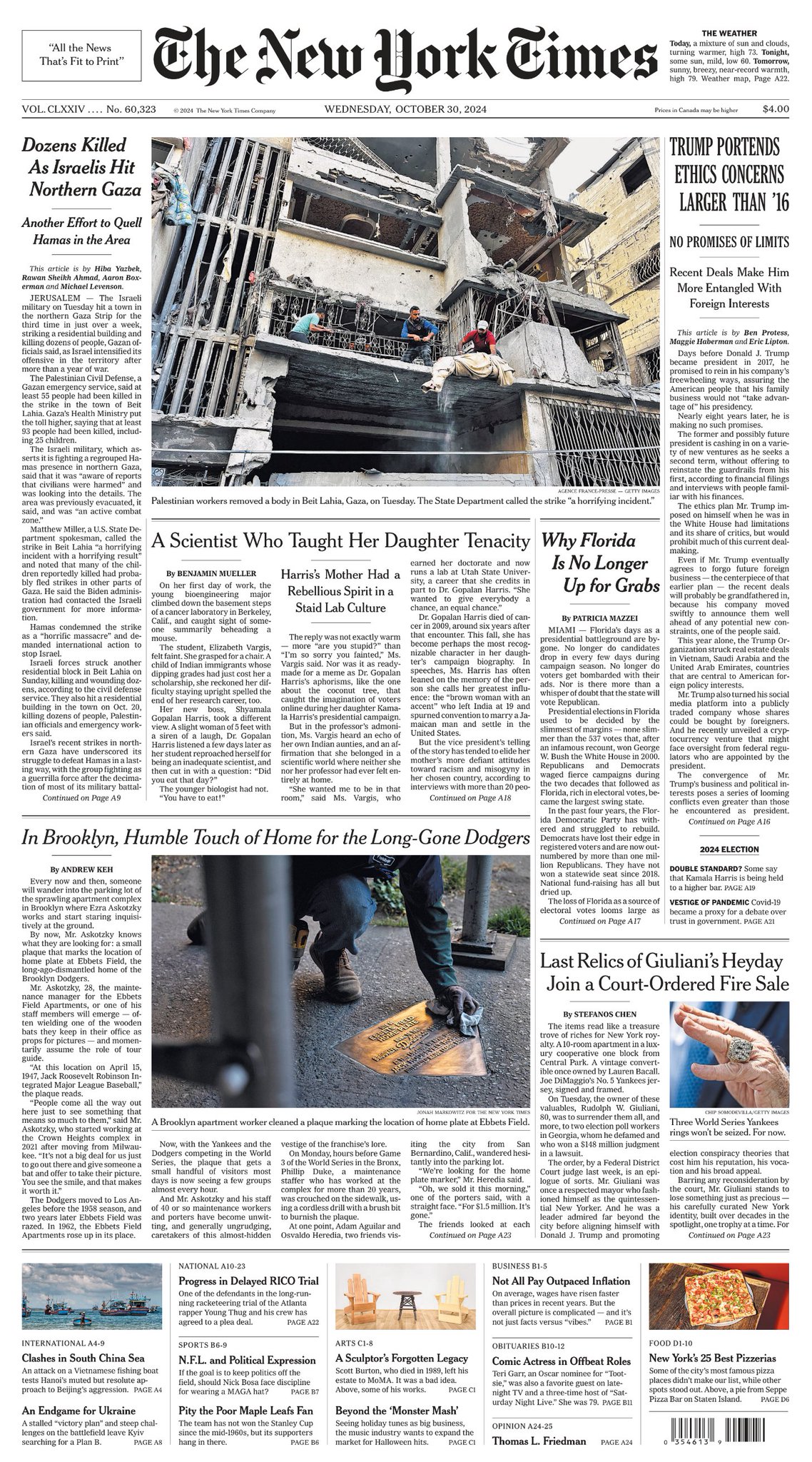
With business ties to foreign governments and holdings in industries overseen by federal regulators, Donald Trump would likely be the most conflicted president in U.S. history.
As Donald Trump’s rhetoric grows more extreme, liberals say Kamala Harris is being held, unfairly, to a higher bar by voters and the media. One is “allowed to be lawless while the other one has to be flawless,” a congresswoman said.
Dueling Trump and Harris rallies outside Atlanta offer a case study in how anger and anxiety over Covid-19, a proxy for the larger debate over trust in government, have shaped the 2024 race.
Once a top presidential battleground, the state is lost to Democrats. The party’s missteps, along with demographic change, led to every one of Florida’s 67 counties becoming more red.

As administrations of both parties have failed to overhaul the nation’s immigration laws, a reckoning for the asylum system, which some say is overdue, seems inevitable.
Activists on both sides say Trump could effectively ban abortion nationwide and establish fetal personhood, the longtime goal of the anti-abortion movement.
The inflammatory rally was a capstone for an increasingly aggrieved campaign for Donald Trump, whose rhetoric has grown darker and more menacing.
The novice Republican candidate’s honesty has come into question in a race that could decide Senate control.
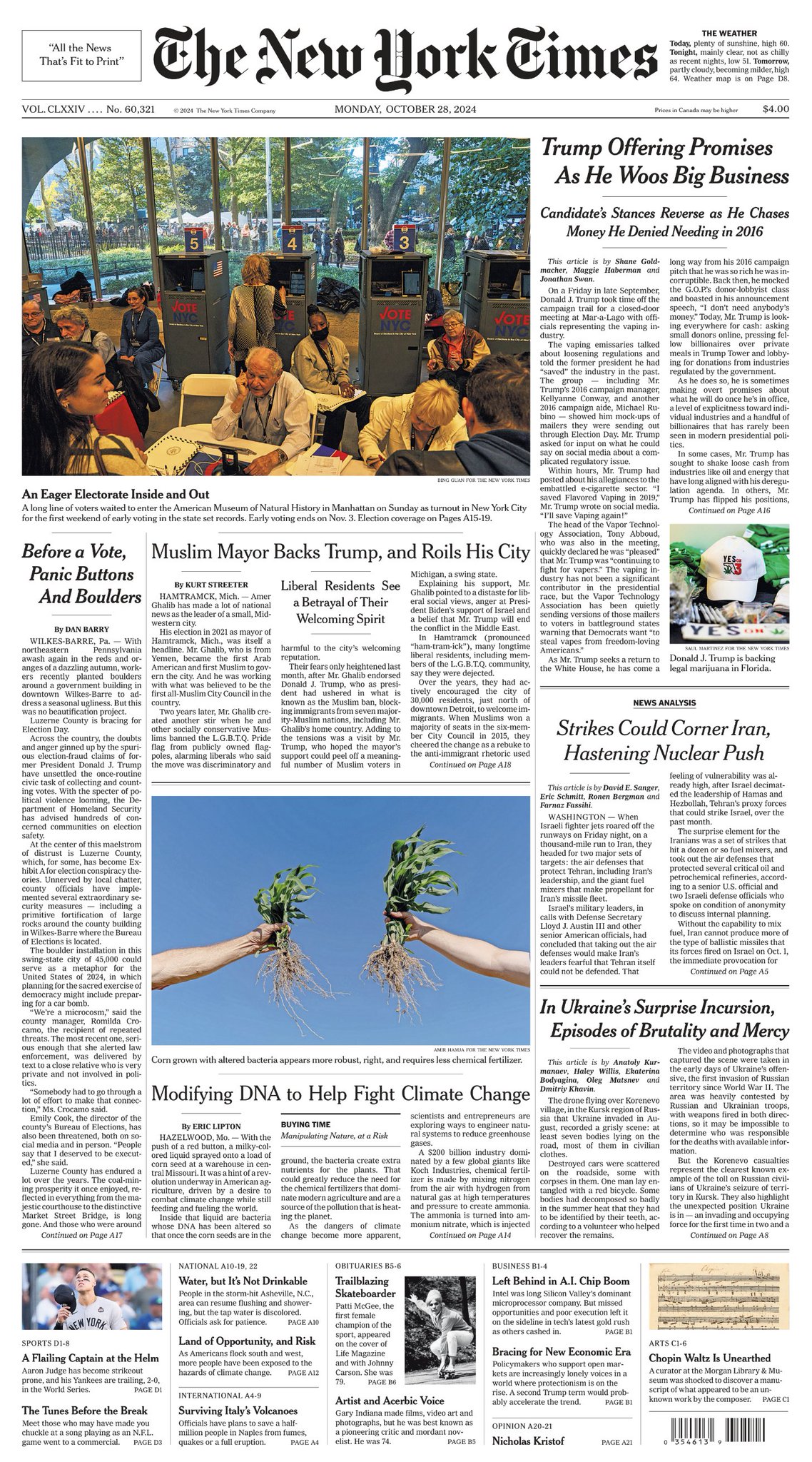
Crypto. Big Oil. Tobacco. Vaping. The former president has been making overt promises to industry leaders, a level of explicitness rarely seen in modern presidential politics.
With the specter of political violence looming, the Department of Homeland Security has advised hundreds of communities on election safety. Luzerne County, Pa., is at the center of the unrest.
The endorsement has roiled Hamtramck, Mich., angering many in the Muslim community, as well as longtime residents who welcomed the newcomers.
Experts inside and outside the Biden administration fear that Iran may conclude it has only one defense left: racing for an atomic weapon.
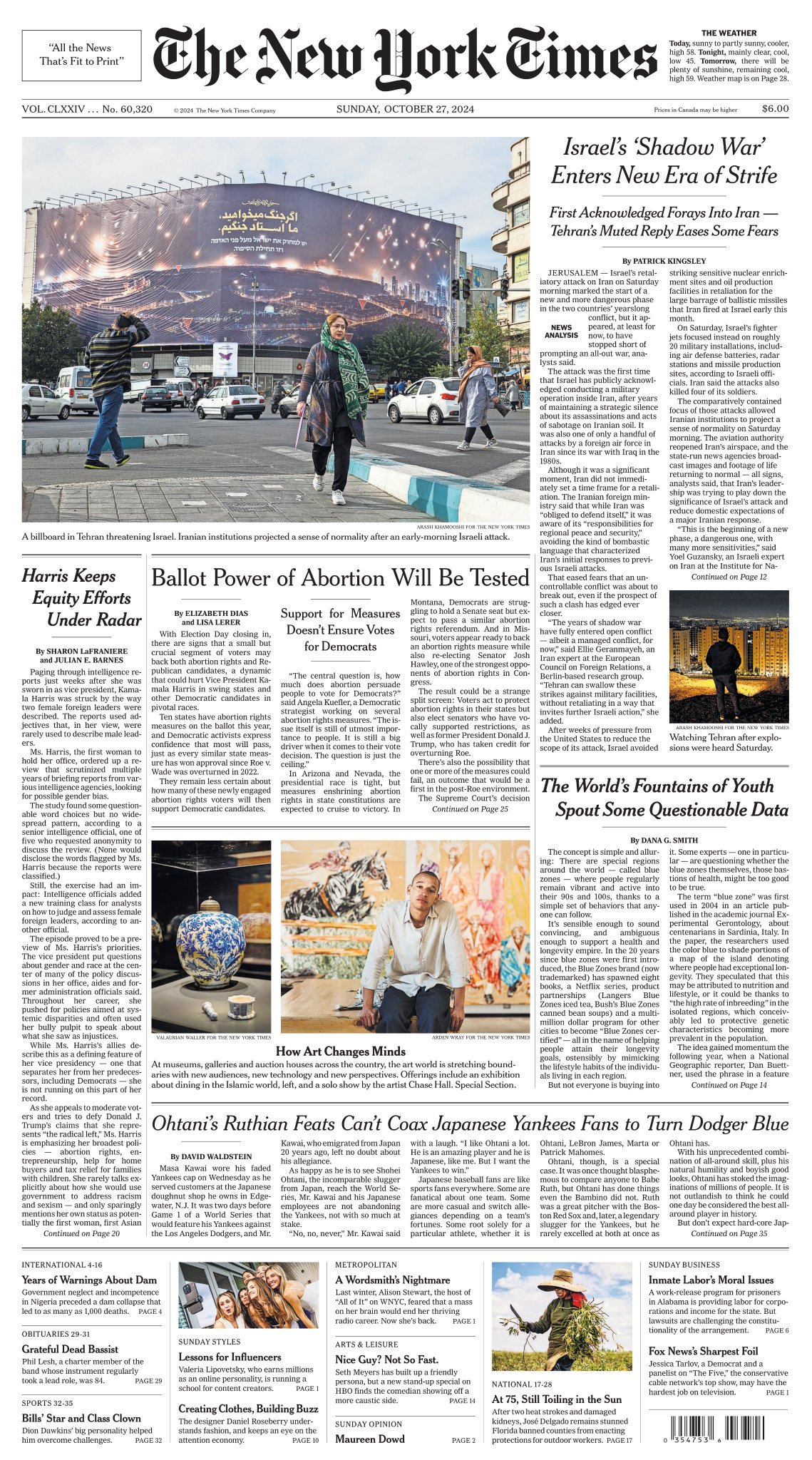
Iran’s initial reaction suggested that the sides had once again averted an uncontrolled war, even if the prospect looms larger than ever.
They hope the issue helps their candidates. But some voters may support Republican candidates as well as abortion-rights ballot measures.
As vice president, Kamala Harris has targeted racial and gender gaps in health care, lending and other areas. She isn’t running on that part of her record.
The premise is catchy, but some think it’s based on faulty data.

Israel struck military bases but avoided targeting nuclear facilities, an attack that appeared to be calibrated to stop short of all-out war.
Donald Trump and his closest allies are planning a radical reshaping of American government. Here are some of the policy stakes if he regains power in 2025.
Gaza’s health ministry reported that dozens of people had been killed in a residential area of Khan Younis, as Israel launched a barrage of attacks across the region on Friday.
The electorate has rarely seemed so evenly divided. The latest New York Times/Siena College poll found Harris and Trump tied 48 to 48.
From the early 1800s to the late 1960s, the federal government forced Native American children into boarding schools where they faced abuse and neglect that led in some cases to death.


Overcrowding leads to violence. Violence worsens a staffing crisis. A staffing crisis impedes rehabilitation
With two weeks to go, the Republican candidate now has a slight lead
Why Israel is now bombing Lebanese banks
He hopes this week’s BRICS summit will spark a sanctions-busting big bang
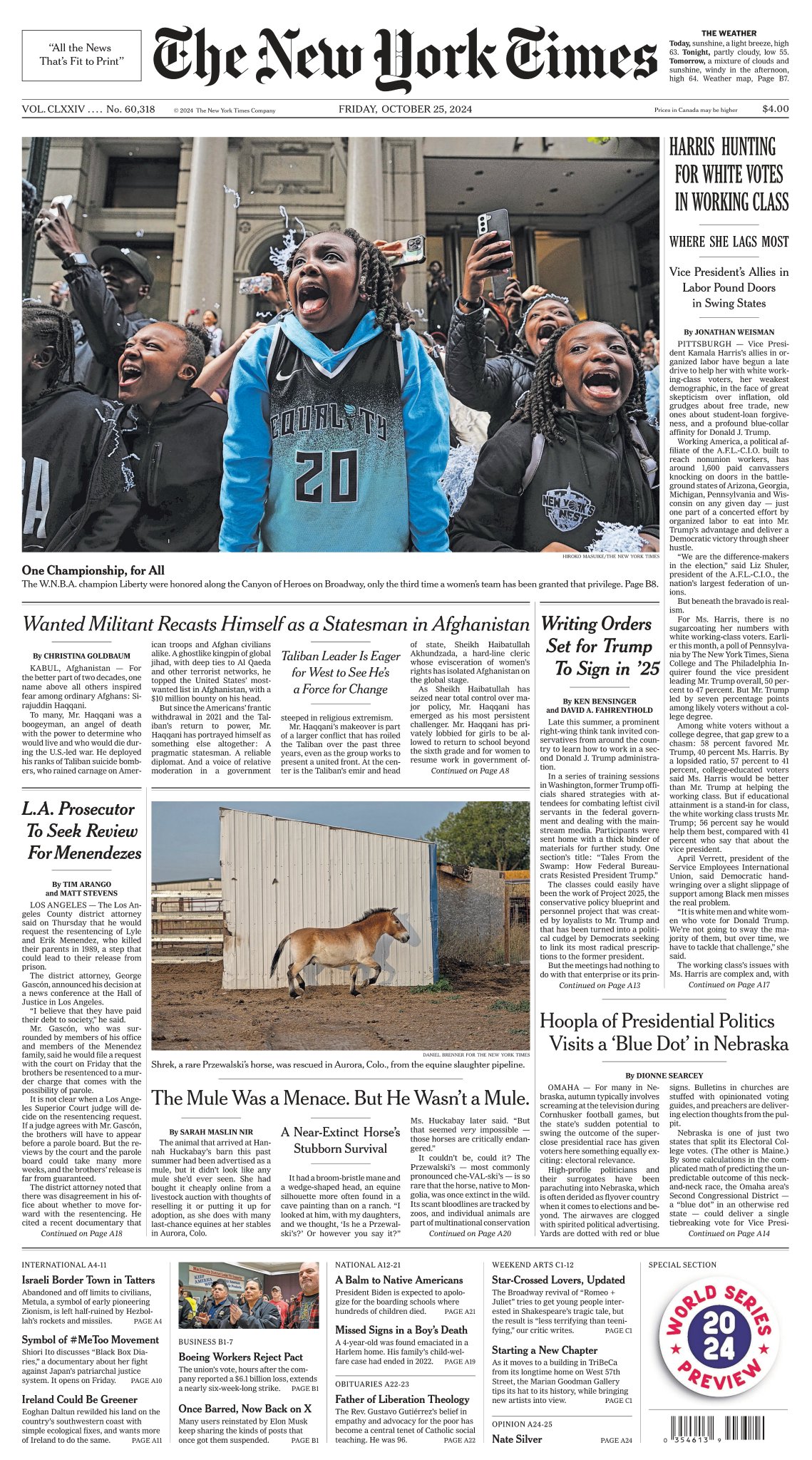
Unions and their affiliates think they can still break through with the Democrats’ worst demographic, white working-class voters, by hustling on the ground. But it has been a slog.
America First Policy Institute didn’t even exist four years ago. But it is poised to be more influential than Project 2025.
Reliably conservative Nebraska is one of just two states that splits its Electoral College votes. That’s why its one small “blue dot” could make a difference to Vice President Kamala Harris’s campaign.
The W.N.B.A.’s newest champions were honored along the Canyon of Heroes on Broadway, the third time a women’s sports team has been granted that privilege.
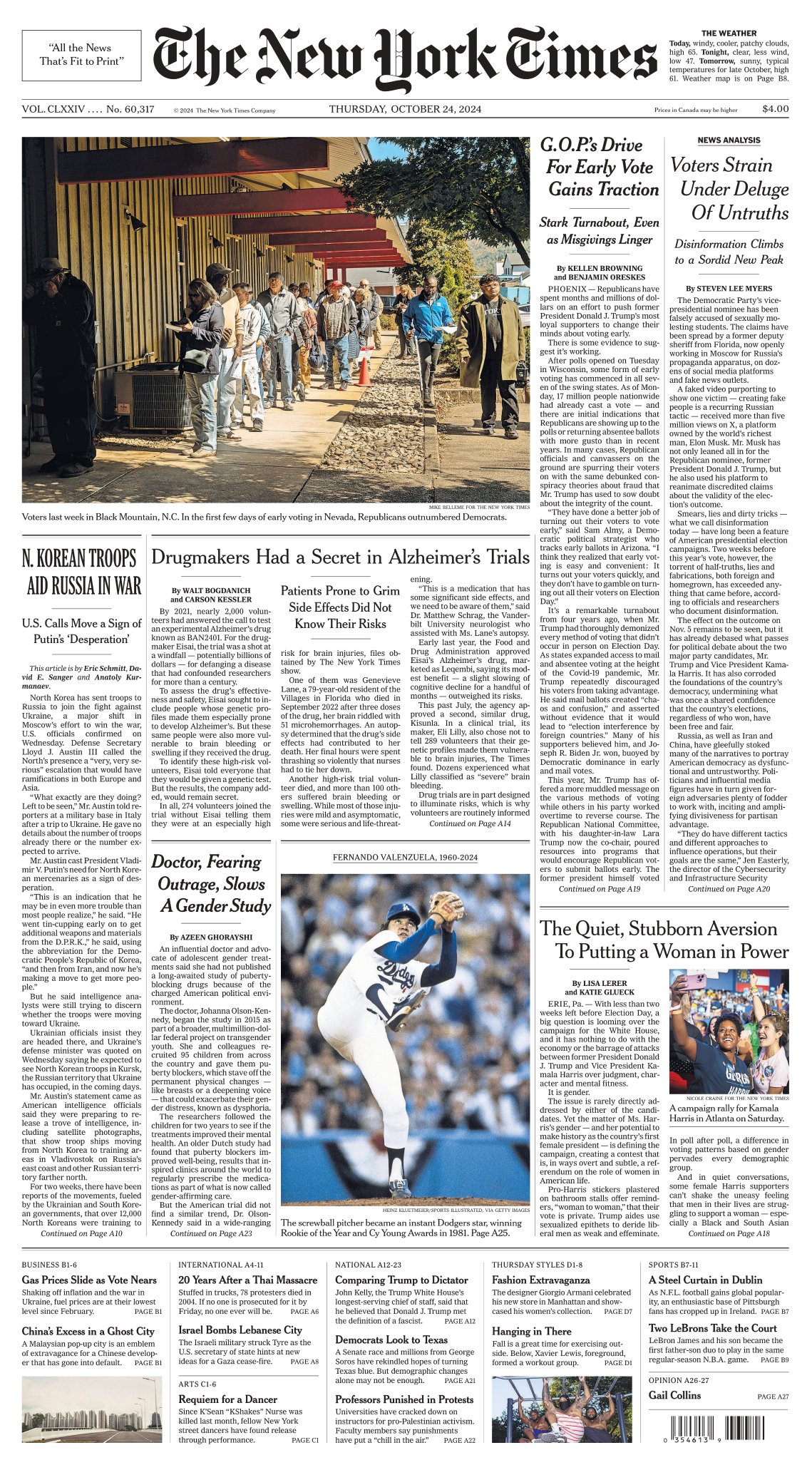
A torrent of falsehoods, from home and abroad, have undermined what was once a shared faith in the honesty of America’s democracy.
In 2020, Donald Trump convinced his supporters that anything but a vote cast in person on Election Day could not be trusted — and lost. In response, Republicans shifted their stance.
Genetic tests showed that certain patients were predisposed to brain injuries if they took the drugs. That information remained secret.
Defense Secretary Lloyd J. Austin III called the situation “very, very serious,” though he said that what the soldiers were doing in Russia was “left to be seen.”


 Boomers Daily