Tag Archives: Poetry

Möbius Dreams: A Journey Of Identity Without End

From Nietzsche’s wanderings to Brodsky’s winters in Venice, identity loops like a Möbius strip—and augmented reality may carry those returns to us all.

By Michael Cummins, Editor, August 25, 2025

It begins, as so many pilgrimages of mind and imagination do, in Italy. To step into one of its cities—Florence with its domes, Rome with its ruins, Venice with its waters—is to experience time folding over itself. Stones are worn by centuries of feet; bells still toll hours as they did five hundred years ago; water mirrors façades that have witnessed empires rise and fall. Italy resists linearity. It does not advance from one stage to another; it loops, bends, recurs. For those who enter it, identity itself begins to feel less like a straight line than like a Möbius strip—a single surface twisting back on itself, where past and present, memory and desire, fold into one another.

Friedrich Nietzsche felt that pull most keenly. His journeys through Italy in the 1870s and 1880s were more than therapeutic sojourns for his fragile health; they were laboratories for thought. He spent time in Sorrento, where the Mediterranean air and lemon groves framed his writing of Human, All Too Human. In Genoa, he walked the cliffs above the port, watching the sun rise and fall in a rhythm that struck him as recurrence itself. In Turin, under its grand porticoes, he composed letters and aphorisms before his final collapse in 1889. And in Venice, he found a strange equilibrium between the city’s music, its tides, and his own restlessness. To his confidant Peter Gast, he wrote: “When I seek another word for ‘music,’ I never find any other word than ‘Venice.’” The gondoliers’ calls, the bells of San Marco, the lapping water—all repeated endlessly, yet never the same, embodying the thought that came to define him: the eternal return.

For Nietzsche, Italy was not a backdrop but a surface on which recurrence became tangible. Each city was a half-twist in the strip of his identity: Sorrento’s clarity, Genoa’s intensity, Turin’s collapse, Venice’s rhythm. He sensed that to live authentically meant to live as though each moment must be lived again and again. Italy, with its cycles of light, water, and bells, made that philosophy palpable.

Henry James —an American expatriate author with a different temperament—also found Italy less a destination than a structure. His Italian Hours (1909) reveals both rapture and unease. “The mere use of one’s eyes in Italy is happiness enough,” he confessed, yet he described Venice as “half fairy tale, half trap.” The city delighted and unsettled him in equal measure. He wandered Rome’s ruins, Florence’s galleries, Venice’s piazzas, and found that they all embodied a peculiar temporal layering—what he called “a museum of itself.” Italy was not history frozen; it was history repeating, haunting, resurfacing.

James’s fiction reflects that same looping structure. In The Aspern Papers, an obsessive narrator circles endlessly around an old woman’s letters, desperate to claim them, caught in a cycle of desire and denial. In The Portrait of a Lady, Isabel Archer discovers that the freedom she once thought she had secured returns as entrapment; her choices loop back on her with tragic inevitability. Even James’s prose mirrors the Möbius curve: sentences curl and return, digress and double back, before pushing forward. Reading James can feel like walking Venetian alleys—you arrive, but only by detour.

Joseph Brodsky, awarded the 1987 Nobel Prize in Literature after being exiled from the Soviet Union in 1972, found in Venice a winter refuge that became ritual. Each January he returned, until his death in 1996, and from those returns came Watermark (1992), a prose meditation that circles like the canals it describes. “Every January I went to Venice, the city of water, the city of mirrors, perhaps the city of illusions,” he wrote. Fog was his companion, “the city’s most faithful ghost.” Brodsky’s Venice was not Nietzsche’s radiant summer or James’s bustling salons. It was a city of silence, damp, reflection—a mirror to exile itself.

He repeated his returns like liturgy: sitting in the Caffè Florian, notebook in hand, crossing the Piazza San Marco through fog so dense the basilica dissolved, watching the lagoon become indistinguishable from the sky. Each January was the same, and yet not. Exile ensured that Russia was always present in absence, and Venice, indifferent to his grief yet faithful in its recurrence, became his Möbius surface. Each year he looped back as both the same man and someone altered.

What unites these three figures—Nietzsche, James, Brodsky—is not their similarity of thought but their recognition of Italy as a mirror for recurrence. Lives are often narrated as linear: childhood, youth, adulthood, decline. But Italy teaches another geometry. Like a Möbius strip, it twists perspective so that to move forward is also to circle back. An old anxiety resurfaces in midlife, but it arrives altered by experience. A desire once abandoned returns, refracted into new form. Nietzsche’s eternal return, James’s recursive characters, Brodsky’s annual exiles—all reveal that identity is not a line but a fold.

Italy amplifies this lesson. Its cities are not progressions but palimpsests. In Rome, one stands before ruins layered upon ruins: the Colosseum shadowed by medieval houses, Renaissance palaces built into ancient stones. In Florence, Brunelleschi’s dome rises above medieval streets, Renaissance paintings glow under electric light. In Venice, Byzantine mosaics shimmer beside Baroque marble while tourists queue for modern ferries. Each city is a surface where centuries loop, never erased, only folded over.

Philosophers and writers have groped toward metaphors for this looping. Nietzsche’s eternal return insists that each moment recurs infinitely. Derrida’s différance plays on the way meaning is always deferred, never fixed, endlessly circling. Borges imagined labyrinths where every turn leads back to the start. Gloria Anzaldúa’s Borderlands describes identity as hybrid, cyclical, recursive. Italy stages all of these. To walk its piazzas is to feel history as Möbius surface: no beginning, no end, only continuous return.

But the Möbius journey of return is not without strain. Increasing overcrowding in Venice has made Piazza San Marco feel at times like a funnel for cruise-ship day trippers, raising questions of whether the city can survive its admirers. Rising costs of travel —inflated flights, pricier accommodations, surcharges for access—place the dream of pilgrimage out of reach for many. The very recurrence that writers once pursued with abandon now risks becoming the privilege of the few. And so the question arises: if one cannot return physically, can another kind of return suffice?

The answer is already being tested. Consider the Notre-Dame de Paris augmented exhibition, created by the French startup Histovery. Visitors carry a HistoPad, a touchscreen tablet, and navigate 850 years of the cathedral’s history. Faux stone tiles line the floor, stained-glass projections illuminate the walls, recordings of tolling bells echo overhead. With a swipe, one moves from the cathedral’s medieval construction to Napoleon’s coronation, then to the smoke and flames of the 2019 fire, then to the scaffolds of its restoration. It is a Möbius strip of architecture, looping centuries in minutes. The exhibition has toured globally, making Notre-Dame accessible to millions who may never step foot in Paris.

Italy, with its fragile architecture and layered history, is poised for the same transformation. Imagine a virtual walk through Venice’s alleys, dry and pristine, free of floods. A reconstructed Pompeii, where one can interact with residents moments before the eruption. Florence restored to its quattrocento brilliance, free of scaffolding and tourist throngs. For those unable to travel, AR offers an uncanny loop: recurrence of experience without presence.

Yet the question lingers: if one can walk through Notre-Dame without smelling the stone, without hearing the echo of one’s own footsteps, have they truly arrived? Recurrence, after all, has always been embodied. Nietzsche needed the Venetian fog to sting his lungs. James needed to feel the cold stones of a Florentine palazzo. Brodsky needed the damp silence of January to write his Watermark. The Möbius loop of identity was sensory, mortal, physical. Can pixels alone replicate that?

Perhaps this is too stark a contrast. Italy itself has always been both ruin and renewal, both stone and scaffolding, both presence and representation. Rome is simultaneously crumbling and rebuilt. Florence is both painted canvas and postcard reproduction. Venice is both sinking and endlessly photographed. Italy has survived by layering contradictions. Augmented reality may become one more layer.

Indeed, there is hope in this possibility. Technology can democratize what travel once restricted. The Notre-Dame exhibition allows a child in Kansas to toggle between centuries in an afternoon. It lets an elder who cannot fly feel the weight of medieval Paris. Applied to Italy, AR could make the experience of recurrence more widely available. Brodsky’s fog, Nietzsche’s bells, James’s labyrinthine sentences—these could be accessed not only by the privileged traveler but by anyone with a headset. The Möbius strip of identity, always looping, would expand to include more voices, more bodies, more experiences.

And yet AR is not a replacement so much as an extension. Those who can still travel will always seek stone, water, and bells. They will walk the Rialto and feel the wood beneath their feet; they will stand in Florence and smell the paint and dust; they will sit in Rome’s piazzas and feel the warmth of stone in the evening. These are not illusions but recurrences embodied. Technology will not end this; it will supplement it, add folds to the Möbius strip rather than cutting it.

In this sense, the Möbius book of identity continues to unfold. Nietzsche’s Italian sojourns, James’s expatriate wanderings, Brodsky’s winter rituals—all are chapters inscribed on the same continuous surface. Augmented reality will not erase those chapters; it will add marginalia, footnotes, annotations accessible to millions more. The loop expands rather than contracts.

So perhaps the hopeful answer is that recurrence itself becomes more democratic. Italy will always be there for those who return, in stone and water. But AR may ensure that those who cannot return physically may still enter the loop. A student in her dormitory may don a headset and hear the same Venetian bells that Nietzsche once called music. A retiree may walk through Florence’s restored galleries without leaving her home. A child may toggle centuries in Notre-Dame and begin to understand what it means to live inside a Möbius strip of time.

Identity, like travel, has never been a straight line. It is a fold, a twist, a surface without end. Italy teaches this lesson in stone and water. Technology may now teach it in pixels and projections. The Möbius book has no last page. It folds on—Nietzsche in Turin, James in Rome, Brodsky in Venice, and now, perhaps, millions more entering the same loop through new, augmented doors.

The self is not a line but a surface, infinite and recursive. And with AR, more of us may learn to trace its folds.

THIS ESSAY WAS WRITTEN AND EDITED UTILIZING AI

THE REPUBLIC OF VOICES

At the height of its power in 1364, Venice was a republic where eloquence was currency and every piazza a stage.

By Michael Cummins, Editor, August 24, 2025

The bells began before sunrise. Their iron tongues tolled across the lagoon, vibrating against the damp November air, carrying from the Campanile of San Marco to the Arsenal’s yards and into the canals of Cannaregio. This was Venice in 1364—at the height of its power, its fleets unrivaled in the Mediterranean, its markets setting the prices of silk and spice across Europe. The city sat at the hinge of East and West, commanding trade routes between Byzantium, the Mamluk Sultanate, and Western Christendom. Venetian galleys, sleek and maneuverable, patrolled waters thick with pirates, their timbers assembled in the Arsenale di Venezia, a proto-industrial marvel capable of producing a galley in a single day. Venice was wood, stone, and gold, but above all, it was sound. “The city is never silent,” one German pilgrim marveled, “every tongue of Christendom and beyond seems to shout at once.”

Venice’s supremacy was not abstract. Its colonies in Crete and Cyprus served as staging posts; its consulates dotted the Dalmatian coast. In Constantinople and Alexandria, Venetians lived in fortified fondaci—walled compounds where merchants traded under their own laws. The wealth of Murano’s glassmakers, Rialto’s bankers, and San Polo’s textile dyers depended on this vast maritime lattice. Even the Doge—Venice’s elected head of state, chosen for life from among the patrician class, part monarch, part magistrate but hemmed in by councils—was more merchant than monarch. Venetian nobility was not feudal but commercial: a patrician might chair the Senate one year and finance a convoy to the Levant the next. Bills of exchange, maritime insurance, joint-stock ventures—all pioneered here—reduced risk and turned uncertainty into empire.

Yet the republic was also built on voices. Speech was its second currency, flowing through churches, palaces, markets, and courts. Treaties were sealed with words before they were inked; rumors shifted markets as much as cargoes; sermons inflamed consciences long before decrees reached the streets.

In San Marco, the Basilica of mosaics and incense, the preacher’s voice dominated. On feast days friars addressed audiences that blurred patrician and plebeian, women and sailors, artisans and merchants. A Franciscan, recalling the Black Death, likened Venetian greed to “a contagion that spreads from house to house.” Andrea Dandolo, the Doge who also wrote a chronicle of his age, noted the murmurs of unease that followed. A parable about false shepherds might by nightfall become tavern gossip, retooled as an attack on patrician governors.

In 1364, Venice granted Petrarch a palazzo on the Riva degli Schiavoni in exchange for his library, a collection that would become the foundation of the Biblioteca Marciana. Known as the father of Humanism and now often called the father of the Italian Renaissance, he was among Europe’s most influential figures—poet of the Canzoniere, rediscoverer of Cicero’s letters, and advocate for the revival of classical eloquence. From his Venetian residence, he praised the city as “a republic not only of ships and laws, but of eloquence itself, where voices, raised in harmony or dissent, bind the state together.” For him, Venice was not only a naval empire but also a theater of speech.

Across the piazza in the Doge’s Palace, words carried a different weight. The cavernous Sala del Maggior Consiglio could hold a thousand patricians, their decisions shaping treaties and wars. The Doge spoke little, his ritual response to petitions—“Si vedrà”, “It will be seen”—an eloquence of restraint. More dramatic were the relazioni, oral reports of ambassadors returning from Constantinople or Cairo. Though later transcribed, in the fourteenth century they were performances. An envoy describing the Byzantine emperor’s throne gestured so vividly that senators felt transported to the imperial court.

Yet it was in the Rialto that Venice’s speech was most raw, where chatter became commerce and gossip became power. By day, the wooden bridge creaked under merchants and beggars, its planks worn smooth by boots from every corner of Europe. Below, spices from Alexandria, silk from Cathay, and pepper from India changed hands, but so too did stories. “The Rialto is a world itself,” wrote the chronicler Marino Sanudo, “where the news of all Christendom and beyond is traded swifter than spices.” Rumors of Ottoman fleets could shift the price of cinnamon. Satirical verses, recited sotto voce, mocked the deafness of patricians: “A house of nodding heads, deaf to its people.”

And when night fell, the Rialto became something else entirely. Carnival transformed it into a stage where anonymity and satire thrived. Masked singers, some of them patrician youths disguised as artisans, improvised verses lampooning senators and guild leaders. One chronicler described young nobles in Greek disguise singing ballads about the Senate’s obsession with ceremony. The laughter echoed across the Grand Canal, tolerated because, as Venetians said, “the republic breathes satire as easily as air.”

The Grand Canal itself was Venice’s liquid stage. By day it was an artery of commerce, alive with the slap of oars, the curses of gondoliers, the hammering of crates. By dusk the atmosphere shifted. Lanterns swayed from boats, their reflections shimmering across the black water. Gondoliers sang what would one day evolve into the barcarolle. Noble families staged boat processions with lutes and trumpets, music drifting across the canal in competing layers of sound. Commerce by day, serenade by night—the same canal a bazaar and a ballroom.

And then there was the Piazza San Marco, the great stage of the republic. On feast days, choirs filled the basilica, their plainsong swelling into polyphony that ricocheted off Byzantine domes. Trumpeters announced the Doge, banners unfurled, and processions wound through the square until, as Dandolo wrote, “the piazza shone with gold and sounded with voices and trumpets.” During Carnival, the sacred gave way to the profane: jugglers, acrobats, and improvisatori recited comic verses in dialect. A fire-breather might draw crowds near the bronze horses while a masked singer mocked senators. It was noisy, unruly, profoundly Venetian—a place where art, politics, and voice collided.

Artisans, too, had their stages. The scuole, confraternities of tradesmen, were gatherings where chants gave way to orations. Statutes might be inscribed, but obligations were enforced aloud. A shoemakers’ statute from 1360 commanded that “each master shall stand and speak before his fellows, giving account not only of his work but of his conduct.” Eloquence was honor; to falter was to risk shame.

The courts offered a harsher stage. Justice, too, was spoken. The Statuta Veneta emphasized testimony over parchment: “testimony is judged not by parchment but by voice.” In 1362, a fisherman accused of theft protested, “Non rubai, ma trovai.”—“I did not steal, I found.” His trembling voice, the notary observed, betrayed him. Eloquence could acquit; faltering speech could condemn.

And words could also damn. After the plague, prophets thundered in piazzas, sailors cursed saints in taverns, women repeated visions too vividly. One inquisitorial record recalls a woman accused of declaring, “the plague is God’s punishment for the pride of merchants.” Whether prophecy or lament, her words were evidence of heresy.

To live in Venice was to live in a polyphony of languages. From Dalmatia to Crete, Cyprus to Trebizond, the city’s empire infused it with voices. The pilgrim Ludolf of Sudheim marveled that in one square he heard “Latin, Greek, Saracen, and Hebrew, all arguing.” Translators ferried not only goods but ideas—fragments of Averroes, Byzantine theology, Jewish philosophy. Did a spice-seller at the Rialto know he was transmitting the seeds of the Renaissance?

In patrician libraries and monastic scriptoria, another kind of voice was taking shape: Aristotle and Thomas Aquinas, arriving in Latin translation, read aloud in candlelit chambers. By 1364, copies of Aristotle’s Politics and Nicomachean Ethics were circulating among patricians. What did it mean to live a life of virtue? Could the common good outweigh private interest? Such debates mattered in a republic balancing mercantile ambition with civic restraint.

Thomas Aquinas, too, was debated in Dominican houses. His Summa Theologica offered a scaffolding that united reason and faith. Did divine law supersede human law, or did the latter participate in the former? A friar might thunder against usury on Sunday while echoing Aquinas’s careful distinctions on just exchange.

What is striking is that these scholastic voices did not remain confined to cloisters. They mingled with guild disputations, senatorial deliberations, carnival satire. And just beyond the horizon, Humanism was stirring. Petrarch, uneasy yet pivotal, urged Venetians to recover eloquence from Cicero and Livy. The republic was poised between worlds: the scholastic synthesis of Aquinas and the humanist insistence that civic life could be ennobled by rhetoric and classical virtue. Venice in 1364 was thus not only a theater of speech but also a laboratory of ideas.

At dusk, the bells tolled once more. Gondoliers sang across the black canal, masked youths mocked senators in the Rialto, choirs rehearsed in San Marco. Senators lingered in debate, artisans rehearsed speeches, children recited prayers before sleep. Venice in 1364 was not only a republic of ships, coins, and statutes. It was a republic of voices. Andrea Dandolo wrote that “our city is a harmony of voices, discordant yet united, a choir upon the waters.”

Perhaps that is the truest way to understand the city at its zenith. Its power lay not only in fleets or treaties, but in the ceaseless interplay of sound and sense: the preacher stirring unease, the envoy swaying senators, the gondolier echoing Aristotle, the satirist mocking the elite. The same city that hammered out galleys in the Arsenale was also hammering out philosophies in its libraries, rhythms in its shipyards, and laughter in its carnivals. To live in Venice in 1364 was to inhabit a world where speech, spectacle, and speculation were indivisible, where every bridge or piazza might become a stage. The republic endured not because it silenced discord but because it orchestrated it—turning sermon, satire, and song into the polyphony of civic life. Venice was, and remains, a choir upon the waters.

THIS ESSAY WAS WRITTEN AND EDITED UTILIZING AI

The Curated Persona vs. The Cultivated Spirit

“There is pleasure in the pathless woods,
There is rapture on the lonely shore,
There is society where none intrudes,
By the deep sea, and music in its roar.”
— Lord Byron, Childe Harold’s Pilgrimage

Intellicurean (July 20, 2025):

We are living in a time when almost nothing reaches us untouched. Our playlists, our emotions, our faces, our thoughts—all curated, filtered, reassembled. Life itself has been stylized and presented as a gallery: a mosaic of moments arranged not by meaning, but by preference. We scroll instead of wander. We select instead of receive. Even grief and solitude are now captioned.

Curation is no longer a method. It is a worldview. It tells us what to see, how to feel, and increasingly, who to be. What once began as a reverent gesture—a monk illuminating a manuscript, a poet capturing awe in verse—has become an omnipresent architecture of control. Curation promises freedom, clarity, and taste. But what if it now functions as a closed system—resisting mystery, filtering out surprise, and sterilizing transformation?

This essay explores the spiritual consequences of that system: how the curated life may be closing us off from the wildness within, the creative rupture, and the deeper architecture of meaning—the kind once accessed by walking, wandering, and waiting.

Taste and the Machinery of Belonging

Taste used to be cultivated: a long apprenticeship shaped by contradiction and immersion. One learned to appreciate Bach or Baldwin not through immediate alignment, but through dedicated effort and often, difficulty. This wasn’t effortless consumption; it was opening oneself to a demanding process of intellectual and emotional growth, engaging with works that pushed against comfort and forced a recalibration of understanding.

Now, taste has transformed. It’s no longer a deep internal process but a signal—displayed, performed, weaponized. Curation, once an act of careful selection, has devolved into a badge of self-justification, less about genuine appreciation and more about broadcasting allegiance.

What we like becomes who we are, flattened into an easily digestible profile. What we reject becomes our political tribe, a litmus test for inclusion. What we curate becomes our moral signature, a selective display designed to prove our sensibility—and to explicitly exclude others who don’t share it. This aesthetic alignment replaces genuine shared values.

This system is inherently brittle. It leaves little room for the tension, rupture, or revision essential for genuine growth. We curate for coherence, not depth—for likability, not truth. We present a seamless, unblemished self, a brand identity without flaw. The more consistent the aesthetic, the more brittle the soul becomes, unable to withstand the complexities of real life.

Friedrich Nietzsche, aware of human fragility, urged us in The Gay Science to “Become who you are.” But authentic becoming requires wandering, failing, and recalibrating. The curated life demands you remain fixed—an unchanging exhibit, perpetually “on brand.” There’s no space for the messy, contradictory process of self-discovery; each deviation is a brand inconsistency.

We have replaced moral formation with aesthetic positioning. Do you quote Simone Weil or wear linen neutrals? Your tastes become your ethics, a shortcut to moral authority. But what happens when we are judged not by our love or actions, but by our mood boards? Identity then becomes a container, rigidly defined by external markers, rather than an expansive horizon of limitless potential.

James Baldwin reminds us that identity, much like love, must be earned anew each day. It’s arduous labor. Curation offers no such labor—only the performative declaration of arrival. In the curated world, to contradict oneself is a failure of brand, not a deepening of the human story.

Interruption as Spiritual Gesture

Transformation—real transformation—arrives uninvited. It’s never strategic or trendy. It arrives as a breach, a profound disruption to our constructed realities. It might be a dream that disturbs, a silence that clarifies, or a stranger who speaks what you needed to hear. These are ruptures that stubbornly refuse to be styled or neatly categorized.

These are not curated moments. They are interruptions, raw and unmediated. And they demand surrender. They ask that we be fundamentally changed, not merely improved. Improvement often implies incremental adjustments; change implies a complete paradigm shift, a dismantling and rebuilding of perception.

Simone Weil wrote, “Attention is the rarest and purest form of generosity.” To give genuine attention—not to social media feeds, but to the world’s unformatted texture—is a profoundly spiritual act. It makes the soul porous, receptive to insights that transcend the superficial. It demands we quiet internal noise and truly behold.

Interruption, when received rightly, becomes revelation. It breaks the insidious feedback loop of curated content. It reclaims our precious time from the relentless scroll. It reminds us that meaning is not a product, but an inherent presence. It calls us out of the familiar, comfortable loop of our curated lives and into the fertile, often uncomfortable, unknown.

Attention is not surveillance. Surveillance consumes and controls. Attention, by contrast, consecrates; it honors sacredness. It is not monitoring. It is beholding, allowing oneself to be transformed by what is perceived. In an age saturated with infinite feeds, sacred attention becomes a truly countercultural act of resistance.

Wilderness as Revelation

Before curation became the metaphor for selfhood, wilderness was. For millennia, human consciousness was shaped by raw, untamed nature. Prophets were formed not in temples, but in the harsh crucible of the wild.

Moses wandered for forty years in the desert before wisdom arrived. Henry David Thoreau withdrew to Walden Pond not to escape, but to immerse himself in fundamental realities. Friedrich Nietzsche walked—often alone and ill—through the Alps, where he conceived eternal recurrence, famously declaring: “All truly great thoughts are conceived by walking.”

The Romantic poets powerfully echoed this truth. William Wordsworth, in Tintern Abbey, describes a profound connection to nature, sensing:

“A sense sublime / Of something far more deeply interfused, / Whose dwelling is the light of setting suns…”

John Keats saw nature as a portal to the eternal.

Yet now, even wilderness is relentlessly curated. Instagrammable hikes. Hashtagged retreats. Silence, commodified. We pose at the edge of cliffs, captioning our solitude for public consumption, turning introspection into performance.

But true wilderness resists framing. It is not aesthetic. It is initiatory. It demands discomfort, challenges complacency, and strips away pretense. It dismantles the ego rather than decorating it, forcing us to confront vulnerabilities. It gives us back our edges—the raw, unpolished contours of our authentic selves—by rubbing away the smooth veneers of curated identity.

In Taoism, the sage follows the path of the uncarved block. In Sufi tradition, the Beloved is glimpsed in the desert wind. Both understand: the wild is not a brand. It is a baptism, a transformative immersion that purifies and reveals.

Wandering as Spiritual Practice

The Romantics knew intuitively that walking is soulwork. John Keats often wandered through fields for the sheer presence of the moment. Lord Byron fled confining salons for pathless woods, declaring: “I love not Man the less, but Nature more.” His escape was a deliberate choice for raw experience.

William Wordsworth’s daffodils become companions, flashing upon “that inward eye / Which is the bliss of solitude.” Walking allows a convergence of external observation and internal reflection.

Walking, in its purest form, breaks pattern. It refuses the algorithm. It is an act of defiance against pre-determined routes. It offers revelation in exchange for rhythm, the unexpected insight found in the meandering journey. Each footstep draws us deeper into the uncurated now.

Bashō, the haiku master, offered a profound directive:

“Do not seek to follow in the footsteps of the wise. Seek what they sought.”

The pilgrim walks not primarily to arrive at a fixed destination, but to be undone, to allow the journey itself to dismantle old assumptions. The act of walking is the destination.

Wandering is not a detour. It is, in its deepest sense, a vocation, a calling to explore the contours of one’s own being and the world without the pressure of predetermined outcomes. It is where the soul regains its shape, shedding rigid molds imposed by external expectations.

Creation as Resistance

To create—freely, imperfectly, urgently—is the ultimate spiritual defiance against the tyranny of curation. The blank page is not optimized; it is sacred ground. The first sketch is not for immediate approval. It is for the artist’s own discovery.

Samuel Taylor Coleridge defined poetry as “the best words in the best order.” Rainer Maria Rilke declared, “You must change your life.” Friedrich Nietzsche articulated art’s existential necessity: “We have art so that we do not perish from the truth.” These are not calls to produce content for an audience; they are invitations to profound engagement with truth and self.

Even creation is now heavily curated by metrics. Poems are optimized for engagement. Music is tailored to specific moods. But art, in its essence, is not engagement; it is invocation. It seeks to summon deeper truths, to ask questions the algorithm can’t answer, to connect us to something beyond the measurable.

To make art is to stand barefoot in mystery—and to respond with courage. To write is to risk being misunderstood. To draw is to embrace the unpolished. This is not inefficiency. This is incarnation—the messy, beautiful process of bringing spirit into form.

Memory and the Refusal to Forget

The curated life often edits memory for coherence. It aestheticizes ancestry, reducing complex family histories to appealing narratives. It arranges sentiment, smoothing over rough edges. But real memory is a covenant with contradiction. It embraces the paradoxical coexistence of joy and sorrow.

John Keats, in his Ode to a Nightingale, confronts the painful reality of transience and loss: “Where youth grows pale, and spectre-thin, and dies…” Memory, in its authentic form, invites this depth, this uncomfortable reckoning with mortality. It is not a mood board. It is a profound reckoning, where pain and glory are allowed to dwell together.

In Jewish tradition, memory is deeply embodied. To remember is not merely to recall a fact; it is to retell, to reenact, to immerse oneself in the experience of the past, remaining in covenant with it. Memory is the very architecture of belonging. It does not simplify complex histories. Instead, it deepens understanding, allowing generations to draw wisdom and resilience from their heritage.

Curation flattens, reducing multifaceted experiences to digestible snippets. Memory expands, connecting us to the vast tapestry of time. And in the sacred act of memory, we remember how grace once broke into our lives, how hope emerged from despair. We remember so we can genuinely hope again, with a resilient awareness of past struggles and unexpected mercies.

The Wilderness Within

The final frontier of uncuration is profoundly internal: the wilderness within. This is the unmapped territory of our own consciousness, the unruly depths that resist control.

Søren Kierkegaard called it dread—not fear, but the trembling before the abyss of possibility. Nietzsche called it becoming—not progression, but metamorphosis. This inner wilderness resists styling, yearns for presence instead of performance, and asks for silence instead of applause.

Even our inner lives are at risk of being paved over. Advertisements and algorithmic suggestions speak to us in our own voice, subtly shaping desires. Choices feel like intuition—but are often mere inference. The landscape of our interiority, once a refuge for untamed thought, is being meticulously mapped and paved over for commercial exploitation, leaving little room for genuine self-discovery.

Simone Weil observed: “We do not obtain the most precious gifts by going in search of them, but by waiting for them.” The uncurated life begins in this waiting—in the ache of not knowing, in the quiet margins where true signals can penetrate. It’s in the embrace of uncertainty that authentic selfhood can emerge.

Let the Soul Wander

“Imagination may be compared to Adam’s dream—he awoke and found it truth.” — Keats

To live beyond curation is to choose vulnerability. It is to walk toward complexity, to embrace nuances. It is to let the soul wander freely and to cultivate patience for genuine waiting. It is to choose mystery over mastery, acknowledging truths revealed in surrender, not control.

Lord Byron found joy in pathless woods. Percy Bysshe Shelley sang alone, discovering his creative spirit. William Wordsworth found holiness in leaves. John Keats touched eternity through birdsong. Friedrich Nietzsche walked, disrupted, and lived with intensity.

None of these lives were curated. They were entered—fully, messily, without a predefined script. They were lives lived in engagement with the raw, untamed forces of self and world.

Perhaps / The truth depends on a walk around a lake, / A composing as the body tires, a stop. // To see hepatica, a stop to watch. / A definition growing certain…” Wallace Stevens

So let us make pilgrimage, not cultivate a profile. Let us write without audience, prioritizing authentic expression. Let us wander into ambiguity, embracing the unknown. And let us courageously welcome rupture, contradiction, and depth, for these are the crucibles of genuine transformation.

And there—at the edge of control, in the sacred wilderness within, where algorithms cannot reach—
Let us find what no curated feed can ever give.
And be profoundly changed by it.

THIS ESSAY WAS WRITTEN AND EDITED BY INTELLICUREAN USING

GRANTA MAGAZINE – SUMMER 2025 PREVIEW

GRANTA MAGAZINE SUMMER 2025: The new issue features ‘Badlands’, traversing inhospitable landscapes, from troubled childhoods to drone-infested Ukraine.

Badlands

‘There are badlands of the Earth, but also badlands of memory – whited-out areas that the mind fills in as best it can.’ By Thomas Meaney

Drones and Decolonization

‘Brody was rich in fresh flowers and fresh grief.’ By William T. Vollmann

WORLD LITERATURE TODAY – JULY 2025 PREVIEW

WORLD LITERATURE TODAY (June 26, 2025): The latest issue features Writing with Light – The 2025 Puterbaugh Lecture, by Guadalupe Nettel

Gaza Voices

Introduction: Eyes of the Pen, Voices of the Cameraby Yousef Khanfar

Writing on War’s Edgeby Yousri Alghoul

They Call It Displacement—In Reality, It’s Hell (This Is My Story)by Nour Abo-Rokb

This Is What I Haveby Shrouq Mohammed Doghmosh

Nun and War (She and War)by Kifah Salama Al-Ghseen

CREATIVE NONFICTION

Ghost by Basem Nabres

Ringtones of My Mobile Phoneby Omar Hammash

THE PARIS REVIEW – SUMMER 2025 LITERARY PREVIEW

Image

THE PARIS REVIEW (June 24, 2025):

Fanny Howe on the Art of Poetry: “If I could say I was assigned something at birth, it would be to keep the soul fresh and clean, and to not let anything bring it down.”

Marie NDiaye on the Art of Fiction: “Oh, no! Reading beautiful books can’t be traumatizing. Seeing awful things can be—but reading? I don’t believe in that at all.”

Prose by Anuk Arudpragasam, Tom Crewe, GauZ’, Zans Brady Krohn, and Joy Williams.

Poetry by Will Alexander, John Berryman, Yongyu Chen, Eugene Ostashevsky, Ricardo Reis, and Nell Wright.

Art by Anne Collier, Celia Paul, and Alessandro Teoldi; cover by Tyler Mitchell.

LOS ANGELES REVIEW OF BOOKS – SUMMER 2025

LOS ANGELES REVIEW OF BOOKS (June 19, 2025): The latest issue of LARB features ‘Submission’ – all new essays, interviews, short fiction, poetry, and art reexamining the complex conditions of power (or a lack thereof).

Emmeline Clein finds pockets of faith in feminist writer Shulamith Firestone’s ostensibly airless spaces;

Jack Lubin examines the relationship between rap and supervised release;

Charley Burlock interrogates the myths surrounding wildfires, grief, and California’s supposed “gasoline trees”;

Cory Bradshaw describes the art and agony involved in making amateur porn;

Nathan Crompton and Andrew Witt discuss the documentary form and photographing Los Angeles

Become a member for all of that and more—including essays and features by Alexander Chee, Elizabeth Rush, and Tal Rosenberg; interviews with Samual Rutter and Abdulrazak Gurnah;

Plus, an excerpt from Yvan Algabé’s Misery of Love; fiction by Erin Taylor, Devin Thomas O’Shea, and A. Cerisse Cohen

Poetry by Farnoosh Fathi, Paula Bohince, John James, Caitlyn Klum, Sawako Nakayasu, and Harryette Mullen;

And art by Carla Williams and Talia Chetrit.

THE BRUSSELS REVIEW – SUMMER 2025 PREVIEW

THE BRUSSELS REVIEW (June 15, 2025): The Summer 2025 issue of The Brussels Review offers a captivating blend of fiction, nonfiction, and poetry, showcasing diverse voices and narratives. On its evocative cover, Ximena Maldonado Sánchez’s vibrant artwork, Terracotta, beautifully sets the tone for a collection defined by profound emotional depth and artistic exploration. You can also read a review of her work or listen to her journey in our new podcast: Call To The Editor on Spotify.

The issue opens with Sonnet Mondal’s poetic reflections, drawing readers into nuanced meditations on memory, loss, and heritage. His pieces, including “Fragments of Life,” “The Biscuit Factory,” “The Bridge at Midnight,” and “Grandpa’s Veranda,” evoke a poignant sense of nostalgia and the passage of time.

In nonfiction, Gaye Brown’s introspective essay “Some Gifts” elegantly probes the complex nature of generosity, intertwining personal anecdotes with thoughtful philosophical insights. Similarly, Sue Tong’s “Father in the Photograph” and Gina Elia’s “Show and Tell” offer deeply personal explorations that resonate universally, inviting readers to reflect on their own histories and relationships.

The fiction selection is particularly compelling, headlined by Patrick ten Brink’s imaginative and thought-provoking “The Word Thief.” Brink masterfully blends elements of mystery and fantasy to craft a tale that explores the profound power of language and memory. Beatriz Seelaender’s “Motion Picture Sickness” adds a clever and satirical dimension, examining fame, identity, and morality through the lens of contemporary pop culture with sharp humor and keen observations.

Louis Kummerer’s intriguingly titled “A Founding Father’s Guide to Contingency Planning” provides both historical nuance and sharp social commentary, while Charles Wilkinson’s “Hayden in March” and Danila Botha’s “Like Freedom or Fear” explore psychological landscapes with acute sensitivity and emotional authenticity.

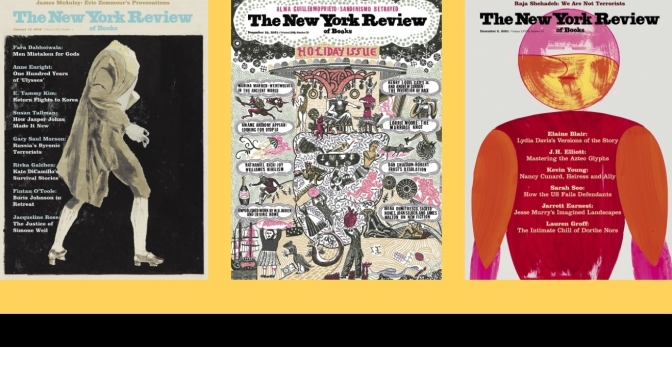
The New York Reviews Of Books – May 15, 2025

THE NEW YORK REVIEW OF BOOKS (April 24, 2025): The latest issue features the Art Issue—with Susan Tallman on warp and weft, Ingrid D. Rowland on Vitruvius, Jerome Groopman on antivaccine lunacy, Martin Filler on the new Frick, Julian Bell on art in an age of crisis, Lisa Halliday on Claire Messud, Heather O’Donnell on the Morgan librarian, Noah Feldman on the rule of law, Jarrett Earnest on fancy furnishings, Madeleine Thien on Fang Fang, Coco Fusco on Felix Gonzalez-Torres, Jed Perl on Surrealism, poems by Ben Lerner and Carmen Boullosa, and much more.

String Theory

Two exhibitions focused on weaving go beyond the functional, the folkloric, and the feminine, tracking fiber’s escape from the connotations of the grid.

Woven Histories: Textiles and Modern Abstraction – an exhibition at the Museum of Modern Art, New York City, April 20–September 13, 2025

Weaving Abstraction in Ancient and Modern Art – An exhibition at the Metropolitan Museum of Art, New York City

Vitruvius & the Warlords

Vitruvius’s Ten Books on Architecture was not only a manual of the building arts but a treatise on how to extend and consolidate the Roman Empire, and lent itself all too well to the autocratic ambitions of Renaissance princes.

All the King’s Horses: Vitruvius in an Age of Princes by Indra Kagis McEwen

Measles Gone Wild

During a burgeoning measles outbreak, HHS Secretary Robert F. Kennedy Jr. has continued to make contradictory remarks, publicly endorsing the measles vaccine while raising doubts about its safety.

Booster Shots: The Urgent Lessons of Measles and the Uncertain Future of Children’s Health by Adam Ratner

So Very Small: How Humans Discovered the Microcosmos, Defeated Germs—and May Still Lose the War Against Infectious Disease by Thomas Levenson

The Frick Reinvigorated

In an ambitious and long-overdue renovation, the architect Annabelle Selldorf attempted to harmonize with the Frick’s Classical aesthetic while asserting her Modernist credentials.

A Century of Surrealism

One hundred years after André Breton launched the Surrealist movement, we’re still trying making sense of its aims and effects.

Surrealism – an exhibition at the Centre Pompidou, Paris, September 4, 2024–January 13, 2025, and the Philadelphia Museum of Art, November 8, 2025–February 6, 2026

Manifestoes of Surrealism by André Breton, translated from the French by Richard Seaver and Helen R. Lane

Revolution of the Mind: The Life of André Breton, Revised and Updated Edition by Mark Polizzotti

Surrealism in Exile and the Beginning of the New York School by Martica Sawin

Surrealism and Painting by André Breton, translated from the French by Simon Watson Taylor, with an introduction by Mark Polizzotti

Times Literary Supplement – April 25, 2025 Preview

TIMES LITERARY SUPPLEMENT (April 23, 2025): The latest issue features ‘The Blakean Spark’ – The artist’s ‘Imaginative Eye’…