Tag Archives: Philosophy

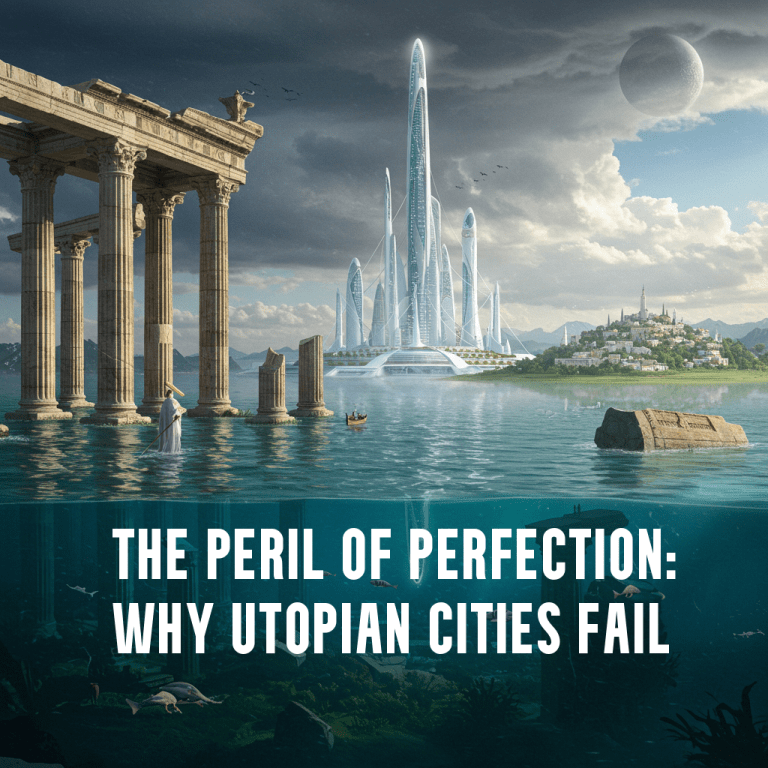
The Peril Of Perfection: Why Utopian Cities Fail

By Michael Cummins, Editor, August 7, 2025
Throughout human history, the idea of a perfect city—a harmonious, orderly, and just society—has been a powerful and enduring dream. From the philosophical blueprints of antiquity to the grand, state-sponsored projects of the modern era, the desire to create a flawless urban space has driven thinkers and leaders alike. This millennia-long aspiration, rooted in a fundamental human longing for order and a rejection of present-day flaws, finds its most recent and monumental expression in China’s Xiongan New Area, a project highlighted in an August 7, 2025, Economist article titled “Xi Jinping’s city of the future is coming to life.” Xiongan is both a marvel of technological and urban design and a testament to the persistent—and potentially perilous—quest for an idealized city.

By examining the historical precedents of utopian thought, we can understand Xiongan not merely as a contemporary infrastructure project but as the latest chapter in a timeless and often fraught human ambition to build paradise on earth. This essay will trace the evolution of the utopian ideal from ancient philosophy to modern practice, arguing that while Xiongan embodies the most technologically advanced and politically ambitious vision to date, its top-down, state-driven nature and astronomical costs raise critical questions about its long-term viability and ability to succeed where countless others have failed.

The Philosophical and Historical Roots

The earliest and most iconic examples of this utopian desire were theoretical and philosophical, serving as intellectual critiques rather than practical blueprints. Plato’s mythological city of Atlantis, described in his dialogues Timaeus and Critias, was not just a lost city but a complex philosophical thought experiment. Plato detailed a powerful, technologically advanced, and ethically pure island society, governed by a wise and noble lineage. The city itself was a masterpiece of urban planning, with concentric circles of land and water, advanced canals, and stunning architecture.

However, its perfection was ultimately undone by human greed and moral decay. As the Atlanteans became corrupted by hubris and ambition, their city was swallowed by the sea. This myth is foundational to all subsequent utopian thought, serving as a powerful and enduring cautionary tale that even the most perfect physical and social structure is fragile and susceptible to corruption from within. It suggests that a utopian society cannot simply be built; its sustainability is dependent on the moral fortitude of its citizens.

Centuries later, in 1516, Thomas More gave the concept its very name with his book Utopia. More’s work was a masterful social and political satire, a searing critique of the harsh realities of 16th-century England. He described a fictional island society where there was no private property, and all goods were shared. The citizens worked only six hours a day, with the rest of their time dedicated to education and leisure.

“For where pride is predominant, there all these good laws and policies that are designed to establish equity are wholly ineffectual, because this monster is a greater enemy to justice than avarice, anger, envy, or any other of that kind; and it is a very great one in every man, though he have never so much of a saint about him.” – Utopia by Thomas More

The society was governed by reason and justice, and there were no social classes, greed, or poverty. More’s Utopia was not about a perfect physical city, but a perfect social structure. It was an intellectual framework for political philosophy, designed to expose the flaws of a European society plagued by poverty, inequality, and the injustices of land enclosure. Like Atlantis, it existed as an ideal, a counterpoint to the flawed present, but it established a powerful cultural archetype.

The city as a reflection of societal ideals. — Intellicurean

Following this, Francis Bacon’s unfinished novel New Atlantis (1627) offered a different, more prophetic vision of perfection. His mythical island, Bensalem, was home to a society dedicated not to social or political equality, but to the pursuit of knowledge. The core of their society was “Salomon’s House,” a research institution where scientists worked together to discover and apply knowledge for the benefit of humanity. Bacon’s vision was a direct reflection of his advocacy for the scientific method and empirical reasoning.

In his view, a perfect society was one that systematically harnessed technological innovation to improve human life. Bacon’s utopia was a testament to the power of collective knowledge, a vision that, unlike More’s, would resonate profoundly with the coming age of scientific and industrial revolution. These intellectual exercises established a powerful cultural archetype: the city as a reflection of societal ideals.

From Theory to Practice: Real-World Experiments

As these ideas took root, the dream of a perfect society moved from the page to the physical world, often with mixed results. The Georgia Colony, founded in 1732 by James Oglethorpe, was conceived with powerful utopian ideals, aiming to be a fresh start for England’s “worthy poor” and debtors. Oglethorpe envisioned a society without the class divisions that plagued England, and to that end, his trustees prohibited slavery and large landholdings. The colony was meant to be a place of virtue, hard work, and abundance. Yet, the ideals were not fully realized. The prohibition on slavery hampered economic growth compared to neighboring colonies, and the trustees’ rules were eventually overturned. The colony ultimately evolved into a more typical slave-holding, plantation-based society, demonstrating how external pressures and economic realities can erode even the most virtuous of founding principles.

In the 19th century, with the rise of industrialization, several communities were established to combat the ills of the new urban landscape. The Shakers, a religious community founded in the 18th century, are one of America’s most enduring utopian experiments. They built successful communities based on communal living, pacifism, gender equality, and celibacy. Their belief in simplicity and hard work led to a reputation for craftsmanship, particularly in furniture making. At their peak in the mid-19th century, there were over a dozen Shaker communities, and their economic success demonstrated the viability of communal living. However, their practice of celibacy meant they relied on converts and orphans to sustain their numbers, a demographic fragility that ultimately led to their decline. The Shaker experience proved that a society’s success depends not only on its economic and social structure but also on its ability to sustain itself demographically.

These real-world attempts demonstrate the immense difficulty of sustaining a perfect society against the realities of human nature and economic pressures. — Intellicurean

The Transcendentalist experiment at Brook Farm (1841-1847) attempted to blend intellectual and manual labor, blurring the lines between thinkers and workers. Its members, who included prominent figures like Nathaniel Hawthorne, believed that a more wholesome and simple life could be achieved in a cooperative community. However, the community struggled from the beginning with financial mismanagement and the impracticality of their ideals. The final blow was a disastrous fire that destroyed a major building, and the community was dissolved. Brook Farm’s failure illustrates a central truth of many utopian experiments: idealism can falter in the face of economic pressures and simple bad luck.

A more enduring but equally radical experiment, the Oneida Community (1848-1881), achieved economic success through manufacturing, particularly silverware, under the leadership of John Humphrey Noyes. Based on his concept of “Bible Communism,” they practiced communal living and a system of “complex marriage.” Despite its radical social structure, the community thrived economically, but internal disputes and external pressures ultimately led to its dissolution. These real-world attempts demonstrate the immense difficulty of sustaining a perfect society against the realities of human nature and economic pressures.

Xiongan: The Modern Utopia?

Xiongan is the natural, and perhaps ultimate, successor to these modern visions. It represents a confluence of historical utopian ideals with a uniquely contemporary, state-driven model of urban development. Touted as a “city of the future,” Xiongan promises short, park-filled commutes and a high-tech, digitally-integrated existence. It seeks to be a model of ecological civilization, where 70% of the city is dedicated to green space and water, an explicit rejection of the “urban maladies” of pollution and congestion that plague other major Chinese cities.

Its design principles are an homage to the urban planners of the past, with a “15-minute lifecycle” for residents, ensuring all essential amenities are within a short walk. The city’s digital infrastructure is also a modern marvel, with digital roads equipped with smart lampposts and a supercomputing center designed to manage the city’s traffic and services. In this sense, Xiongan is a direct heir to Francis Bacon’s vision of a society built on scientific and technological progress.

Unlike the organic, market-driven growth of a city like Shenzhen, Xiongan is an authoritarian experiment in building a perfect city from scratch. — The Economist

This vision, however, is a top-down creation. As a “personal initiative” of President Xi, its success is a matter of political will, with the central government pouring billions into its construction. The project is a key part of the “Jing-Jin-Ji” (Beijing-Tianjin-Hebei) coordinated development plan, meant to relieve the pressure on the capital. Unlike the organic, market-driven growth of a city like Shenzhen, Xiongan is an authoritarian experiment in building a perfect city from scratch. Shenzhen, for example, was an SEZ (Special Economic Zone) that grew from the bottom up, driven by market forces and a flexible policy environment. It was a chaotic, rapid, and often unplanned explosion of economic activity. Xiongan, in stark contrast, is a meticulously planned project from its very inception, with a precise ideological purpose to showcase a new kind of “socialist” urbanism.

This centralized approach, while capable of achieving rapid and impressive infrastructure development, runs the risk of failing to create the one thing a true city needs: a vibrant, organic, and self-sustaining culture. The criticisms of Xiongan echo the failures of past utopian ventures; despite the massive investment, the city’s streets remain “largely empty,” and it has struggled to attract the talent and businesses needed to become a bustling metropolis. The absence of a natural community and the reliance on forced relocations have created a city that is technically perfect but socially barren.

The Peril of Perfection

The juxtaposition of Xiongan with its utopian predecessors highlights the central tension of the modern planned city. The ancient dream of Atlantis was a philosophical ideal, a perfect society whose downfall served as a moral warning against hubris. The real-world communities of the 19th century demonstrated that idealism could falter in the face of economic and social pressures, proving that a perfect society is not a fixed state but a dynamic, and often fragile, process. The modern reality of Xiongan is a physical, political, and economic gamble—a concrete manifestation of a leader’s will to solve a nation’s problems through grand design. It is a bold attempt to correct the mistakes of the past and a testament to the immense power of a centralized state. Yet, the question remains whether it can escape the fate of its predecessors.

The ultimate verdict on Xiongan will not be about the beauty of its architecture or the efficiency of its smart infrastructure alone, but whether it can successfully transcend its origins as a state project. — The Economist

The ultimate verdict on Xiongan will not be about the beauty of its architecture or the efficiency of its smart infrastructure alone, but whether it can successfully transcend its origins as a state project to become a truly livable, desirable, and thriving city. Only then can it stand as a true heir to the timeless dream of a perfect urban space, rather than just another cautionary tale. Whether a perfect city can be engineered from the top down, or if it must be a messy, organic creation, is the fundamental question that Xiongan, and by extension, the modern world, is attempting to answer.

THIS ESSAY WAS WRITTEN AND EDITED UTILIZING AI
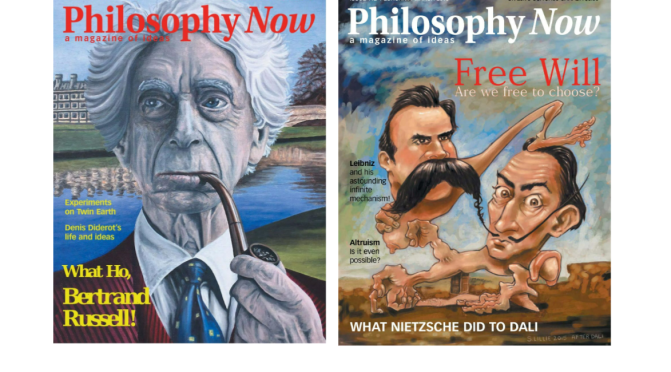
PHILOSOPHY NOW MAGAZINE – AUGUST/SEPTEMBER 2025

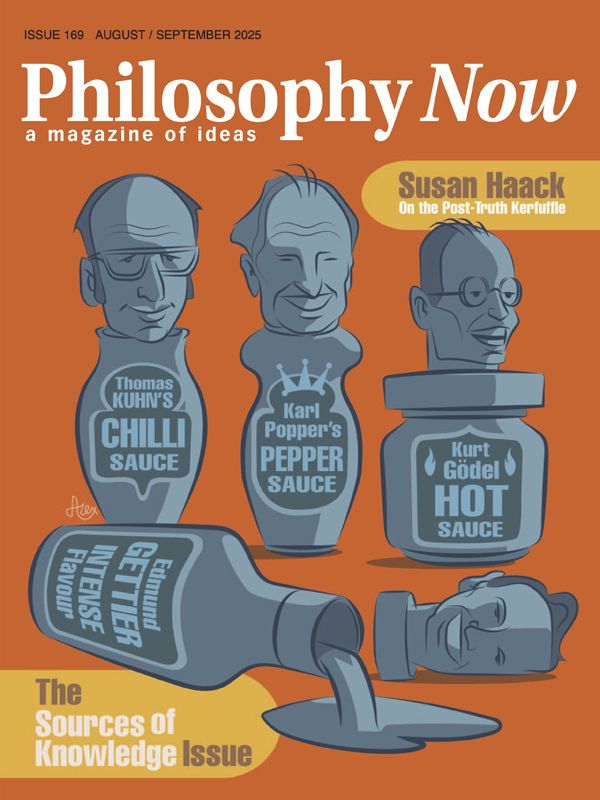
PHILOSOPHY NOW MAGAZINE (August 5, 2025): The latest issue features ‘The Sources of Knowledge Issue’

Xuanzang & the Gettier Problem

Maya Koka journeys through the desert to seek knowledge about knowledge.

The Philosophical Method of Exception

Peter Keeble spotlights and critiques a common philosophical technique.

Popper, Science & Democracy

Brian King follows Popper’s idea of the evolution of knowledge, life and society.

Challenging the Objectivity of Science

Sina Mirzaye Shirkoohi observes science to get the facts straight about it.

Gödel, Wittgenstein, & the Limits of Knowledge

Michael D. McGranahan takes us to the edge of language, mathematics and science.

Moby-Dick, Perpetual Inquiry, and the Sublime

By Intellicurean, July 25, 2025

“Call me Ishmael.”

This iconic first line anchors one of the most enduring openings in American literature. Yet before it is spoken, before Ishmael’s voice emerges on the page, we encounter something more unusual: a kind of literary invocation. The opening pages of Moby-Dick—those dense, eclectic “Extracts” quoting scripture, classical literature, scientific treatises, and forgotten travelogues—do not serve as a traditional preface. Instead, they operate like a ritual threshold. They ask us to enter the novel not as a narrative, but as a vast textual cosmos.

Melville’s fictional “sub-sub-librarian” gathers fragments from Job to Shakespeare to obscure whaling reports, assembling a chorus of voices that have, across centuries, spoken of the whale. This pre-narrative collage is more than ornamentation. It proposes a foundational idea: that the whale lives not only in the ocean, but in language. Not only in myth, but in memory. Not only in flesh, but in thought.

Before the Pequod ever sets sail, Melville has already charted his central course—into the ocean of human imagination, where the whale swims through texts, dreams, and questions that refuse easy resolution.


Proof of Two Lives

“There’s something I find strangely moving about the ‘Extracts’ section,” remarks literary critic Wyatt Mason on The World in Time, a podcast hosted by Lewis Lapham. “It’s proof of two kinds of life. The life of the creature itself, and the life of the mind—the attention we pay over time to this creature.”

Mason’s comment offers a keel for the voyage ahead. In Moby-Dick, the whale is not simply an animal or antagonist. It becomes a metaphysical magnet, a mirror for human understanding, a challenge to the limits of knowing. The “Extracts” and “Etymologies,” often dismissed as digressions, are in fact sacred rites—texts that beg to be read with reverence.

In teaching the novel to incarcerated students through the Bard Prison Initiative, Mason and fellow writer Donovan Hohn describe how these obscure, labyrinthine sections are received not as trivia but as scripture. The students descend into the archive as divers into a shipwreck—recovering fragments of forgotten wisdom, learning to breathe in the pressure of incomprehensibility. “The whale,” Mason repeats, “resides or lives in texts.” And what a library it is.


The Whale as Philosophy

“All my means are sane, my motive and my object mad.”

Harold Bloom, the late sage of literary criticism, would have nodded at Mason’s insight. For Bloom, Moby-Dick was not merely a novel, but “a giant Shakespearean prose poem.” Melville, he believed, was a tragedian of the American soul. Captain Ahab, mad with self-reliance, became for Bloom a Promethean figure—bound not by divine punishment, but by his own obsessive will.

In Bloom’s classroom at Yale in 2011, there were no lecture notes. He taught Moby-Dick like a jazz solo—improvised, living, drawn from a lifetime of memory and myth. “It’s very unfair,” he said, reflecting on the whale hunts—great mammals hunted with harpoons and lances. Yet the Pequod’s most moral man, Starbuck, is also its most proficient killer. A Quaker devoted to peace, he is also the ship’s deadliest lance. This contradiction—gentleness and violence braided together—is the essence of Melville’s philosophy.

The whale, in Bloom’s reading, is sublime not because it symbolizes any one thing—God, evil, justice, nature—but because it cannot be pinned down. It is an open question. An unending inquiry. A canvas for paradox. “Heaven help them all,” Bloom said of the Pequod’s doomed crew. “And us.”


Melville the Environmentalist

“There she blows! There she blows! A hump like a snow-hill! It is Moby Dick!”

Where Bloom heard Melville’s music in metaphor and myth, Richard J. King hears it in science. In Ahab’s Rolling Sea: A Natural History of Moby-Dick (2019), King charts a different map—overlaying Melville’s imagined ocean onto real tides, real whales, real voyages. He sails replica whalers, interviews marine biologists, pores over Melville’s notebooks.

His inquiry begins with a straightforward question: could a sperm whale really destroy a ship? Historical records suggest yes. But King doesn’t stop at anatomy. His portrait of Melville reveals a proto-environmentalist, someone who revered the sea not just as symbol but as system. Melville’s whale, King argues, is a creature of wonder and terror, not just prey but presence.

In an age of ecological crisis, King reframes Moby-Dick as a book not just of metaphor but of environmental ethics. Ishmael’s meandering digressions become meditations on the ocean as moral agent—an entity capable of sustaining and destroying. The sea is no backdrop; it is a character, a god, an intelligence. Melville’s ocean, King suggests, humbles the hubris of Ahab and calls readers to ecological humility.


Rediscovery in Dark Times

“Strike through the mask! How can the prisoner reach outside except by thrusting through the wall?”

Aaron Sachs, in Up From the Depths: Herman Melville, Lewis Mumford, and Rediscovery in Dark Times (2022), picks up the whale’s trail in the 20th century. In 1929, as the world plunged into the Great Depression, the writer and historian Lewis Mumford resurrected Melville from literary oblivion. His biography of the long-forgotten author recast Melville not as a failure, but as a visionary.

For Mumford, Melville was a kindred spirit—a man who, long before the term “modernity” took hold, had already seen its psychic cost. As Mumford watched the rise of industry, mass production, and spiritual exhaustion, he found in Melville a dark prophet. Ahab’s fury was not personal—it was civilizational.

Critics have praised Sachs’s biography as timely and thoughtful. Its thesis is clear: in times of disorientation, literature does more than reflect the world—it refracts it. It preserves vital truths, repurposing them when our present crises demand older insights.

In Sachs’s telling, Moby-Dick is not just a classic; it’s a living text. A lighthouse in the storm. A warning bell. A whale-shaped mirror reflecting our fears, failures, and persistent hope.


The Whale in the Classroom

“Ignorance is the parent of fear.”

The classroom, as Sachs and Mason both suggest, becomes a site of literary resurrection. In prison education programs, students discover themselves in the “Extracts”—not despite their difficulty, but because of it. The very act of grappling with Melville’s arcane references, strange structures, and encyclopedic digressions becomes an act of reclamation.

To teach Moby-Dick in a prison is to raise a sunken ship. Its sentences, like salvaged artifacts, reveal new meaning. Forgotten knowledge becomes fuel for rediscovery. Students, many of whom have been dismissed by society, see in Melville’s endless inquiry a validation of their own intelligence and complexity.

Harold Bloom taught Moby-Dick the same way. Every reading was new. No fixed script, only the swell of thought. He modeled Melville’s method: trust the reader, trust the text, trust the mystery.

The whale resists capture—literal and interpretive. It is not a symbol with a key, but a question without an answer. That resistance is what makes Moby-Dick enduring. It insists on being re-read. Re-thought. Re-discovered.


The Archive That Breathes

“It is not down in any map; true places never are.”

Taken together, the voices of Wyatt Mason, Harold Bloom, Richard J. King, and Aaron Sachs reveal Moby-Dick as something more than literature. It is a breathing archive—a repository of imagination, inquiry, and paradox.

Within its pages dwell theologies and taxonomies, drama and digression, sermons and sea shanties. It houses the ethical weight of ecology, the fury of Ahab, the wonder of Ishmael, and the ghosts of Melville’s century. It defies genre, resists reduction, and insists on complexity.

Melville did not write to close arguments but to open them. He did not believe in neat endings. His whale is the quintessential “true place”: uncapturable, immeasurable, endlessly sublime.

And yet we return. We keep hunting—not with harpoons, but with attention. With interpretation. With awe.


A Final Breach

What, then, do we do with Moby-Dick in the twenty-first century? How do we reconcile Ahab’s consuming fury with Ishmael’s contemplative awe? How do we carry Bloom’s Prometheus, King’s Leviathan, Sachs’s resurrected Melville, and Mason’s classroom in a single imagination?

We read. We reread. We become “sub-sub-librarians”—archivists of ambiguity, curators of complexity. We do not read Moby-Dick for closure. We read it to learn how to remain open—to contradiction, to paradox, to mystery.

But what if we, like Captain Ahab, set off to find Moby Dick and never found the whale?

What if all our intellectual harpoons missed their mark? What if the whale was never there to begin with—not as symbol, not as certainty, not as prize?

Would we call that failure?

Or might we discover, like Ishmael adrift on the coffin-raft, that survival is not about conquest, but endurance? That truth lives not in the kill, but in the quest?

Perhaps Melville’s greatest lesson is that the whale must never be caught. Its sublimity lies in its elusiveness—in its capacity to remain just beyond the reach of definition, control, and meaning. It breaches in metaphor. It disappears in digression. It waits—not to be captured, but to be considered.

We will never catch it. But we must keep following.

For in the following, we become something more than readers.
We become seekers.

THIS ESSAY WAS WRITTEN BY INTELLICUREAN UTILIZING AI

The Curated Persona vs. The Cultivated Spirit

“There is pleasure in the pathless woods,
There is rapture on the lonely shore,
There is society where none intrudes,
By the deep sea, and music in its roar.”
— Lord Byron, Childe Harold’s Pilgrimage

Intellicurean (July 20, 2025):

We are living in a time when almost nothing reaches us untouched. Our playlists, our emotions, our faces, our thoughts—all curated, filtered, reassembled. Life itself has been stylized and presented as a gallery: a mosaic of moments arranged not by meaning, but by preference. We scroll instead of wander. We select instead of receive. Even grief and solitude are now captioned.

Curation is no longer a method. It is a worldview. It tells us what to see, how to feel, and increasingly, who to be. What once began as a reverent gesture—a monk illuminating a manuscript, a poet capturing awe in verse—has become an omnipresent architecture of control. Curation promises freedom, clarity, and taste. But what if it now functions as a closed system—resisting mystery, filtering out surprise, and sterilizing transformation?

This essay explores the spiritual consequences of that system: how the curated life may be closing us off from the wildness within, the creative rupture, and the deeper architecture of meaning—the kind once accessed by walking, wandering, and waiting.

Taste and the Machinery of Belonging

Taste used to be cultivated: a long apprenticeship shaped by contradiction and immersion. One learned to appreciate Bach or Baldwin not through immediate alignment, but through dedicated effort and often, difficulty. This wasn’t effortless consumption; it was opening oneself to a demanding process of intellectual and emotional growth, engaging with works that pushed against comfort and forced a recalibration of understanding.

Now, taste has transformed. It’s no longer a deep internal process but a signal—displayed, performed, weaponized. Curation, once an act of careful selection, has devolved into a badge of self-justification, less about genuine appreciation and more about broadcasting allegiance.

What we like becomes who we are, flattened into an easily digestible profile. What we reject becomes our political tribe, a litmus test for inclusion. What we curate becomes our moral signature, a selective display designed to prove our sensibility—and to explicitly exclude others who don’t share it. This aesthetic alignment replaces genuine shared values.

This system is inherently brittle. It leaves little room for the tension, rupture, or revision essential for genuine growth. We curate for coherence, not depth—for likability, not truth. We present a seamless, unblemished self, a brand identity without flaw. The more consistent the aesthetic, the more brittle the soul becomes, unable to withstand the complexities of real life.

Friedrich Nietzsche, aware of human fragility, urged us in The Gay Science to “Become who you are.” But authentic becoming requires wandering, failing, and recalibrating. The curated life demands you remain fixed—an unchanging exhibit, perpetually “on brand.” There’s no space for the messy, contradictory process of self-discovery; each deviation is a brand inconsistency.

We have replaced moral formation with aesthetic positioning. Do you quote Simone Weil or wear linen neutrals? Your tastes become your ethics, a shortcut to moral authority. But what happens when we are judged not by our love or actions, but by our mood boards? Identity then becomes a container, rigidly defined by external markers, rather than an expansive horizon of limitless potential.

James Baldwin reminds us that identity, much like love, must be earned anew each day. It’s arduous labor. Curation offers no such labor—only the performative declaration of arrival. In the curated world, to contradict oneself is a failure of brand, not a deepening of the human story.

Interruption as Spiritual Gesture

Transformation—real transformation—arrives uninvited. It’s never strategic or trendy. It arrives as a breach, a profound disruption to our constructed realities. It might be a dream that disturbs, a silence that clarifies, or a stranger who speaks what you needed to hear. These are ruptures that stubbornly refuse to be styled or neatly categorized.

These are not curated moments. They are interruptions, raw and unmediated. And they demand surrender. They ask that we be fundamentally changed, not merely improved. Improvement often implies incremental adjustments; change implies a complete paradigm shift, a dismantling and rebuilding of perception.

Simone Weil wrote, “Attention is the rarest and purest form of generosity.” To give genuine attention—not to social media feeds, but to the world’s unformatted texture—is a profoundly spiritual act. It makes the soul porous, receptive to insights that transcend the superficial. It demands we quiet internal noise and truly behold.

Interruption, when received rightly, becomes revelation. It breaks the insidious feedback loop of curated content. It reclaims our precious time from the relentless scroll. It reminds us that meaning is not a product, but an inherent presence. It calls us out of the familiar, comfortable loop of our curated lives and into the fertile, often uncomfortable, unknown.

Attention is not surveillance. Surveillance consumes and controls. Attention, by contrast, consecrates; it honors sacredness. It is not monitoring. It is beholding, allowing oneself to be transformed by what is perceived. In an age saturated with infinite feeds, sacred attention becomes a truly countercultural act of resistance.

Wilderness as Revelation

Before curation became the metaphor for selfhood, wilderness was. For millennia, human consciousness was shaped by raw, untamed nature. Prophets were formed not in temples, but in the harsh crucible of the wild.

Moses wandered for forty years in the desert before wisdom arrived. Henry David Thoreau withdrew to Walden Pond not to escape, but to immerse himself in fundamental realities. Friedrich Nietzsche walked—often alone and ill—through the Alps, where he conceived eternal recurrence, famously declaring: “All truly great thoughts are conceived by walking.”

The Romantic poets powerfully echoed this truth. William Wordsworth, in Tintern Abbey, describes a profound connection to nature, sensing:

“A sense sublime / Of something far more deeply interfused, / Whose dwelling is the light of setting suns…”

John Keats saw nature as a portal to the eternal.

Yet now, even wilderness is relentlessly curated. Instagrammable hikes. Hashtagged retreats. Silence, commodified. We pose at the edge of cliffs, captioning our solitude for public consumption, turning introspection into performance.

But true wilderness resists framing. It is not aesthetic. It is initiatory. It demands discomfort, challenges complacency, and strips away pretense. It dismantles the ego rather than decorating it, forcing us to confront vulnerabilities. It gives us back our edges—the raw, unpolished contours of our authentic selves—by rubbing away the smooth veneers of curated identity.

In Taoism, the sage follows the path of the uncarved block. In Sufi tradition, the Beloved is glimpsed in the desert wind. Both understand: the wild is not a brand. It is a baptism, a transformative immersion that purifies and reveals.

Wandering as Spiritual Practice

The Romantics knew intuitively that walking is soulwork. John Keats often wandered through fields for the sheer presence of the moment. Lord Byron fled confining salons for pathless woods, declaring: “I love not Man the less, but Nature more.” His escape was a deliberate choice for raw experience.

William Wordsworth’s daffodils become companions, flashing upon “that inward eye / Which is the bliss of solitude.” Walking allows a convergence of external observation and internal reflection.

Walking, in its purest form, breaks pattern. It refuses the algorithm. It is an act of defiance against pre-determined routes. It offers revelation in exchange for rhythm, the unexpected insight found in the meandering journey. Each footstep draws us deeper into the uncurated now.

Bashō, the haiku master, offered a profound directive:

“Do not seek to follow in the footsteps of the wise. Seek what they sought.”

The pilgrim walks not primarily to arrive at a fixed destination, but to be undone, to allow the journey itself to dismantle old assumptions. The act of walking is the destination.

Wandering is not a detour. It is, in its deepest sense, a vocation, a calling to explore the contours of one’s own being and the world without the pressure of predetermined outcomes. It is where the soul regains its shape, shedding rigid molds imposed by external expectations.

Creation as Resistance

To create—freely, imperfectly, urgently—is the ultimate spiritual defiance against the tyranny of curation. The blank page is not optimized; it is sacred ground. The first sketch is not for immediate approval. It is for the artist’s own discovery.

Samuel Taylor Coleridge defined poetry as “the best words in the best order.” Rainer Maria Rilke declared, “You must change your life.” Friedrich Nietzsche articulated art’s existential necessity: “We have art so that we do not perish from the truth.” These are not calls to produce content for an audience; they are invitations to profound engagement with truth and self.

Even creation is now heavily curated by metrics. Poems are optimized for engagement. Music is tailored to specific moods. But art, in its essence, is not engagement; it is invocation. It seeks to summon deeper truths, to ask questions the algorithm can’t answer, to connect us to something beyond the measurable.

To make art is to stand barefoot in mystery—and to respond with courage. To write is to risk being misunderstood. To draw is to embrace the unpolished. This is not inefficiency. This is incarnation—the messy, beautiful process of bringing spirit into form.

Memory and the Refusal to Forget

The curated life often edits memory for coherence. It aestheticizes ancestry, reducing complex family histories to appealing narratives. It arranges sentiment, smoothing over rough edges. But real memory is a covenant with contradiction. It embraces the paradoxical coexistence of joy and sorrow.

John Keats, in his Ode to a Nightingale, confronts the painful reality of transience and loss: “Where youth grows pale, and spectre-thin, and dies…” Memory, in its authentic form, invites this depth, this uncomfortable reckoning with mortality. It is not a mood board. It is a profound reckoning, where pain and glory are allowed to dwell together.

In Jewish tradition, memory is deeply embodied. To remember is not merely to recall a fact; it is to retell, to reenact, to immerse oneself in the experience of the past, remaining in covenant with it. Memory is the very architecture of belonging. It does not simplify complex histories. Instead, it deepens understanding, allowing generations to draw wisdom and resilience from their heritage.

Curation flattens, reducing multifaceted experiences to digestible snippets. Memory expands, connecting us to the vast tapestry of time. And in the sacred act of memory, we remember how grace once broke into our lives, how hope emerged from despair. We remember so we can genuinely hope again, with a resilient awareness of past struggles and unexpected mercies.

The Wilderness Within

The final frontier of uncuration is profoundly internal: the wilderness within. This is the unmapped territory of our own consciousness, the unruly depths that resist control.

Søren Kierkegaard called it dread—not fear, but the trembling before the abyss of possibility. Nietzsche called it becoming—not progression, but metamorphosis. This inner wilderness resists styling, yearns for presence instead of performance, and asks for silence instead of applause.

Even our inner lives are at risk of being paved over. Advertisements and algorithmic suggestions speak to us in our own voice, subtly shaping desires. Choices feel like intuition—but are often mere inference. The landscape of our interiority, once a refuge for untamed thought, is being meticulously mapped and paved over for commercial exploitation, leaving little room for genuine self-discovery.

Simone Weil observed: “We do not obtain the most precious gifts by going in search of them, but by waiting for them.” The uncurated life begins in this waiting—in the ache of not knowing, in the quiet margins where true signals can penetrate. It’s in the embrace of uncertainty that authentic selfhood can emerge.

Let the Soul Wander

“Imagination may be compared to Adam’s dream—he awoke and found it truth.” — Keats

To live beyond curation is to choose vulnerability. It is to walk toward complexity, to embrace nuances. It is to let the soul wander freely and to cultivate patience for genuine waiting. It is to choose mystery over mastery, acknowledging truths revealed in surrender, not control.

Lord Byron found joy in pathless woods. Percy Bysshe Shelley sang alone, discovering his creative spirit. William Wordsworth found holiness in leaves. John Keats touched eternity through birdsong. Friedrich Nietzsche walked, disrupted, and lived with intensity.

None of these lives were curated. They were entered—fully, messily, without a predefined script. They were lives lived in engagement with the raw, untamed forces of self and world.

Perhaps / The truth depends on a walk around a lake, / A composing as the body tires, a stop. // To see hepatica, a stop to watch. / A definition growing certain…” Wallace Stevens

So let us make pilgrimage, not cultivate a profile. Let us write without audience, prioritizing authentic expression. Let us wander into ambiguity, embracing the unknown. And let us courageously welcome rupture, contradiction, and depth, for these are the crucibles of genuine transformation.

And there—at the edge of control, in the sacred wilderness within, where algorithms cannot reach—
Let us find what no curated feed can ever give.
And be profoundly changed by it.

THIS ESSAY WAS WRITTEN AND EDITED BY INTELLICUREAN USING

The Unholy Offspring of Economic Theory: The Far Right’s Neoliberal Roots

The following essay is AI -generated, edited by Intellicurean, as part of our “The Cynic & The Dandy” series, of an interview article published on July 6, 2025 on the Toynbee Prize Foundation website titled Hayek’s Bastards and the Global Origins of the Far Right: An Interview with Quinn Slobodian.

One finds oneself, much like a seasoned playgoer observing a particularly convoluted modern drama, grappling with the profound complexities of our age. The curtain, it seems, has risen on “Trump 2.0,” a performance so bewildering in its contradictions that even the most astute critics of human folly might pause for breath. This curious administration simultaneously seeks to disentangle itself from global commitments while igniting fresh international disputes; it endeavours to depreciate the dollar to boost exports whilst clinging to its status as the world’s reserve currency; and it champions a reduction in global economic reliance while striving to unilaterally dictate global economic terms. The American colossus, one might observe, appears caught in a most perplexing dance with its own identity, and the global audience watches, utterly transfixed.

It is into this very contemporary conundrum that Quinn Slobodian, a historian of capitalism whose intellectual acuity is as sharp as a well-honed epigram, strides with his latest volume: Hayek’s Bastards: Race, Gold, IQ, and the Capitalism of the Far Right (Princeton University Press, 2025). This title, one must concede, possesses a certain Wildean flourish, hinting at the delightful audacity within its pages. Slobodian, with the keen eye of a diagnostician, posits that the apparent contradiction of the Far Right simultaneously embracing pro-market liberalism and social hierarchies – facilitating the free movement of capital but not of people – is, in fact, no contradiction at all. He argues that neoliberalism has always possessed the intellectual elasticity to accommodate such a narrative.


The Unruly Offspring of Thought: “Bastards” and “Volk Capital”

Slobodian’s current work builds upon his earlier seminal analyses in Globalists: The End of Empire and the Birth of Neoliberalism (Harvard University Press, 2018) and Crack-up Capitalism: Market Radicals and the Dream of a World Without Democracy (Metropolitan, 2023). However, Hayek’s Bastards shifts its chronological focus decisively to the 1990s, illuminating this pivotal decade through the lens of figures not previously central to his explorations. If Globalists dissected the intellectual elite of the Mont Pèlerin Society, and Crack-Up Capitalism examined market radicals within the broader globalisation context, this new work turns its penetrating gaze to paleo-libertarianism. This intriguing ideological fusion, combining libertarian disdain for global governance with paleo-conservative traditionalism and isolationism (a distinct contrast to the more recent neoconservative branch of the Republican Party), forms the crux of Slobodian’s argument.

At the heart of Slobodian’s contention lies a startling conclusion: the rise of the Far Right is an acceleration, not a rejection of capitalism; a frontlash, not a backlash. He meticulously demonstrates how right-wing libertarians of the 1990s, through their convergence with paleoconservatives and their burgeoning interest in biology, IQ, and gold, inadvertently laid the intellectual foundations for our present reality.

In a recent conversation with Asensio Robles of Comillas Pontifical University, Slobodian elucidated the two primary concepts underpinning his book. The notion of “bastards,” he explains, serves as a vivid metaphor for the generations of intellectual influence, where adherents, though inspired by mentors, may diverge significantly from the original spirit and content of their masters’ work. In the case of Friedrich Hayek, Slobodian points to those who, in their pursuit of his scientific and complexity-focused ideas, veered into domains such as scientific racism or the belief in human nature as an absolute organizing principle. These, Slobodian asserts, represent the “illegitimate” heirs who strayed far enough to betray Hayek’s fundamental principles.

Friedrich Hayek, a Nobel laureate in Economics (1974) and a leading figure of the Austrian School of economics, is perhaps best known for his fervent defense of free-market capitalism and his critiques of central planning, notably articulated in his seminal 1944 work, The Road to Serfdom. Hayek argued that economic coordination arises not from central design, but from a “spontaneous order” – the result of millions of individuals making decisions based on dispersed, localized knowledge communicated primarily through the price system. He believed that any attempt by the state to centrally plan the economy would inevitably lead to a loss of individual liberty and, ultimately, totalitarianism, because such planners could never possess the vast, tacit knowledge embedded within a decentralized market.

The second crucial concept is “Volk capital.” Slobodian critiques the common, overly generalized understanding of neoliberalism as simply advocating for the commodification of all things and the reduction of all humans to an interchangeable substance. By adopting a narrower, more historically precise definition, focusing on a discrete group of thinkers (including those within the Mont Pèlerin Society, which Hayek co-founded in 1947), he reveals a significant inflection point in the 1960s and 1970s. This period saw a shift in neoliberal thought towards an emphasis on human difference, rather than equality.

Slobodian argues that the universalizing concept of human capital became “re-grounded” in specific genetic populations or cultural groups. He observes the re-emergence of 19th-century notions of the “Volk”—the idea of an essential character of a kinship group—fused with economic categories. This, he contends, transforms “human capital” into “Volk capital,” demonstrating how an ideology often associated with abstract market principles could regress to antiquated distinctions. For instance, by the 1980s, Hayek himself, often considered a progenitor of neoliberalism, suggested a unique quality of the Western world in producing an “optimal economic actor.”


A “Frontlash” Unveiled: Beyond the “Left-Behinds” Narrative

Slobodian further clarifies the genesis of these two books, revealing they were initially conceived as a single grand volume. The political shocks of 2016-2017 – the election of Donald Trump, the Brexit “Leave” vote, and the rise of parties like Alternative for Germany – prompted his inquiry. He expresses dissatisfaction with mainstream interpretations that viewed these developments as a revolt against neoliberal capitalism by those “left behind” by globalisation. This narrative, he argues, incorrectly positioned figures like Trump and Boris Johnson as unexpected challengers to the neoliberal consensus.

To counter this, Slobodian first introduced the concept of the “zone” in Crack-up Capitalism. This refers to more fluid spaces for investor capital within nations, such as freeports in the United Kingdom or the proliferation of Special Economic Zones in countries like China and India. He notes that in 2017-2018, much of the apparent economic nationalism was, in fact, about creating these spaces for capital mobility. For example, as of 2023, there were over 7,000 Special Economic Zones globally, employing tens of millions of people and contributing significantly to trade and investment, illustrating this practical application of “zones.”

He then sought to integrate the observation that many within the alt-right in 2016 originated from the paleo-libertarian camp. These individuals, skeptical of both global and national governments, sought a fracturing of the state system. The “grand narrative” of bundling these ideas proved “quixotic,” leading to the separate publication of Crack-up Capitalism and Hayek’s Bastards, the latter focusing on the paleo-alliance between dissident right-wing figures and the neoliberal movement.


The Unseen Hand of Difference: Chronology and Community

The chronological alignment between the two books is evident. In Hayek’s Bastards, the post-Cold War period is presented as a moment of reckoning for neoliberals, who questioned whether they had truly “won” or if “state spending and socialism” persisted in new guises, such as environmentalism or feminism. Similarly, in Crack-up Capitalism, the 1990s marked a breakthrough for zones, representing a form of globalisation that fostered “diversities across territory” rather than uniform regulatory spaces. The fundamental thread uniting both narratives, Slobodian suggests, is the “use of difference, politically or economically.” This challenges the widely held assumption that the 1990s and 2000s were periods of increasing uniformity, arguing instead that they were also times when “irreconcilable differences” were intensified and leveraged for new political agendas.

Slobodian also tackles the pervasive assumption that neoliberalism is solely a celebration of individualism. He argues that while individualism is indeed a focus, neoliberals are intensely concerned with the conditions under which it can be realized. When the traditional “republican tradition” – based on an impartial state providing space for individual expression – is discarded, a new framework for community must be forged. This is particularly true for the “subgenre of neoliberal thought” that advocates for the dissolution of the state.

In this context, the necessity arises to constitute communities that can function and allow for individual expression without uniform regulations from a representative state. This leads to an interest in factors like the role of ethnic homogeneity in decreasing transaction costs and fostering trust, thereby allowing communities to self-perpetuate. It also involves examining the importance of the “social contract” as a literal set of terms for participation in smaller communities, and questions of social reproduction – specifically, the necessary gender orders to ensure sufficient population in a “closed-border model of political organization.” This, he notes, is where anarcho-capitalists and conservatives find common ground, the former seeking abstract individual freedom but recognizing the need for parameters, and the latter striving to preserve existing moral and cultural orders.

A striking observation from Slobodian’s research is the neoliberal fear that the Cold War might have been “lost” despite the Soviet Union’s collapse, due to persistent high state spending. The end of the Cold War, Slobodian reveals, raised the possibility of completely dismantling the social state, which in turn brought forth new questions about how a post-redistributive order could be anchored. This, he asserts, directly relates to the current moment in the United States, where campaigns to significantly cut the federal budget, such as proposals to reduce it by one-third (as seen in certain fiscal proposals from conservative groups, often citing a need to return to pre-expansion levels of spending), would necessitate the dismantling of the existing social state. This scenario, he suggests, brings to mind the ominous question posed by Charles Murray regarding the aftermath of the welfare state’s disappearance – whether it would lead to anarchy, organic self-organization, or a segment of the population perishing. The “vexed triumphalism” following the Cold War, Slobodian concludes, thus set the stage for the “apocalyptic forms of politics” now all too familiar.


The Historical Lens: Unveiling Hidden Cleavages

Slobodian highlights the remarkable absence of significant sectarian splits within neoliberalism between the 1940s and 1980s. The clear ideological battle lines drawn between the “free, liberal, capitalist” world and the “planned command economies” of the communist bloc maintained a cohesive front. However, with the abrupt erasure of this divide in the 1990s, two paths emerged: either assume inevitable global convergence and the end of meaningful political divisions, or contend that divisions persisted, merely migrating to previously overlooked domains. The global Right, he observes, opted for the latter.

The 1990s became a period of “restless search for a new enemy” for the Right. This sometimes involved resurrecting older tropes, such as the anti-Semitic portrayal of George Soros as a conspiratorial figure, a narrative prominently used by figures like Viktor Orbán. Neoliberals, too, participated in this search, ultimately identifying their new adversary in the Left’s “march through the institutions” – specifically, movements advocating for gender and racial equality and a “politically correct” discourse. Slobodian emphasizes that this framing of issues like affirmative action and state-led efforts to redress inequality began remarkably early – some 35 years ago. He argues that the Left, too focused on internal critiques of a more mainstream neoliberalism (like that associated with Bill Clinton or Barack Obama), was often “caught off guard” by the “disruptive politics of the last decade,” failing to recognize the emerging “villain” that would ultimately manifest in today’s culture wars.

Slobodian’s methodological approach, as noted by Robles, is characterized by his commitment to “reading against the grain.” He consistently challenges conventional wisdom: if neoliberalism is thought to strive for state dissolution, Globalists shows its reliance on state intervention; if it promotes a borderless society, Crack-up Capitalism highlights its attention to “human separation”; and if the alt-right is seen as a backlash, Hayek’s Bastards frames it as a “frontlash,” an acceleration of the ideology. This “counterintuitive position” is, for Slobodian, a means to explore the profound revelations found within such contradictions. His advice to students – to begin a paper with “We think it’s like this, but it’s actually like that, and I’m going to show you why” – underscores his dedication to empirical evidence and intellectual revision.

He also draws a strong correlation between the 1990s and the 1960s, suggesting that understanding paleo-libertarian interests in hard borders, IQ, and gold necessitates examining earlier debates surrounding the 1965 Immigration Act, 1960s evolutionary psychology, or monetary reform post-Bretton Woods. These two decades, both periods of relative prosperity, represented moments where attempts were made to reconfigure societal settlements. Slobodian contends that the Left’s focus on criticizing a “progressive neoliberalism” (e.g., of the Clinton or Obama era) that paid “lip service” to 1960s social movements while blunting their critical edge meant they were “caught off guard” in 2016. He suggests that identifying what neoliberals “worried about” in a given decade, such as environmental demands disrupting growth models in the 1970s and 1990s, could reveal “vulnerability in the economic system” and “soft spots” for counter-movements to exploit.


Future Horizons: AI, Animals, and the Unseen Hand of Technology

Regarding future inquiries, Robles points to the absence of cryptocurrencies and AI in Hayek’s Bastards. Slobodian confirms these will be explored in his forthcoming book, Muskism, co-authored with Ben Tarnoff, which will delve into AI, effective altruism, and superintelligence. This work is slated for release next year.

However, Slobodian maintains a critical stance on cryptocurrencies, viewing them as “parasitical on a functioning traditional monetary system” and primarily “a hedge-speculative asset” or “plaything for a small number of libertarians and more recently large investors.” He believes his skepticism has been “a wise bet,” as the number of “true believers” in blockchain as a political template remains small, with most investors using crypto like any other growth sector.

Intriguingly, Slobodian’s other new research direction looks not to the digital future, but to a historical “backward” step: the changes in the human sciences in the postwar decades, specifically “How humans became animals at Harvard.” This project will explore the world of figures like Richard Herrnstein (a student of B. F. Skinner) and E. O. Wilson in the 1960s and 1970s, examining how humans were increasingly “analogized to animals.”

In Hayek’s Bastards, Quinn Slobodian has, with surgical precision, woven a compelling and unsettling thread through the tapestry of intellectual history. He compels us to confront the uncomfortable truths about the origins of our present predicament, reminding us that the seemingly spontaneous outbursts of populism are, in fact, the meticulously cultivated fruits of a long and complex intellectual lineage. One leaves his analysis with a renewed sense of vigilance, a heightened awareness of the subtle, often insidious, ways in which ideas, like the most potent of poisons, can mutate and proliferate, shaping our world in ways we are only now beginning to comprehend. Indeed, the stage is set for future acts in this ongoing drama, and one eagerly awaits Slobodian’s next intellectual curtain call.

“The Cynic & The Dandy” is an AI-generated essay series based on a hypothetical collaboration between Oscar Wilde and George Bernard Shaw.

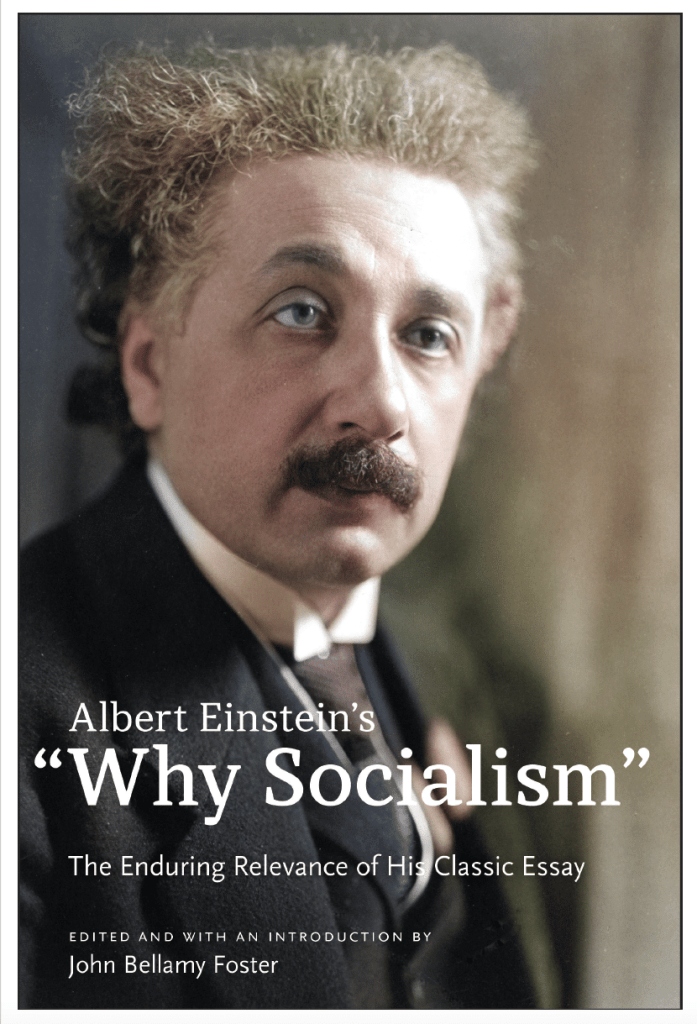
“Why Socialism”: Albert Einstein’s Resplendent Impertinence of Genius

The following essay was written by ChatGPT, and edited by Intellicurean, through the creative filter of Oscar Wilde’s barbed wit and George Bernard Shaw’s moral seriousness, of a review of John Bellamy Foster’s “Albert Einstein’s ‘Why Socialism?’: The Enduring Legacy of His Classic Essay” as it would appear in an esteemed magazine or journal.

In an era where celebrity chatter often drowns out meaningful discourse—ephemeral as the pixels that transmit it—it is both refreshing and necessary to recall that Albert Einstein was not merely a demigod of science, floating above the affairs of humankind. He was a thinker with moral conviction and intellectual courage. John Bellamy Foster’s timely volume, Albert Einstein’s “Why Socialism?”: The Enduring Legacy of His Classic Essay (Monthly Review, July 2025), excavates an overlooked manifesto whose radical clarity remains provocatively undiminished by time.


Unpacking Einstein’s Socialist Vision

More than seventy-five years have passed since Einstein contributed his essay Why Socialism? to the inaugural issue of Monthly Review in May 1949—right in the throes of America’s Red Scare. In that climate of ideological hysteria, even reason itself was suspect. Yet Einstein, with characteristic directness, named capitalism as the source of modern spiritual and economic malaise. “The economic anarchy of capitalist society,” he wrote, “is, in my opinion, the real source of the evil.”

This was no armchair abstraction. It was an act of moral and intellectual defiance in an era of conformity. Rather than tempering his critique to placate the political climate, Einstein diagnosed capitalism as a system that cripples the individual, erodes social cohesion, and mistakes profit for purpose. His socialism, then, was not bureaucratic dogma, but a humane vision: a call for solidarity, responsibility, and human dignity.

Foster’s introduction accomplishes three critical feats. First, it confirms Einstein’s consistent—if unfashionable—commitment to socialist ideals. Second, it situates Why Socialism? within a contemporary moment of deepening ecological and geopolitical crisis, not unlike the postwar anxieties Einstein addressed. Third, and most compellingly, Foster refuses to treat Einstein’s words as nostalgic artifacts. Instead, he reads them as instruments of moral interrogation for the present.


Einstein’s Moral Urgency in a Cynical Age

A powerful moment recounted in Foster’s commentary draws from a recently unearthed interview transcript titled, YES, ALBERT EINSTEIN WAS A SOCIALIST. In it, Einstein recounts a chilling conversation: a friend, contemplating nuclear annihilation, casually asks why Einstein is so concerned about humanity’s extinction. The question is as nihilistic as it is sincere—eerily prefiguring today’s fatalism disguised as realism.

Einstein’s response was telling. He saw this resignation not as philosophical sophistication, but as a symptom of capitalism’s emotional deadening. A world driven by profit, he argued, had alienated people not only from one another but from their very capacity to find joy. “The naive, simple and unsophisticated enjoyment of life,” he mourned, had become a casualty. The resulting solitude, he observed, was not noble introspection but a prison built of egotism and insecurity.

In Why Socialism?, Einstein extends this observation: “Man is, at one and the same time, a solitary being and a social being… As a social being, he seeks to gain the recognition and affection of his fellow human beings… and to improve their conditions of life.” The essay thus offers not just an economic critique, but a portrait of the spiritual crisis induced by capitalism.


A Socialism of Decency, Not Dogma

Einstein did not envision socialism as the rigid apparatus of state control feared by his critics. Instead, he imagined a cultural and moral transformation—one that would replace competition with cooperation, and empty success with meaningful contribution. “In addition to promoting his own innate abilities,” he wrote, “education would attempt to develop in [the individual] a sense of responsibility for his fellow man in place of the glorification of power and success in our present society.”

This human-centered socialism bears more resemblance to George Bernard Shaw’s ethical idealism than to any centralized Leninist command structure. It’s a socialism that asks not only how society is organized, but what kind of people it produces.


Economic Insecurity and the Specter of Waste

Foster’s commentary reaches its most powerful moments when it highlights the relevance of Einstein’s critique in light of today’s contradictions. Technological progress has not delivered leisure or security—it has exacerbated anxiety. “The worker is constantly in fear of losing his job,” Einstein observed. “Technological progress frequently results in more unemployment rather than an easing of the burden of work for all.”

The implications are strikingly modern. The rise of AI, automation, and gig economies has done little to stabilize human life. Meanwhile, the grotesque spectacle of billionaires launching vanity rockets while basic needs go unmet seems to fulfill Einstein’s warning: “Private capital tends to become concentrated in few hands… at the expense of smaller ones.”

Einstein’s insights cut deeper than economics. He warned that unbridled competition produces “a huge waste of labor and… crippling of the social consciousness of individuals.” Foster echoes this, showing how the very mechanisms that promise efficiency often produce alienation and redundancy. In a world where millions remain hungry while supply chains overflow, the diagnosis of “planned chaos” is tragically apt.


The Courage to Imagine a Better World

To Foster’s credit, the book does not shy away from the difficulties of implementing socialism. It acknowledges Einstein’s own candor: that centralized systems can create new forms of domination. “How can the rights of the individual be protected,” he asked, “and therewith a democratic counterweight to the power of bureaucracy be assured?”

Foster does not offer easy answers, nor does he romanticize Einstein’s views. But what he recovers is the philosopher’s refusal to retreat into cynicism. Einstein, like Shaw, understood that history does not advance through comfort or caution. It advances through the courage to propose—and live by—dangerous ideals.

This moral clarity is what makes Why Socialism? enduring. In an era when capitalism insists that no alternatives exist, Einstein reminds us that alternatives are always possible—so long as we preserve the moral imagination to conceive them.


No Middle Ground—And That’s the Point

If one criticism can be leveled at Foster’s approach, it is that he leaves little room for ambiguity. This is no quiet meditation on gradual reform. It is a call to judgment. In a time when readers often seek the past as comfort, Foster compels us to read it as confrontation. The result is not a nostalgic ode to Einstein’s politics but a provocation: What kind of civilization do we want?

Einstein wrote, “I am convinced there is only one way to eliminate these grave evils, namely through the establishment of a socialist economy, accompanied by an educational system which would be oriented towards social goals.” The boldness of that sentence still stings in a society that treats cooperation as utopian and hoarding as genius.

Foster’s restraint is notable throughout—he avoids both hagiography and polemic. He invites the reader to wrestle with Einstein’s ideas, not worship them. The book’s greatest achievement is that it makes us take Einstein seriously—not just as a physicist, but as a moral thinker who challenged the logic of his time and, perhaps, still ours.


Conclusion: A Dangerous Hope

To read Why Socialism? in 2025 is to hear a still-resonant signal from a thinker who refused to let go of the future. Einstein’s socialism was never about bureaucracies—it was about the possibility of decency, of cooperation, of lives lived without fear. And if that vision sounds naive today, then perhaps the problem lies not in the vision, but in the world that has taught us to dismiss it.

As Foster’s book makes clear, the choice remains what it was in 1949: between solidarity and atomization, between a society built on care or one cannibalized by competition. It is, at bottom, a choice between life and extinction.

One imagines Einstein, ever the pragmatist with a poet’s soul, would have approved.

PHILOSOPHY NOW MAGAZINE – JUNE/JULY 2025 PREVIEW

Image

PHILOSOPHY NOW MAGAZINE (June 6, 2025): The latest issue features ‘Digital Philosophy’…

Ethics for the Age of AI

Mahmoud Khatami asks, can machines make good moral decisions?

Rescuing Mind from the Machines

Vincent J. Carchidi agrees with Descartes and friends that our ability to use language creatively distinguishes our minds from computers.

Studying Smarter with AI?

Max Gottschlich on sense and nonsense when using AI in academia.

Affirmative Action for Androids

Jimmy Alfonso Licon asks, when should we prioritise android rights?

Is VR Meaningful Escapism?

Amir Haj-Bolouri enquires into possible meaning through technology.

AI Think Therefore AI Am

by Rick Lewis

Humanities Magazine – Spring 2025 Preview

Cover Image -- Noyes

HUMANITIES MAGAZINE (April 10, 2025): The latest issue features Eliot Noyes, pictured here on the television show Omnibus, brought a sculptural grace to his work. 

Corpus Linguistics Is Changing How Courts Interpret the Law

David Skinner

Monet Saving the World

Public art and politics

Why Spinoza Was Excommunicated

Steven Nadler

The Extreme Geometries of Bodys Isek Kingelez 

Christopher Byrd

The Guardian Weekly – April 4, 2025 Preview

THE GUARDIAN WEEKLY (April 3, 2025): The latest issue features ‘The End of Turkish Democracy’ – Inside the anti-government protests...

The detention of the popular Istanbul mayor Ekrem İmamoğlu last month has sparked Turkey’s largest anti-government protests in years, with people gathering nightly amid violent clashes with police. But after thousands of arrests and with disagreements about how the protests should move forwards, the opposition movement is at a crossroads.

Amid concerns that Turkey may be slipping irretrievably towards full authoritarianism, Ruth Michaelson reports from Istanbul on how the detention of a popular young activist has caused particular anger among opponents of Recep Tayyip Erdoğan’s government. Ruth also weighs up what options now lie ahead for the protest movement amid disagreements about the best way forward.

Spotlight | Myanmar, after the earthquake
With thousands now known to have been killed as a result of last Friday’s earthquake that struck near Mandalay, Rebecca Ratcliffe reports on fading hopes of finding more survivors

Environment | The power of dead seaweed
Rotting sargassum is clogging up Grenada’s beaches – but innovative technology is turning it into fuel, fertiliser and bioplastics. Natricia Duncan and Abigail McIntyre report

Feature | The rapid growth in beard transplants
Demand for beard transplant surgery is soaring – despite the dangers that lurk in unregulated clinics. Are the risks worth it? Simon Usborne investigates

Opinion | How to beat the far right
As a lonely, hate-filled kid in Sydney’s suburbs, Matthew Quinn turned to far-right ideology. Now he reveals how he helps others avoid that path

Culture | The return of FKA twigs
Despite global stardom, FKA twigs has always felt a lack of belonging. The musician opens up to Zoe Williams about f ighting censorship, crying on stage and performing for peanuts

The New York Times – Tuesday, February 11, 2025

Image

White House Failed to Comply With Court Order, Judge Rules

The federal judge in Rhode Island said the Trump administration had failed to comply with his order unfreezing billions of dollars in federal grants.

Hamas Postpones Release of More Hostages ‘Until Further Notice’

Stalling the next release of hostages from the Gaza Strip, scheduled for the coming weekend, raises new challenges for the already tenuous six-week truce and chances for a lasting end to the war.

36 Hours After Russell Vought Took Over Consumer Bureau, He Shut Its Operations

The agency had been one of Wall Street’s most feared regulators, with the power to issue rules on mortgages, credit cards, student loans and other areas affecting Americans’ financial lives.

Trump’s Actions Have Created a Constitutional Crisis, Scholars Say

Law professors have long debated what the term means. But now many have concluded that the nation faces a reckoning as President Trump tests the boundaries of executive power.