

On Sept. 5, 2021, for the first time, a large high-temperature superconducting electromagnet was ramped up to a field strength of 20 tesla, the most powerful magnetic field of its kind ever created on Earth. That successful demonstration helps resolve the greatest uncertainty in the quest to build the world’s first fusion power plant that can produce more power than it consumes, according to the project’s leaders at MIT and startup company Commonwealth Fusion Systems.
Tag Archives: MIT
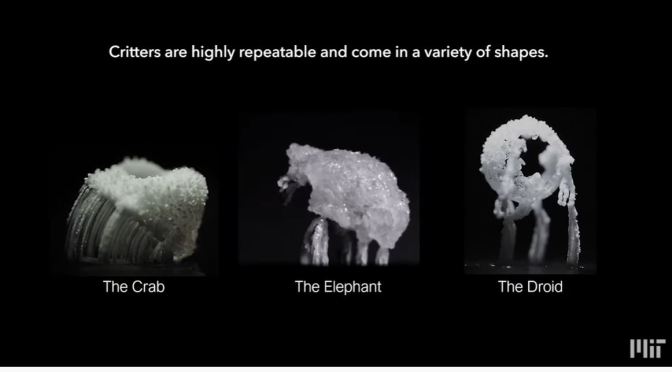
Science: Salt Water Evaporation Creates “Crystal Critters’ (MIT)
A team of MIT researchers have observed that when salty water evaporates from a heated, superhydrophobic surface the crystal structures that form can easily be removed or roll away on their own.
This phenomenon could make it possible to use brackish or salty water, without any pretreatment, rather than relying on freshwater sources, for cooling systems in power plants.

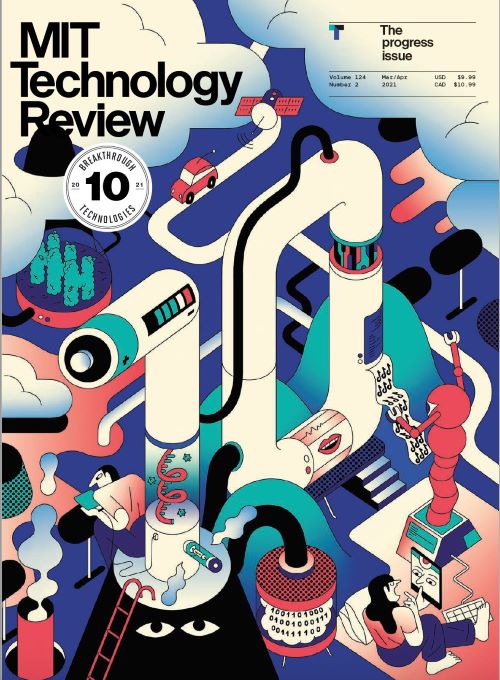
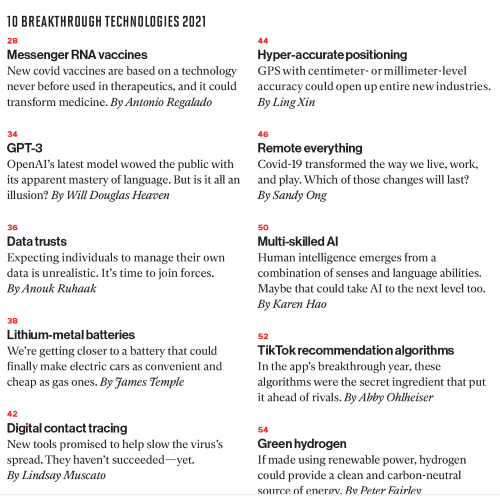
MIT Technology Review: The ‘Top 10 Breakthrough Technologies’ (Mar 2021)
Science Podcast: Ash Trees At Risk, Organizing Active Matter And Robot Swarms
Freelance journalist Gabriel Popkin and host Sarah Crespi discuss what will happen to ash trees in the United States as federal regulators announce dropping quarantine measures meant to control the emerald ash borer—a devastating pest that has killed tens of millions of trees since 2002.
Instead of quarantines, the government will use tiny wasps known to kill the invasive beetles in hopes of saving the ash. Sarah also talks with Pavel Chvykov, a postdoctoral researcher at the Massachusetts Institute of Technology, about the principles for organizing active matter—things like ant bridges, bird flocks, or little swarms of robots.
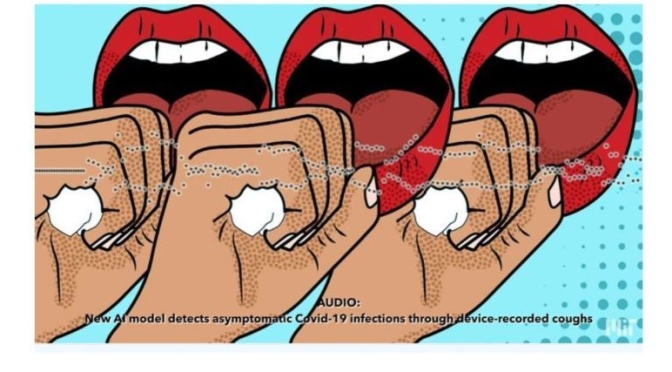
Health & Technology: New MIT AI Model Detects Asymptomatic Covid-19
A team of MIT researchers have developed an AI model that can distinguish asymptomatic people with Covid-19 from healthy individuals without the disease through forced-cough recordings. (Learn more: http://news.mit.edu/2020/covid-19-cou…

Global News: Putin’s Fears, The Trump Convention & MIT Of France (Economist)
A selection of three essential articles read aloud from the latest issue of The Economist. This week: what Putin fears, (9:10) Trump at the Republican National Convention and (16:10) France’s university to rival MIT.
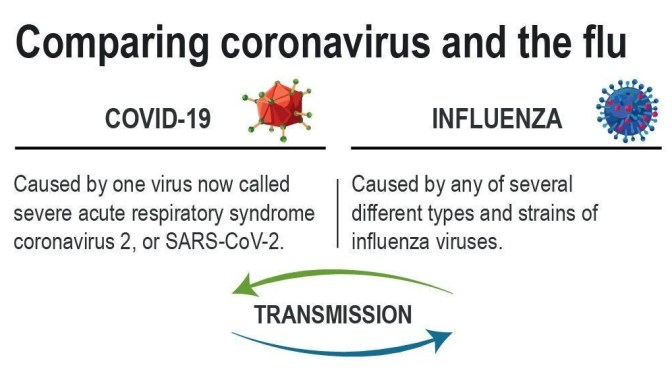
Health Update: Comparing “Coronavirus / Covid-19” And “Influenza” (W.H.O.)
From an MIT Technology Review article (March 11, 2020):
Here are six differences between coronavirus and the flu:
 Coronavirus appears to spread more slowly than the flu. This is probably the biggest difference between the two. The flu has a shorter incubation period (the time it takes for an infected person to show symptoms) and a shorter serial interval (or the time between successive cases). Coronavirus’s serial interval is around five to six days, while flu’s gap between cases is more like three days, the WHO says. So flu still spreads more quickly.
- Shedding: Viral shedding is what happens when a virus has infected a host, has reproduced, and is now being released into the environment. It is what makes a patient infectious. Some people start shedding the coronavirus within two days of contracting it, and before they show symptoms, although this probably isn’t the main way it is spreading, the WHO says.
- Secondary infections. As if contracting coronavirus wasn’t bad enough, it leads to about two more secondary infections on average. The flu can sometimes cause a secondary infection, usually pneumonia, but it’s rare for a flu patient to get two infections after the flu. The WHO warned that context is key (someone who contracts coronavirus might already have been fighting another condition, for example).
 Don’t blame snotty kids—adults are passing coronavirus around. While kids are the primary culprits for flu transmission, this coronavirus seems to be passed between adults. That also means adults are getting hit hardest—especially those who are older and have underlying medical conditions. Experts are baffled as to why kids seem protected from the worst effects of the coronavirus, according to the Washington Post. Some say they might already have some immunity from other versions of the coronavirus that appear in the common cold; another theory is that kids’ immune systems are always on high alert and might simply be faster than adults’ in battling Covid-19.
- Coronavirus is far deadlier than the flu. Thus far, the mortality rate for coronavirus (the number of reported cases divided by the number of deaths) is around 3% to 4%, although it’s likely to be lower because many cases have not yet been reported. The flu’s rate is 0.1%.
- There is no cure or vaccine for the coronavirus. Not yet, anyway, although work is under way. There is, however, a flu vaccine—and everyone should get it, not least because being vaccinated could help lessen the load on overstretched medical services in the coming weeks.
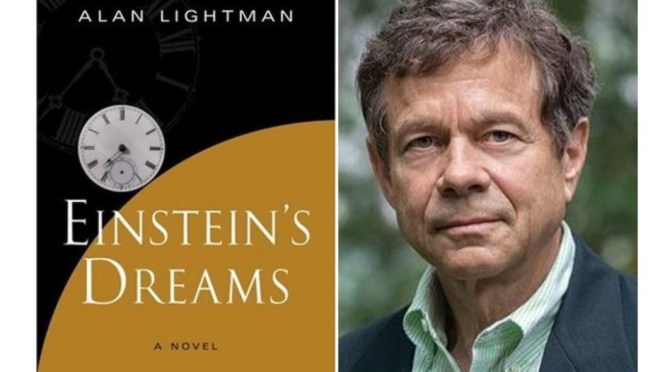
Profiles: 71-Year Old Physicist And Author Alan Lightman’s “Creative Life”
From a New York Times online article (February 13, 2020):
“I love physics, but what was even more important to me was leading a creative life,” Dr. Lightman said. “And I knew that writers could continue doing their best work later in life.”

Lightman is best known in literary circles for his 1992 novel, “Einstein’s Dreams,” which is all about the vicissitudes – romantic, physical and otherwise – of time. It recounts the nightly visions of a young patent clerk in Bern, Switzerland, as he struggles to finish his theory of relativity.
But before that, Dr. Lightman was an astrophysicist, a card-carrying wizard of space and time, with a Ph.D. from the California Institute of Technology and subsequent posts at Cornell and Harvard In 1989, at the peak of his prowess as a physicist, he began to walk away from the world of black holes to enter the world of black ink and the uncertain, lonely life of the writer.
Recently he was in New York for the opening of “Einstein’s Dreams,” an off-Broadway play based on his book. There have been dozens of such stage adaptations over the last 30 years.
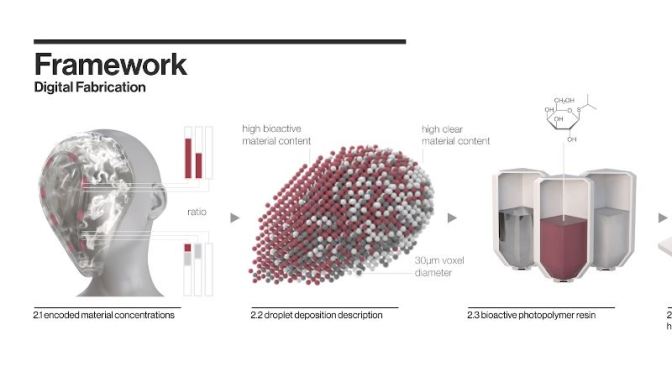
Science And Technology: “3D Printing With Living Organisms” (MIT Video)
A method for printing 3D objects that can control living organisms in predicable ways has been developed by an interdisciplinary team of researchers at MIT and elsewhere. This technique may lead to 3D printing of biomedical tools that can be customized to fit the physical body and biomarkers of its users.
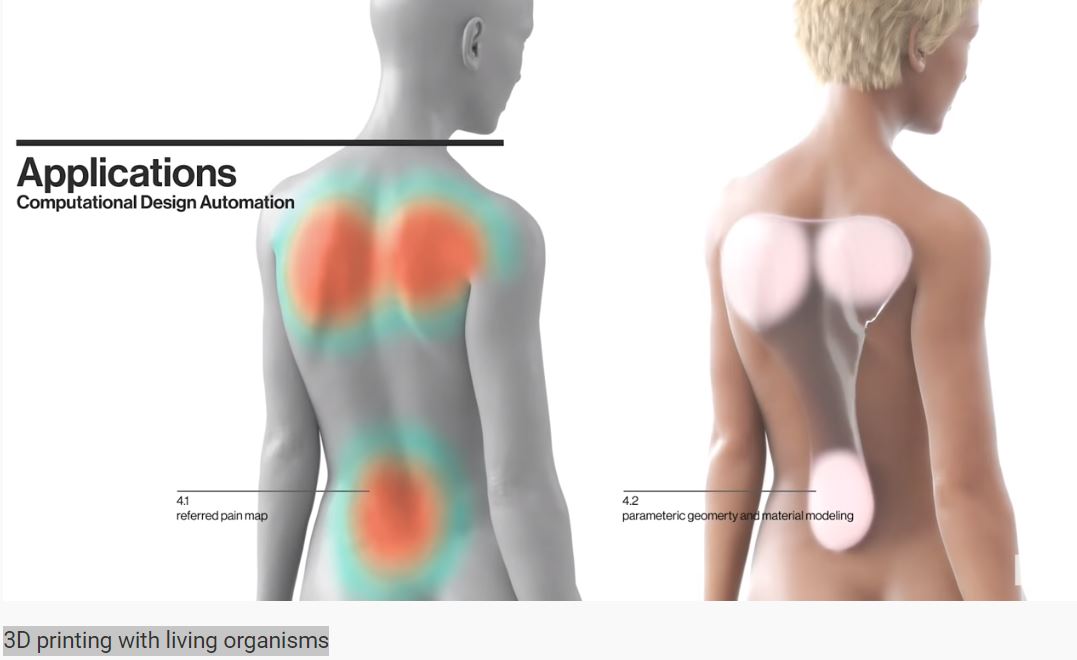
(Learn more: http://news.mit.edu/2020/3-d-bioprint…)
Listen to an explainer on 3D bioprinting and biohybrid materials: https://soundcloud.com/mitnewsoffice/…

Photography: History Of Instant Photos At “The Polaroid Project” (PBS)
The Polaroid camera bypassed the entire process of film development, thus providing photographers an immediate look at their work. Released for sale in 1948, the first version was an “instant” hit. Now, the museum at the Massachusetts Institute of Technology is showcasing the intersection of technology and art. Special correspondent Jared Bowen of WGBH reports.
 Boomers Daily