A selection of three essential articles read aloud from the latest issue of The Economist. This week: what Putin fears, (9:10) Trump at the Republican National Convention and (16:10) France’s university to rival MIT.
Tag Archives: MIT
Health Update: Comparing “Coronavirus / Covid-19” And “Influenza” (W.H.O.)
From an MIT Technology Review article (March 11, 2020):
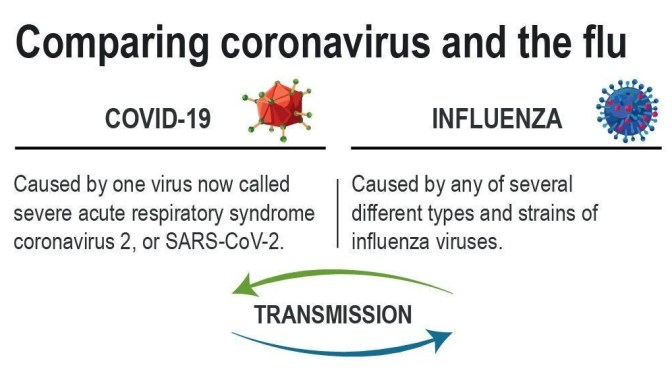
Here are six differences between coronavirus and the flu:
Coronavirus appears to spread more slowly than the flu. This is probably the biggest difference between the two. The flu has a shorter incubation period (the time it takes for an infected person to show symptoms) and a shorter serial interval (or the time between successive cases). Coronavirus’s serial interval is around five to six days, while flu’s gap between cases is more like three days, the WHO says. So flu still spreads more quickly.- Shedding: Viral shedding is what happens when a virus has infected a host, has reproduced, and is now being released into the environment. It is what makes a patient infectious. Some people start shedding the coronavirus within two days of contracting it, and before they show symptoms, although this probably isn’t the main way it is spreading, the WHO says.
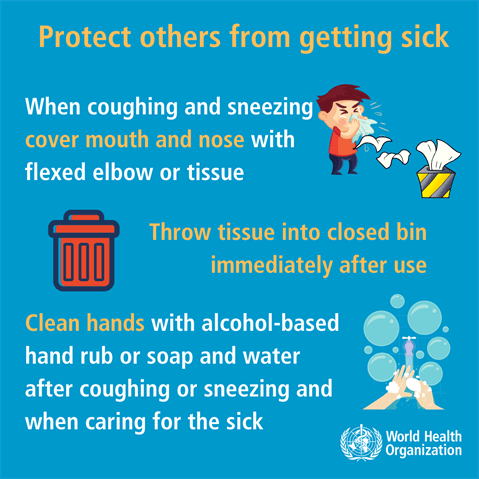
- Secondary infections. As if contracting coronavirus wasn’t bad enough, it leads to about two more secondary infections on average. The flu can sometimes cause a secondary infection, usually pneumonia, but it’s rare for a flu patient to get two infections after the flu. The WHO warned that context is key (someone who contracts coronavirus might already have been fighting another condition, for example).
Don’t blame snotty kids—adults are passing coronavirus around. While kids are the primary culprits for flu transmission, this coronavirus seems to be passed between adults. That also means adults are getting hit hardest—especially those who are older and have underlying medical conditions. Experts are baffled as to why kids seem protected from the worst effects of the coronavirus, according to the Washington Post. Some say they might already have some immunity from other versions of the coronavirus that appear in the common cold; another theory is that kids’ immune systems are always on high alert and might simply be faster than adults’ in battling Covid-19.- Coronavirus is far deadlier than the flu. Thus far, the mortality rate for coronavirus (the number of reported cases divided by the number of deaths) is around 3% to 4%, although it’s likely to be lower because many cases have not yet been reported. The flu’s rate is 0.1%.

- There is no cure or vaccine for the coronavirus. Not yet, anyway, although work is under way. There is, however, a flu vaccine—and everyone should get it, not least because being vaccinated could help lessen the load on overstretched medical services in the coming weeks.
Profiles: 71-Year Old Physicist And Author Alan Lightman’s “Creative Life”
From a New York Times online article (February 13, 2020):
“I love physics, but what was even more important to me was leading a creative life,” Dr. Lightman said. “And I knew that writers could continue doing their best work later in life.”

Lightman is best known in literary circles for his 1992 novel, “Einstein’s Dreams,” which is all about the vicissitudes – romantic, physical and otherwise – of time. It recounts the nightly visions of a young patent clerk in Bern, Switzerland, as he struggles to finish his theory of relativity.
But before that, Dr. Lightman was an astrophysicist, a card-carrying wizard of space and time, with a Ph.D. from the California Institute of Technology and subsequent posts at Cornell and Harvard In 1989, at the peak of his prowess as a physicist, he began to walk away from the world of black holes to enter the world of black ink and the uncertain, lonely life of the writer.
Recently he was in New York for the opening of “Einstein’s Dreams,” an off-Broadway play based on his book. There have been dozens of such stage adaptations over the last 30 years.
Science And Technology: “3D Printing With Living Organisms” (MIT Video)
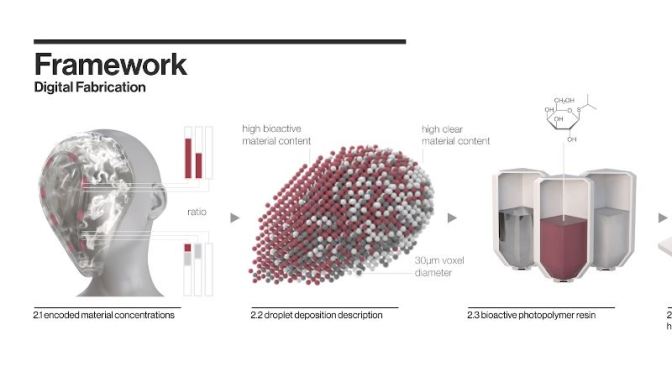
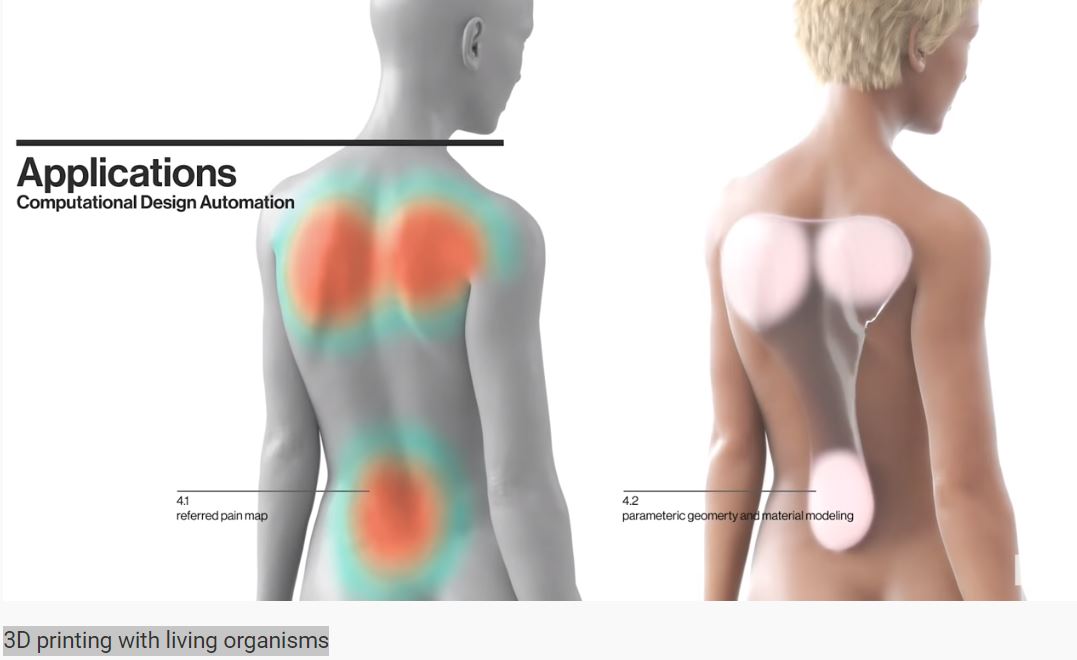
A method for printing 3D objects that can control living organisms in predicable ways has been developed by an interdisciplinary team of researchers at MIT and elsewhere. This technique may lead to 3D printing of biomedical tools that can be customized to fit the physical body and biomarkers of its users.

(Learn more: http://news.mit.edu/2020/3-d-bioprint…)
Listen to an explainer on 3D bioprinting and biohybrid materials: https://soundcloud.com/mitnewsoffice/…
Photography: History Of Instant Photos At “The Polaroid Project” (PBS)
The Polaroid camera bypassed the entire process of film development, thus providing photographers an immediate look at their work. Released for sale in 1948, the first version was an “instant” hit. Now, the museum at the Massachusetts Institute of Technology is showcasing the intersection of technology and art. Special correspondent Jared Bowen of WGBH reports.
New Research Videos: “Mining The Deep Sea” (MIT)
Mining minerals found 15,000 feet below sea level could help secure a low-carbon future, but at what cost? Researchers including Thomas Peacock, professor of mechanical engineering at MIT, are racing to understand the environmental impact of deep-sea mining.
Home Energy Podcasts: “The Economics Of Rooftop Solar” (MIT)
Scott Burger, MITEI Energy Fellow and researcher, discusses rooftop solar economics, net metering, energy poverty, and electricity costs. Show notes and transcript: https://energy.mit.edu/podcast/16

Consumer Issues: Many Products Designed For Older People Are Just “Brown, Beige And Boring”
From a MIT Technology Review online article:
Engaging older people in designing for older people “is a good thing,” says Smith. “Because younger people do tend to have this picture of designing things that are functional for older people, but not really understanding what makes them happy.” Presented with products that are “brown, beige, and boring,” many older people will forgo convenience for dignity.
It’s a familiar tune to engineer Ken Smith, director of the mobility division of the Stanford Center on Longevity. He says one of the biggest mistakes designers make is to assume that around the age of 60 people lose interest in aesthetics and design. This can have dire consequences for products meant to help people with their health. No one wants to stick a golf-ball-size hearing aid the color of chewed gum in their ear, any more than they want to wear a T-shirt that reads “SENIOR CITIZEN.”
To read more click on the following link: https://www.technologyreview.com/s/614167/why-are-products-for-older-people-so-ugly/?utm_campaign=the_download.unpaid.engagement&utm_source=hs_email&utm_medium=email&utm_content=76169117&_hsenc=p2ANqtz-_dlTg24O7Cr_1b5J4cniKFvi74Dmh8Fm3nuJVTbblAB8Z3fna_Rj6WoV6M6aodqOVSJnh603-liOHFgjAr_EQEh9sVQw&_hsmi=76169117
Health Care: Researchers Have Developed “Fast-Acting” Skin Patch To Attack Melanoma Cells
From a ScienceDaily.com online article:
Now, researchers have developed a fast-acting skin patch that efficiently delivers medication to attack melanoma cells. The device, tested in mice and human skin samples, is an advance toward developing a vaccine to treat melanoma and has widespread applications for other vaccines.
Nearly 100,000 new cases of melanoma are diagnosed annually, and 20 Americans die every day from it. Now, researchers have developed a skin patch that efficiently delivers medication within one minute to attack melanoma cells. The device, tested in mice and human skin samples, also could be adapted to deliver other vaccines.
“Our patch has a unique chemical coating and mode of action that allows it to be applied and removed from the skin in just a minute while still delivering a therapeutic dose of drugs,” says Yanpu He, a graduate student who helped develop the device. “Our patches elicit a robust antibody response in living mice and show promise in eliciting a strong immune response in human skin.”
To read more click on the following link: https://www.sciencedaily.com/releases/2019/08/190825075926.htm
MIT AgeLab: Consumer Product Companies Need To Make Older Adults A “Core Constituency”
From an MIT Technology Review article by Joseph F. Coughlin:
Technologists, particularly those who make consumer products, will have a strong influence over how we’ll live tomorrow. By treating older adults not as an ancillary market but as a core constituency, the tech sector can do much of the work required to redefine old age. But tech workplaces also skew infamously young. Asking young designers to merely step into the shoes of older consumers (and we at the MIT AgeLab have literally developed a physiological aging simulation suit for that purpose) is a good start, but it is not enough to give them true insight into the desires of older consumers. Luckily there’s a simpler route: hire older workers.
Of all the wrenching changes humanity knows it will face in the next few decades—climate change, the rise of AI, the gene-editing revolution—none is nearly as predictable in its effects as global aging. Life expectancy in industrialized economies has gained more than 30 years since 1900, and for the first time in human history there are now more people over 65 than under 5—all thanks to a combination of increasing longevity, diminished fertility, and an aging Baby Boom cohort. We’ve watched these trends develop for generations; demographers can chart them decades in advance.
To read more click on the following link: https://www.technologyreview.com/s/614155/old-age-is-made-upand-this-concept-is-hurting-everyone/