Tag Archives: Melbourne

Homes: Anderson Road, Hawthorn, Australia

When an architect designs a home, the idea of balance is keenly considered. Testifying to this notion is Anderson Road, which sees B.E Architecture use custom flooring and landscape architecture to control the impact of a raw material palette.

00:00 – Introduction to the Home 00:41 – Utilising Raw and Natural Materials 01:22 – Strong Features and Elements in the Home 01:57 – Unique Connection of Buildings and Spaces 03:06 – Landscape Architecture 03:32 – Customised, Natural Timber Flooring 04:58 – Low Maintenance Living 05:19 – What the Architect is Most Proud Of 05:39 – What Made by Storey is Most Proud Of

A house tour of the resulting residence reveals a harmonious pairing of brickwork and natural timber. Located in the Melbourne suburb of Hawthorn, Anderson Road embraces the spatial opportunities afforded by its site. Externally, the architect designs a home that is staggered in levels; a series of buildings, separated by surprising pockets of landscape architecture. To the rear of the property, an expanse of greenery leads to the swimming pool. Internally, the architect designs a home with a dynamic spatial arrangement. Whilst the soaring ceiling of the living room interacts with the compressed hallway space, a statement ribbon staircase flows smoothly into an open kitchen that is centred on a concrete island bench. Responding to the brickwork of the house, timber flooring by Made by Storey softens the material character of the dwelling. When an architect designs a home, Made by Storey is on-hand to provide bespoke flooring solutions that embrace the desire for customisation. Selected in the warming colour of Sesame, the flooring of Anderson Road is comprised of narrow boards, with each echoing the profile of the brickwork. Pushing the boundaries of residential interior design, the architect designs a home that serves as a lesson in materiality. By balancing the impactful brickwork with timber flooring, B.E Architecture creates a sense of harmony within a dynamic and custom-made project.
Modern Architecture: 10 Apartment Home ‘Fenwick’, Kew, Melbourne, Australia

Uniting the gestures of interior design, architecture and landscape, Fenwick embodies a coherent vision of modern apartment homes. Developed by ANGLE in collaboration with Edition Office and Flack Studio, the building uses an evolving connection to context to answer an open design brief.

00:00 – Introduction to the Modern Apartment Homes 00:42 – The Client Brief 01:29 – Finding Inspiration for the Apartment’s Design 02:18 – The Kitchen Island Bench 02:35 – Durable Material Selection 03:10 – Hero Spaces 03:30 – Landscape Architecture 04:42 – Connection to Country

Situated on the banks of Yarra River in the Melbourne suburb of Kew, Fenwick straddles environments of dense forest and heritage buildings. As a unique by-product of its location – wherein nothing can be built in front of the home – the ten modern apartment homes have access to immersive, panoramic views that capture both the wilderness and city.

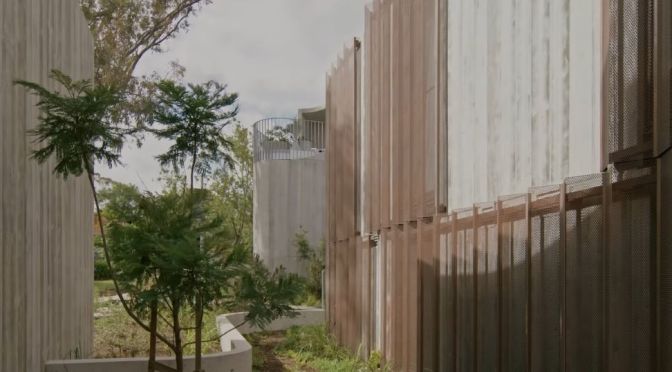
The exterior of Fenwick purposefully interacts with the natural surrounds. Conceived as a broken mass, the modern apartment homes are divided amongst three distinct pavilions that allow for view corridors between parts, extending across the gardens to the landscaped scenes beyond. Presenting Fenwick as an extension of the environment, Eckersley Garden Architecture designs a landscape reminiscent of the neighbouring greenery.

Lying beyond the modern apartment homes are layers of native shrubs, grasses and lower ground covers that change in accordance with the seasons, continuing to establish the development over time. With an interior design that draws the eye towards the outdoors, Fenwick thoroughly embraces its Kew context. By pursuing a connection to nature through interior design, architecture and landscaping, ANGLE ensures that the modern apartment homes effectively echo the language of the surrounds.

Architecture: Flinders Residence – A Modern Cabin Design In Australia

Flinders Residence is a modern cabin mansion imbued with the romantic character of a farm-style home. Created by Abe McCarthy Architects with an interior crafted by AV-ID, the coastal building combines minimalism and luxury to benefit a growing family.

Timeline: 00:00 – Introduction to The Modern Cabin Mansion 00:46 – The Reveal 02:09 – Collaboration Between Architect and Interior Designer 02:47 – Use of Materials 03:27 – Contrast Between Light and Dark 04:10 – Design and Detail 04:44 – Materials, Products and Furniture Round-Up 06:18 – What the Interior Designer is Most Proud Of

Aptly removed from the city workings of nearby Melbourne, Flinders Residence sits in its namesake town as a modern cabin mansion. The building is first revealed at the end of a long driveway, standing as three interconnected pavilions nestled within the landscape. Located at the entry point of the home is an architecturally framed view of the horizon, whilst a sense of volume created by the barn-style framework contributes to the dramatic experience of the internal envelope of the modern cabin mansion.

The interior design of the modern cabin mansion intertwines the aesthetic preferences of both homeowners. A minimalist scheme of contrasting light and dark tones is complemented by luxurious materials and finishes, including Brazilian granite, marble, brass and bronze.

The use of timber pays homage to both clients’ involvement in the timber industry. Inspired by European and American homesteads, Flinders Residence stands as a refined and modern cabin mansion. Using a sophisticated and restrained materiality, the design successfully captures the romantic appeal of a farm-style home whilst adding a luxurious touch.

Townhome Tours: Azura Aspendale, Australia (4K)

Developed by Lowe Living in collaboration with Chamberlain Architects and GOLDEN, Azura Aspendale showcases the very best of beachside living. A house tour of an exemplar modern apartment proves the property to be a well-considered complex, seeing each resident have direct access to the nearby ocean.

Chapters: 00:00 – Introduction to the Modern Apartment 00:43 – Meeting the Brief 01:45 – Beach Access 02:07 – Designing for the Landscape 03:00 – Sustainable Design Features 03:45 – Apartment Living Features 04:24 – Indoor-Outdoor Living 04:55 – Executing a Strong Idea 05:19 – What the Architect is Most Proud Of

Sitting on a slither of land between the beach and the railway in Aspendale, the modern apartment is one of 19 within the complex, which is complemented by eight townhouses. Behind the apartment is a designed landscape that uses walkways to directly connect residents to the beachfront, with the walkways leading to a purposeful cut in the front of the building.

Presenting as a singular form, the external architecture of Azura Aspendale picks up on the vast horizon that the modern apartment faces. The rectilinear structure of the building succeeds in light of its modest presence; as opposed to visually dominating the natural landscape, the development presents as architecturally timeless and in harmony with its context.

The interior design of Azura Aspendale follows from the surrounding landscape. Natural materials such as chalky limestone and textured granite subtly refer to the outdoors whilst testifying to the significance of material longevity. Windows to the front and back of each modern apartment complete the airy, externally focused interior design.

Standing as a highly admirable collection of residences, Azura Aspendale is a gem in the Lowe Living property portfolio. From its materiality to its well-developed connection to the outdoors, each modern apartment provides an elegant means of experiencing beachside living.

Architecture: Hopetoun In Melbourne, Australia

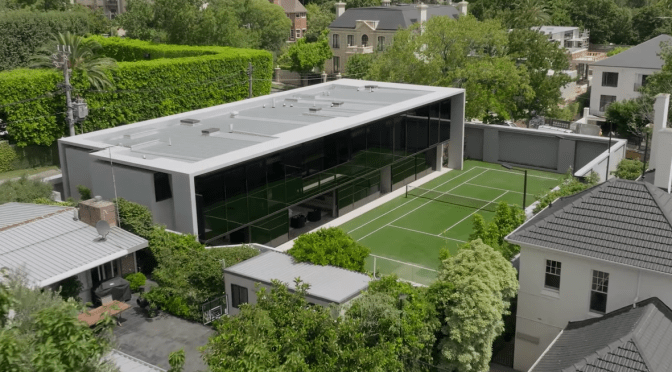
A solid concrete dwelling, The Hopetoun is a luxury super house, complete with a tennis court and sleek garage. Meticulously designed by FGR Architects, the new build combines architecture, lighting and textural detail to reveal internal spaces of surprising delicacy.

Video Timeline: 00:27 – Entering the Super House 01:21 – Minimalist Architecture 01:57 – Connection Between Spaces 02:19 – Positioning the House 02:59 – Lighting in the House 03:40 – Concrete Architecture 04:37 – Utilising Stone and Timber 04:54 – Breaking Tradition

Located in the leafy Melbourne suburb of Toorak, The Hopetoun is a super house designed to accommodate a large family. Situated on the corner of a road, the house is crafted to dramatically embrace the breadth of its site, presenting a broad and expansive façade to the street. A house tour of the property sheds light on the layout of the super house, carefully planned by the architect.

FGR Architects configures the home to maximise solar penetration via the northern aspect, fitting the sunlit side of the house with ample glazing and arranging the internal spaces to reflect the need for natural light. Whilst the southern orientation houses utilities and services, the northern counterpart is occupied by the most frequently habited rooms. A sculptural set of stairs forms the highlight of the interior design. FGR Architects uses lighting to express the structural prowess of the concrete super house, including the implemented overhangs within the architecture.

The delicate interaction between the undulating texture of the concrete walls and the warm wash of artificial light presents lighting almost as a material in itself, equal amongst the concrete, glass, stone and timber. Utilising the refined nature of concrete in relation to light, FGR Architects is able to create a sophisticated super house that possesses the robust material character to age elegantly through time. 00:00 – Introduction to the Super House

Architecture & Design: ‘Courtyard House’ In Hawthorn, Australia

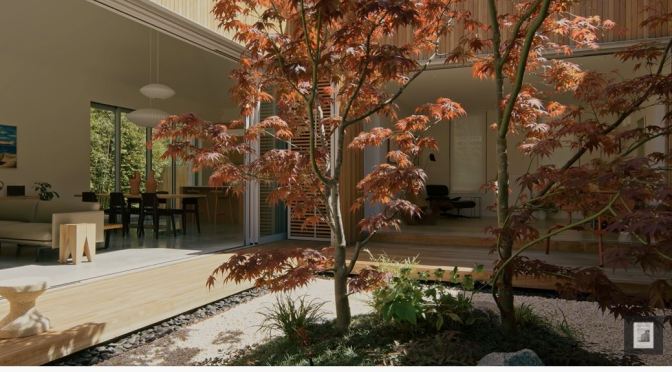
Courtyard House by Ha Architecture is a Japanese inspired home, presented as a merging of heritage and contemporary design. The home’s streetscape heritage overlay allowed the existing home façade to be maintained; it was restored and repaired to its original condition, including the original windows. Internally, a meeting of contemporary and traditional principles imbues the space with a tranquil charm – a quiet space of reflection and rest. Inside the Japanese inspired home, Courtyard House is centred around its internal courtyard.

The brief required an adaption of contemporary Japanese architecture and lifestyle ideologies, with a focus on outdoor spaces and passive design principles. The entryway is intimate, instilled with ambient light and an immediate saturation of timber. This sensory experience allows Courtyard House to emerge as a Japanese inspired home, propelled by an inherent sustainability that underpins the very fabric of the project. Windows frame backdrops of bamboo and showcase selected stone features, creating a constant discourse between the internal and external spaces. The landscape orientation, as well as vantage points, play a considered role in the architecture.

Design Tour: ‘Harry House’ In Melbourne, Australia

Nestled in the northern suburb of Coburg, Harry House by Archier is a Japanese-inspired home that radiates familiarity and comfort. As per the clients’ brief,

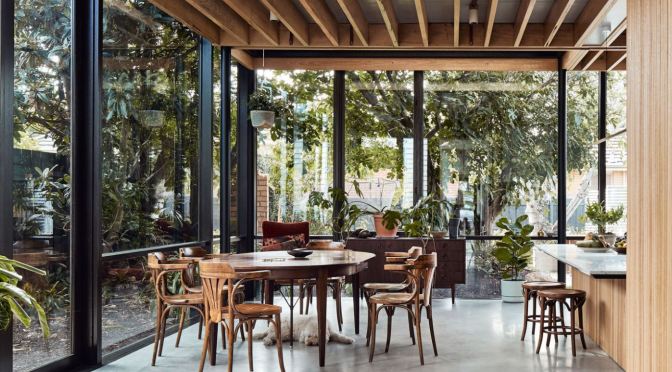
Harry House is a Japanese-inspired home, with Archier incorporating Japanese design into many aspects of the architecture. Originally, the site was a double-fronted pre-war weatherboard cottage; the clients wanted to retain the entry’s warmth but reorientate the living space to frame the green foliage. This allowed the space to be maximised, combining the old and new aspects of the building. Named after the family dog ‘Harry’,

Harry House experiments with interior design, space and usability. The materials were chosen with care, making sure that each element ages well and is robust for family life. The textures celebrate honest carpentry, with materials that are unpolished yet full of life, adding to the atmosphere of the home. Harry House is centred around family, with bespoke living areas that connect multiple aspects of the home. This includes the soft netted areas located in the voids, allowing the residents to occupy spaces without needing furniture. Archier’s extension adds new elements of play, specifically in its design references to a childhood treehouse. The client’s Japanese heritage inspired the house, including how the space interplays with natural light and connection to the lush gardens. Located 10 minutes from the Archier Studio, the house has access to the Merri Creek, as well as restaurants on Lygon Street and Sydney Road. As a Japanese-inspired home, the layout of the bathrooms was important for functionality and design. With separate spaces for the toilet, basin and bathing, it is easy to see how the architecture was influenced by the client’s heritage, honouring the traditional ways Japanese bathrooms are configured. Having exceeded the clients’ expectations, and taking design inspiration from the client’s Japanese heritage, Harry House by Archier is a sustainable home, ready to raise a young family. Architecture and Interior Design by Archier. Filmed and Edited by Dan Preston. Production by The Local Project.

Culture & Design: The ‘Chinatown’ Style In Cities

From London, to Manila, to Melbourne, Chinatowns in cities around the world share similar design elements. And that’s on purpose. Their distinct “Chinatown” style can be traced back to a single event: the 1906 San Francisco earthquake, which came on the heels of decades of violence and racist laws targeting Chinese communities in the US. The earthquake devastated Chinatown. But in the destruction, San Francisco’s Chinese businessmen had an idea for a fresh start: a way to keep their culture alive, by inventing a completely new one. Chinatown carved out a place for itself under the threat of hate and violence. Today, that legacy is staring us in the face.

Architectural Home Tour: A Converted Warehouse, Melbourne, Australia (4K)

An architect’s own home can be a challenge to design, with no brief or boundaries to adhere to, leaving the architect’s skill set and true style exposed for all to see. This converted warehouse is an architect’s own home, designed by and for Rob Mills of Rob Mills Architecture and Interior Design.

Located in Armadale, a Melbourne suburb known for its character and village atmosphere, the house was created through a warehouse conversion, which gave the architect plenty of scope and space to design a piece of architecture that truly reflected his likes and wishes. Harnessing this space in the converted warehouse home, the house carries over three levels, with an apartment, sauna and garage at ground level, living in the middle, and bedrooms above.

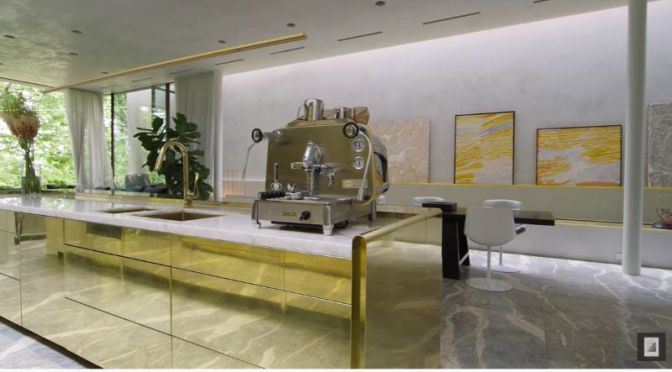
The interior design uses a minimal palette of stone, timber, stucco, glass and metal, with brass playing a large part in the design, especially in the kitchen where it is used extensively and effectively. This glamour and drama are at the heart of the interior design of the converted warehouse. A spiral staircase adds a sculptural element to the house, while also providing an efficient method of travelling between floors.

The office, which has an English aesthetic with lush yet classic-style furniture, features timber shutters that close off to create a focused environment or open to let in plenty of natural daylight. Close connections to nature were important to the architect, Rob Mills of Rob Mills Architecture and Interior Design. A water feature trickles through the living space of the converted warehouse, providing a meditative element to the room. Materials were chosen for their non-toxicity, with stucco walls specified as a natural alternative to paint.

An architect’s own converted warehouse home, Armadale Residence features designer furniture throughout that is carefully chosen to subtly fit with the shine and glamour of the materials. Architecture and Interior Design by Rob Mills Architecture and Interior Design. Filmed and Edited by Cheer Squad Film Co. Production by The Local Project.

Architectural Tours: ‘JARtB House’, Melbourne, Australia (4K Video)

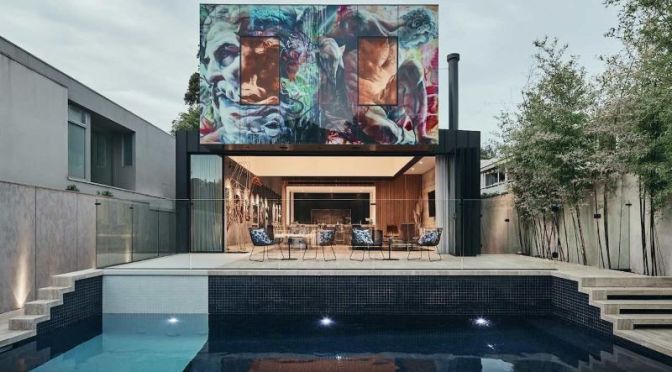
Nestled in a tree-lined street in the affluent suburb of Toorak in Melbourne, JARtB House is an architect’s home that explores art and architecture. Director of international award-winning architecture firm Kavellaris Urban Design (KUD), Billy Kavellaris designed his house with a view to creating both an art gallery and a family home.

The design explores the idea that art and architecture are separate disciplines but also that art can be fused with everyday life. A white circulation strip through the house doubles as a gallery, displaying the architect’s extensive art collection. Some pieces, such as the lofty giraffe sculptures, were designed especially for the space within the architect’s own home. The upper floor is ensconced in a custom mural created by Spanish artist duo PichiAvo.

Made up of 13 panels stitched together across the facade of the house, this artwork can be experienced from both inside and outside the house. The architecture and interior design can also be seen as art itself, with unusual and opulent staircases connecting floors, and uniquely shaped openings and furniture pieces. Bespoke timber flooring and panelling created by Made by Storey is used throughout the home on walls and floors, creating a sense of cohesion and warmth.

Other materials, such as concrete and steel, are carefully chosen for atmosphere and visual interest, while colour is largely provided by the artworks.

Architecture and Interior Design by Kavellaris Urban Design (KUD). Custom Timber Flooring, Stairs and Ceiling by Made by Storey. Video by Cheer Squad Film Co. Production by The Local Project.