Tag Archives: Literature

The New York Times Magazine – Oct 22, 2023

Image

THE NEW YORK TIMES MAGAZINE (October 22, 2023): The latest issue features In Search of Kamala Harris; Longer Commutes, Shorter Lives: The Costs of Not Investing in America and The Botched Hunt for the Gilgo Beach Killer….

In Search of Kamala Harris

Vice President Kamala Harris stands with her arms crossed.

After nearly three years, the vice president is still struggling to make the case for herself — and feels she shouldn’t have to.

By Astead W. Herndon

All the conditions seemed right for a chance to reset the narrative.

At the Munich Security Conference in February, amid rising international angst about Russia’s war in Ukraine, Vice President Kamala Harris led a delegation of Americans, including around 50 lawmakers from both parties. She spent her first day in Germany in seclusion, preparing for the next 48 hours: meetings with European leaders the first day and a keynote speech the next in the ornate ballroom of the Hotel Bayerischer Hof. When she emerged, head high and shoulders back, Harris exuded what her staff members have argued is a particular comfort with her role on the international stage. There, they say, she is respected.

Longer Commutes, Shorter Lives: The Costs of Not Investing in America

An illustration of various historical photographs depicting technologies in a collage.

For decades, spending on the future put the nation ahead of all others. What would it take to revive that spirit?

By David Leonhardt

Every morning in 21st-century America, thousands of people wake up and prepare to take a cross-country trip. Some are traveling for business. Others are visiting family or going on vacations. Whether they are leaving from New York or Los Angeles, Atlanta or Seattle, their trips have a lot in common.

The New York Times Magazine – Oct 15, 2023

Image

THE NEW YORK TIMES MAGAZINE (October 15, 2023):

My Delirious Trip to the Heart of Swiftiedom

All the photographs in this article are black-and-white. Taylor Swift onstage facing away from the camera.

Taylor Swift’s greatest gift is for telling her own story — better than any journalist could. But Taffy Brodesser-Akner gives it a shot anyway.

By Taffy Brodesser-Akner

Section 301, in the second-to-highest tier of Levi’s Stadium, floats 105 feet above Santa Clara, Calif. It comprises 251 seats — a mere hamlet in the vast 64,000-seat general kingdom of the place, but it was our hamlet, and on the last Saturday in July, we took up each one of those seats and watched, our collective breath held, as Taylor Swift emerged from a bevy of billowing pastel parachutes and rose up on a platform to perform the 47th show of her Eras Tour. A few songs in, she announced, laughing, that her father told her that Santa Clara had named her its honorary mayor during her two-night stay there and that the entire town had been renamed Swiftie Clara. 

How Jesmyn Ward Is Reimagining Southern Literature

Jesmyn Ward

The novelist is competing with giants like William Faulkner, while mapping territory all her own.

By Imani Perry

Jesmyn Ward gestured with her eyes and a tilt of her face, hands on the wheel. “This crazy colored house right here? That’s my grandmother’s house. That’s the house I grew up in. And her sister lives there” — she pointed — “and then that little blue house? That’s my great-grandparents’ house.” She was driving me around DeLisle, Miss., her hometown and the inspiration for Bois Sauvage, the fictional setting of her first three novels. It is Deep South-in-August hot outside, and the air-conditioning was a relief. “My mom’s side of the family was all clustered around this road.”

Los Angeles Review Of Books – Autumn 2023

Image

LA Review of Books (Autumn 2023) – The latest issue features The Funny Thing About Misogyny; The New Scarcity Studies: On Two New Socioeconomic Histories and Endgame Emotions: The Melting of Time, the Mourning of the World…

The Funny Thing About Misogyny

By Katie Kadue

THE FUNNY THING about misogyny is it’s structured like a joke. Not a very good joke—a groaner, a dad joke. Why are they called “women”? Because they’re a woe to men. Get it? Woman is a container for man; language engenders gender subordination. As Mike Myers recites on stage in his role as a moody slam poet in the thrillingly zany 1993 Hitchcockian send-up So I Married an Axe Murderer, “Woman! Whoa, man. Whoaaaaaa. Man!”

The New Scarcity Studies: On Two New Socioeconomic Histories

By Scott R. MacKenzie

Scarcity: A History from the Origins of Capitalism to the Climate Crisis by CARL WENNERLIND

WATER FALLS FROM the sky, literally. It is the most abundant chemical compound on Earth, and yet many people buy it in plastic bottles. Nestlé and other corporations source water cheaply and add labels that depict something other than heavy-industry and fossil-fuel derivatives, as though you’re drinking straight from a pristine spring. By bottling this natural resource and selling it as a commodity, Nestlé creates a form of scarcity. 

Arts & Literature: Kenyon Review – Autumn 2023

Image

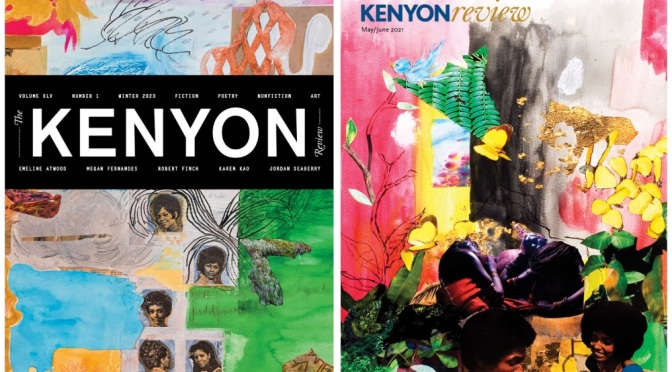
Kenyon Review – Autumn 2023: The new issue includes the winner and runners-up for the Patricia Grodd Poetry Prize for Young Writers, selected by Ruth Awad, and a Food-themed folio, with poetry by sam saxInga Lea Schmidt, and Holly Zhou; fiction by Rebecca AckermannElvis Bego, and Douglas Silver; nonfiction by Katie Culligan and Erica N. Cardwell; and much more. Luminous Gender Vessel, a folio guest-edited by Gabrielle Calvocoressi and Melissa Faliveno, features work by Krys Malcolm BelcKB BrookinsAlexis Pauline GumbsCatherine Kim, and many others. The cover art is by Joanna Anos.

Journalism: 2023 Whiting Literary Magazine Prizes

2023 Whiting Literary Magazine Prizes

Guernica

Guernica is a digital magazine with a global outlook, exploring connections between ideas, ideals, communities, and individual lives. It rejects binary thinking and conventional wisdom, investing instead in the power of counter-narratives, especially those driven by lived experience. Across fiction, poetry, essays, reportage, criticism, and art, Guernica is a home for established and emerging writers, in conversation with each other. Guernica is committed to global literature — highlighting work from independent presses across the Global South and translating work from every continent into English, and from English into global languages. Going into its twentieth year, Guernica remains a trusted home for incisive, urgent writing and singular perspectives on critical issues of the day.

Subscribe

Judges’ citation: 

Perennially curious, eager to reckon with the world head-on, Guernica draws readers into uncharted conversations and traces the complex ligaments connecting culture, politics, art, and ecology. Over twenty years, Guernica has built an impressive record as a place of first publication for important writers and thinkers. Guernica’s ability to deepen our sense of wonder, of responsibility, and of connection is rooted in a core conviction that we must hear from diverse voices and diverse places.

Los Angeles Review of Books

Drawing on literary tradition—and discarding it when necessary—Los Angeles Review of Books dwells in contradiction: the tension between depth and breadth, filth and glamor, destruction and creation, dream and nightmare, that L.A. lives and breathes. LARB launched in 2011 in part as a response to the disappearance of the newspaper book review supplement, and with it, the art of lively, intelligent, long-form writing on recent publications in every genre. LARB has since become a polyvocal cultural force reinventing book criticism for the internet age. It publishes new reviews, essays, and interviews online daily, as well as a print journal, LARB Quarterly, and offers events and programs that connect writers and artists to readers both in Los Angeles and across the globe.

Subscribe

Judges’ citation: 

A pillar of West Coast literary culture with national impact, Los Angeles Review of Books astounds with its scope. Its essays, reviews, and interviews are imbued with the irresistible appeal of fresh ideas and the rigor of academic inquiry. As an organization it creates and renews vital space for connection, especially through its innovative publishing workshop. New and accomplished international authors and translators cascade out of LARB, and its coverage of contemporary literature is steeped in style and substance. The commitment to history, critical thought, imagination, and to its eponymous city runs deep.

Mizna

Mizna reflects the literatures of Southwest Asian and North African (SWANA) communities and fosters the exchange and examination of ideas, allowing readers and audiences to engage with SWANA writers and artists on their own terms. It has been a critical platform for contemporary literature, film, art, and cultural production since 1999, publishing a biannual print journal of poetry, fiction, essays, comix, and visual art in addition to producing the Twin Cities Arab Film Festival, the largest and longest running Arab film fest in the Midwest. Recognizing that open cultural spaces are not a luxury but a necessity, Mizna also hosts classes, readings, and community events that offer points of connection between emerging and established SWANA artists and their local Twin Cities community and beyond.

Subscribe

Judges’ citation: 

Mizna is an absolute gem of a journal: tightly edited, gorgeously curated, and visually striking. Care and craft float off its pages of beautifully laid-out poetry and lovingly printed images. Mizna is both a grassroots community organization and an esteemed international artistic platform, furthering important intergenerational dialogue within the Southwest Asian and North African (SWANA) diaspora and showcasing thrilling new literature.

n+1

n+1 encourages writers, new and established, to take themselves as seriously as possible, to write with as much energy and daring as possible, and to connect their own deepest concerns with the broader social and political environment—that is, to write, while it happens, a history of the present day. n+1 was founded in New York City, in 2004, by six young writers and editors who wanted to make a magazine that didn’t shy away from difficult and ambitious writing and would take literature, culture, and politics as aspects of the same project. In addition to the triannual print and digital magazine, n+1 also publishes books that expand on the interests of the magazine and programs readings, panels, and events in New York City and across the US.

Subscribe

Judges’ citation: 

A distinctive, erudite editorial project overflowing with rigor and generosity, n+1 is both magnet and catapult for intellectually fearless writers. Its uniquely attentive and structural approach to editing has helped cement a reputation as a major site of discovery for new talent, and it indisputably lives on the cutting edge of literary and political discourse. n+1’s ethos is deep investment in writers and their growth. A must-read for critical engagement with pressing issues of the day.

Orion

Orion invites readers into a community of caring for the planet. Through writing and art that explore the connection between nature and culture, it inspires new thinking about how humanity might live on Earth justly, sustainably, and joyously. Founded in 1982, Orion has grown into a quarterly print magazine with in-depth features, poetry, photo essays, science reporting, profiles, book reviews, and interviews. Orion also publishes full-length books as well as original work on its website that probe humanity’s ethical obligation towards and connection to our planet and hosts workshops designed to help writers deepen their relationship with nature and place.

Subscribe

Judges’ citation: 

Orion sounds out the depth and breadth of the natural world and our human experiences in it, proving over and again how necessary a publication it is in this age of climate crisis. The magazine is the nucleus of something much larger: a network of readers and contributors bound by a desire to protect and marvel at natural beauty. Each themed issue, replete with illustrations that complement and elevate the text, is a printed object to cherish. To read Orion is to feel the planet as a living organism of which we are a part.

Oxford American

Dedicated to the complexity and vitality of the American South, Oxford American is a national magazine with a regional point of view. It began publishing in 1992 out of Oxford, Mississippi, and strives to reflect the multicultural tapestry of the region as it truly exists–to explore many Souths and trouble familiar, singular stereotypes. Oxford American publishes a wide array of literature written in diverse registers, including investigative reportage, memoir, cultural criticism, fiction, poetry, and book reviews, in addition to an iconic annual Southern music issue. Oxford American celebrates the South’s immense cultural impact on the nation–its foodways, literary innovation, fashion history, visual art, and music–and recognizes that as much as the South can be found in the world, one can find the world in the South.

Subscribe

Judges’ citation: 

Oxford American is our most adventurous and authoritative window on the South, pushing beyond headlines to deliver a textured, ever-evolving portrait of its cultural wealth. Drawn in by eye-catching art direction and dazzling editorial letters, readers stay to savor the unique weave of the journalistic with habit-forming fiction and vivid travel writing. A generous intellectual hospitality serves the magazine’s Southern neighbors and a broad national readership all at once. Oxford American is a spring of innovation, honoring tradition while forging something new.

The Paris Review

The Paris Review showcases a lively mix of exceptional poetry, fiction, and nonfiction and delights in celebrating writers at all career stages. Its “Writers at Work” series, hailed by the New York Times as “the most remarkable interviewing project we possess,” offers rich psychological portraits and a trove of practical advice for aspiring writers, and has been a hallmark of the magazine since its inception in 1953. With a quarterly print journal, a website that publishes daily, a digital archive, and a podcast featuring a blend of classic stories and poems, vintage interview recordings, and new work, The Paris Review favors daring, original writing and seeks to be the best kind of party: open, inclusive, and excitingly vibrant.

Subscribe

Judges’ citation: 

For seventy years and counting, The Paris Review has remained wonderfully distinctive and sophisticated, never short on chic art direction, impeccable curation, or international flair. The interviews make you ache to have been in the room for the conversation. Readers will find exceptional work by feted writers in every issue, but The Paris Review does not rest on its legacy: it deftly employs its footing as the standard bearer for American literary magazines to uplift talent that hasn’t yet gotten its due.

Literary Previews: The Paris Review – Fall 2023

Image

Paris Review Fall 2023 — The new issue features Robert Glück on the Art of Fiction: “When people would ask me—and sometimes they did—to write about them, I’d reply, ‘First, break my heart.’”; Lynn Nottage on the Art of Theater: “I embrace the fact that I write plays that are popular. Audiences make their own decisions.”

TABLE OF CONTENTS

Literary Essays: Seamus Perry On ‘Evelyn Waugh’

‘A novelist is condemned to produce a succession of novelties, new names for characters, new incidents for his plots, new scenery,’ reflects the beleaguered hero of The Ordeal of Gilbert Pinfold, Evelyn Waugh’s portrait of the artist as a middle-aged car crash.

London Review of Books (LRB – August 5, 2023) – But really, as Pinfold goes on to say, ‘most men harbour the germs of one or two books only; all else is professional trickery of which the most daemonic of the masters – Dickens and Balzac even – were flagrantly guilty.’ Pinfold is by admission a self-portrait, so Waugh must have expected readers to speculate on how this observation applied to his own career, and whether he was a one or a two-book man himself.

In 1958, a Cambridge don called Frederick J. Stopp produced a study of Waugh – uniquely, Waugh himself gave ‘generous assistance’ – which warmly endorsed the idea that he had basically ‘two books in his armoury’, the first featuring the ‘contrast between sanity and insanity’ and the second ‘sanity venturing out into the surrounding sphere of insanity, and defeating it at its own game’.

Whether this particular dualism had Waugh’s approval is unclear, but either way it doesn’t seem entirely satisfactory since the two alternatives look like variants of the same thing. Less well-disposed readers have thought that Waugh’s books divided on much more rudimentary lines: the good ones, which are funny, and the bad ones, which are pious.

There is the string of brilliant, brittle social comedies in the 1930s, and then there is whatever started happening with the publication in 1945 of Brideshead Revisited. Stopp reported, presumably with his master’s sanction, that ‘Mr Waugh’s reputation among the critics has hardly yet recovered from the blow.’ Brigid Brophy had the best joke: ‘In literary calendars, 1945 is marked as the year Waugh ended.’

READ MORE

Los Angeles Review Of Books – Summer 2023

Image

LA Review of Books (Summer 2023) – In this elemental issue of LARB Quarterly, no. 38: Earth, we found new ways of looking at the planet. Writers were free to take up the theme casually or catastrophically, studying the earth beneath their fingernails or the planet from hundreds of thousands of miles away. We imagined being sealed outside, dreaming of coming home.

Illicit, Offshore, Shadow, Invisible: Financial Thrillers and Global Capital

By Michelle Chihara

ON AN UNUSUALLY rainy evening in Los Angeles this March, at the Thomas Mann House in Pacific Palisades, two investigative reporters from Germany gave a talk about a financial scandal known as “cum-ex.” Against the backdrop of a mid-century modern terrace, its polished cement looking dull and gray in the storm, the pair flashed through a series of slides about international tax embezzlement.

A relatively small drip of funds from the German cultural ministry sometimes supports talks like these in the name of Mann’s legacy. When the capital of German literary life was exiled to Los Angeles around the Second World War, the author built a home that now still hosts salons in the name of democratic cultural exchange.

The Banality of Heroism: Marek Edelman and the Warsaw Ghetto Uprising

By Samuel Tchorek-Bentall

THE YEAR WAS 1971, the place Łódź. Journalist Hanna Krall was interviewing a pioneering heart surgeon named Jan Moll. The good doctor, apparently unhappy with the outcome of previous interviews, told Krall that everything journalists ever wrote about medicine was nonsense. So, if she wanted to avoid doing the same, he strongly suggested she have her article vetted by a certain cardiologist, a Dr. Edelman, who, said Moll, would correct her mistakes. Krall agreed and arranged a meeting. She sat down with Marek Edelman in the Grand Hotel café, where it took 15 minutes for him to read through her article.

The New York Review Of Books – July 20, 2023

Image

The New York Review of Books – July 20, 2023 issue: The Fiction Issue features Adam Thirlwell on Emmanuel Carrère, Carolina Miranda on contemporary Caribbean art, Darryl Pinckney on a new reissue of a classic of American vernacular literature, Fintan O’Toole on Mike Pence’s pallid pomp, Daniel Mendelsohn on Bob Gottlieb, and more.

The Trouble with Truth

Emmanuel Carrère

Adam Thirlwell

Emmanuel Carrère’s new book, Yoga, has been the subject of gossipy debate about its veracity, but it is seductively open about its own anxiety as a work of fiction.

Life Made Light

Ruth Bernard Yeazell

Johannes Vermeer, one of the most intimate and quiet of artists, who is celebrated for the silence and light of his paintings, has become, paradoxically, a crowd-pleaser.

Johannes Vermeer: Faith, Light and Reflection by Gregor J.M. Weber

Vermeer and the Art of Love by Aneta Georgievska-Shine

Literary Preview: The Paris Review – Summer 2023

Image

The Paris Review – Summer 2023 Issue: The  Review  take an especial pleasure, as readers, in the diary form: that peculiar mixture of performance and unwitting self-revelation, of shapelessness and obsessive (occasionally deranged) selectivity; that sense of a narrative unfolding in real time, almost without the author’s permission. And while the Review doesn’t do themes, as we were putting together our new Summer issue, no. 244, it was hard not to notice our partiality peeking through.

In the issue, Lydia Davis shares selections from her 1996 journal, and they often read like warm-up scales for her exquisitely off-kilter stories. (“For lunch—a huge potato and a glass of milk.”) You’ll also find masterful uses of the diary as a fictional device. The Brazilian writer Juliana Leite’s “My Good Friend,” translated by Zoë Perry, is an elderly widow’s apparently unremarkable Sunday-evening entry—“About the roof repair, I have nothing new to report”—that turns into a story of mostly unspoken decadeslong love. And James Lasdun’s “Helen” features excerpts from the journal of a woman who lives in what the narrator describes as a “state of incandescent, almost spiritual horror,” and whose crippling self-consciousness doesn’t protect her from humiliations the reader can see coming.

Also in issue no. 244, John Keene, in an Art of Fiction interview with Aaron Robertson, describes how blogging heralded his recovery as a writer after losing drafts of several of the stories that eventually became Counternarratives. And Sharon Olds, in an Art of Poetry interview, tells Jessica Laser about the need to keep one’s art and biography separate, especially when they are clearly not. Keeping a diary might be therapeutic, Olds explains, but “writing a poem to understand yourself better would be like making a cup with no clay, or maybe like having the clay but not making the cup.” She concludes, “If I had to choose between a poem being therapeutic and it being a better poem, I’d want it to be a better poem.”