

Center for the Digital Future at USC Annenberg (Feb 19, 2020):
 Many Americans are willing to make significant personal tradeoffs to lower their health insurance rates or medical costs, such as agreeing to 24/7 personal monitoring or working with artificial intelligence instead of a human doctor, the Center for the Digital Future at the USC Annenberg School for Communication and Journalism finds.
Among the study’s findings:
- Nearly 1 in 4 Americans (24%) would work with an artificial intelligence-based technology if it lowered the cost of their health care.
- Most Americans (80%) think that access to health care is a basic right that should be available to all citizens regardless of their ability to pay. This is a view shared even by a majority of citizens who identify themselves as very conservative (56%).
- Significant percentages of Americans are willing to make profound lifestyle choices in exchange for lower insurance rates. For example, one-third of Americans would agree to 24/7 personal monitoring by insurance companies or health care professionals if their insurance rates were reduced.
- Twenty-one percent of Americans said they would stay in their current job if leaving it meant losing their current health coverage.
- Almost all Americans say health care is a key issue in the 2020 presidential election (92%).
- Even though Americans say they are satisfied with their current health insurance, they are open to alternatives. Thirty percent of Americans would consider buying health coverage from any company that offers lower costs, including a variety of non-insurance companies such as Amazon, Google, or Costco.
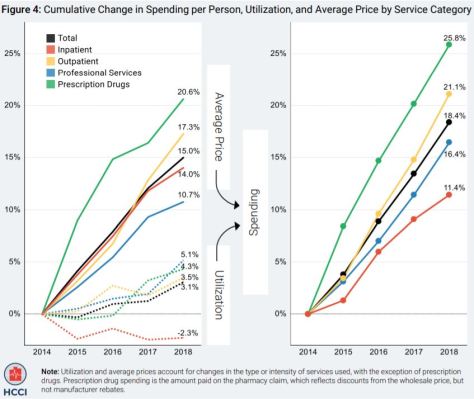

 High medical prices and billing practices may reduce public trust in the medical profession and can result in the avoidance of care. In a survey of 1000 patients, 64% reported that they delayed or neglected seeking medical care in the past year because of concern about high medical bills. The field of quality science in health care has developed measures of medical complications; however, there are no standardized metrics of billing quality.
 A recent study found that only 53 of 101 hospitals were able to provide a price for standard coronary artery bypass graft surgery. Notably, among the hospitals that provided a price, the price ranged from approximately $44 000 and $448 000 and was not associated with quality of care as measured by risk-adjusted outcomes and the Society of Thoracic Surgeons composite quality score.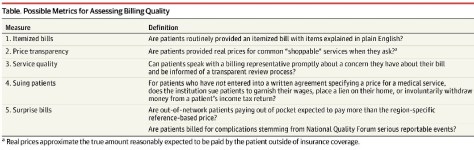


 In a WTOP-FM interview, Health Affairs Editor-In-Chief Alan Weil assesses how consumers may (or may not) benefit from two long-anticipated rules, recently unveiled by the Trump Administration, that increase price transparency for both hospitals and insurers.
 “Will price transparency lower health care costs? Economic theory and hospital opposition suggest it would, but the answer is not as straightforward as you might expect and could differ from market to market. Health care is a
  Boomers Daily