Tag Archives: Health

Ethics Of Lying About A Terminal Cancer Diagnosis Explored In Movie “The Farewell”

From a New Scientist online review:

The prevailing narrative of “battling cancer” in Western society has its own issues, with its discourse of personal triumph that values individual responsibility and determination. But the alternative – to lie outright – might seem inconceivable, particularly to those accustomed to the norms of Western culture. It is, however, a common practice in China, rooted in the belief that telling a person about their diagnosis can make their condition deteriorate quicker.


The Farewell Movie about Cancer DiagnosisThe plot line of The Farewell is familiar to me. Like Billi’s Nai Nai, my aunt was diagnosed with metatastic lung cancer. Nobody in the family told her – nor did the doctors when she later underwent surgery to remove a tumour. The last time I saw her was in north-eastern China a few years ago. Her once-plump figure had shrunk to a wiry frame. She was in her early 70s, in good spirits, but a far cry from the feisty matriarch who used to dominate conversations.
The Farewell is a heartfelt film, punctuated by moments of unexpected – and unexpectedly uplifting – humour. In a darkly comical scene in a printing shop, Nai Nai’s younger sister demands that the results of a medical report be doctored to edit out references to cancerous nodules and replaced with the nebulous term “benign shadows”.

Read more: https://www.newscientist.com/article/2221673-the-farewell-explores-the-ethics-of-lying-about-a-cancer-diagnosis/#ixzz63pnQELiY

Health: Important Facts Regarding Flu Vaccines And Influenza Virus

From a The Week online article:

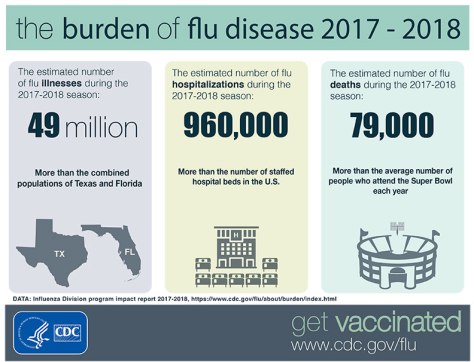
The disease kills 12,000 Americans during mild flu seasons and up to 56,000 in severe ones, with 90 percent of the victims over 65 years old. 

Although the U.S. has one of the highest vaccination rates in the world, only 45 percent of adults and 63 percent of children get flu shots each year. Scientists estimate that if the vaccination rates were boosted to between 80 and 90 percent, it could effectively stop seasonal flu from spreading because of herd immunity. 

burden-flu-infographic-update

How does the vaccine work?
The flu vaccine contains inactive or weakened versions of three or four different strains of the influenza virus. Most people receive the vaccine via injection, but there is also a nasal spray available. The weakened viruses can’t cause serious illness, but they trigger and train the immune system to fight off the invading microorganisms. White blood cells generate an army of antibodies, which attack and destroy the vaccine viruses by attaching themselves to parts of the virus known as antigens. The vaccine antigens have the same shape as real flu antigens, so the immune system now has antibodies that match up with the real flu virus. That experience teaches the immune system to recognize future flu infections and quickly make antibodies to attack the invading viruses. It takes about two weeks after receiving the vaccine to develop immunity, which is why doctors recommend getting it early in the flu season, which begins in October and can last as late as May.

To read more: https://theweek.com/articles/874101/flu-vaccine-everything-need-know

Health Care Technology: Facebook Unveils Tool For “Preventative Health”

From a The Verge online article:

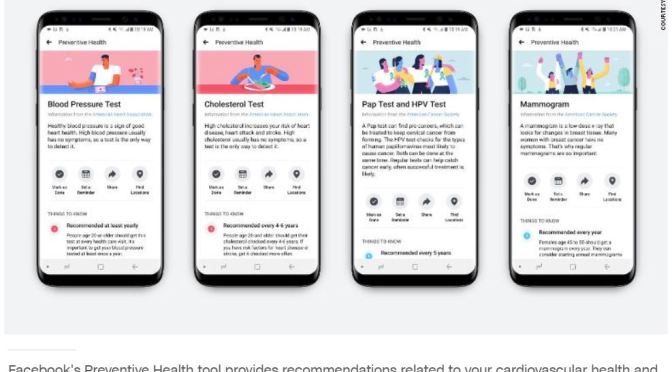
Facebook Preventative HealthThe tool is simply called Preventive Health, and is now available to Facebook users in the United States. It takes a user’s age and sex from their Facebook profile and provides them with a list of recommended screenings based on those two data points.
“Let’s say you’re 52 years old,” Freddy Abnousi, Facebook’s head of health care research, tells The Verge. “One of the things that will come to you — based on the American Cancer Society’s recommendations — is that you should have a colorectal cancer screening.” Abnousi says that the app will then give you more information about what kinds of tests are available, from a colonoscopy to a stool test or a CT scan. Abnousi hopes that users will then take what they’ve learned and talk to their primary care physician about what would be best for them. Users can also adjust the age and sex in the tool to get different screening recommendations without having it affect anything on their profile.

To read more: https://www.theverge.com/2019/10/28/20936541/facebook-preventative-health-cancer-heart-disease-flu-tool

Health Surveys: “World Alzheimer Report 2019” Reveals The Attitudes And Perceptions To Dementia

From the The 2019 World Report:

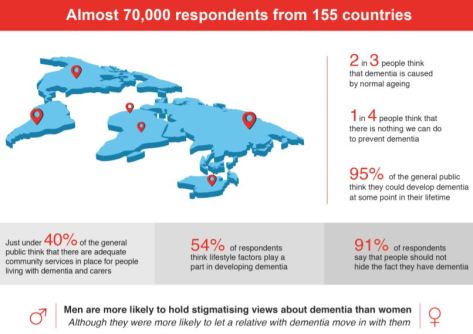
At the core of the 2019 report are the results of a global survey, commissioned by ADI and undertaken by the London School of Economics and Political Science (LSE). Almost 70,000 people globally engaged with the survey, making it the biggest of its kind ever undertaken.

2019 World Alzheimer's Report Attitudes toward Dementia Main

2019 World Alzheimer's Report Attitudes toward Dementia Key FindingsLSE developed the survey to target four key groups:

(1) people living with dementia,    (2) careers,            (3) healthcare  practitioners and    (4) the general public, with analysis being provided in three categories: knowledge, attitudes and behaviour.


2019 World Alzheimer's Report Attitudes toward Dementia Key Findings BehaviorIn the survey analysis we highlight the behavioural element first, giving prominence to the voices and experiences of people living with dementia as direct assessment of actual behaviour is central to discrimination and is the closest representation of the true impact of stigma on people living with dementia.
Read the report: https://www.alz.co.uk/research/WorldAlzheimerReport2019-Summary.pdf


Health Studies: Immune System Cells Rewire And Repair During Sleep

From a Sleep Review Magazine online release:

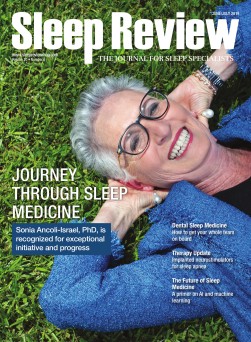
Sleep Review June July 2019The current study points to the role of norepinephrine, a neurotransmitter that signals arousal and stress in the central nervous system. This chemical is present in low levels in the brain while we sleep, but when production ramps up it arouses our nerve cells, causing us to wake up and become alert. The study showed that norepinephrine also acts on a specific receptor, the beta2 adrenergic receptor, which is expressed at high levels in microglia. When this chemical is present in the brain, the microglia slip into a sort of hibernation.

New research shows that immune cells called microglia—which play an important role in reorganizing the connections between nerve cells, fighting infections, and repairing damage—are primarily active during sleep.

The findings, which were conducted in mice and appear in the journal Nature Neuroscience, have implications for brain plasticity, diseases like autism spectrum disorders, schizophrenia, and dementia, which arise when the brain’s networks are not maintained properly, and the ability of the brain to fight off infection and repair the damage following a stroke or other traumatic injury.

To read more: http://www.sleepreviewmag.com/2019/10/during-sleep-immune-cells-rewire/?ref=cl-title

Future Of Health Care: New Machine Learning System Detects Infections 48 Hours In Advance

From a Health IT Analytics online release:

Philips Machine Learning SystemThe prototype revealed that using artificial intelligence and machine learning to examine certain combinations of vital signs and other biomarkers could strongly predict the likelihood of infection up to 48 hours in advance of clinical suspicion, including observable symptoms.

Royal Philips, in collaboration with the Defense Threat Reduction Agency (DTRA) and Defense Innovation Unit (DIU) of the US Department of Defense (DoD), are building a machine learning algorithm that will be able to detect an infection before a patient shows signs or symptoms.

The partnering organizations recently announced results from an 18-month project, called Rapid Analysis of Threat Exposure (RATE), the first large-scale exploration of pre-symptomatic infection in humans. The project aims to develop an early warning system that accelerates diagnosis and treatment of infection, containing the spread of communicable disease.

To read more: https://healthitanalytics.com/news/philips-dod-build-machine-learning-system-to-detect-infection

Health Podcasts: Stable Blood Sugar Can Lower Alzheimer’s Risk (NPR)

NPR Health News“The risk for dementia is elevated about twofold in people who have diabetes or metabolic syndrome (a group of risk factors that often precedes diabetes),” Holtzman says. 

…poor sleep is a known risk factor for Alzheimer’s. So maintaining normal blood sugar levels in Alzheimer’s patients could improve their sleep and might even slow down the disease, she says.

Health Care Costs: Top 5 Highest Paid Physician Specialties (PayScale.com)

From a Becker’s Spine online article:

PayScale LogoPayScale reports real-time salary data from over 54 million reports from job seekers, fact checking the data against private and public compensation data.

Here’s how average pay ranges for five physician specialties stack up:

1. Neurosurgeon: $401,499

2. Cardiothoracic surgeon: $387,451

3. Invasive cardiologist: $382,361

4. Orthopedic surgeon: $375,091

5. Gastroenterologist: $309,604

To read more: https://www.beckersspine.com/spine/item/47223-5-highest-paying-physician-specialties-neurosurgeon-no-1-at-401k.html?oly_enc_id=9129H5611090H0N


Health: Asymptomatic Bacteriuria Diagnosis In Older Patients Should Not Require Antibiotics

From a New York Times online article:

Asymtomatic Bacteriuria DefinitionAt Dr. Soong’s hospital, withholding the results of urine cultures, unless doctors actually called the microbiology lab to request them, reduced prescriptions for asymptomatic bacteriuria to 12 percent from 48 percent of non-catheterized patients, with no loss of safety.

“The extra step of having the clinician call eliminated a lot of frivolous testing,” Dr. Soong said.

In patients who have none of the typical symptoms of a urinary tract infection — no painful or frequent urination, no blood in the urine, no fever or lower abdominal tenderness — lab results detecting bacteria in the urine don’t indicate infection and thus shouldn’t trigger treatment.

Older people, and nursing home residents in particular, often have urinary systems colonized by bacteria; they will have a positive urine test almost every time, but they’re not sick.

To read more: https://www.nytimes.com/2019/10/14/health/urine-tests-elderly.html

Health Care: Number Of Organ Transplant Physicians Shrinks As Demand Increases

From a StatNews.com online article:

Liver Transplants & DonorsMost Americans probably aren’t aware of the decline in the number of individuals training to become transplant physicians and how it will affect the future of medicine. Neither are the 2020 presidential hopefuls, all of whom have policies they believe best provide health care coverage for Americans without acknowledging or calling attention to the fact that soon there may not be enough doctors to do the work once more people are insured. We need a plan for that.

During the 25 years I’ve been a transplant doctor, I’ve cared for hundreds of patients who received lung transplants. I’m now worried about the growing number of people who will need this lifesaving procedure in the future but who won’t have enough transplant physicians to do it.

At any given time in the U.S., about 120,000 people are waiting for the call that they’ve been matched with a donor for a new lung, heart, liver, or kidney. That number will continue to rise, but the number of doctors to take the 2 a.m. call that a donor has been found for their patient and perform the transplant is dwindling.

To read more: https://www.statnews.com/2019/10/17/transplant-physicians-number-dwindling/?utm_source=STAT+Newsletters&utm_campaign=20aba6d000-First_Opinion&utm_medium=email&utm_term=0_8cab1d7961-20aba6d000-150443417