
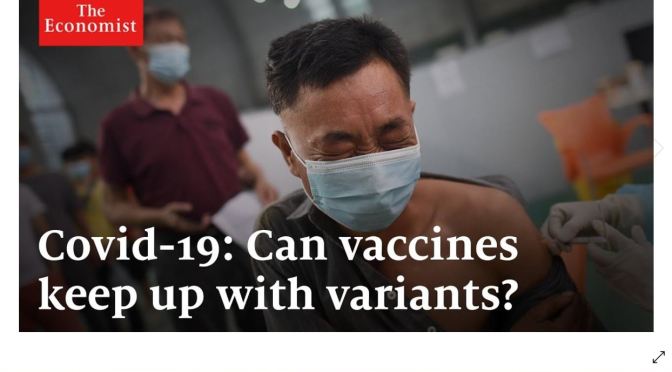
The race between covid-19 vaccines and variants is on. Alok Jha, The Economist’s science correspondent, and Natasha Loder, health policy editor, discuss what this means for the future Read more of our coverage on coronavirus: https://econ.st/3t1L6wx
Tag Archives: Health
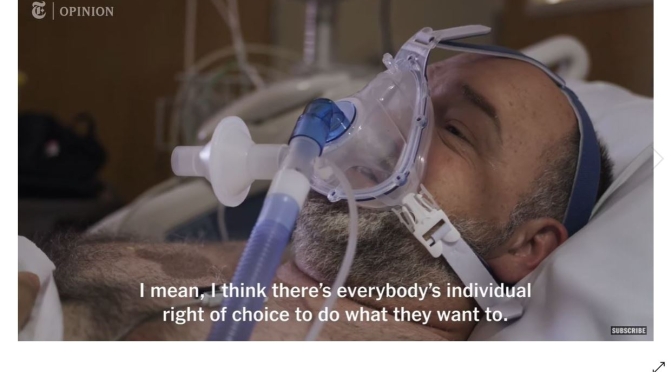
Covid-19: Patients Dying In Name Of Vaccine Freedom
In the video above, Alexander Stockton, a producer on the Opinion Video team, explores two of the main reasons the number of Covid cases is soaring once again in the United States: vaccine hesitancy and refusal. “It’s hard to watch the pandemic drag on as Americans refuse the vaccine in the name of freedom,” he says. Seeking understanding, Mr. Stockton travels to Mountain Home, Ark., in the Ozarks, a region with galloping contagion and — not unrelated — abysmal vaccination rates. He finds that a range of feelings and beliefs underpins the low rates — including fear, skepticism and a libertarian strain of defiance. This doubt even extends to the staff at a regional hospital, where about half of the medical personnel are not vaccinated — even while the intensive care unit is crowded with unvaccinated Covid patients fighting for their lives. Mountain Home — like the United States as a whole — is caught in a tug of war between private liberty and public health. But Mr. Stockton suggests that unless government upholds its duty to protect Americans, keeping the common good in mind, this may be a battle with no end.

Health: Looking Out For Diverticulitis (Harvard)

Cover Stories: Newsweek – ‘The Doomsday Variant’

Views: Top Covid Cartoons


Analysis: Athletes Focus On Mental Health (Video)
Simone Biles’s withdrawal from competitions at the Tokyo Olympics has put renewed focus on mental health in sports. WSJ looks at how the stigma and treatment for athletes’ state of mind has shifted. Photo: Mike Blake/Reuters

Infographic: Fighting Fatty Liver Disease



Views: Tufts ‘Health & Nutrition Letter’ (Aug ’21)


Covid-19: How The Delta Variant Spread Globally
Covid-19’s Delta variant is proliferating world-wide threatening unvaccinated populations and economic recovery. WSJ breaks down events in key countries to explain why Delta spreads faster than previously detected strains. Composite: Sharon Shi
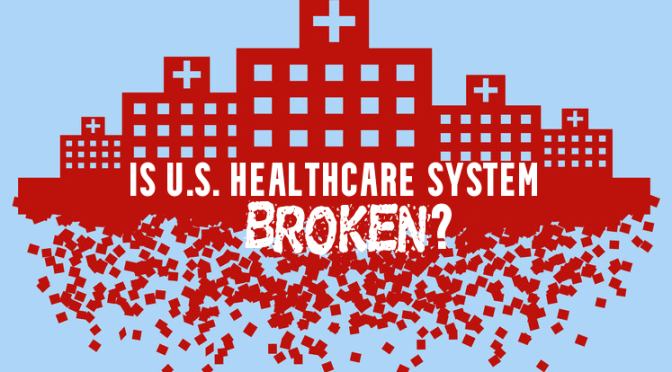
Views: Is U.S. Healthcare System Broken? (Harvard)


Here’s a question that’s been on my mind and perhaps yours: Is the US healthcare system expensive, complicated, dysfunctional, or broken? The simple answer is yes to all.
Below are 10 of the most convincing arguments I’ve heard that our system needs a major overhaul. And that’s just the tip of the iceberg. Remember, an entire industry has evolved in the US just to help people navigate the maddeningly complex task of choosing a health insurance plan.
The cost is enormous
- High cost, not highest quality. Despite spending far more on healthcare than other high-income nations, the US scores poorly on many key health measures, including life expectancy, preventable hospital admissions, suicide, and maternal mortality. And for all that expense, satisfaction with the current healthcare system is relatively low in the US.
- Financial burden. High costs combined with high numbers of underinsured or uninsured means many people risk bankruptcy if they develop a serious illness. Prices vary widely, and it’s nearly impossible to compare the quality or cost of your healthcare options — or even to know how big a bill to expect. And even when you ask lots of questions ahead of time and stick with recommended doctors in your health insurance network, you may still wind up getting a surprise bill. My neighbor did after knee surgery: even though the hospital and his surgeon were in his insurance network, the anesthesiologist was not.
Access is uneven
- Health insurance tied to employment. During World War II, healthcare was offered as a way to attract workers since employers had few other options. Few people had private insurance then, but now a layoff can jeopardize your access to healthcare.
- Healthcare disparities. The current US healthcare system has a cruel tendency to delay or deny high-quality care to those who are most in need of it but can least afford its high cost. This contributes to avoidable healthcare disparities for people of color and other disadvantaged groups.
- Health insurers may discourage care to hold down costs. Many health insurance companies restrict expensive medications, tests, and other services by declining coverage until forms are filled out to justify the service to the insurer. True, this can prevent unnecessary expense to the healthcare system — and to the insurance company. Yet it also discourages care deemed appropriate by your physician.
 Boomers Daily