Tag Archives: Health Benefits of Fasting

Brain Health: The Benefits Of Intermittent Fasting

Although intermittent fasting is most widely known as a weight-loss strategy, emerging research suggests that it could have benefits for brain health and cognition. But does it actually work, are there any drawbacks and how long would you have to fast to see benefits? WSJ’s Daniela Hernandez breaks down what’s known and what’s not about the neuroscience of intermittent fasting.

Timeline: 0:00 Could intermittent fasting help our brains work better and longer? 0:31 How long would you have to fast to see any potential cognitive benefits? 1:04 How intermittent fasting could affect your ability to focus 2:27 Potential mood-related benefits of intermittent fasting 2:48 How intermittent fasting can affect brain health 4:03 Potential drawbacks of intermittent fasting
Diet: “Skeptical” NY Times Health Writer Endorses Numerous Health Benefits Of 16+ Hour Fasting

From a New York Times article by Jane E. Brody (Feb 17, 2020):

“It takes 10 to 12 hours to use up the calories in the liver before a metabolic shift occurs to using stored fat,” Dr. Mattson told me. After meals, glucose is used for energy and fat is stored in fat tissue, but during fasts, once glucose is depleted, fat is broken down and used for energy.

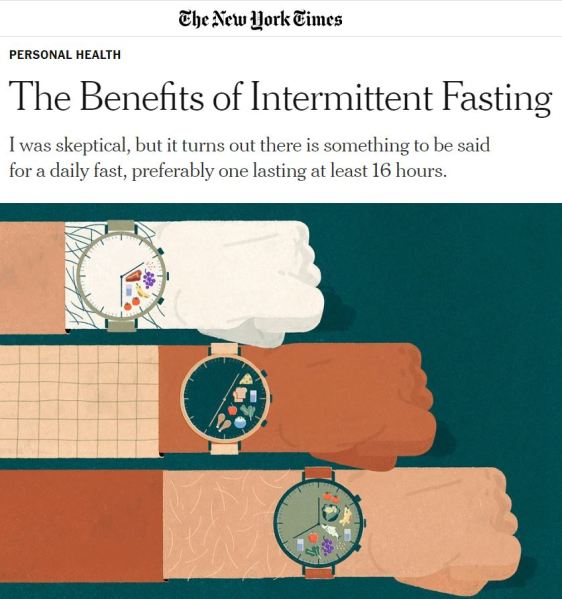
The Benefits of Intermittent Fasting Jane E Brody New York Times February 17 2020I was skeptical, but it turns out there is something to be said for practicing a rather prolonged diurnal fast, preferably one lasting at least 16 hours. Mark P. Mattson, neuroscientist at the National Institute on Aging and Johns Hopkins University School of Medicine, explained that the liver stores glucose, which the body uses preferentially for energy before it turns to burning body fat.
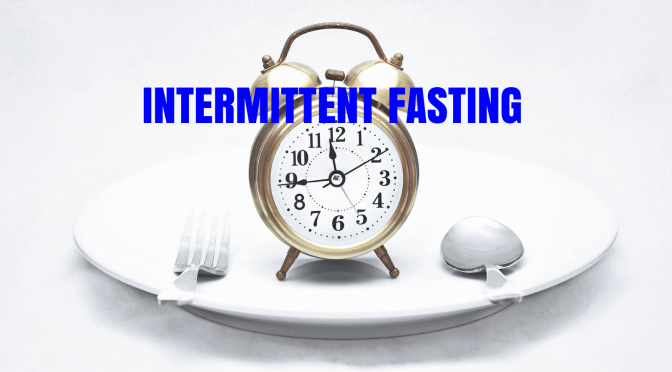

For example, human studies of intermittent fasting found that it improved such disease indicators as insulin resistance, blood fat abnormalities, high blood pressure and inflammation, even independently of weight loss. In patients with multiple sclerosis, intermittent fasting reduced symptoms in just two months, a research team in Baltimore reported in 2018.

https://www.youtube.com/watch?v=91l8req6EqM

Read more


Health: 60-Year Old “B-D” Editor Launches “18-Hour Intermittent Fasting” Diet Study For 2020’s Decade

Following the important publishing of “The Benefits Of Intermittent Fasting” study by Johns Hopkins in the New England Journal of Medicine on December 26, 2019, the 60-year old editor of Boomers-Daily.com (“B-D”) will launch, participate in, and document a decade-long, 18-Hour Intermittent Fasting Diet on December 30, 2019. The following protocol will be followed:

  • All daily food consumption will be between 10 am and 4 pm
  • Diet will be followed 7 days a week
  • High fiber, nutrition-dense foods will be favored
  • Gluten-free and Lactose-free foods will be favored
  • Eating will NOT be calorie-restricted
  • Bedtime target of 7:30 to 8:30 pm (or earlier) every night
  • 7-8+ hours of sleep per night a PRIORITY
  • Early morning vigorous exercise daily of 1 – 1 1/2 hours targeted

All readers of Boomers-Daily.com are encouraged to communicate with B-D and launch their own 18-hour Intermittent Fasting Diet (the 6-hour eating period can be varied 1-2 hours later or earlier). Please email boomersdaily@gmail.com to join the study, comment or inquire about this or your own 18-Hour Intermittent Fasting Diet. We will be looking to start an online chat room and other online platforms to increase the size, scope, visibility and transparency of the study over the next decade.

12-26-19  Intermittent Fasting: Live ‘Fast,’ Live longer? (infographic).png.png

New Studies: Beneficial Effects Of “18-Hour Intermittent Fasting” On Health And Aging (NEJM)

From a New England Journal of Medicine online release:

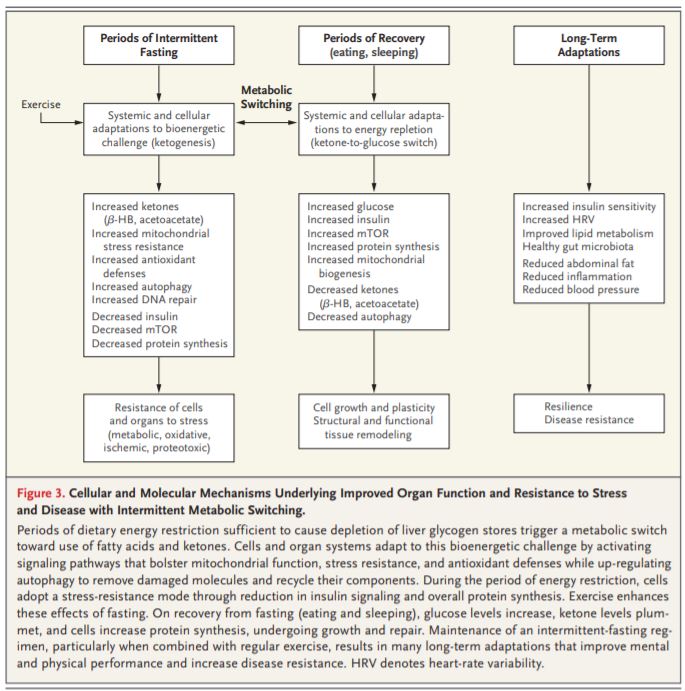
In humans, intermittent-fasting interventions ameliorate obesity, insulin resistance, dyslipidemia, hypertension, and inflammation. Intermittent fasting seems to confer health benefits to a greater extent than can be attributed just to a reduction in caloric intake.

Evidence is accumulating that eating in a 6-hour period and fasting for 18 hours can trigger a metabolic switch from glucose-based to ketone-based energy, with increased stress resistance, increased longevity, and a decreased incidence of diseases, including cancer and obesity.

The New England Journal of Medicine Logo

Preclinical studies and clinical trials have shown that intermittent fasting has broad-spectrum benefits for many health conditions, such as obesity, diabetes mellitus, cardiovascular disease, cancers, and neurologic disorders. Animal models show that intermittent fasting improves health throughout the life span, whereas clinical studies have mainly involved relatively short-term interventions, over a period of months.

Effects of Intermittent Fasting on Health, Aging, and Disease New England Journal of Medicine December 26 2019

BOOMERS-DAILY.COM “18-HOUR INTERMITTENT FASTING DIET” STUDY

How much of the benefit of intermittent fasting is due to metabolic switching and how much is due to weight loss? Many studies have indicated that several of the benefits of intermittent fasting are dissociated from its effects on weight loss. These benefits include improvements in glucose regulation, blood pressure, and heart rate; the efficacy of endurance training; and abdominal fat loss.

To read more

Inline image