The Globalist Podcast (October 5, 2023) – What’s on the agenda for Ukraine as leaders from the European Political Community meet.
Also in the program: following Kevin McCarthy’s ejection as House Speaker, Jim Jordan throws his name in the hat. Plus: the latest with papers and why French workers are leading the way when it comes to returning to the office.
The Globalist Podcast (October 4, 2023) – Kevin McCarthy is ousted as speaker of the US House of Representatives: Now what?
Plus: Thailand’s prime minister maps out his foreign policy ambitions, the latest business news, Mali’s escalating crisis and a special interview with the British Film Institute’s new festivals director.
“Xi’s sense of personal destiny entails significant risk of war…”
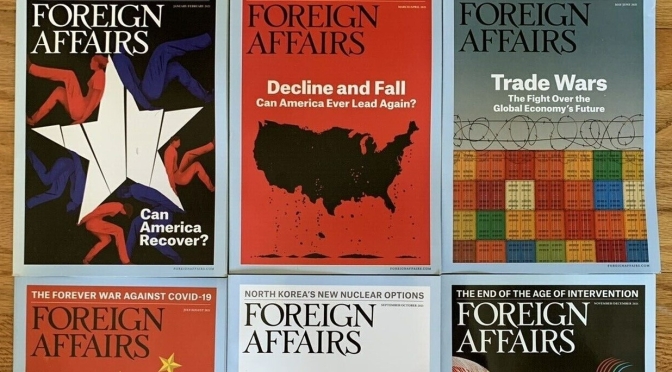
Foreign Affairs (September 29, 2023):The United States now confronts graver threats to its security than it has in decades, perhaps ever. Never before has it faced four allied antagonists at the same time—Russia, China, North Korea, and Iran—whose collective nuclear arsenal could within a few years be nearly double the size of its own. Not since the Korean War has the United States had to contend with powerful military rivals in both Europe and Asia. And no one alive can remember a time when an adversary had as much economic, scientific, technological, and military power as China does today.
The problem, however, is that at the very moment that events demand a strong and coherent response from the United States, the country cannot provide one. Its fractured political leadership—Republican and Democratic, in the White House and in Congress—has failed to convince enough Americans that developments in China and Russia matter. Political leaders have failed to explain how the threats posed by these countries are interconnected. They have failed to articulate a long-term strategy to ensure that the United States, and democratic values more broadly, will prevail.
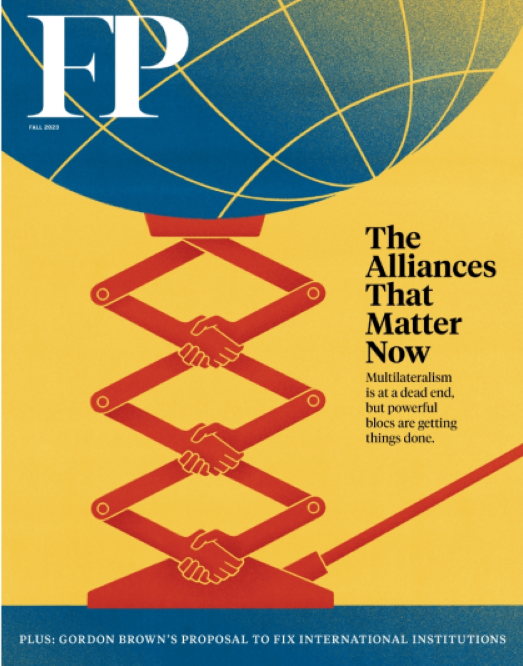
Foreign Policy Magazine – Fall 2023: The new issue features The G-7 Becomes a Power Player – Russia’s war and China’s rise are turning a talking shop into a fledgling alliance of democracies; Vivek Ramaswamy’s Foreign Policies Raise Eyebrows in Washington – The GOP’s rising star offers up a grab bag of ideas cribbed from Eminem to Richard Nixon and more…
Russia’s war and China’s rise are turning a talking shop into a fledgling alliance of democracies.
By G. John Ikenberry, a professor of politics and international affairs at Princeton University.
Time and again over the last century, the United States and the other liberal democracies in Europe, East Asia, and elsewhere have found themselves on the same side in grand struggles over the terms of the world order. This political grouping has been given various names: the West, the free world, the trilateral world, the community of democracies. In one sense, it is a geopolitical formation, uniting North America, Europe, and Japan, among others. It is an artifact of the Cold War and U.S. hegemony, anchored in NATO and Washington’s East Asian alliances.
End American dependence on Taiwan’s semiconductor factories. Declare economic independence from China. Give India an AUKUS-like submarine deal. And stage a dramatic visit to Moscow to broker a deal to end Russia’s full-scale invasion of Ukraine.
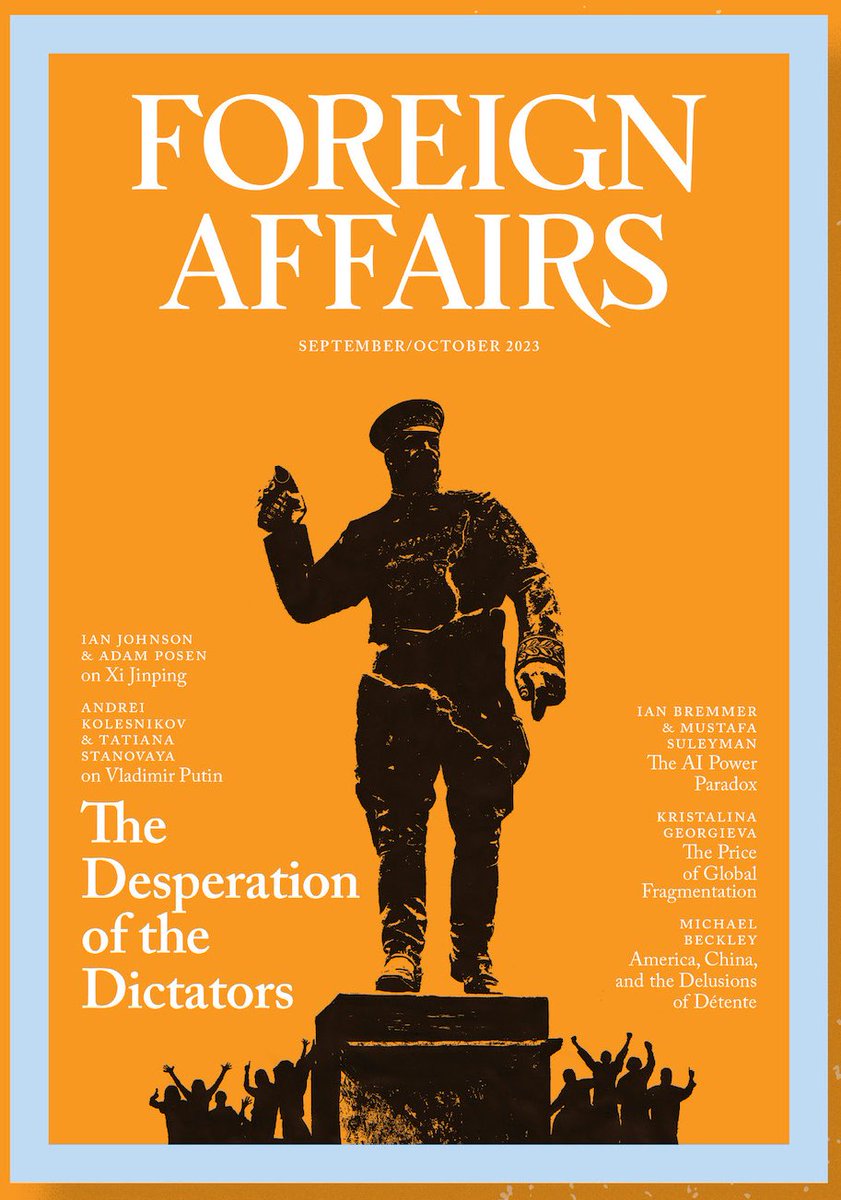
Foreign Affairs – September/October 2023: The issue features ‘The Desperation of the Dictators’; Why America and China Will Be Enduring Rivals; What It Will Take to Break Putinism’s Grip; Xi’s Age of Stagnation – The Great Walling-Off of China, and more…
With U.S.-Chinese relations worse than they have been in over 50 years, an old fairy tale has resurfaced: if only the United States would talk more to China and accommodate its rise, the two countries could live in peace. The story goes that with ample summitry, Washington could recognize Beijing’s redlines and restore crisis hotlines and cultural exchanges. Over time and through myriad points of face-to-face contact—in other words, reengagement—the two countries could settle into peaceful, if still competitive, coexistence.
In June 17, 2023, Russian President Vladimir Putin staged a special ceremony on the St. Petersburg waterfront to mark the anniversary of three flags: the flag of the Russian Federation, otherwise known as Peter the Great’s tricolor, formally unfurled in 1693; the imperial Russian flag, introduced by Tsar Alexander II in 1858; and the Red Banner, the Soviet Union’s hammer and sickle, adopted by the Soviet state 100 years ago and later used by Joseph Stalin. Putin watched the event from a boat as the National Philharmonic and the St. Petersburg State Choir performed the national anthem, which, thanks to a law Putin enacted in 2000, has the same melody as its Stalin-era counterpart.
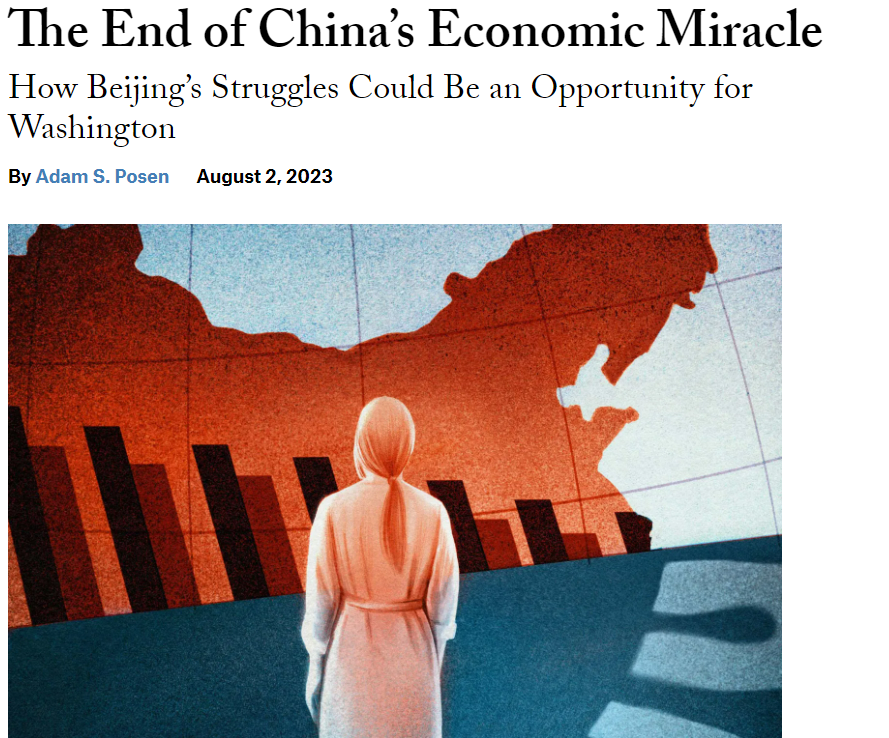
Foreign Affairs (August 2, 2023) – As 2022 came to an end, hopes were rising that China’s economy—and, consequently, the global economy—was poised for a surge. After three years of stringent restrictions on movement, mandatory mass testing, and interminable lockdowns, the Chinese government had suddenly decided to abandon its “zero COVID” policy, which had suppressed demand, hampered manufacturing, roiled supply lines, and produced the most significant slowdown that the country’s economy had seen since pro-market reforms began in the late 1970s.
Economic long COVID will likely plague the Chinese economy for years.
In the weeks following the policy change, global prices of oil, copper, and other commodities rose on expectations that Chinese demand would surge. In March, then Chinese Premier Li Keqiang announced a target for real GDP growth of around five percent, and many external analysts predicted it would go far higher.
There is good reason to be pessimistic about the prospects of Russia’s changing course under Putin. He has taken his country in a darker, more authoritarian direction, a turn intensified by the invasion of Ukraine.
In March, at the end of Chinese President Xi Jinping’s visit to Moscow, Russian President Vladimir Putin stood at the door of the Kremlin to bid his friend farewell. Xi told his Russian counterpart, “Right now, there are changes—the likes of which we haven’t seen for 100 years—and we are the ones driving these changes together.” Putin, smiling, responded, “I agree.”
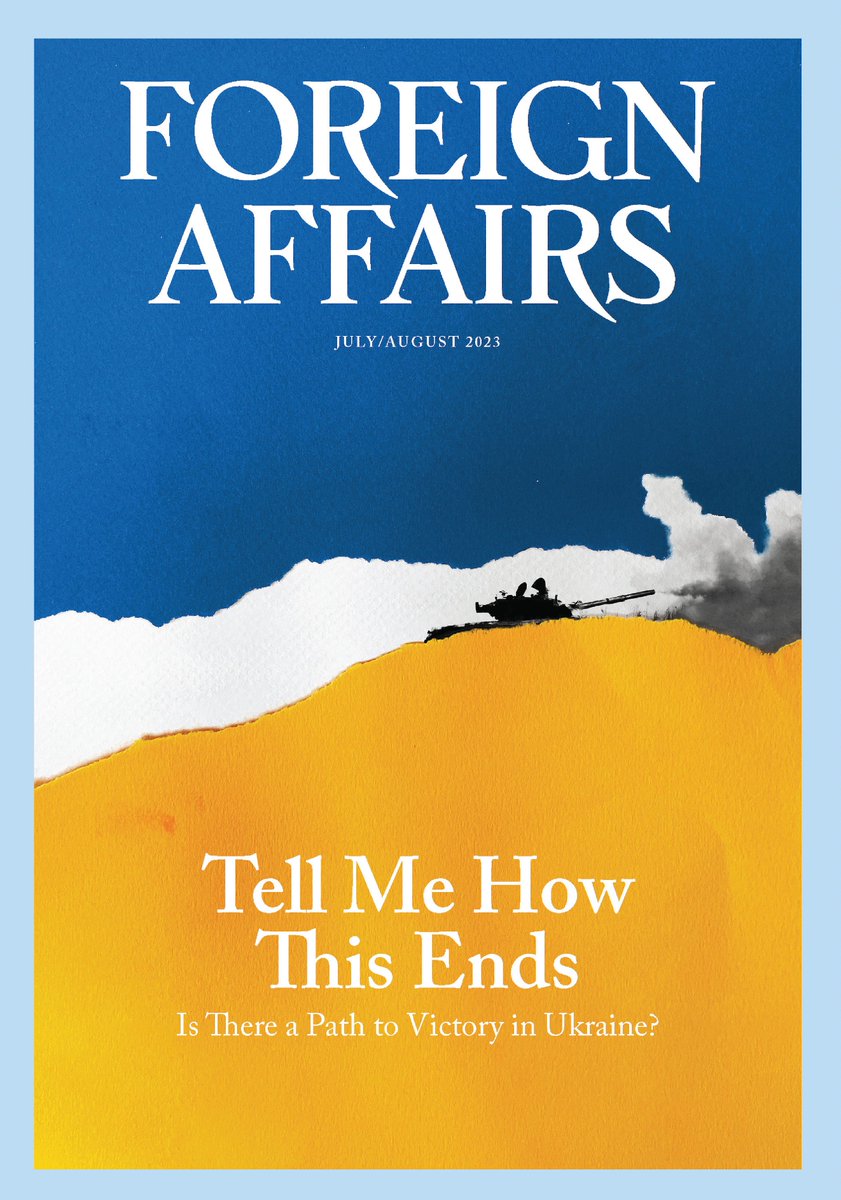
Russia’s invasion of Ukraine in February 2022 was a moment of clarity for the United States and its allies. An urgent mission was before them: to assist Ukraine as it countered Russian aggression and to punish Moscow for its transgressions. While the Western response was clear from the start, the objective—the endgame of this war—has been nebulous.
Why an Armistice Offers the Best Hope for Peace in Ukraine
In the middle of August 1952, Chinese Premier Zhou Enlai traveled nearly 4,000 miles to Moscow to meet with the Soviet dictator Joseph Stalin… The two Communist powers were allies at the time, but it was not a partnership of equals: the Soviet Union was a superpower, and China depended on it for economic assistance and military equipment.
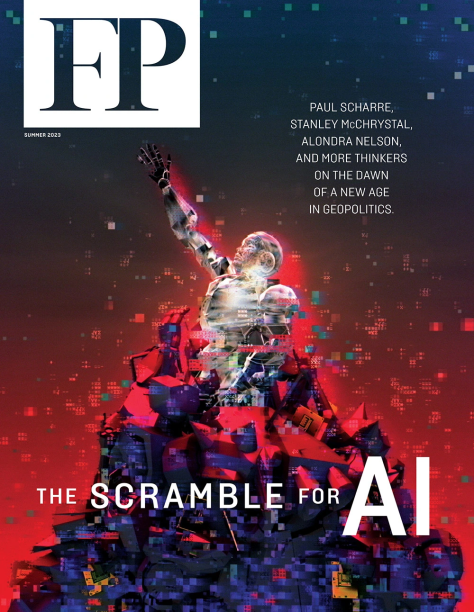
Foreign Policy Magazine – Summer 2023: Artificial intelligence is suddenly everywhere. It seems as though no conversation about jobs, education, health care, technology, or politics happens without an inevitable question about how AI could disrupt it all.
As countries in the global South refuse to take a side in the war in Ukraine, many in the West are struggling to understand why. Some speculate that these countries have opted for neutrality out of economic interest. Others see ideological alignments with Moscow and Beijing behind their unwillingness to take a stand—or even a lack of morals. But the behavior of large developing countries can be explained by something much simpler: the desire to avoid being trampled in a brawl among China, Russia, and the United States.
For China, Russia, and the West, the last year has been one of fear and conflict. Russia’s invasion of Ukraine has killed tens of thousands, perhaps even hundreds of thousands, of people. It has prompted the United States and Europe to rearm and has pushed Moscow and Washington back into Cold War–style competition.












 Boomers Daily