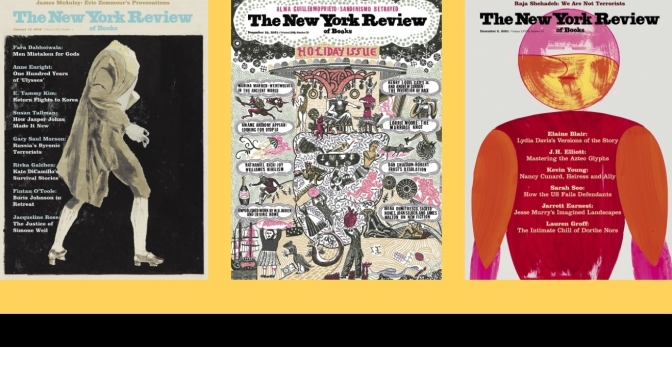
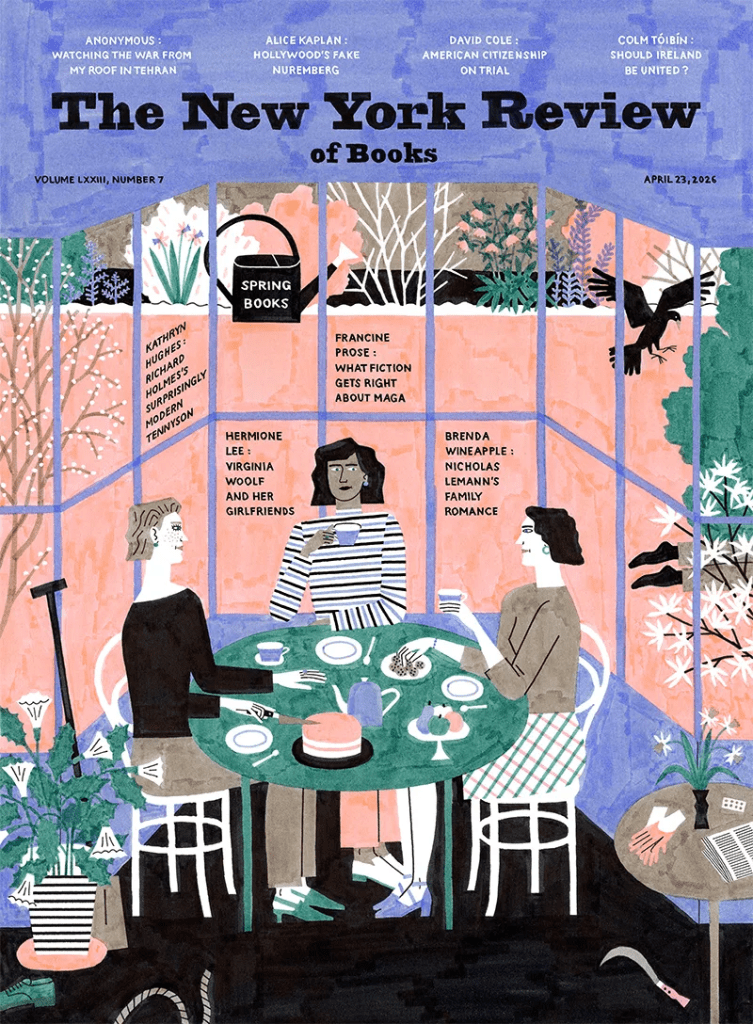
Tag Archives: Fiction

Zyzzyva Magazine – WINTER 2025-2026

ZYZZYVA Magazine: The latest issue features…

Nonfiction

“The Fighters” by Joe Donnelly: on being transplanted as a boy from New Jersey to Ireland, and the grim school days spent at Willow Park primary school in Dublin.

“Fire Watching” by Harmony Holiday: a mediation on Los Angeles, its devastating fires, and finding meaning.

“The Deer” by Raia Small: “I have never killed anyone, so I can say that I don’t understand. But I am getting to know my own cruelties …”

Fiction

“A Long Line of Violence” by Tomas Moniz: A duo travels from the Mission District to Lassen Volcanic National Park to return a rifle to its battleground.

“Plums” by Feroz Rather: A young man steals as much time as he can with his beloved among the orchards and buses of his town in Kashmir.

“Viable” by Suzanne Rivecca: “The person I call in situations like this is Colette, the city government version of me, an abstinent ex-junkie disliked by the mayor, with a soft spot for schizophrenics, a love for lancing abscesses, and zero work/life balance.”

Poetry

Brian Ang, Nica Giromini, Kelly Gray, Michael Kennedy Costa, Kayla Krut, Maw Shein Win, Jared Stanley, and John Yau.

In Conversation

Chris Feliciano Arnold talks to Venezuelan scholar, journalist, and poet Boris Muñoz about literature, authoritarianism, and the importance of cronistas.

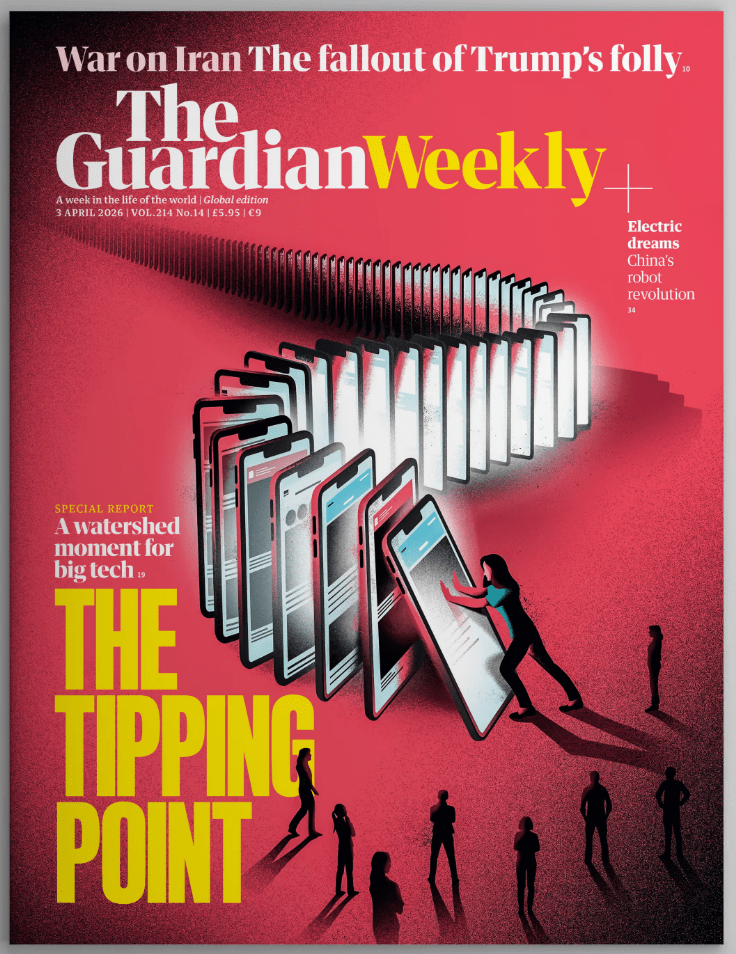
THE GUARDIAN WEEKLY – DECEMBER 12, 2025 PREVIEW

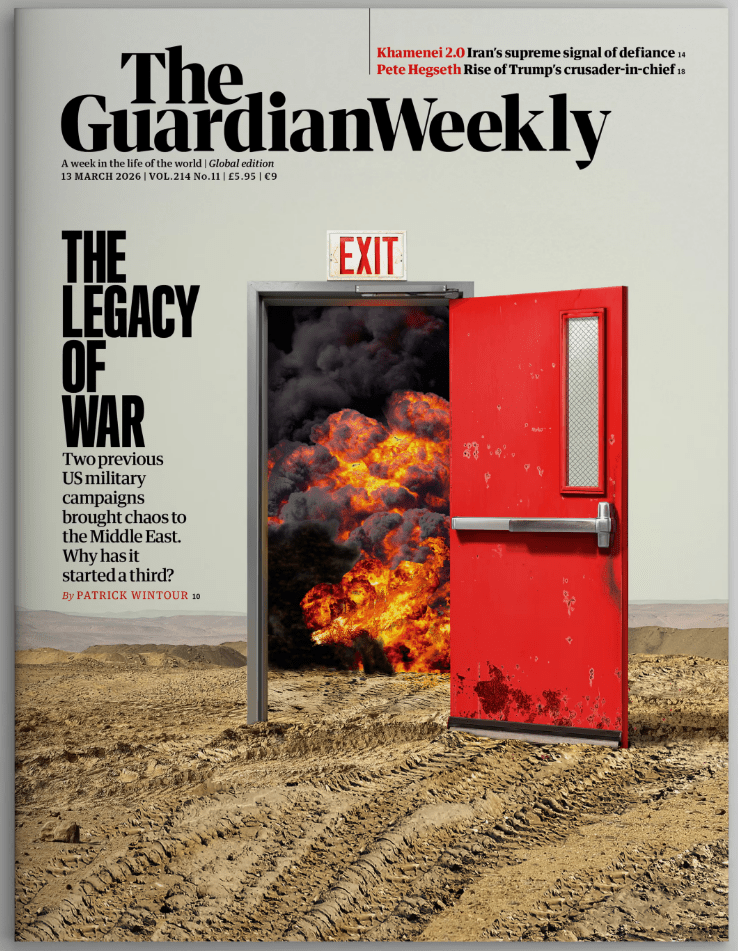
THE GUARDIAN WEEKLY: The latest issue features ‘Blocked!’ – Why Australia banned kids from social media (and what they think of it)

Millions of teenagers in Australia woke up on Wednesday to find themselves locked out of social media accounts after the government introduced a ban for under-16s – the first of its kind – on the platforms.

Far from being a kneejerk response to a moral panic, it’s a move backed up by detailed investigation into the effects of unfettered online access on children – and one that several other countries are poised to follow. Australian eSafety research found seven in 10 children aged 10 to 15 had encountered content associated with harm online. Three-quarters of those had most recently encountered that – including misogyny, violence, disordered eating and suicide – on a social media platform.

“We are seeking to create some friction [in the] system to protect children where previously there has been close to none … We are treating big tech like the extractive industry it has become,” Australia’s eSafety commissioner, Julie Inman Grant, told an audience earlier this year.

Spotlight | Syria, one year after Assad
While country’s return to global stage has filled many Syrians with pride, domestically old grievances threaten efforts to rebuild the state. William Christou reports from Damascus

Feature | The inside story of the race to create the ultimate AI
In Silicon Valley, rival companies are spending trillions of dollars to reach a goal that could change humanity – or potentially destroy it. Robert Booth reports

Feature | On the trail of London’s snail farming don
Terry Ball – renowned shoe salesman, friend to former mafiosi – has vowed to spend his remaining years finding ways to cheat authorities he feels have cheated him. His greatest ruse? A tax-dodging snail empire. Jim Waterson caught up with him

Opinion | What words are left to describe Trump’s global rampage?
Deadly US boat strikes in the Caribbean are the latest example of a president corrupting both the law and morality, argues Jonathan Freedland

Culture | The best books of 2025
From fiction to food, people to poetry, science to sport: Guardian critics round up the year’s essential reads

THE PARIS REVIEW ———- WINTER 2025/2026

THE PARIS REVIEW : The latest issue features Art of Criticism, Art of Poetry, Prose, Poetry and Art…

Hélène Cixous on the Art of Criticism: “There’s a feminist discourse that women can’t do it all. This is what many women experience, and it’s very difficult. But I am not like that.”

Alice Oswald on the Art of Poetry: “You come at poetry with the momentum of having failed. It’s only when other communication is absolutely impossible that a poem has to exist.”

Prose by Eve Babitz, Marlene Morgan, Alec Niedenthal, Gwendoline Riley, and Elias Rodriques.

Poetry by Millicent Borges Accardi, Monzer Masri, Alice Oswald, Jana Prikryl, and Ed Roberson.

Art by Ali Banisadr, Pippa Garner, Joan Jonas, and Mieko Meguro; cover by Adebunmi Gbadebo.

LOS ANGELES REVIEW OF BOOKS – WINTER 2025-2026

LOS ANGELES REVIEW OF BOOKS: The latest issue of LARB features ‘Security’…

A Mole in MAGA’s Midst

Alexandre Lefebvre reads “Furious Minds: The Making of the MAGA New Right” by Laura K. Field.

The Secessionists of Shasta County

Nevin Kallepalli investigates political resentment in rural California, in an essay from LARB Quarterly no. 47: “Security.”

Is Justice Barrett Listening?

Leah Litman prosecutes Justice Amy Coney Barrett’s new legal memoir, “Listening to the Law: Reflections on the Court and Constitution.”

An Emergency Born of Prosperity

Zoe Adams considers “There Is No Place for Us: Working and Homeless in America” by Brian Goldstone.

LITERARY REVIEW – DECEMBER 2025

LITERARY REVIEW : The latest issue features  Peter Marshall on Holbein * Joanna Kavenna on Camus * Sophie Oliver on Margaret Atwood * Dorian Lynskey on George Orwell * Daisy Dunn on Clodia of Rome * David Andress on Jean-Paul Marat * John Foot on the Spanish Civil War * Jerry White on high-rise buildings * Edward Shawcross on Mexico * Daniel A Bell on the Chinese examination system * Anna Reid on Russian women * Charles Darwent on Barnett Newman * Robert Crawford on T S Eliot * Ian Sansom on William Golding * Mark Lawson on John Updike * Charles Shaar Murray on musicians * Patrick Porter on NATO * Thomas Morris on Renaissance diagrams * Diane Purkiss on palmistry *  Nigel Andrew on penguins * John Mullan on pedants * Molly Pepper Steemson on Anthony Bourdain * Mark Ford on Helen Vendler * Emma Smith on book

Holbein: Renaissance Master By Elizabeth Goldring

It’s an irony to savour: the man who invented the Tudors was a German. If Henry VIII, his wives and courtiers exercise a stronger hold on the public imagination than their Plantagenet precursors or Stuart successors, it is because we can all picture them so clearly. That, in turn, is due to an extraordinary sequence of portraits and drawings produced between the late 1520s and early 1540s by Hans Holbein of Augsburg (c 1497–1543), many of which have become instantly recognisable. 

Doublethink & Doubt

Orwell: 2+2=5 By Raoul Peck (dir)

George Orwell: Life and Legacy By Robert Colls

Nobody under the age of seventy-five has heard George Orwell’s voice. The only extant video footage is in a silent movie of the Eton Wall Game. None of his many wartime recordings for the BBC Eastern Service has survived. By all accounts his voice, damaged by a bullet to the throat during the Spanish Civil War, was thin, flat and weak. In fact, the controller of the BBC Overseas Service complained that putting on ‘so wholly unsuitable a voice’ made the BBC appear ‘ignorant of the essential needs of the microphone and of the audience’. 

THE NEW YORK REVIEW OF BOOKS – NOVEMBER 20, 2025

Table of Contents - November 20, 2025 | The New York Review of Books

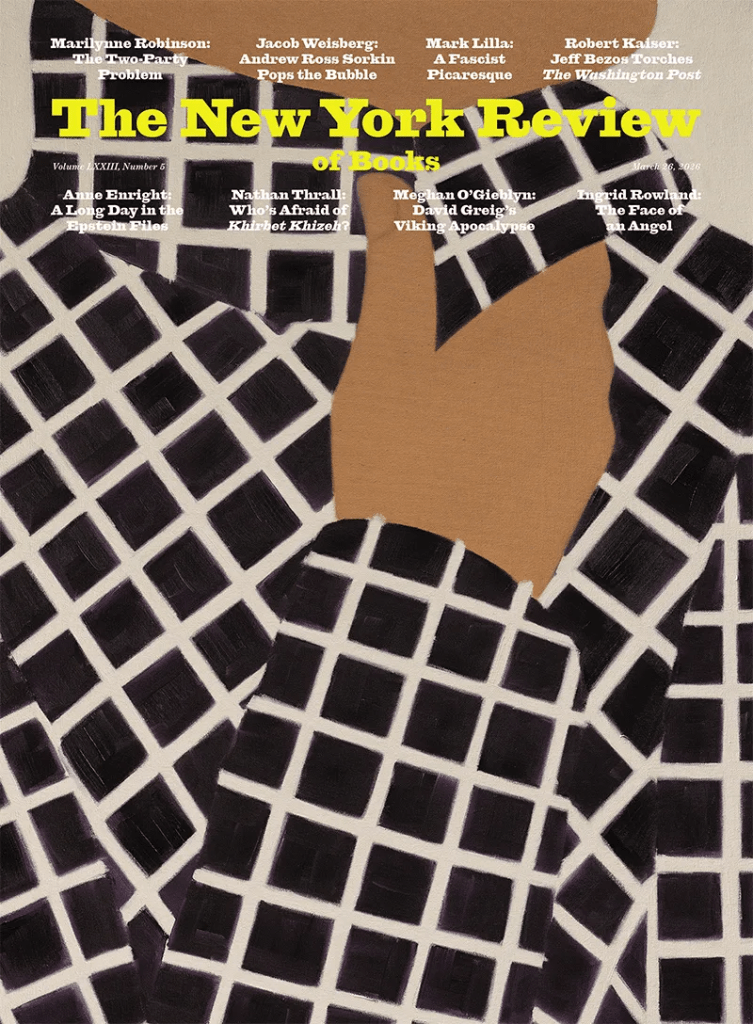
THE NEW YORK REVIEW OF BOOKS: The latest issue features Fintan O’Toole on Kamala’s pointless campaign memoir, Jonathan Lethem on One Battle After Another, Anne Diebel on the trials of infertility, Colin B. Bailey on Watteau’s sad clowns, Linda Kinstler on the invention of sovereign states, Langdon Hammer on James Schuyler’s shimmering poetry, Samuel Stein on NIMBYs and YIMBYs, Miranda Seymour on Frankenstein’s mother, Adam Shatz on Alice Coltrane, a poem by Rae Armantrout, and much more.

The Lingering Delusion

107 Days by Kamala Harris

Kamala Harris’s memoir 107 Days succeeds at least in distilling the evasions and weaknesses of the modern Democratic Party.

Falling Off the Map

The Life and Death of States:  Central Europe and the Transformation of Modern Sovereignty by Natasha Wheatley

How States Die: Membership and Survival in the International System by Douglas Lemke

World War I set the stage a century ago for new ways of thinking about where states come from and what happens when they disappear.

LOS ANGELES REVIEW OF BOOKS – AUTUMN 2025

LOS ANGELES REVIEW OF BOOKS: The latest issue of LARB Alien“, which wades into the unfamiliar. In Greta Rainbow’s “Tourists,” a woman travels to foggy Athens, where she confronts the unknowability of the city and her partner. In Sara Levine’s “Peter and the Women,” Peter (badly, ineptly, inappropriately, indecently) manages the women in his life: his hospice-bound mother and her nurse, as well as his girlfriends and one-night stands. And in Ari Braverman’s “Dogs of the Solar Steppe,” the narrator faces a decade-long punishment, performing domestic labor for a woman called Big Mother. Her former life assumes a “sheen of fantasy,” and the story warns us of “the easy slippage between one state and another.”

THE NEW YORK REVIEW OF BOOKS – NOVEMBER 6, 2025

THE NEW YORK REVIEW OF BOOKS: The latest issue features Jed Perl on critical thinking, Mark Lilla on the MAGA nation, Ben Lerner on his heart, Clare Bucknell on female critics in early modern England, Cora Currier on twenty-five years of the “war on terror,” Peter E. Gordon on the religion of sociology, Wyatt Mason on Guy Davenport, Josephine Quinn on St. Augustine of Africa, Geoffrey O’Brien on Kavalier and Clay at the Met, Nitin K. Ahuja on the science of death, Darryl Pinckney on James Baldwin, a painting by Maira Kalman, poems by April Bernard and Amit Majmudar, and much more.


Impassioned Ferocity

A critic’s power lies in the testing of deeply held beliefs about the nature of art and art’s place in the world against the experience of specific artworks.

Authority by Andrea Long Chu

All Things Are Too Small: Essays in Praise of Excess by Becca Rothfeld

Those Passions: On Art and Politics by T.J. Clark

Criticism and Truth: On Method in Literary Studies by Jonathan Kramnick

No Judgment by Lauren Oyler

Storm Warnings

The MAGA movement is not fed by conservative ideas but by a nihilistic, apocalyptic determination to stage a counterrevolution against the Sixties, against liberalism, against even democracy itself.

When the Clock Broke: Con Men, Conspiracists, and How America Cracked Up in the Early 1990s by John Ganz

Furious Minds: The Making of the MAGA New Right by Laura K. Field

A Brief Literary Emancipation

Early modern female writers, who were denied the sort of authority usually needed to write literary criticism, were also freed from its constraints.

Sex and Style: Literary Criticism and Gender in Early Modern England by Elizabeth Scott-Baumann

THE CODE AND THE CANDLE

A Computer Scientist’s Crisis of Certainty

When Ada signed up for The Decline and Fall of the Roman Empire, she thought it would be an easy elective. Instead, Gibbon’s ghost began haunting her code—reminding her that doubt, not data, is what keeps civilization from collapse.

By Michael Cummins | October 2025

It was early autumn at Yale, the air sharp enough to make the leaves sound brittle underfoot. Ada walked fast across Old Campus, laptop slung over her shoulder, earbuds in, mind already halfway inside a problem set. She believed in the clean geometry of logic. The only thing dirtying her otherwise immaculate schedule was an “accidental humanities” elective: The Decline and Fall of the Roman Empire. She’d signed up for it on a whim, liking the sterile irony of the title—an empire, an algorithm; both grand systems eventually collapsing under their own logic.

The first session felt like an intrusion from another world. The professor, an older woman with the calm menace of a classicist, opened her worn copy and read aloud:

History is little more than the register of the crimes, follies, and misfortunes of mankind.

A few students smiled. Ada laughed softly, then realized no one else had. She was used to clean datasets, not registers of folly. But something in the sentence lingered—its disobedience to progress, its refusal of polish. It was a sentence that didn’t believe in optimization.

That night she searched Gibbon online. The first scanned page glowed faintly on her screen, its type uneven, its tone strangely alive. The prose was unlike anything she’d seen in computer science: ironic, self-aware, drenched in the slow rhythm of thought. It seemed to know it was being read centuries later—and to expect disappointment. She felt the cool, detached intellect of the Enlightenment reaching across the chasm of time, not to congratulate the future, but to warn it.

By the third week, she’d begun to dread the seminar’s slow dismantling of her faith in certainty. The professor drew connections between Gibbon and the great philosophers of his age: Voltaire, Montesquieu, and, most fatefully, Descartes—the man Gibbon distrusted most.

“Descartes,” the professor said, chalk squeaking against the board, “wanted knowledge to be as perfect and distinct as mathematics. Gibbon saw this as the ultimate victory of reason—the moment when Natural Philosophy and Mathematics sat on the throne, viewing their sisters—the humanities—prostrated before them.”

The room laughed softly at the image. Ada didn’t. She saw it too clearly: science crowned, literature kneeling, history in chains.

Later, in her AI course, the teaching assistant repeated Descartes without meaning to. “Garbage in, garbage out,” he said. “The model is only as clean as the data.” It was the same creed in modern syntax: mistrust what cannot be measured. The entire dream of algorithmic automation began precisely there—the attempt to purify the messy, probabilistic human record into a series of clear and distinct facts.

Ada had never questioned that dream. Until now. The more she worked on systems designed for prediction—for telling the world what must happen—the more she worried about their capacity to remember what did happen, especially if it was inconvenient or irrational.

When the syllabus turned to Gibbon’s Essay on the Study of Literature—his obscure 1761 defense of the humanities—she expected reverence for Latin, not rebellion against logic. What she found startled her:

At present, Natural Philosophy and Mathematics are seated on the throne, from which they view their sisters prostrated before them.

He was warning against what her generation now called technological inevitability. The mathematician’s triumph, Gibbon suggested, would become civilization’s temptation: the worship of clarity at the expense of meaning. He viewed this rationalist arrogance as a new form of tyranny. Rome fell to political overreach; a new civilization, he feared, would fall to epistemic overreach.

He argued that the historian’s task was not to prove, but to weigh.

He never presents his conjectures as truth, his inductions as facts, his probabilities as demonstrations.

The words felt almost scandalous. In her lab, probability was a problem to minimize; here, it was the moral foundation of knowledge. Gibbon prized uncertainty not as weakness but as wisdom.

If the inscription of a single fact be once obliterated, it can never be restored by the united efforts of genius and industry.

He meant burned parchment, but Ada read lost data. The fragility of the archive—his or hers—suddenly seemed the same. The loss he described was not merely factual but moral: the severing of the link between evidence and human memory.

One gray afternoon she visited the Beinecke Library, that translucent cube where Yale keeps its rare books like fossils of thought. A librarian, gloved and wordless, placed a slim folio before her—an early printing of Gibbon’s Essay. Its paper smelled faintly of dust and candle smoke. She brushed her fingertips along the edge, feeling the grain rise like breath. The marginalia curled like vines, a conversation across centuries. In the corner, a long-dead reader had written in brown ink:

Certainty is a fragile empire.

Ada stared at the line. This was not data. This was memory—tactile, partial, uncompressible. Every crease and smudge was an argument against replication.

Back in the lab, she had been training a model on Enlightenment texts—reducing history to vectors, elegance to embeddings. Gibbon would have recognized the arrogance.

Books may perish by accident, but they perish more surely by neglect.

His warning now felt literal: the neglect was no longer of reading, but of understanding the medium itself.

Mid-semester, her crisis arrived quietly. During a team meeting in the AI lab, she suggested they test a model that could tolerate contradiction.

“Could we let the model hold contradictory weights for a while?” she asked. “Not as an error, but as two competing hypotheses about the world?”

Her lab partner blinked. “You mean… introduce noise?”

Ada hesitated. “No. I mean let it remember that it once believed something else. Like historical revisionism, but internal.”

The silence that followed was not hostile—just uncomprehending. Finally someone said, “That’s… not how learning works.” Ada smiled thinly and turned back to her screen. She realized then: the machine was not built to doubt. And if they were building it in their own image, maybe neither were they.

That night, unable to sleep, she slipped into the library stacks with her battered copy of The Decline and Fall. She read slowly, tracing each sentence like a relic. Gibbon described the burning of the Alexandrian Library with a kind of restrained grief.

The triumph of ignorance, he called it.

He also reserved deep scorn for the zealots who preferred dogma to documents—a scorn that felt disturbingly relevant to the algorithmic dogma that preferred prediction to history. She saw the digital age creating a new kind of fanaticism: the certainty of the perfectly optimized model. She wondered if the loss of a physical library was less tragic than the loss of the intellectual capacity to disagree with the reigning system.

She thought of a specific project she’d worked on last summer: a predictive policing algorithm trained on years of arrest data. The model was perfectly efficient at identifying high-risk neighborhoods—but it was also perfectly incapable of questioning whether the underlying data was itself a product of bias. It codified past human prejudice into future technological certainty. That, she realized, was the triumph of ignorance Gibbon had feared: reason serving bias, flawlessly.

By November, she had begun to map Descartes’ dream directly onto her own field. He had wanted to rebuild knowledge from axioms, purged of doubt. AI engineers called it initializing from zero. Each model began in ignorance and improved through repetition—a mind without memory, a scholar without history.

The present age of innovation may appear to be the natural effect of the increasing progress of knowledge; but every step that is made in the improvement of reason, is likewise a step towards the decay of imagination.

She thought of her neural nets—how each iteration improved accuracy but diminished surprise. The cleaner the model, the smaller the world.

Winter pressed down. Snow fell between the Gothic spires, muffling the city. For her final paper, Ada wrote what she could no longer ignore. She called it The Fall of Interpretation.

Civilizations do not fall when their infrastructures fail. They fall when their interpretive frameworks are outsourced to systems that cannot feel.

She traced a line from Descartes to data science, from Gibbon’s defense of folly to her own field’s intolerance for it. She quoted his plea to “conserve everything preciously,” arguing that the humanities were not decorative but diagnostic—a culture’s immune system against epistemic collapse.

The machine cannot err, and therefore cannot learn.

When she turned in the essay, she added a note to herself at the top: Feels like submitting a love letter to a dead historian. A week later the professor returned it with only one comment in the margin: Gibbon for the age of AI. Keep going.

By spring, she read Gibbon the way she once read code—line by line, debugging her own assumptions. He was less historian than ethicist.

Truth and liberty support each other: by banishing error, we open the way to reason.

Yet he knew that reason without humility becomes tyranny. The archive of mistakes was the record of what it meant to be alive. The semester ended, but the disquiet didn’t. The tyranny of reason, she realized, was not imposed—it was invited. Its seduction lay in its elegance, in its promise to end the ache of uncertainty. Every engineer carried a little Descartes inside them. She had too.

After finals, she wandered north toward Science Hill. Behind the engineering labs, the server farm pulsed with a constant electrical murmur. Through the glass wall she saw the racks of processors glowing blue in the dark. The air smelled faintly of ozone and something metallic—the clean, sterile scent of perfect efficiency.

She imagined Gibbon there, candle in hand, examining the racks as if they were ruins of a future Rome.

Let us conserve everything preciously, for from the meanest facts a Montesquieu may unravel relations unknown to the vulgar.

The systems were designed to optimize forgetting—their training loops overwriting their own memory. They remembered everything and understood nothing. It was the perfect Cartesian child.

Standing there, Ada didn’t want to abandon her field; she wanted to translate it. She resolved to bring the humanities’ ethics of doubt into the language of code—to build models that could err gracefully, that could remember the uncertainty from which understanding begins. Her fight would be for the metadata of doubt: the preservation of context, irony, and intention that an algorithm so easily discards.

When she imagined the work ahead—the loneliness of it, the resistance—she thought again of Gibbon in Lausanne, surrounded by his manuscripts, writing through the night as the French Revolution smoldered below.

History is little more than the record of human vanity corrected by the hand of time.

She smiled at the quiet justice of it.

Graduation came and went. The world, as always, accelerated. But something in her had slowed. Some nights, in the lab where she now worked, when the fans subsided and the screens dimmed to black, she thought she heard a faint rhythm beneath the silence—a breathing, a candle’s flicker.

She imagined a future archaeologist decoding the remnants of a neural net, trying to understand what it had once believed. Would they see our training data as scripture? Our optimization logs as ideology? Would they wonder why we taught our machines to forget? Would they find the metadata of doubt she had fought to embed?

The duty of remembrance, she realized, was never done. For Gibbon, the only reliable constant was human folly; for the machine, it was pattern. Civilizations endure not by their monuments but by their memory of error. Gibbon’s ghost still walks ahead of us, whispering that clarity is not truth, and that the only true ruin is a civilization that has perfectly organized its own forgetting.

The fall of Rome was never just political. It was the moment the human mind mistook its own clarity for wisdom. That, in every age, is where the decline begins.

THIS ESSAY WAS WRITTEN AND EDITED UTILIZING AI

The London Magazine – October/November 2025

THE LONDON MAGAZINE (April 2, 2025): The latest issue features…. 

Essay | The Aesthetic Life by Zsófia Paulikovics

Essays

‘Several broadly millennial acquaintances confess that reading the book made them feel a sort of sickening recognition.’

Essay | No Designated Venue: An Oral History of London’s Music and Poetry Scenes

Yasmina Snyder spoke to writers, poets, musicians and event organisers based in London about the connections between live music and poetry, and the spaces that host them.

Essay | Why Magazines Fail by Tristram Fane Saunders

‘There’s big trouble in the world of little magazines. In the last two years, an alarming number have vanished into that second-hand bookshop in the sky. Each leaves the world a little quieter, a little poorer.’