Tag Archives: E-Commerce

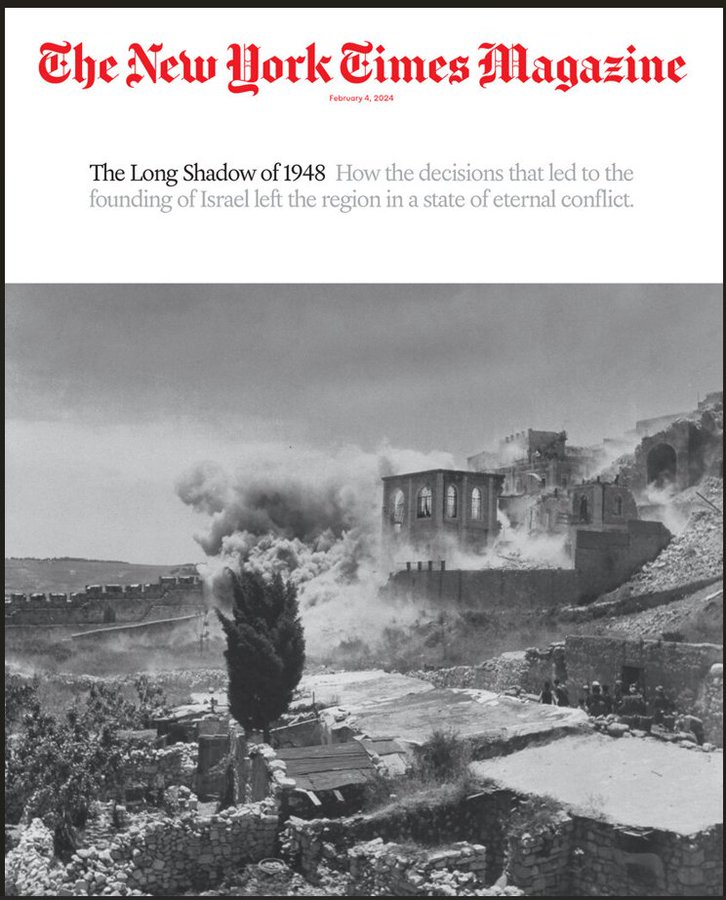
The New York Times Magazine-February 4, 2024

Image

THE NEW YORK TIMES MAGAZINE (February 2, 2024): The new issue features ‘The Long Shadow of 1948’ – How the decisions that led to the founding of Israel left the region in a state of eternal conflict…

The Road to 1948

How the decisions that led to the founding of Israel left the region in a state of eternal conflict.

A discussion moderated by Emily Bazelon

One year matters more than any other for understanding the Israeli-Palestinian conflict. In 1948, Jews realized their wildly improbable dream of a state, and Palestinians experienced the mass flight and expulsion called the Nakba, or catastrophe. The events are burned into the collective memories of these two peoples — often in diametrically opposed ways — and continue to shape their trajectories.

John Malkovich on (Really) Being John Malkovich

An illustration of John Malkovich.

By David Marchese 

There’s a scene in that modern classic of screwball existentialism, “Being John Malkovich,” from 1999, in which John Malkovich, playing a version of himself, enters a portal that others have been using to climb inside his mind. Suddenly, Malkovich is in a world populated solely by variations on himself: Malkovich as a flirtatious sexpot, a genteel waiter, a jazz chanteuse, a bemused child, everyone speaking only the word “Malkovich.” In a way, that scene is a microcosm of the actor’s decades-long, always-interesting career. 

The New York Times Magazine- January 28, 2024

THE NEW YORK TIMES MAGAZINE (January 26, 2024): The new issue features ‘America’s 21st-Century E-Commerce Economy Has Stoked A 19th-Century Form of Crime: The Train Robbery’….

The Great Freight-Train Heists of the 21st Century

A photo illustration composed of an old black-and-white photograph of train robbers stealing amazon packages in color.

The explosion of the e-commerce economy has created an opportunity for thieves — and a conundrum for the railways.

College Is All About Curiosity. And That Requires Free Speech.

An illustration of a professor in front of a class that is shouting and picketing from the rafters.

True learning can only happen on campuses where academic freedom is paramount — within and outside the classroom.

Research Preview: Nature Magazine- January 25, 2024

Volume 625 Issue 7996

Nature Magazine – January 24, 2024: The latest issue cover features ‘Brain Drain’ – A hub for the outflow of Cerebrospinal Fluid…

A quantum fix makes e-commerce more tamper-resistant

Light pulses with specific quantum properties could be harnessed to send digital ‘contracts’ between buyer and seller.

How an exercise habit paves the way for injured muscles to heal

Mice that work out regularly have higher levels of a molecule that promotes muscle regeneration than sedentary mice do.

Flexible geothermal power makes it easier to harness Earth’s inner heat

Next-generation plants that respond to demand could be key to making a low-carbon energy source more economically appealing.

Online Shopping: Alibaba Challenges Amazon (WSJ)

Inside the company’s automated warehouse in China Chinese e-commerce giant Alibaba is challenging Amazon by promising fast deliveries from China to anywhere in the world. WSJ visits Alibaba’s largest automated warehouse to see how robots and a vast logistics network are helping it expand globally. Composite: Clément Bürge

E-Commerce: How China Reined In Ant & Alibaba

In less than six months, Chinese entrepreneur Jack Ma’s Ant IPO, which could have been the world’s largest, was scuttled and his companies brought in line by regulators. The U.S. is also taking aim at big tech, but here’s how China moves faster. Photo illustration: Sharon Shi

Analysis: ‘Why U.S. Malls Are Disappearing’ (Video)

Shopping malls in the U.S. were already in decline before the Covid-19 pandemic as consumers shifted away from traditional brick-and-mortar stores to e-commerce. The outbreak has only exacerbated the challenges at malls as social distancing has placed restrictions on stores, movie theaters and restaurants.

So what will become of malls in America after the pandemic ends? Shopping malls across the U.S. have been reeling as restaurant and retail tenants struggle to keep their doors open. Data compiled by Coresight Research shows about a quarter of U.S. malls could close over the next three to five years, accelerating a trend that began before the pandemic.

Simon Property Group — the nation’s biggest mall owner — said earlier this month that its fourth-quarter revenue dropped by 24% on a year-over-year basis to $1.1 billion. However, some analysts think Simon — with its portfolio of A-rated malls and a healthy balance sheet — will benefit as distressed malls operated by its rivals close their doors. The company is also expected to see gains from new additions like hotels and luxury residences.

“Unfortunately there are a lot of centers that don’t fit that high profile and that have lost their competitive edge,” said Piper Sandler analyst Alexander Goldfarb. “The thing about Simon is they’ve been really focused on maintaining it, and that’s both been through a combination of culling the lower productive centers as well as making sure that they keep investing in their top centers.”

Simon Property Group CEO David Simon said the company is also getting a lift from increasing traffic at some of its locations and from tenants paying their rent on time. Malls are a big tax driver for the communities they serve and employ lots of people locally. Watch the video above to find out more about the struggles U.S. malls face and what could become of them after the pandemic ends.

Global News: Britain In The World, E-Commerce & Heating Homes (Podcast)

A selection of three essential articles read aloud from the latest issue of The Economist. This week: Britain’s place in the worldthe future of global e-commerce (9:25), and using urine to heat homes (16:30).