
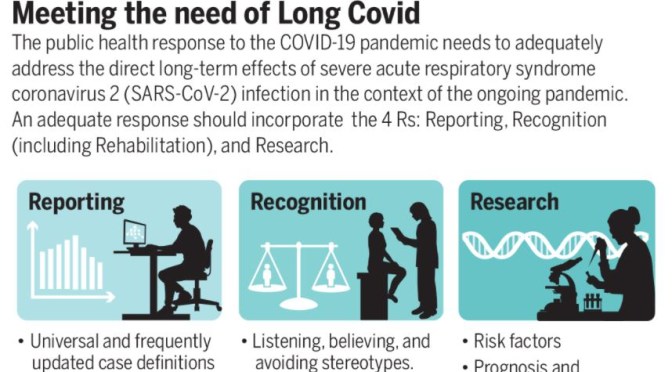
While much about Long Covid remains unknown, a new #SciencePerspective argues that reporting, recognizing and researching this emerging syndrome are essential to fully understand and address the #COVID19 pandemic and its long-lasting effects. https://t.co/r9s6mvZfBi pic.twitter.com/OGk6RPD8Iq
— Science Magazine (@ScienceMagazine) July 30, 2021
Tag Archives: Covid-19

Political Analysis: Tamara Keith And Amy Walter On Covid-19, Infrastructure
NPR’s Tamara Keith and Amy Walter of the Cook Political Report join John Yang to discuss the latest political news, including COVID-19 vaccine hesitancy, congressional debate on a bipartisan infrastructure deal, and the Jan. 6 Capitol insurrection investigation.

Morning News: World Economies Amid Covid, Tokyo 2021 Medal Count
A.M. Edition for July 26. WSJ’s Paul Hannon examines where world economies stand amid the Covid-19 pandemic and the highly contagious Delta variant.
Wall Street traders prepare for a long list of corporate earnings this week. American swimmers win medals at the Tokyo Olympics. And, a push for government-funded diapers.

Covid-19: How The Delta Variant Spread Globally
Covid-19’s Delta variant is proliferating world-wide threatening unvaccinated populations and economic recovery. WSJ breaks down events in key countries to explain why Delta spreads faster than previously detected strains. Composite: Sharon Shi

Views: Top Covid Cartoons


Morning News: Flooding & Covid In Europe, Car Prices, Facial Recognition
The flood waters in Germany and Belgium have started receding with more than 180 people dead. It’s the worst flooding the region has seen in decades and comes on top of a worsening COVID outbreak throughout Europe.
- Plus, why car prices are driving inflation.
- And, retailers turn to facial recognition technology.
Guests: Axios’ Dave Lawler, Kim Hart and Felix Salmon.

Container Shipping: How Maersk Managed Crisis
The global container business is in chaos. Surging consumer demand, covid outbreaks and a shortage of containers has led to higher volume for ocean carriers and congestion at ports.
Maersk, the world’s largest container shipper, has seen record profits. The Danish shipping firm whose customers include Walmart and Nike announced May 2021 first-quarter revenue of $12.4 billion, a 30% increase from a year earlier. Maersk has a fleet of over 700 ships and handles one in every five containers shipped by sea. The company also owns terminals around the world and has a growing land-based logistics business. On average a Maersk container ship calls on a port somewhere around the globe every six minutes.
Like its competitors the company has faced a series of obstacles in the first half of 2021 ranging from the worldwide shortage of shipping containers to the blockage of the Suez Canal. So, with vaccine rollouts in place in the U.S. and consumer discretionary spending shifting towards services will Maersk and its rivals be able to maintain their momentum? And what do bottlenecks at ports and higher freight rates mean for U.S. consumers? Watch the video to find out what’s next for Maersk.

Analysis: The Cognitive Effects Of Covid-19
Covid-19 is complex. It can affect the nervous system, leading to language disorders, strokes and seizures. Scientists are still trying to understand why. 75% of people hospitalised with the virus continue to suffer from secondary symptoms at least six months after they recover. Many find it hard to function in their daily lives. Researchers hope understanding Covid’s impact on the brain could pave a way for treatment.

Harvard: ‘Nanobodies’ Evolved From Synthetic Antibody Fragments
A new approach developed by Harvard Medical School researchers uses yeast to rapidly evolve synthetic antibody fragments called nanobodies with the aim to find variants that are effective at binding to selected antigens, including SARS-CoV-2. The antibodies are intended for use in diagnostic tests and disease treatments. Read the full story: https://hms.harvard.edu/news/antibody…

Covid-19: The Economist ‘Global Normalcy Index’
Across much of the world, covid-19 restrictions are starting to ease. The Economist has crunched the data to calculate how close countries are to pre-pandemic levels of normality—but will life ever be the same again? Read more here: https://econ.st/3AG9siz
 Boomers Daily