After experiencing a spring surge, Michigan is easing COVID restrictions. The Tokyo Olympics are still weeks away but some fear it could turn into a superspreader event.
The Tokyo Olympics are due to begin in just over two months. But with coronavirus cases climbing in recent months, 80% of Japanese people want the games to be cancelled.
The navigation signals sent by satellites like America’s GPS constellation are surprisingly weak. What happens when they’re jammed—or tricked? And in America cicadas have emerged from their underground redoubts for the first time in 17 years, for a frenzied few weeks of mating. How do you study a species that emerges fewer than six times in a century?
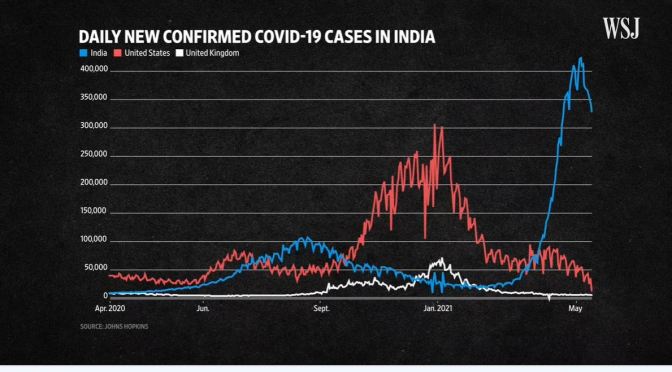
India’s Covid-19 crisis has resulted in record numbers of cases and deaths. WSJ breaks down the chain of events that led to the fastest-growing wave of infection since the pandemic started, and what it means for the world. Photo: Samuel Rajkumar/Reuters
Five stories to know for May 17: Israel-Gaza fighting continues, Los Angeles blaze, train derails in Iowa, CDC mask guidelines, and coronavirus in India.
1. Israel bombed what it said were underground tunnels used by Hamas and Palestinian militants fired rocket barrages at Israeli cities as fighting spilled into a second week.
2. A wildfire in Los Angeles, California, gained momentum on Sunday and about 1,000 residents were put under evacuation orders. Two suspects were detained as arson investigators and police looked into the cause of the blaze.
3. A Union Pacific train hauling hazardous materials derailed and then caught fire in the city of Sibley, Iowa, authorities said.
4. New U.S. guidance allowing people to go without masks in most places provided one more topic of disagreement among Americans who have found little common ground throughout the pandemic.
5. India reported a further decline in new coronavirus cases on Monday but daily deaths remained above 4,000, and experts said the data was unreliable due to a lack of testing in rural areas where the virus is spreading fast.
The Schleiregion including Eckernförde is one of four areas that have been selected for a test project. The project is meant to find out if tourism is possible during a pandemic. DW host Nicole Frölich was in the region.
A.M. Edition for May 14. WSJ’s Rochelle Toplensky discusses Internal Revenue Service attention on cryptocurrency investors. WSJ’s Betsy McKay on the continuing search for clues about the origin of the Covid-19 pandemic.
And, air travelers face new frustrations. Marc Stewart hosts.
In 2018, Michael Lewis published “The Fifth Risk,” which argued, in short, that the federal government was underprepared for a variety of disaster scenarios. Guess what his new book is about? Lewis visits the podcast this week to discuss “The Premonition,” which recounts the initial response to the coronavirus pandemic.
“It wasn’t just Trump,” Lewis says. “Trump made everything worse. But there had ben changes in the American government, and changes in particular at the C.D.C., that made them less and less capable of actually controlling disease and more and more like a fine academic institution that came in after the battle and tried to assess what had happened; but not equipped for actual battlefield command. The book doesn’t get to the pandemic until Page 160. The back story tells you how the story is going to play out.”
The historian Annette Gordon-Reed visits the podcast to talk about her new book, “On Juneteenth,” which combines history about slavery in Texas and Juneteenth with more personal, essayistic writing about her own family and childhood.
“This is a departure for me, but it is actually the kind of writing that I always thought that I would be doing when I was growing up, dreaming about being a writer,” Gordon-Reed says. “I’ve always been a great admirer of James Baldwin, and Gore Vidal’s essays I thought were wonderful, better than the novels, and that’s the kind of thing that I wanted to do. So it was sort of a dream come true for me to be able to take this form and talk about some things that were very important to me.”
Also on this week’s episode, Tina Jordan looks back at Book Review history during this year of its 125th anniversary; Alexandra Alter has news from the publishing world; and Parul Sehgal and John Williams talk about the latest in literary criticism. Pamela Paul is the host.
Here are the books discussed by the critics this week:













 Boomers Daily