
Tag Archives: Coronavirus

 NPR News Now reports: Protests erupt in Beirut in aftermath of massive explosion, Tik Tok sues U.S., and other world news.
Morning News Now: New Stimulus Bill Falters, Covid-19 Vaccine Update
 NPR News Now reports: Congress fails to agree on a new stimulus bill, President Trump considers action, and other top news.

Top New Science Podcasts: Pregnancy Risks Of Covid-19, Razor Blades & Hair
 Staff Writer Meredith Wadman joins host Sarah Crespi to discuss the risk of the novel coronavirus infection to pregnant women. Early data suggest expectant women are more likely to get severe forms of the infection and require hospitalization. Meredith describes how the biology of pregnancy—such as changes to the maternal immune system and added stress on the heart and lungs—might explain the harsher effects of the virus.
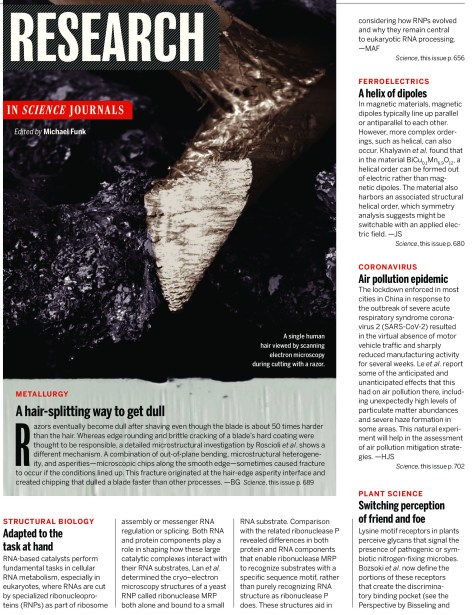
Also this week, Sarah talks with Gianluca Roscioli about his experiments with commercial razor blades and real human hair. By using a scanning electron microscope, he was able to show how something relatively soft like hair is able to damage something 50 times harder like stainless steel.

TOP JOURNALS: RESEARCH HIGHLIGHTS FROM SCIENCE MAGAZINE (August 7, 2020)
Morning News Podcast: New Stimulus Bill Talks, California Covid-19 Rates
NPR News Now reports on Stimulus Bill talks on Saturday, California reaches 500,000 coronavirus infections and 9200 fatalities, Florida tropical storm, and more.

New Restaurants: “Ampia Rooftop NYC” – “Sanitary, Social Distance Dining”
Ampia Rooftop (Ampia meaning “Space” in Italian) is a sprawling 4,500 Sq. foot outdoor rooftop terrace featuring individual greenhouses for a social distance dining experience, opulent clusters of colorful flower gardens, and Italian-themed art and décor dispersed throughout. Chef Michele Iuliano offers up an authentic Italian menu of lite casual fare, along with a selection of inventive seafood paninis.
Restaurant Business (August 1, 2020) – The first step was a name change. When New York City announced that restaurants could open for outdoor dining during Phase 2, the Iulianos changed the name from Gnoccheria Rooftop to Ampia—a move that gave it a distinct identity. Then they set about redesigning the space to satisfy all the restrictions.
The entire space was sprayed with an electrostatic sanitary coating, including the tables, chairs, bar and every touchable surface. The process sanitizes for up to three months. The pair also purchased a facial recognition thermometer and all the essential PPE specified in New York Gov. Andrew Cuomo’s Phase 2 guidelines.
Next, the space was reconcepted from the original 250-seat restaurant to an outdoor dining venue with a limited bar and food menu. The beer garden in the original plan had to be scrapped; it’s impossible to enforce social distancing in that kind of setting. Instead, tables were spread out and seating areas set far apart, accommodating 60 to 65 guests.
The regulations around social distancing state that if tables cannot be arranged six feet apart, a restaurant can use plexiglass dividers between them. But the Iulianos wanted to infuse Ampia with the same stylish elements that differentiate their other restaurants.

Health & Business: “The Office Redesign Is Just Beginning” (WSJ Video)
Plexiglass dividers and floor decals might not be permanent, but the pandemic will bring lasting change to offices. Experts from the architecture and real-estate industries share how they are getting back to work and what offices will look like in the future.
Photo: Cesare Salerno for The Wall Street Journal
Morning News Podcast: Covid-19 Hospital Data, Protests In Portland
NPR News Now reports on tracking hospital data on Covid-19, continuing protests in Portland, and other top news stories.

Top New Science Podcasts: Covid-19 Vaccine Fears And Origin Controversies
Science Editor-in-Chief Holden Thorp joins host Sarah Crespi to discuss his editorial on preventing vaccine hesitancy during the coronavirus pandemic. Even before the current crisis, fear of vaccines had become a global problem, with the World Health Organization naming it as one of the top 10 worldwide health threats in 2019. Now, it seems increasingly possible that many people will refuse to get vaccinated. What can public health officials and researchers do to get ahead of this issue?
Also this week, Sarah talks with Science Senior Correspondent Jon Cohen about his story on Chinese scientist Shi Zhengli, the bat researcher at the center of the COVID-19 origins controversy—and why she thinks President Donald Trump owes her an apology.
Finally, Geert Van der Snickt, a professor in the conservation-restoration department at the University of Antwerp, talks with Sarah about his Science Advances paper on a new process for peering into the past of paintings. His team used a combination of techniques to look beneath an overpainting on the Ghent Altarpiece by Hubert and Jan Van Eyck—a pivotal piece that showed the potential of oil paints and even included an early example of painting from an aerial view.

Top New Science Podcasts: How The Skin Stretches, Covid-19 Conferences And Pain Resistance Traits
 This week’s Nature podcast looks at how skin’s unusual response to stretching is finally explained, a coronavirus update and the latest in a huge effort to map DNA.
In this episode:
01:06 Stretching skin
For decades it’s been known that stretching skin causes more skin to grow, but the reasons why have been a mystery. Now, researchers have uncovered a mechanism to explain the phenomenon. Research Article: Aragona et al.; News and Views: Stretch exercises for stem cells expand the skin
07:49 Coronapod
We discuss how the coronavirus pandemic has affected scientific meetings and how the learned societies that organise them are adapting. How scientific conferences will survive the coronavirus shock; How scientific societies are weathering the pandemic’s financial storm;
A year without conferences? How the coronavirus pandemic could change research
18:18 Research Highlights
A genetic trait for pain-resistance, and the accessibility-aware ancient Greeks. Research Highlight: A gene helps women in labour to skip the painkillers; Research Highlight: This temple was equipped with accessibility ramps more than 2,000 years ago
20:42 ENCODE updates
The ENCODE project aims to identify all the regions in the human genome involved in gene regulation. This week, data from its third iteration has been published and we examine the highlights. Research Article: Snyder; News and Views: Expanded ENCODE delivers invaluable genomic encyclopaedia
28:50 Briefing Chat
We take a look at some highlights from the Nature Briefing. This time we look at how smallpox may be much older than previously thought, and how the Earth’s atmosphere rings like a bell. Nature News: Smallpox and other viruses plagued humans much earlier than suspected; Physics World:
 Boomers Daily