Tag Archives: Coral Reefs

The New York Times Magazine – Oct 29, 2023

Image

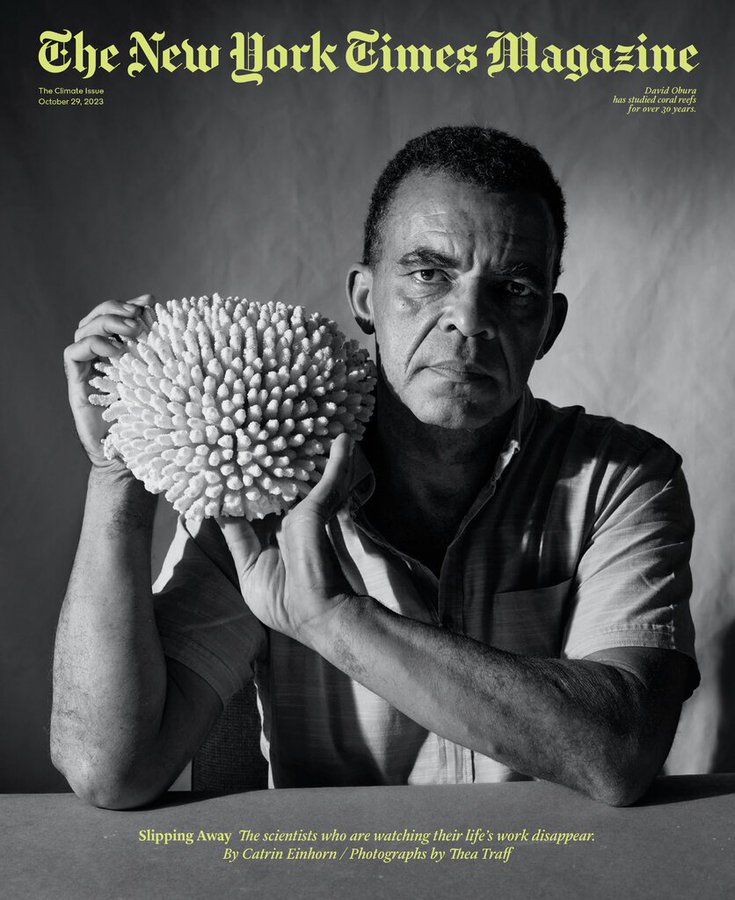
THE NEW YORK TIMES MAGAZINE (October 29, 2023): The latest issue features The Scientists Watching Their Life’s Work Disappear; Can We Save the #Redwoods by Helping Them Move?; ‘It’s Like Our Country Exploded’: #Canada’s Year of #Fire and #ClimateChange Is Keeping Therapists Up at Night….

The Scientists Watching Their Life’s Work Disappear

All the photographs in this article are black-and-white. David Obura holds finger coral.

Some are stubborn optimists. Others struggle with despair. Their faces show the weight they carry as they witness the impact of climate change.

Interviews by Catrin Einhorn

Amid the chaos of climate change, humans tend to focus on humans. But Earth is home to countless other species, including animals, plants and fungi. For centuries, we have been making it harder for them to exist by cutting down forests, plowing grasslands, building roads, damming rivers, draining wetlands and polluting. Now that wildlife is depleted and hemmed in, climate change has come crashing down. In 2016, scientists in Australia announced the loss of a rodent called the Bramble Cay melomys, one of the first known species driven to global extinction by climate change. Others are all but certain to follow. How many depends on how much we let the planet heat.

Can We Save the Redwoods by Helping Them Move?

Redwoods with foliage in a violet specturm. All of the photographs in this article have special color treatment to highlight the foliage.

The largest trees on the planet can’t easily ‘migrate’ — but in a warming world, some humans are helping them try to find new homes.

By Moises Velasquez-Manoff

When Philip Stielstra retired from Boeing in 2012, he needed something purposeful to do. He and his wife, Gay, were casual golfers, but Stielstra, an antiwar activist in college who refused to fight in Vietnam — he worked in a post office instead — wanted a pastime with bigger stakes. Before leaving his job, he received an email from the city of Seattle: The Parks and Recreation Department needed “tree ambassadors.” Tree canopy cover had receded in the city, and the department was responding by promoting an appreciation for its remaining trees. The volunteer ambassadors would learn about these trees and lead residents on walking tours to marvel at them. Stielstra, despite being a self-described introvert, signed up.


World Economic Forum: Top Stories- June 17, 2023

World Economic Forum (June 17, 2023) – This week’s top stories of the week include:

0:15 How to solve the global rice shortage – Every day, more than half the world sits down to a plate of rice. A shortage could harm the food security of billions of the poorest people. But if scientists and farmers can solve this problem it would be great news for the climate, too

2:24 How El Niño will affect your weather – El Niño is a climate pattern in the Pacific Ocean and a new phase of it has just begun. Normally, Pacific ‘trade winds’ blow from east to west, pushing warm water away from South America towards Asia. Cold water rises in its place, regulating temperatures and drawing up nutrients for marine life from the ocean depths.

4:17 This fabric blocks mosquito bites – Researchers at Auburn University used a programmable 3D-knitting robot to create a weave that has a ‘chainmail effect’ at the microscopic level and which does not create openings as it bends. It also has enough holes for air flow to keep wearers cool in hot countries.

5:56 Indonesian poachers restore coral reefs – Marine scientist Syafyudin Yusuf is leading the efforts. Together, his team has restored 12 hectares of corals . Just 15 years ago, only 2% of the region’s original reefs remained undamaged. Local fishers used explosives and chemicals to stun or kill fish, making them easier to catch. “We needed to live and survive, but the chances of getting a decent job aren’t good, and the only job we knew of was that, that’s how we began bombing the reefs.”

_____________________________________________

The World Economic Forum is the International Organization for Public-Private Cooperation. The Forum engages the foremost political, business, cultural and other leaders of society to shape global, regional and industry agendas. We believe that progress happens by bringing together people from all walks of life who have the drive and the influence to make positive change.

Research Preview: Nature Magazine – June 15, 2023

Image

nature Magazine – June 15, 2023 issue: In this week’s issue, Abhinav Kandala and his colleagues show that it is still possible for a quantum computer to outperform a classical computer, by mitigating, rather  than correcting, the errors. 

DeepMind AI creates algorithms that sort data faster than those built by people

A replica of a game between 'Go' player Lee Se-Dol and a Google-developed super-computer, in Seoul, Korea, 2016.

The technology developed by DeepMind that plays Go and chess can also help to write code.

An artificial intelligence (AI) system based on Google DeepMind’s AlphaZero AI created algorithms that, when translated into the standard programming language C++, can sort data up to three times as fast as human-generated versions.

“We were a bit shocked,” said Daniel Mankowitz, a computer scientist at DeepMind who led the work. “We didn’t believe it at first.”

Ukraine dam collapse: what scientists are watching

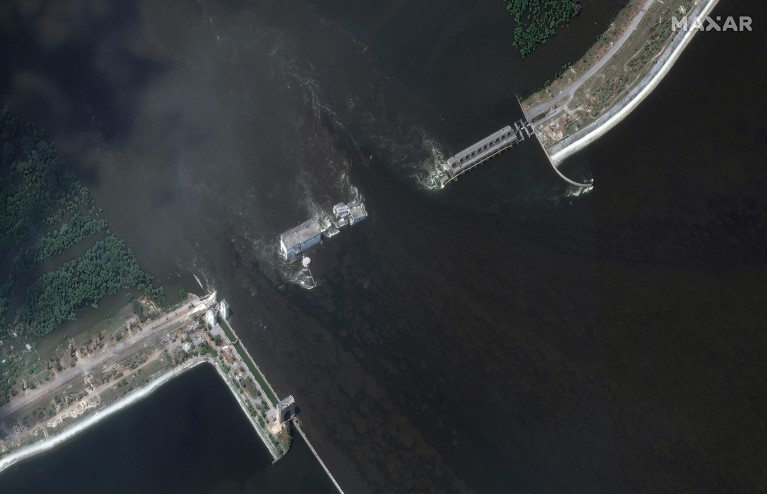
Maxar satellite imagery of the destruction of the Nova Kakhovka dam and hydroelectric power facility.
Large sections of the Kakhovka dam have collapsed, unleashing catastrophic floods. Credit: Satellite image (c) 2023 Maxar Technologies via Getty

Extensive flooding could have severe consequences for farming, health and the environment.

The 66-year-old Kakhovka dam on the Dnieper River in south Ukraine collapsed on the morning of 6 June after a suspected explosion, triggering a catastrophic humanitarian and environmental crisis.

Research Preview: Nature Magazine – June 8, 2023

Image

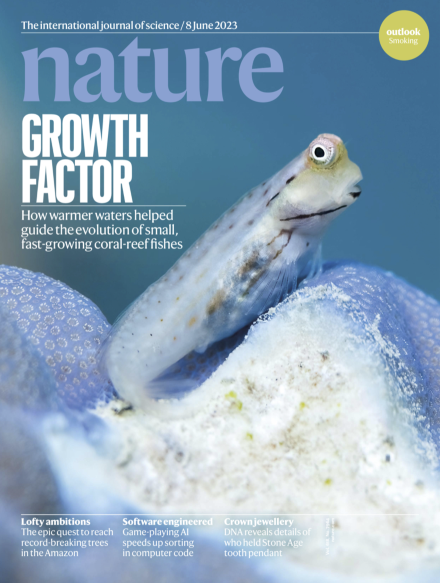
nature Magazine – June 8, 2023 issue:  Coral reef fishes, such as the blenny Ecsenius stictus pictured on the cover, are diverse, abundant and grow quickly. In this week’s issue, Alexandre Siqueira and his colleagues investigate the evolutionary history of these fishes to find out how growth has shaped life on coral reefs. 

Camera that could fit on a penny captures vivid colour photos

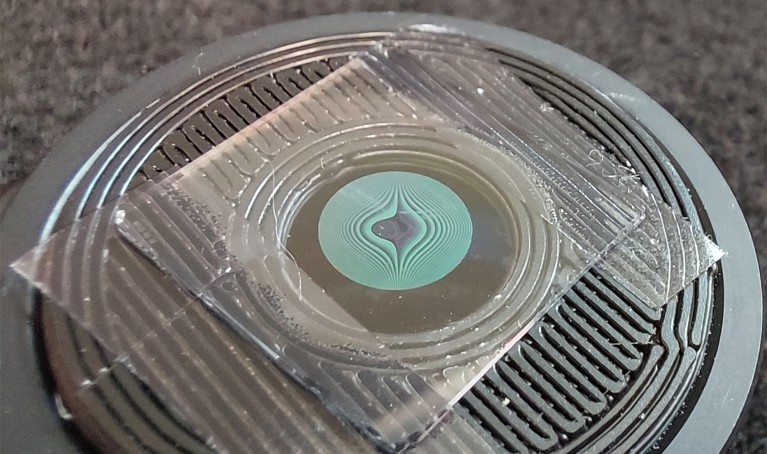
Optimized phase mask of five-millimetre diameter fabricated using a nanofabrication approach.

A ‘meta-lens’ and corrective algorithms allow a tiny device to produce high-resolution images.

A computational-imaging technique paves the way for ultra-small cameras that could be used in various portable devices.

These hardy ants build their own landmarks in the desert

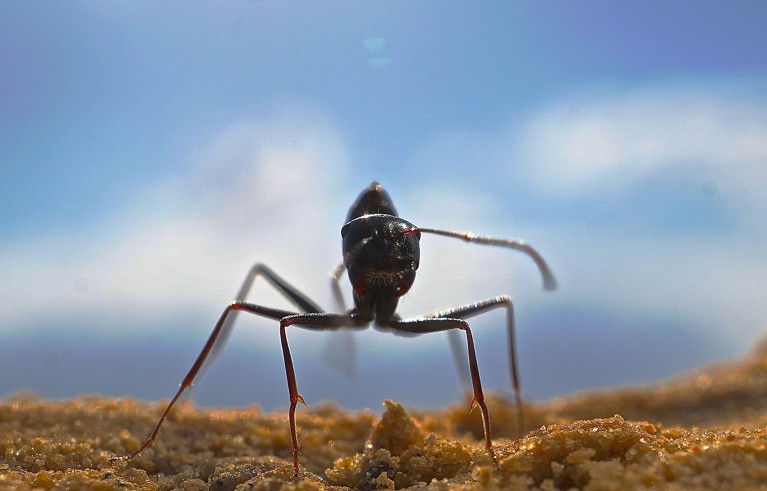
Tunisian desert ant Cataglyphis fortis.

Ants living on the sprawling salt pans of Tunisia use DIY markers to find their way home.

The desert ant Cataglyphis fortis lives in Tunisia’s arid salt flats, and can travel more than a kilometre from its underground nest in search of food. Now scientists have found that these ants build tall hills on top of their nests that help the insects to find their way home across the vast, featureless landscape1.

Ocean Views: Predators Of The World’s Coral Reefs

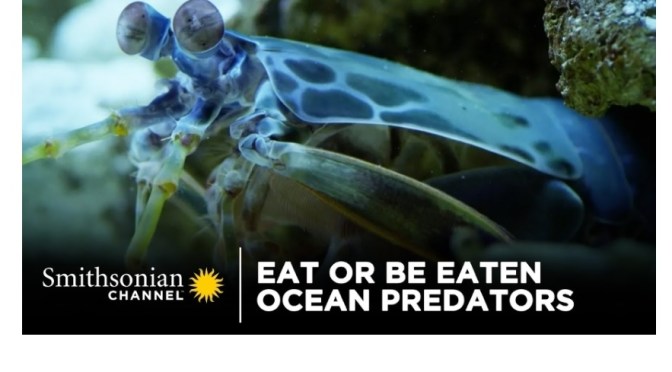
Smithsonian Channel (April 15, 2023) – From Lionfish to Peacock Mantis Shrimp, here’s a look at some of the reef’s fiercest predators from ‘Castro’s Secret Reef,’ Deadly Australians: Oceans and Beaches,’ ‘Great Blue Wild: Indonesia,’ and ‘David Attenborough’s Great Barrier Reef.’

Views: Saving The Maldives From Rising Sea Levels

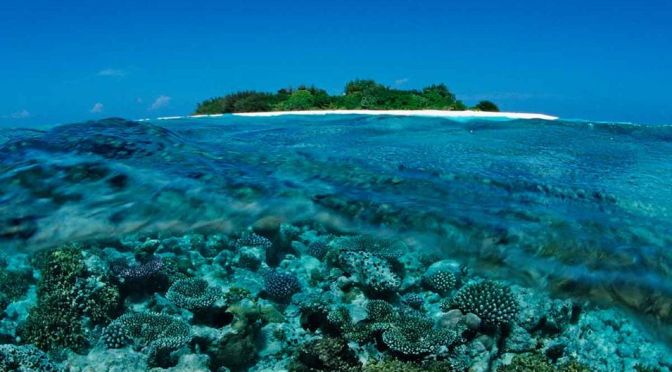
BBC Earth (January 10, 2023) – The Maldives could be underwater by 2100. Maldivians are working together to look to the very thing that defines them – the ocean – to save its future, and their island homes. Narrated by wildlife filmmaker Laura Pennafort.

Micronesia Views: Marine Sanctuaries In Palau

CBS Mornings – As small island developing states make their case for climate awareness at COP27 in Egypt, one member of the group is reconsidering a historic act of preservation it undertook two years ago. Lee Cowan reports.

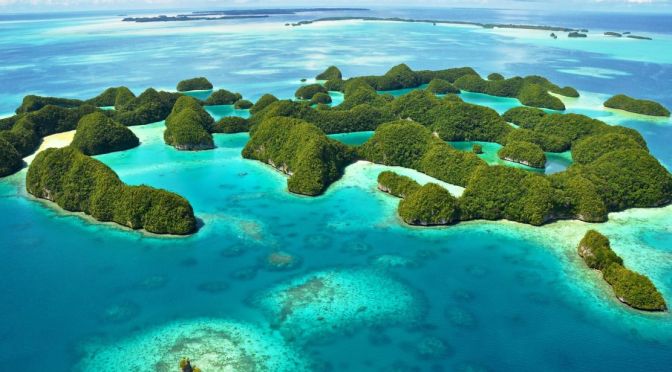
Palau is an archipelago of over 500 islands, part of the Micronesia region in the western Pacific Ocean. Koror Island is home to the former capital, also named Koror, and is the islands’ commercial center. The larger Babeldaob has the present capital, Ngerulmud, plus mountains and sandy beaches on its east coast. In its north, ancient basalt monoliths known as Badrulchau lie in grassy fields surrounded by palm trees.

360° Views: Underwater Life In Marsa Alam, Egypt

A 360° underwater view in the waters off Marsa Alam, Egypt.

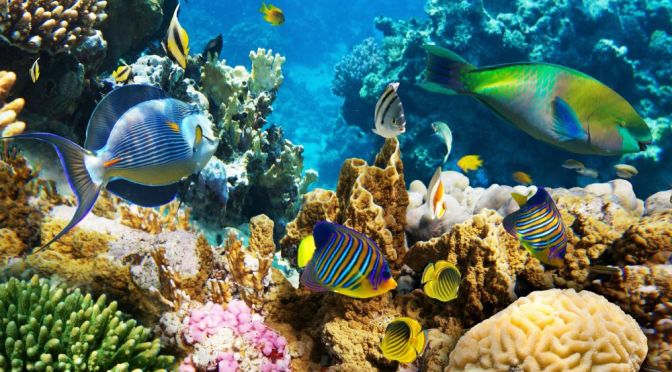
Marsa Alam is a resort town on the Red Sea in Egypt. It’s renowned for its sandy beaches and coral reefs. The U-shaped Abu Dabab Bay is known for its sea turtles and dugongs (sea cows). Kite-surf site El Naaba Lagoon is separated from the open sea by a coral reef. Wadi el-Gemal National Park, south of the town, encompasses desert, seagrass beds, reefs and islands. 

Cover Preview: Science Magazine – May 6, 2022

IN DEPTH

Bids for Anthropocene’s ‘golden spike’ emerge

Download PDFSites compete to mark global changes of the 1950s and define new geological age

Census aims for better U.S. statistical portrait

Download PDFAgency wants to retool its surveys and decennial census to improve efficiency and generate better data

Doubt cast on inflammation’s stop signals

Download PDFCritics challenge data underpinning “resolution immunology,” triggering university probes

Germany weighs whether culling excess lab animals is a crime

Download PDFAs prosecutors evaluate complaints from animal rights groups, labs try to reduce surplus

Balloon detects first signs of ‘sound tunnel’ in the sky

Download PDFAtmospheric analog to ocean’s acoustic channel could be used to monitor eruptions and bombs

Marine Life: Preserving Coral Reefs In Maldives

The One Ocean Summit opens this Wednesday in the French port of Brest. Seas and oceans cover around 70 percent of the surface of our planet, but continue to face an onslaught of problems, from pollution to rising temperatures. In the Maldives, coral reefs are dying because of climate change. However, locals are doing their best to save them. Our France 2 colleagues report, with FRANCE 24’s Wassim Cornet.

Maldives, officially the Republic of Maldives, is an archipelagic country in the Indian subcontinent of Asia, situated in the Indian Ocean. It lies southwest of Sri Lanka and India, about 750 kilometres from the Asian continent’s mainland.