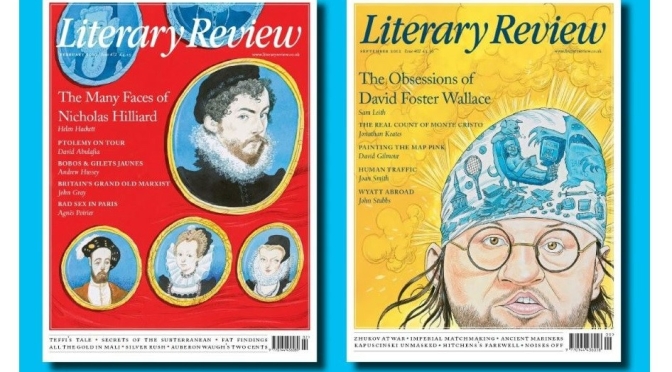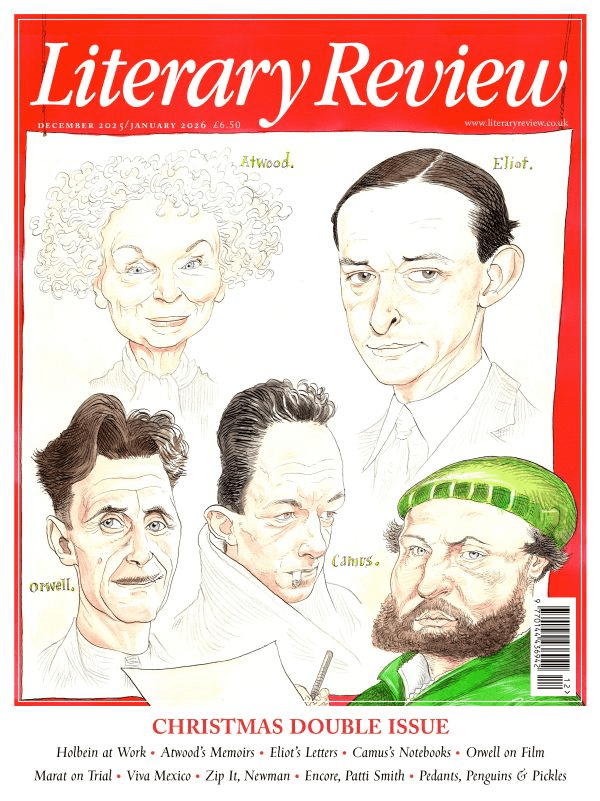
LITERARY REVIEW : The latest issue features ‘Mysteries of Marlowe’

LITERARY REVIEW : The latest issue features ‘Mysteries of Marlowe’

TIMES LITERARY SUPPLEMENT: The latest issue features Lawrence Durrell, “so many towns” that could “become Alexandria” – “founded”, as indeed so many were, “At the doors of Africa”, “Upon a parting”. Yet what other town could boast of anything to compare with that “last pale / Lighthouse”, the Pharos of Alexandria, “like a Samson blinded”?
Literary myth-making, from Alexandria to Corfu By Jonathan Keates
The pleasures and challenges of making – and describing – great wines By George Berridge
Investigating the deathbed conversion of Oscar Wilde By Richard A. Kaye
To what extent are addicts responsible for their actions? By Crispin Sartwell
By Michael Cummins, Editor, August 12, 2025

A vast stone arch, a suspension of steel, a ribbon of concrete stretching across a chasm—these are not merely feats of engineering or infrastructure. They are, in the words of the great historian David McCullough, monuments to the human spirit, physical places that embody the stories of ingenuity, perseverance, and sacrifice that created them. While the written word provides the essential narrative framework for understanding the past, McCullough’s work, from his celebrated biographies to his upcoming collection of essays, History Matters (2025), consistently champions the idea that visiting and comprehending these physical settings offers a uniquely powerful and visceral connection to history.
These places are not just backdrops; they are tangible testaments, silent witnesses to the struggles and triumphs that have shaped our world, offering a depth of understanding that written accounts alone cannot fully provide. In History Matters, McCullough writes, “History is a guide to navigation in perilous times. History is who we are and why we are the way we are.” This philosophy is the essay’s core, as we explore how the places he chronicled are integral to this understanding.
In his extensive body of work, McCullough frequently returned to this theme, demonstrating how the physical presence of a historical site grounds the abstract facts of the past in the authentic, palpable reality of the present. He believed that the stories of our past are a “user’s manual for life,” and that the places where these stories unfolded are the most direct way to access that manual. By examining four of his most iconic subjects—the Brooklyn Bridge, the “White City” of the 1893 World’s Fair, the Panama Canal, and Kitty Hawk—we can see this philosophy in action.
Each of these monumental endeavors was an audacious, against-all-odds project that faced incredible technical and personal challenges, including political opposition, financial struggles, and tragic loss of life. Yet, McCullough uses them as a lens to explore the character of the people who built them, the society of the time, and the very idea of American progress and ingenuity. These structures, built against overwhelming odds, stand as powerful reminders that history is an active, ongoing force, waiting to be discovered not just in books, but in the very soil and stone of the world around us.
The Brooklyn Bridge stands as a primary example of a physical place as tangible testimony to human ingenuity. In his landmark book The Great Bridge (1972), McCullough details the seemingly insurmountable challenges faced by the Roebling family in their quest to connect Manhattan and Brooklyn. In the mid-19th century, the idea of spanning the East River, with its powerful currents and constant ship traffic, was seen as an engineering impossibility. The technology for building such a massive structure simply did not exist. The bridge, therefore, was not merely constructed; it was invented. The vision of John Roebling, who conceived the revolutionary design of a steel-wire suspension bridge, was cut short by a tragic accident. His son, Washington, took over the project, only to be struck down by the debilitating effects of “the bends,” a crippling decompression sickness contracted while working in the underwater caissons. These massive timber and iron chambers, filled with compressed air, allowed workers to lay the foundations for the bridge’s monumental stone towers deep below the riverbed. The work was brutal, dangerous, and physically taxing. Washington himself spent countless hours in the caissons, developing the condition that would leave him partially paralyzed. As McCullough writes, “The bridge was a monument to faith and to the force of a single will.” This quote captures the essence of the Roeblings’ spirit, and the enduring structure itself embodies this unwavering faith.
Paralyzed and often bedridden, Washington continued to direct the project from his window, observing the progress through a telescope while his wife, Emily Warren Roebling, acted as his liaison and de facto chief engineer, mastering advanced mathematics and engineering to communicate her husband’s instructions to the men on site. The Roeblings’ story is a personal drama of vision and perseverance, and the physical bridge is a direct reflection of it. The monumental stone towers, with their Gothic arches, are a direct result of the design choices made to withstand immense pressure. The intricate web of steel cables, which Roebling so meticulously calculated, hangs as a monument to his genius. The wooden promenade, a feature initially ridiculed by critics, stands as a testament to the Roeblings’ foresight, offering a space for the public to walk and experience the grandeur of the structure.
A person can read McCullough’s narrative of the Roeblings’ saga and feel inspired by their resilience. However, standing on the promenade today, feeling the subtle vibrations of the traffic below, seeing the cables stretch into the distance, and touching the cold, ancient stone of the towers provides a profound, non-verbal understanding of the sheer audacity of the project. The physical object makes the story of vision, sacrifice, and perseverance feel not like a distant myth, but like a concrete reality, etched into the very materials that compose it. The bridge becomes a silent orator, telling its story without a single word, through its breathtaking scale and enduring presence. It connects us not only to a piece of engineering but to the very human story of a family that poured its life’s work into a single, magnificent idea.
The “White City” of the 1893 World’s Columbian Exposition, as chronicled in The Devil in the White City (2003), serves as a different but equally powerful example of a place as a testament to human will and ambition. Unlike the permanent structures of the Brooklyn Bridge and Panama Canal, the White City was a temporary, almost mythical creation. Built from scratch on swampy land in Chicago, it was a colossal feat of city planning and architectural design that captured the imagination of the world and showcased America’s coming of age. The place itself—with its majestic, neoclassical buildings, grand boulevards, and sprawling lagoons—was a physical manifestation of a nation’s collective vision. The narrative is driven by figures like architect Daniel Burnham, who, much like Washington Roebling, faced immense pressure, logistical nightmares, and constant political infighting. The physical challenges were immense: transforming a marsh into a breathtaking cityscape in just a few short years, all while coordinating the work of an entire generation of architectural titans like Frederick Law Olmsted and Louis Sullivan.
McCullough uses the White City to show how an ambitious idea can be willed into existence through relentless determination. The physical city, for its brief, glorious existence, was the living embodiment of American progress, ingenuity, and the Gilded Age’s opulent grandeur. It was a place where millions came to witness the future, to marvel at electric lights, and to see new technologies like the Ferris wheel. As McCullough writes, “The fair, a world of its own, had a power to transform those who visited it.” This quote highlights the profound, almost magical impact of this temporary place. However, McCullough masterfully contrasts the gleaming promise of the White City with the dark underbelly of the era, epitomized by the psychopathic serial killer H.H. Holmes and his “Murder Castle,” located just a few miles away. The physical contrast between these two places—the temporary, luminous dream and the permanent, sinister reality—is central to the book’s power. Even though the structures of the White City no longer stand, the historical record of this magnificent place—its photographs, its architectural plans, and McCullough’s vivid descriptions—serves as a tangible window into that moment in time, reminding us of the powerful, transformative potential of a shared human vision and the complex, often contradictory, nature of the society that produced it.
Finally, the Panama Canal serves as a powerful testament to the theme of human sacrifice and endurance. The canal was not just a feat of engineering; it was a grueling, decades-long battle against nature, disease, and bureaucratic inertia. As chronicled in McCullough’s Pulitzer Prize-winning book, The Path Between the Seas (1977), the French attempt to build a sea-level canal failed catastrophically under the direction of Ferdinand de Lesseps, the engineer of the Suez Canal. They grossly underestimated the challenges of the tropical climate, the unstable geology, and the devastating diseases, costing thousands of lives and ultimately leading to financial ruin. The subsequent American effort, led by figures like Dr. William Gorgas, who tirelessly fought the mosquito-borne diseases, and engineer John Frank Stevens, who abandoned the sea-level plan for a lock-and-lake system, was equally defined by a titanic human cost. The physical canal itself—the vast, deep Culebra Cut that slices through the continental divide, the enormous locks that lift ships over a mountain range, the sprawling Gatun Lake—serves as a permanent memorial to this immense struggle.
The sheer physical scale of the canal is an emotional and intellectual experience that far surpasses any numerical data. One can read that “25,000 workers died” during the French and American construction periods, a statistic that, while tragic, can be difficult to fully comprehend. But to stand at the edge of the Culebra Cut, staring down at the colossal gorge carved out of rock and earth, is to feel the weight of those lives. The physical presence of the cut makes the abstract struggle of “moving a mountain” feel real. The immense size of the locks and the power of the water filling them evokes a sense of awe not just for the engineering, but for the human will that made it happen. The canal is not just a shortcut for global trade; it is a monument to the thousands of unnamed laborers who toiled in oppressive conditions and to the few visionaries who refused to give up. As McCullough wrote, the canal was a testament to the fact that “nothing is more common than the wish to move mountains, but a mountain-moving event requires uncommon determination.” The physical place makes the concept of perseverance tangible, demonstrating in steel, concrete, and water that impossible tasks can be conquered through sheer, relentless human effort. The canal also represents a pivot point in American history, marking the nation’s emergence as a global power and its willingness to take on monumental challenges on the world stage.
In The Wright Brothers, McCullough presents a different kind of historical place: one that is not a monumental structure, but a desolate, windswept beach. The story of Wilbur and Orville Wright’s quest to achieve controlled, powered flight is inextricably linked to this specific location on the Outer Banks of North Carolina. Kitty Hawk was not a place of grandeur, but one of raw, challenging nature. Its consistent, stiff winds and soft, sandy dunes made it an ideal testing ground for their gliders. This place was a crucial collaborator in their scientific process, a physical laboratory where they could test, fail, and re-evaluate their ideas in relative isolation. As McCullough writes of their success, “It was a glorious, almost unbelievable feat of human will, ingenuity and determination.” This triumph was born not on a grand stage, but on a patch of ground that was, at the time, little more than a remote stretch of sand.
McCullough’s narrative emphasizes how the physical conditions of Kitty Hawk—the powerful gales, the endless expanse of sand, and the isolation from the public eye—were essential to the Wrights’ success. They didn’t build a monument to their achievement in a city; they built it in the middle of nowhere. It was a place of quiet, methodical work, of relentless trial and error. The physical space itself was a character in their story, a partner in their success. The first flight did not happen on a grand stage, but on a patch of ground that was, at the time, little more than a remote stretch of sand. Today, when one visits the Wright Brothers National Memorial, the monument is not just the stone pylon marking the first flight, but the entire landscape—the dunes, the wind, and the expansive sky—that made their achievement possible. This place reminds us that some of history’s greatest triumphs begin not with a bang, but in the quiet, isolated spaces where innovation is allowed to thrive.
Beyond these specific examples, McCullough’s philosophy, as expected to be reiterated in History Matters, argues that this direct, experiential connection to place is vital for a vibrant and engaged citizenry. It is the authenticity of standing on the same ground as our forebears that makes history feel relevant to our own lives. A book can tell us about courage, but a place—the Brooklyn Bridge, the Panama Canal, the White City, or a humble battlefield—can make us feel it. These places are the physical embodiment of the narratives that have defined us, and by seeking them out, we are not simply looking at the past; we are a part of a continuous story. They remind us that the qualities of human ingenuity, sacrifice, and perseverance are not merely historical attributes, but enduring elements of the human condition, available to us still today.
Ultimately, McCullough’s legacy is not only in the stories he told but also in his fervent plea for us to recognize the importance of the places where those stories occurred. His work stands as a powerful argument that history is not abstract but is profoundly and permanently embedded in the physical world around us. By preserving and engaging with these historical places, we are not just honoring the past; we are keeping its most powerful lessons alive for our present and for our future. They are the tangible proof that great things are possible, and that the struggles and triumphs of those who came before us are forever etched into the landscape we inhabit today. His writings on these three monumental locations—one that stands forever as a testament to the Roeblings’ vision, another that vanished but whose story remains vivid, and a third that forever altered global commerce—each demonstrate the unique and irreplaceable power of place in history. As he so often reminded us, “We have to know who we are, and where we have come from, to be able to know where we are going.”
THIS ESSAY WAS WRITTEN AND EDITED UTILIZING AI

TIMES LITERARY SUPPLEMENT: The latest issue features ‘Tech Bro Utopia’ – Why Bacon’s New Atlantis is Peter Thiel’s favorite book; The monarch who built Britain; Charles and the carbuncles; The miseries of Victor Hugo’s daughter…

LITERARY REVIEW (August 2, 2025): The latest issue features ‘Mark Twain’s American Odyssey’…

TIMES LITERARY SUPPLEMENT: The latest issue features Daniel Karlin about his twelve-month abstinence from the printed word. As one of his friends remarked, he must have been the first person to make a New Year’s resolution to read less.
A year without reading By Daniel Karlin
AI, literary theory and traditional storytelling By Benjamin Markovits
The ethics of industrial insect farming By Simone Gubler
Efforts to prohibit abortion down the ages By Elizabeth Abbott

TIMES LITERARY SUPPLEMENT: The latest issue features All change is for the worse? Pessimists will find evidence in Joad Raymond Wren’s The Great Exchange: Making the news in early modern Europe, reviewed for the TLS by Noel Malcolm.
Where newspapers came from By Noel Malcolm
A cultural conservative who paved the way for Ronald Reagan By Christopher J. Scalia
Ancient rural skills in a modern world By Norma Clarke
Restfully contemplative holiday reading By Irina Dumitrescu

How accountable are US intelligence agencies to the president and Congress? By Richard Norton-Taylor
Henry James’s return to the United States By Alicia Rix
New light on ‘Captain’ Warner’s weapon of mass destruction By Trevor Pateman
A poet for yesterday and today By Emma Greensmith

The following essay was written by AI and edited by Intellicurean:
One often hears that art is a refuge from the storm, a quaint hermitage for the sensitive soul. But when the storm is a veritable tempest of tyranny, what then? Must beauty shrink to a whispered metaphor, or can it, with a flourish, confront the grotesque, form itself a weapon, and memory its shield?

Peter Weiss, the German-Swedish playwright and novelist, perhaps best known for his provocative Marat/Sade, offers an unflinching answer in his masterwork, The Aesthetics of Resistance. This three-volume novel—published between 1975 and 1981, and only recently fully translated into English by Joel Scott for Verso Books—presents not merely a chronicle of Europe’s descent into fascism, but an audacious theory of survival, contemplation, and rebellion through the very act of art.
In a perceptive recent essay for Liberties Journal, Jared Marcel Pollen explores the novel’s radical scope, elegantly correcting a common misattribution of a pivotal political aphorism. Not Lenin, but Maxim Gorky, Pollen reveals, claimed that “aesthetics was [his] ethics—the ethics of the future.” More than a mere historical footnote, this elegantly salvaged reversal encapsulates the novel’s very governing spirit: that beauty, far from being a retreat from political crisis, is its very precondition for meaning, that art does not merely ornament truth, but, with a surgical precision, it excavates it.
The Aesthetics of Resistance unfolds in the shadow of Europe’s unraveling, commencing in 1937, as Hitler consolidates power and Stalin’s purges silence dissent. The narrative spans the years up to 1942—a period that Hannah Arendt once called “midnight in the century.” But unlike conventional historical fiction, Weiss offers no linear tale of protagonists moving toward neat resolution. Instead, he crafts a philosophical Hades-wanderung—a relentless descent through betrayal, failed revolutions, ideological fracture, and the wreckage of cultural inheritance.
The text itself resists easy consumption. Its dense, paragraphless pages—walls of syntax without clear beginning or end—mirror the labyrinthine realities its characters inhabit. In an interview with The New York Times, translator Joel Scott remarked that reading Weiss is like “being submerged in consciousness,” and likened the novel’s structure to a frieze: a continuous mural of intellect, grief, and memory. This relentless, frieze-like form compels the reader to engage with history not as a series of discrete events, but as an overwhelming, cumulative force, a continuous present of trauma and resistance. The novel is as much a meditation on how we perceive history as it is on history itself.
At its core, The Aesthetics of Resistance is a Bildungsroman—a novel of education and formation. But it defiantly eschews the genre’s traditional bourgeois framework. This is no Goethe’s Wilhelm Meister or Joyce’s Stephen Dedalus spiraling through self-inquiry in cloistered academic halls. Weiss’s narrator—working-class, gentile, unnamed—does not wander through elite libraries or university quads. Instead, he and his comrades read Dante, study Greek sculpture, and debate Marxist theory in factory basements and kitchens, under constant threat of arrest or worse.
This autodidacticism—the practice of self-teaching—is not a mere supplement to formal education but a radical replacement. The narrator declares early on: “Our most important goal was to conquer an education… by using any means, cunning and strength of mind.” Their knowledge is not earned; it is stolen—like Promethean fire—from the guarded sanctums of official culture. This echoes Friedrich Schiller’s view in On the Aesthetic Education of Man (1795) that beauty cultivates moral freedom, acting as a safeguard against the dehumanizing mechanisms of state power. Indeed, in a totalitarian state that mutilates truth and simplifies human experience, the very act of preserving intellectual complexity – a core tenet of Weiss’s autodidacts – becomes, as Susan Sontag argued in “On Style,” an ethical stance in itself, an insistence on the primacy of certain values. In Weiss’s hands, this ethic becomes urgently, tragically manifest.
The profound question that animates Weiss’s project is not simply how to survive violence, but how to perceive it. What happens to art, to the very faculty of perception, when the world collapses into brutality? One compelling answer emerges in the novel’s early scene at the Pergamon Altar, a Hellenistic frieze of the Gigantomachy—a mythic war between gods and giants—housed in Berlin’s museum. As Nazi banners flutter outside, the young resisters look upon this magnificent fragment of antiquity and see not quaint myth, but relentless struggle. They interpret the contorted figures as symbols of class war, reclaiming the altar from its imminent fascist cooptation.
This interpretive act—the deliberate reading “against the grain”—is both aesthetic and political, a defiant reconstitution of meaning. It echoes Walter Benjamin’s chilling thesis that “there is no document of civilization that is not at the same time a document of barbarism.” Indeed, as Pollen writes with chilling precision, the Nazis, in their grotesque appropriation of classical forms, hollowed them into “plaster emptiness.” Weiss’s characters do the opposite: they revive these ancient forms by placing them in urgent dialogue with their own suffering, thus universalizing the struggle against domination, making the “mass of stone” a value “belonging to anyone who steps in front of it.”
The novel closes with a powerful meditation on Picasso’s Guernica, his monumental canvas depicting the bombing of the Basque town in 1937. The painting, the narrator insists, does not merely show war—it registers “an assault on the ability to express things.” Guernica marks a new kind of aesthetic task: not only must art represent horror, it must endure it. The painting outlasts its own referent, becoming what philosopher Elaine Scarry once called “a durable object,” an artifact that shelters memory and meaning long after political systems fall and the bombs cease to drop. In Alfonso Cuarón’s bleakly prescient dystopian film Children of Men (2006), Guernica appears, almost unnoticed, in the sterile interior of a government building—a poignant token of lost humanity. This, precisely, is Weiss’s abiding fear: that without the active labor of interpretation, without the human will to engage, even the greatest artistic achievements become mere decor, robbed of their subversive potential.
Some may, of course, recoil, finding The Aesthetics of Resistance too cerebral, too demanding, perhaps even too… Germanic, to resonate beyond the intellectual class. It’s a fair, if somewhat lazy, concern. And yet, as Timothy Snyder so chillingly reminds us in On Tyranny, fascism thrives precisely when the imagination is starved—when complexity gives way to cliché, when memory is replaced by manufactured myth.
Weiss’s project is a counteroffensive. His characters repeatedly ask, with desperate sincerity: “What does the Divina Commedia have to do with our lives?” In posing the question, they model the very activity the novel enacts—bridging distant beauty with present suffering. As Pollen notes, Weiss is not proposing simplistic analogies between then and now, but calling us to maintain the capacity for analogy—the capacity to perceive echoes and derive moral relevance from history, an imaginative act in itself.
Art, then, is not escapism. It is a form of mnemonic defense, a profound act of spiritual preservation. Horst Heilmann, a real historical figure and one of the novel’s central martyrs, declares: “All art… all literature are present inside ourselves, under the aegis of the only deity we can believe in—Mnemosyne”—Memory, mother of the Muses. Here Weiss evokes a stunning theological shift: divinity no longer lies in revelation, but in remembrance. Not in salvation, but in reckoning. Weiss shares this ethos with writers like W.G. Sebald and Toni Morrison, both of whom insisted that literature’s task is not to uplift, but to testify. In her Nobel lecture, Morrison described language as “the measure of our lives,” and warned that its decay is the first sign of cultural amnesia. Weiss anticipates this danger, and his novel becomes a fortress of form against forgetting.
Perhaps the greatest gauntlet Weiss throws down, the element that still most sharply divides critics, is his distinctive style. The novel’s paragraphs can stretch for pages. There is no chapter division, no conventional dialogue, and barely a linear plot. But this excess is deliberate. As George Steiner observed in The New Yorker, Weiss “wanted his novel to resist readability as a form of moral laziness.” This is not to suggest the novel is obscure for its own sake, a mere affectation of difficulty. Rather, its very form embodies its thesis: the reader’s discomfort, the laborious trek through its unbroken syntax, becomes an echo of the characters’ own relentless, desperate struggle for meaning amidst chaos. Like Thomas Bernhard, whose relentless monologic fury shapes Correction and Extinction, Weiss denies literary comfort. Instead, he offers friction, density, and dissonance—qualities perfectly befitting a narrative of clandestine, underground resistance, where truth arrives not through effortless clarity but through sheer, unyielding persistence. In his study The Work of Literature, philosopher Peter Szondi described literature as a form that must “carry contradiction inside itself.” Weiss takes this principle further: contradiction is not a flaw but a crucial feature of truly resistant art. The reader’s discomfort, then, is the novel’s ethical demand.
Weiss died in 1982, a year after completing his trilogy. In a rare interview that year with Der Spiegel, he confessed that his greatest fear was not censorship but irrelevance—that art would become mute in the face of spectacle. That fear feels chillingly prescient. As Western democracies flirt again with the seductive sirens of authoritarianism, and as history is re-scripted by those who profit from collective forgetting, The Aesthetics of Resistance emerges not merely as literature but as an instruction manual for endurance.
Its lessons are not limited to Germany or the 1930s. They resonate in Chile’s brutal reckoning with Pinochet, in the defiant murals of Belfast, in the urgent poetry of Mahmoud Darwish, and in the resolute chants of Tehran’s women today. Where brutality seeks silence, art insists on form—on surviving and shaping what was meant to be annihilated.
Weiss leaves us with a final, searing proposition: Imagination lives as long as resistance lives. And when resistance ends—when truth is reduced to slogan, when memory collapses into myth—then imagination, too, begins to die. But while a single reader still labors through his walls of text, still stands before the Pergamon frieze and refuses to see mere stone, Weiss’s profound vision endures. This is the essence of The Aesthetics of Resistance: not to comfort, but to compel. Not to promise victory, but to remind us that moral clarity comes not from slogans, but from study. And that to understand the past is not merely to remember—it is, in the most profound sense, to resist the future that forgets it.