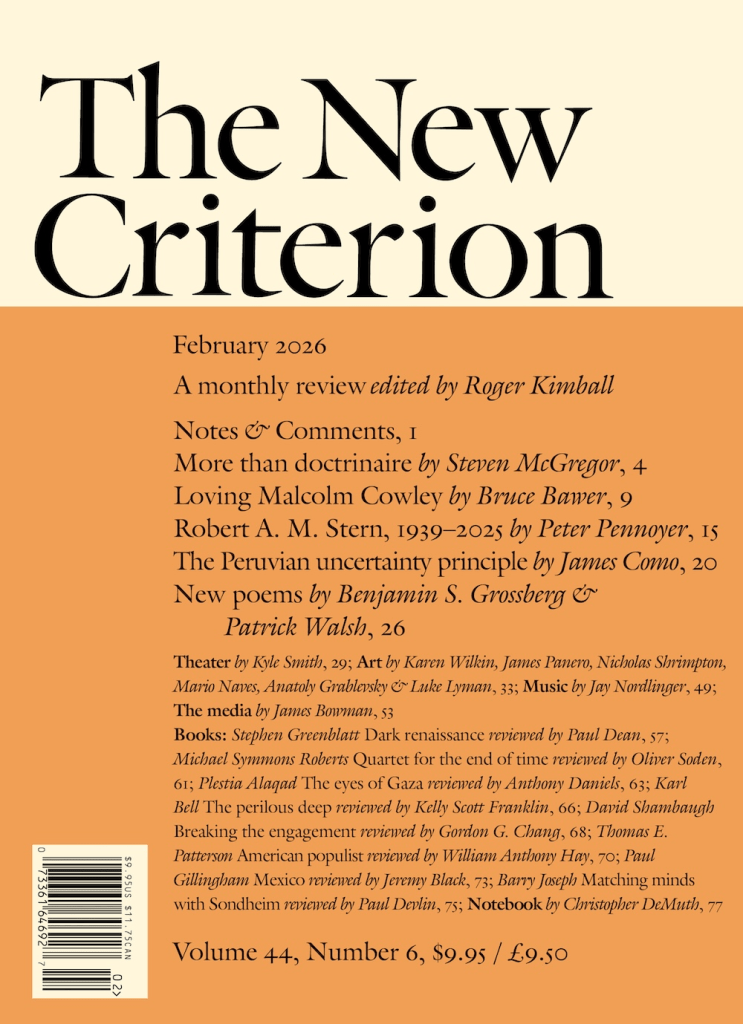
THE NEW CRITERION: The latest issue features…
More than doctrinaire by Steven McGregor
Loving Malcolm Cowley by Bruce Bawer
Robert A. M. Stern, 1939–2025 by Peter Pennoyer
The Peruvian uncertainty principle by James Como

THE NEW CRITERION: The latest issue features…
The Peruvian uncertainty principle by James Como
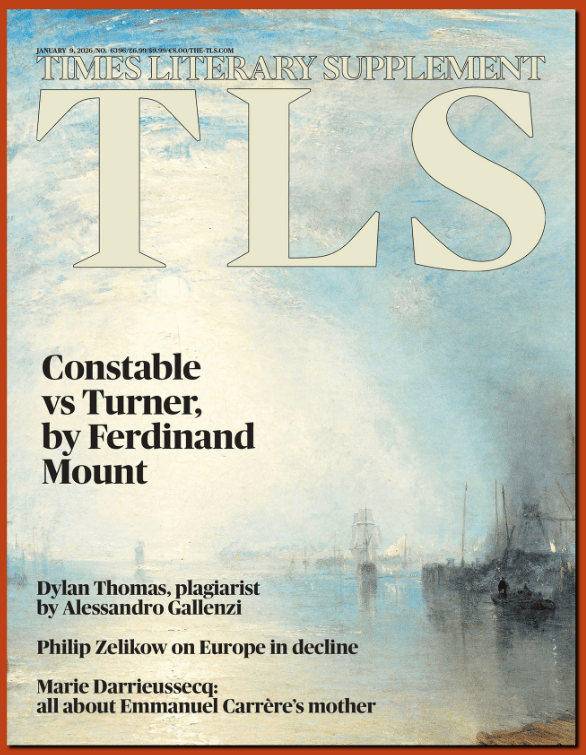
TIMES LITERARY SUPPLEMENT: The latest issue features ‘Constable vs Turner’ by Ferdinand Mount….
Turner is on our banknotes, Constable in our hearts By Ferdinand Mount
Coming out of Tate Britain just before noon on Budget Day, you are blinded by a blistering white sun behind Vauxhall Cross. The steepling glass towers south of the river are washed in an opal mist, the ziggurats of the MI6 HQ eclipsed to a ruined beige. Vauxhall Bridge gleams in the scarlet and yellow of a Turner sunset. J. M. W. would have rushed to the Embankment, whipped out his sketchbook, then worked up the whole shimmering scene into a six-footer and called it something like “The End of England”. John Constable would probably have turned away to catch the next coach to Hampstead Heath to paint Branch Hill Pond again.
How the young Dylan Thomas repeatedly stole from others By Alessandro Gallenzi
A love-hate relationship recalled by France’s ‘greatest living writer’ By Marie Darrieussecq
Why stylish stationery won’t change your life By Ian Sansom
Weary of war and staring down the likelihood of an unjust peace, Ukrainian intellectuals are plotting out a road map for the future.
Josh Safdie’s new film, starring Timothée Chalamet, is both a character study of monomania and a moving fable of how the American century of table tennis was lost.
Concern over antisemitism on the right has split the conservative world in two—and GOP gatekeepers have lost the ability to contain it.
More than a century after white mobs in Elaine, Arkansas, murdered hundreds of black sharecroppers in 1919, the massacre’s memory remains contested.
If the movies are dead, why does Bi Gan’s Resurrection feel so alive?

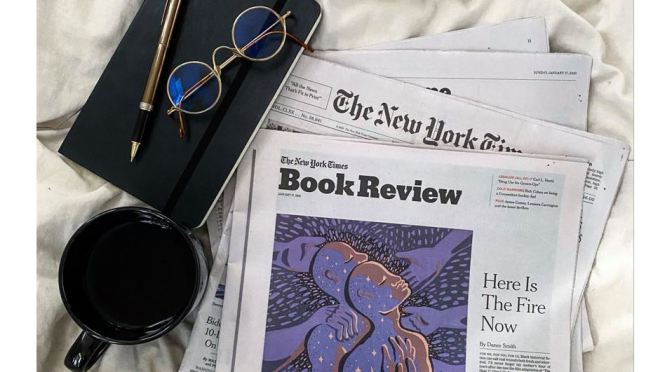
THE NEW YORK TIMES BOOK REVIEW: The latest issue features ‘Fight The Power’
The novelist and musician is a voracious reader of books in translation. In “This Year,” he annotates the literary lyrics to 365 of his own songs.
Rare recordings of E.E. Cummings, Mary Oliver and more offer a tour through literary history led by authors in their own words — and voices. Take a listen.
It’s the day the “Animal Goncourt” is awarded. “Who better,” a judge says, “to talk about the fabulous relationship between animals and men than writers and philosophers?”

THE NEW CRITERION: The latest issue features…
On George Washington’s Farewell Address of 1796. by Roger Kimball
On revolution and counterrevolution in America. by Myron Magnet
On the Gordon riots of 1780. by Dominic Green
On the causes of the American Revolution. by Andrew Roberts

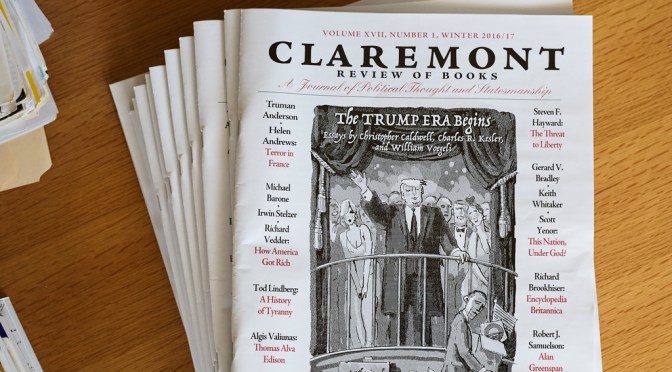
Claremont Review of Books: The latest issue features ‘Special Anniversary Double Issue’….

Imagine sitting near the apex of power in an empire and then being shown the door. You might want to write a tell-all book about it. If so, however, you would be advised to proceed with caution. Now, imagine what would barely be conceivable today: that you undertook to write your exposé while you were still in office. You would need all the finesse of a tightrope walker.
This essay is adapted from remarks delivered at the Claremont Review of Books 25th anniversary gala, held at the Metropolitan Club in New York City on November 6, 2025.
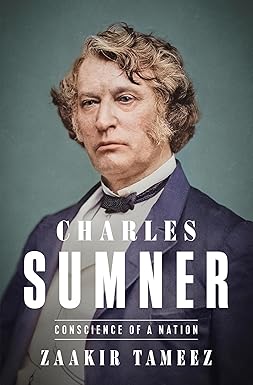
In the early hours of March 11, 1874, word spread around Washington that Charles Sumner was on the brink of death. The 63-year-old senator from Massachusetts had suffered a massive heart attack the previous evening. By 9 a.m., a crowd of several hundred had gathered in front of his home on Lafayette Square. “Colored men and women mingled with white in knots about his home,” wrote The New-York Tribune. Government workers, merchants, shopmen, waiters, and even “old colored women with baskets and bundles on their arms” stood together. Many were crying and begging to be let inside. They were stopped by one of Sumner’s friends and two policemen standing guard at the front door.

TIMES LITERARY SUPPLEMENT: The latest issue features ‘A Snail’s Tale – An unpublished story by Sylvia Townsend Warner…
Tactful notes from a literary self-promoter By Nicola Shulman
Marking the 250th anniversary of Jane Austen’s birth By Devoney Looser
Irritating professors for the ages By Peter Thonemann
An unpublished story by Sylvia Townsend Warner, with a commentary by Peter Swaab By Sylvia Townsend Warner
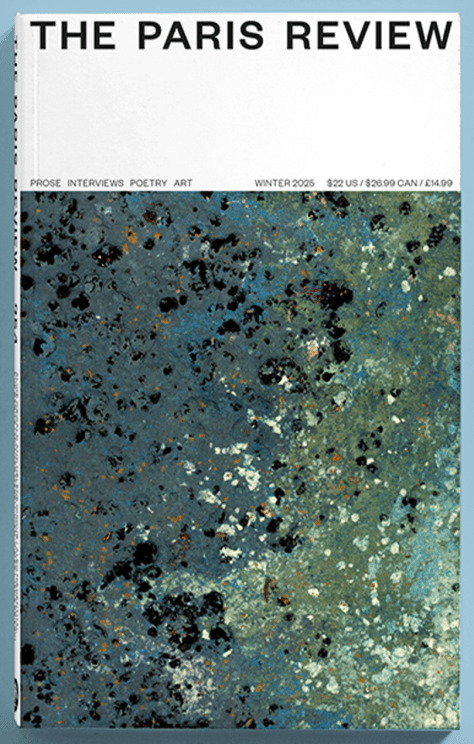
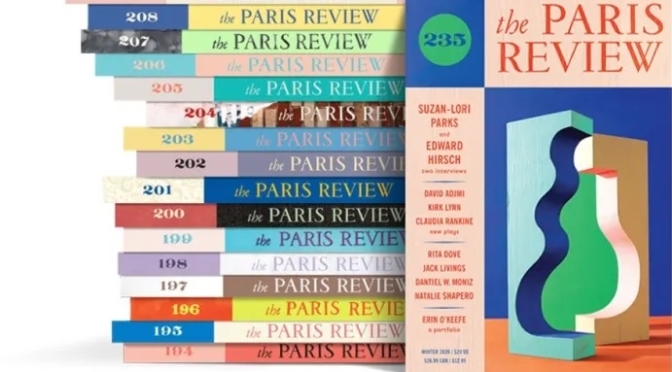
THE PARIS REVIEW : The latest issue features Art of Criticism, Art of Poetry, Prose, Poetry and Art…
Hélène Cixous on the Art of Criticism: “There’s a feminist discourse that women can’t do it all. This is what many women experience, and it’s very difficult. But I am not like that.”
Alice Oswald on the Art of Poetry: “You come at poetry with the momentum of having failed. It’s only when other communication is absolutely impossible that a poem has to exist.”
Prose by Eve Babitz, Marlene Morgan, Alec Niedenthal, Gwendoline Riley, and Elias Rodriques.
Poetry by Millicent Borges Accardi, Monzer Masri, Alice Oswald, Jana Prikryl, and Ed Roberson.
Art by Ali Banisadr, Pippa Garner, Joan Jonas, and Mieko Meguro; cover by Adebunmi Gbadebo.
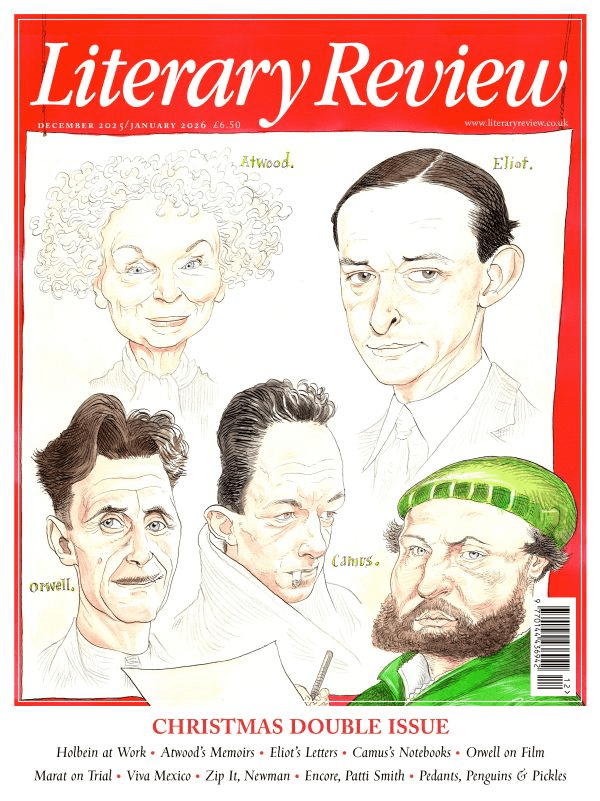
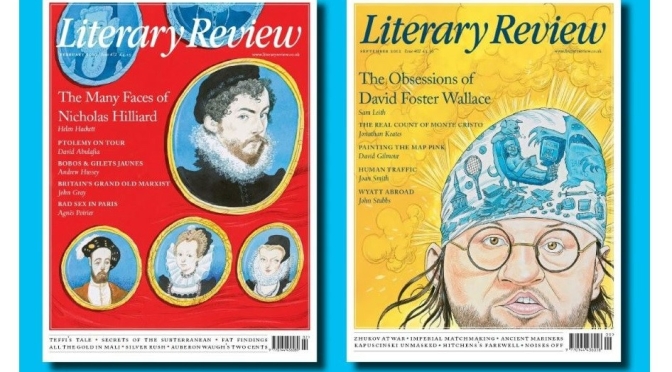
It’s an irony to savour: the man who invented the Tudors was a German. If Henry VIII, his wives and courtiers exercise a stronger hold on the public imagination than their Plantagenet precursors or Stuart successors, it is because we can all picture them so clearly. That, in turn, is due to an extraordinary sequence of portraits and drawings produced between the late 1520s and early 1540s by Hans Holbein of Augsburg (c 1497–1543), many of which have become instantly recognisable.
Orwell: 2+2=5 By Raoul Peck (dir)
George Orwell: Life and Legacy By Robert Colls
Nobody under the age of seventy-five has heard George Orwell’s voice. The only extant video footage is in a silent movie of the Eton Wall Game. None of his many wartime recordings for the BBC Eastern Service has survived. By all accounts his voice, damaged by a bullet to the throat during the Spanish Civil War, was thin, flat and weak. In fact, the controller of the BBC Overseas Service complained that putting on ‘so wholly unsuitable a voice’ made the BBC appear ‘ignorant of the essential needs of the microphone and of the audience’.

THE NEW CRITERION: The latest issue features…
My Grandma Moses by Jane Kallir
America beautiful by James Panero
Leiden lights by Karen Wilkin
Behind the scenes by Michele H. Bogart
The consonant Cushing by Alexandra Cushing Howard
A bull with his own china shop by Eric Gibson
Mittel march by Peter Pennoyer
The unsentimental builder by Michael J. Lewis
The mage of Torino by Philip Rylands
“Architecture unshackled” by Harry Adams

 Boomers Daily