Phoenix, Arizona is coming up with innovative ways to beat the heat.
Phoenix, the capital of Arizona, is accustomed to a hot desert climate, but day and night temperatures have been rising due to global heating and the city’s unchecked development, which has created a sprawling urban heat island.
Scorching temperatures have made summers increasingly perilous for the city’s 1.4 million people, with mortality and morbidity rates creeping up over the past two decades, but 2020 was a gamechanger when heat related deaths jumped by about 60%.
The warmer it gets, the more people use air conditioning—but the more people use air conditioning, the warmer it gets. Is there any way out of this trap?
Video timeline: 00:00: What’s the cooling conundrum? 01:05: The pros and cons of AC 03:28: How to reinvent air conditioning 05:02: Can buildings be redesigned to keep cool? 07:30: Scalable, affordable cooling solutions 10:24: Policy interventions for cooling
As the weather gets colder and people head indoors, the risk of catching Covid-19 is rising. WSJ explains why air ventilation and filtration are one of our biggest defenses against the coronavirus this winter.
The World Health Organization recently acknowledged that some evidence about in-room transmission is worrisome. In addition, after analyzing a transmission event at a restaurant in China, the US Centers for Disease Control and Prevention (CDC) concluded that an asymptomatic patient transmitted the virus to families at two nearby tables.
Based on the restaurant layout, seating arrangements, and smear samples from air-conditioning inlets and outlets, the CDC found that the coronavirus was likely transmitted when strong airflows from a nearby air conditioner spread large droplets from the infected person. These droplets traveled more than one meter—further than usual, but less than the distance aerosols can typically travel.







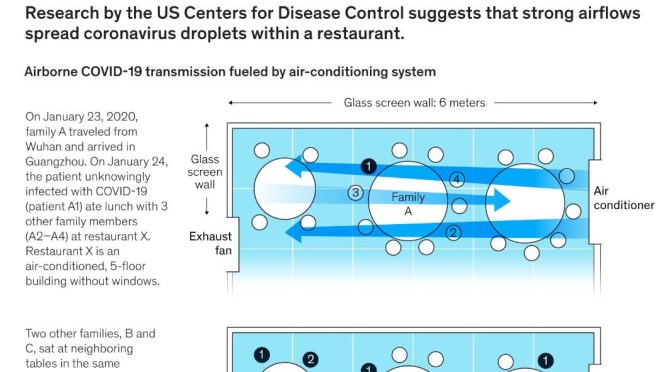
 The World Health Organization recently acknowledged that some evidence about in-room transmission is worrisome. In addition, after analyzing a transmission event at a restaurant in China, the US Centers for Disease Control and Prevention (CDC) concluded that an asymptomatic patient transmitted the virus to families at two nearby tables.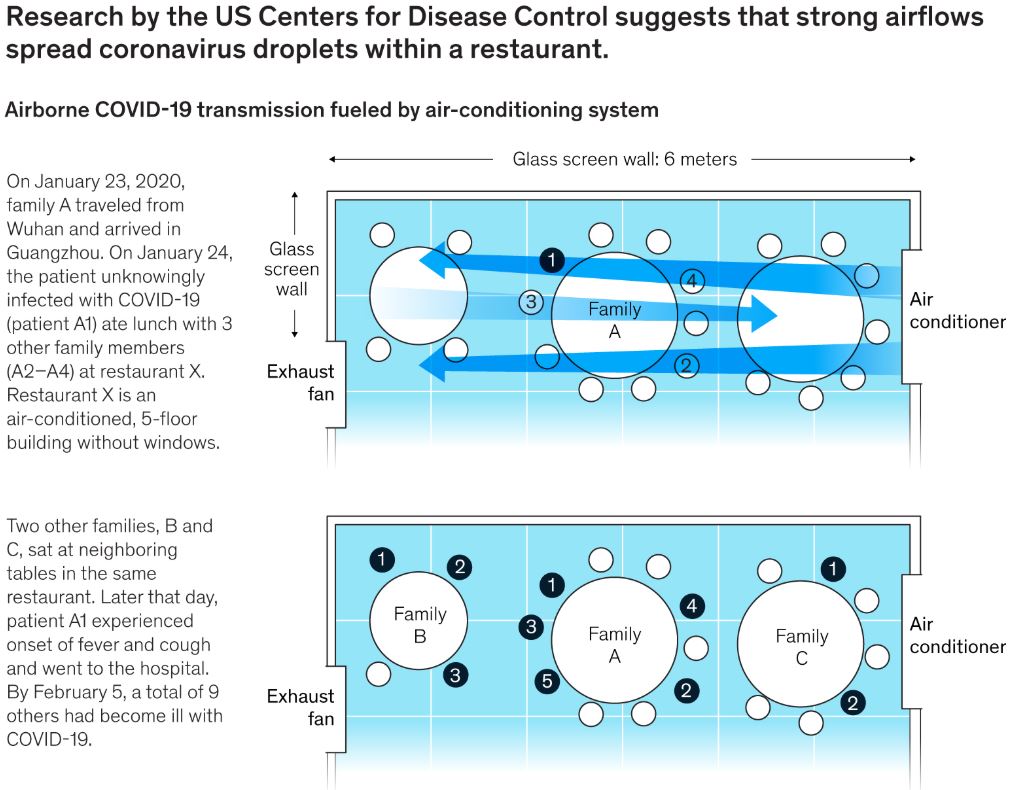
 Boomers Daily