Category Archives: Society

Preview: New York Times Magazine – June 18, 2023

Image

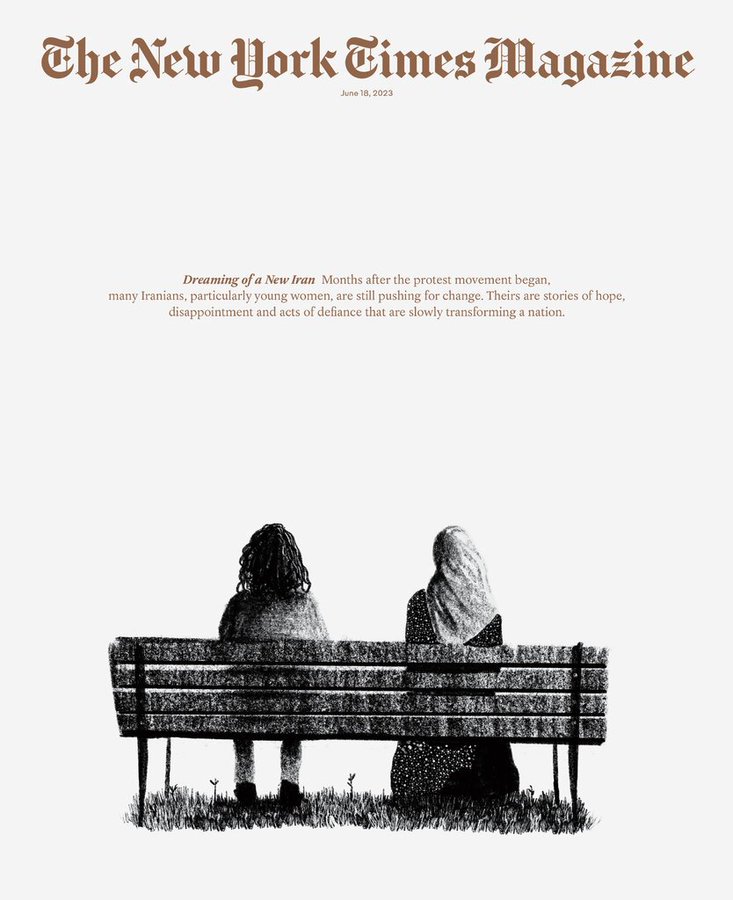
THE NEW YORK TIMES MAGAZINE (June 16, 2023) – Three young Iranian women share their diaries; plus, a profile of the YouTube superstar MrBeast; and inside the moral crisis of America’s doctors.

The Moral Crisis of America’s Doctors

A black-and-white photograph of Keith Corl in scrubs.

The corporatization of health care has changed the practice of medicine, causing many physicians to feel alienated from their work.

By Eyal Press

Some years ago, a psychiatrist named Wendy Dean read an article about a physician who died by suicide. Such deaths were distressingly common, she discovered. The suicide rate among doctors appeared to be even higher than the rate among active military members, a notion that startled Dean, who was then working as an administrator at a U.S. Army medical research center in Maryland. Dean started asking the physicians she knew how they felt about their jobs, and many of them confided that they were struggling. Some complained that they didn’t have enough time to talk to their patients because they were too busy filling out electronic medical records. 

How MrBeast Became the Willy Wonka of YouTube

An illustration of MrBeast, surrounded by amazed faces and stacks of cash.

Jimmy Donaldson, a.k.a. MrBeast, has become a viral sensation for his absurd acts of altruism. Why do so many people think he’s evil?

Even within this context, Donaldson stands out for his dedication to understanding how YouTube works. For most of his teenage years, “I woke up, I studied YouTube, I studied videos, I studied filmmaking, I went to bed and that was my life,” Donaldson once told Bloomberg. “I hardly had any friends because I was so obsessed with YouTube,” he said on “The Joe Rogan Experience” last year.

Documentary: “Waiting To Die” In North Korea (BBC)

BBC News (June 15, 2023) – Three North Koreans want to tell the world about the situation in the country. They expose, for the first time, the disaster unfolding there since the government sealed the borders more than three years ago starvation, brutal crackdowns and no chance to escape.

Under the tyrannical rule of Kim Jong Un, North Koreans are forbidden from making contact with the outside world. A spokesperson for the North Korean government has disputed the claims, which they said were “not entirely factual”.

Politics: The Guardian Weekly – June 16, 2023

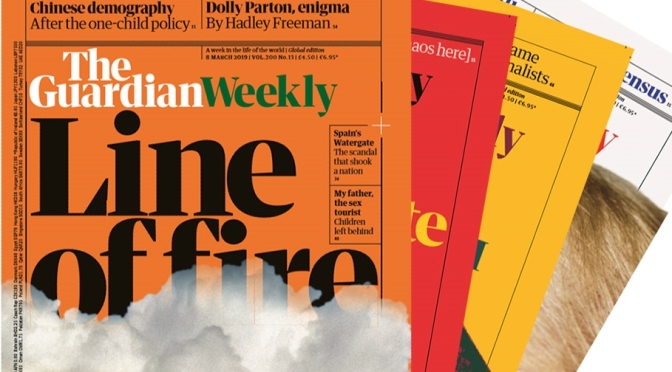
The Guardian Weekly (June 16, 2023) Ukraine and the Kakhovka dam burst. Plus: biting down into doughnut economics

More than a week has passed since the collapse of the Kakhovka dam in Ukraine. Only as the flood waters begin to recede is the long-term scale of the disaster becoming apparent.

With suspicion (though not yet, according to western capitals, conclusive proof) falling on Moscow, Dan SabbaghArtem Mazhulin and Julian Borger report on a human and environmental catastrophe, and what it might mean for Ukraine’s counteroffensive plans against Russia.

And amid reports of disunity among Moscow’s ruling elite, Shaun Walker went along to a gathering of exiled influential Russians who are once again daring to dream of an end to Vladimir Putin’s rule.

Opinion: Ukraine Strikes Back, Apple’s Vision Pro, The Global Cities Index

‘Editor’s Picks’ Podcast (June 12, 2023) A selection of three essential articles read aloud from the latest issue of The Economist – Ukraine strikes back, why Apple’s new Vision Pro gadget matters (9:00) and the results of our new global cities index (13:35).

Ukraine strikes back

The counter-offensive is getting under way. The next few weeks will be critical

Trailed ten days early with a blood-stirring video in which Ukrainian troops asked God to bless their “sacred revenge”, Ukraine’s counter-offensive is under way. For weeks its armed forces have conducted probing and shaping operations along the 1,000km front line, looking for weaknesses and confusing the Russians.

Apple’s Vision Pro is an incredible machine. Now to find out what it is for

The Apple Vision Pro headset in a showroom on the Apple campus in Cupertino, California.

The meaning of “spatial computing”

Apple’s message is clear: after desktop and mobile computing, the next big tech era will be spatial computing—also known as augmented reality—in which computer graphics are overlaid on the world around the user.

Amoral cities are flourishing in a turbulent geopolitical era

Visitors at Jewel Changi Airport mall in Singapore

Our index ranks economic performance over the past three years

 In order to assess which are thriving in this new era, The Economist has compiled a rough-and-ready index. It scrutinises a sample of ten locations, looking at changes in four measures—population, economic growth, office vacancies and house prices—over the past three years.

Preview: New York Times Magazine – June 11, 2023

Image

THE NEW YORK TIMES MAGAZINE (June 09, 2023) – Inside the $4-billion credit repair industry. Plus, the mycologist who wants us to learn about the magic of mushrooms and the cringe comedian perfect for this moment.

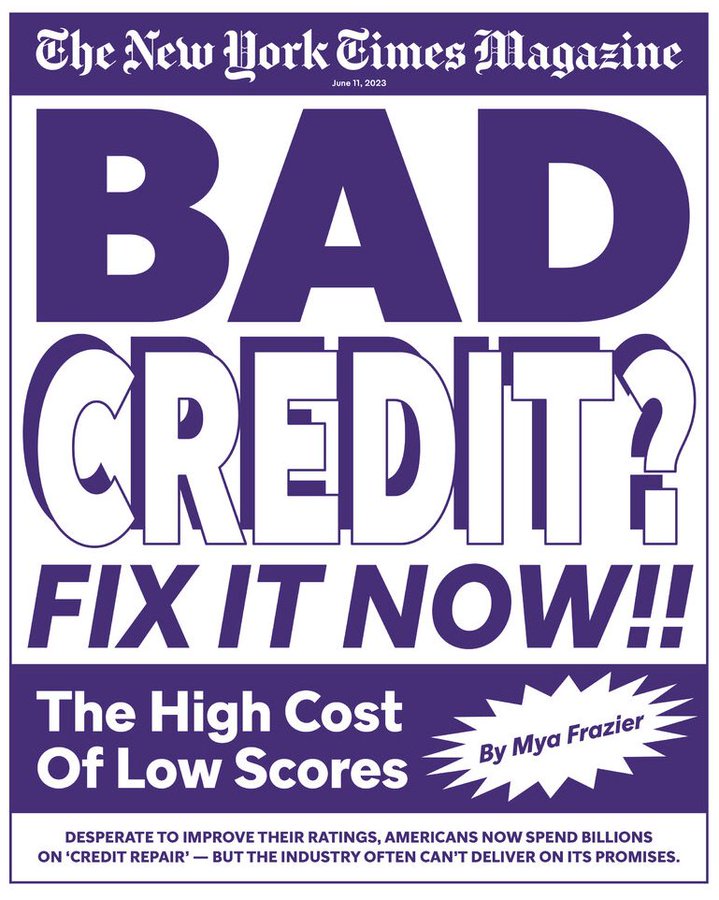
The High Cost of Bad Credit

Taqwanna Clark standing in an office in a blue suit. "Credit Life Inc" is on the wall behind Clark.
Taqwanna Clark, a credit-repair agent in Houston and the founder of Credit Lift Inc.Credit…Eli Durst for The New York Times

Desperate to improve their ratings, Americans now spend billions on “credit repair” — but the industry often can’t deliver on its promises.

By Mya Frazier

When Taqwanna Clark went to buy a video camera at Fry’s Electronics in Houston, she asked if they had a layaway plan. The cashier instead handed her an application for a store credit card. She applied. “Instantly, it came back declined — like, No!” she says. “Denied, denied — you know, your credit is not good enough.” Clark was 30 and working as a security guard at the Port of Houston. On weekends, she performed as a rapper in the local club scene, under the name T-Baby. She wanted the camera to shoot music videos, to promote her music career. “If I can’t afford a $200 camera,” she recalls thinking, “then I’m in a bad way with this credit thing.”

The Man Who Turned the World on to the Genius of Fungi

A close-up photograph of Merlin Sheldrake.
Merlin Sheldrake, author of the best-selling book “Entangled Life.” 

A vast fungal web braids together life on Earth. Merlin Sheldrake wants to help us see it.

By Jennifer Kahn

One evening last winter, Merlin Sheldrake, the mycologist and author of the best-selling book “Entangled Life,” was headlining an event in London’s Soho. The night was billed as a “salon,” and the crowd, which included the novelist Edward St. Aubyn, was elegant and arty, with lots of leggy women in black tights and men in perfectly draped camel’s-hair coats. “Entangled Life” is a scientific study of all things fungal that reads like a fairy tale, and since the book’s publication in 2020, Sheldrake has become a coveted speaker.

Tim Robinson and the Golden Age of Cringe Comedy

A photo illustration of Tim Robinson’s face stretched lengthwise in a collage.
Credit…Photo illustration by Lola Dupre

His sketch show, “I Think You Should Leave,” zeroes in on the panic-inducing feelings of living in a society where we can’t agree on the rules.

By Sam Anderson

Tim Robinson loves spicy food.

This minor fact is one of the major things I learned at my very awkward dinner interview with Robinson and Zach Kanin, creators of the cult Netflix comedy series “I Think You Should Leave.” Robinson ordered drunken spaghetti with tofu — spicy — and, almost immediately, the spaghetti started to make his voice hoarse. He insisted, however, that this had nothing to do with the spice — in fact, he said, his food wasn’t spicy enough. I asked our server if she could go spicier. She brought out a whole dish of special chiles. Robinson spooned them enthusiastically over his noodles.

Politics: The Guardian Weekly – June 9, 2023

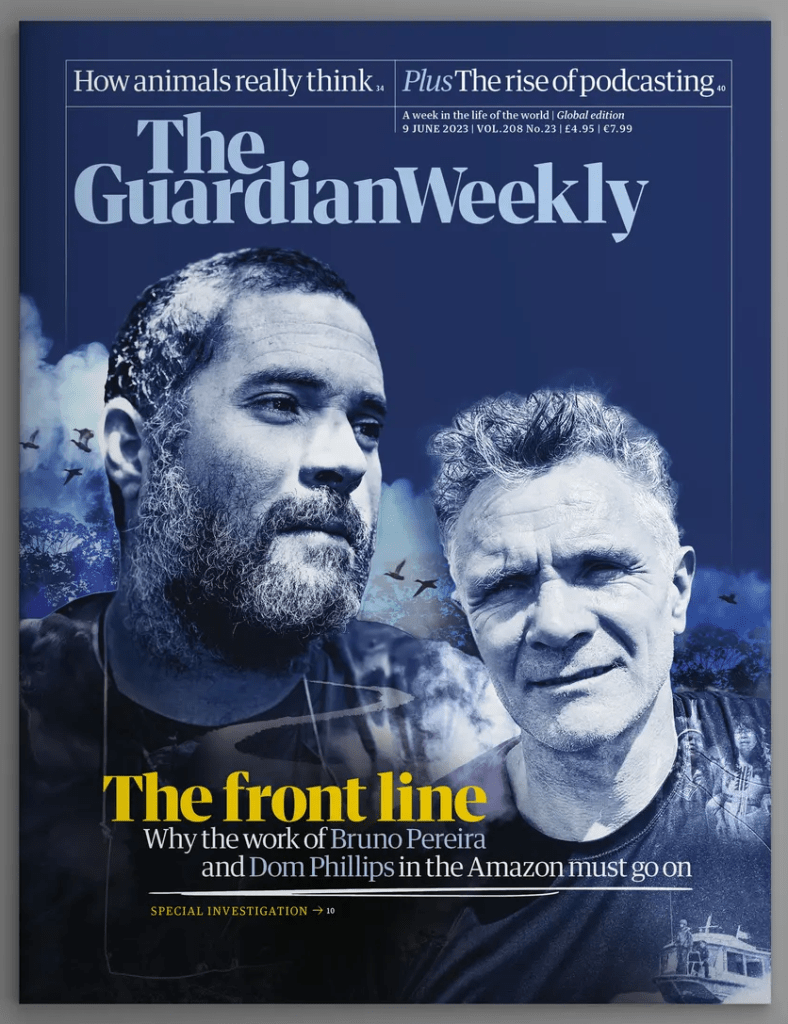
The Guardian Weekly (June 9, 2023) – A year ago, the Indigenous expert Bruno Pereira and Guardian contributor Dom Phillips were murdered in a remote area of the Brazilian Amazon. They had travelled there to meet with Indigenous activists who patrol the Javari valley to protect it from illegal fishing and mining gangs.

Their deaths laid bare the environmental devastation inflicted under Brazil’s former president, Jair Bolsonaro, as well as the extreme threat to those who dare to disrupt the activities of exploitative industries in the region. That’s why, in collaboration with an international journalists’ consortium, the Guardian has published the Bruno and Dom project: a series that seeks to honour their work and continue it. You’ll find a selection of pieces in this week’s Guardian Weekly and the rest are available online.

Culture: The American Scholar – Summer 2023

Image

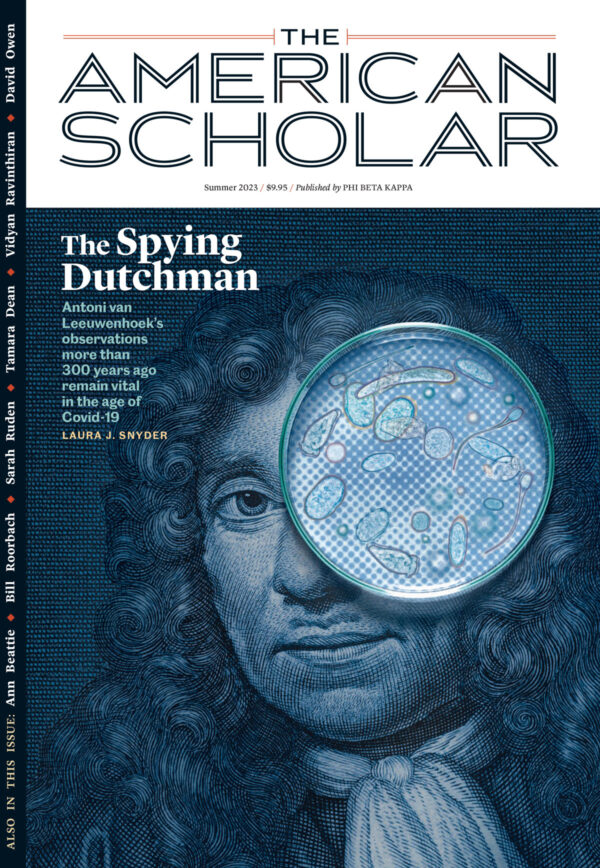
THE AMERICAN SCHOLAR SUMMER 2023 issue: What does Antoni van Leeuwenhoek have to do with Covid? Can a digital restoration of a supposed da Vinci be just as good as the real thing? What was it like to be a young journalist on one of François Truffaut’s sets?

A Kingdom of Little Animals

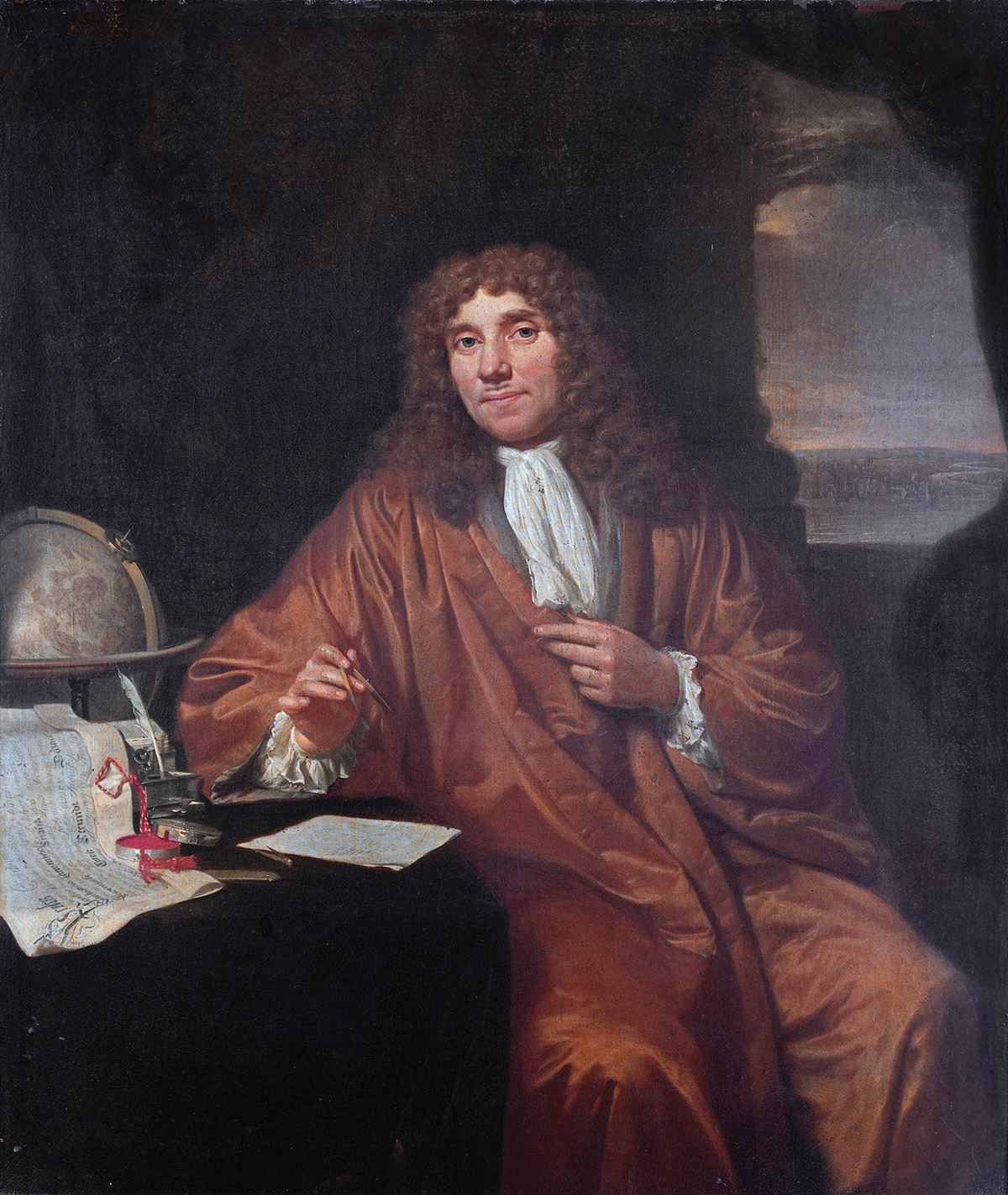
Antoni van Leeuwenhoek, in a circa 1680 painting by the Dutch artist Jan Verkolje, famous for his portraits of prominent members of Delft society (Wikimedia Commons)
Antoni van Leeuwenhoek, in a circa 1680 painting by the Dutch artist Jan Verkolje, famous for his portraits of prominent members of Delft society

Antoni van Leeuwenhoek’s discovery of microorganisms made possible the revolutionary advances in biology and medicine that continue to inform our Covid age

By Laura J. Snyder

One night in 1677, a grizzled man in a wrinkled linen nightshirt rushed from his bemused wife’s bed with a candle in hand to examine the “remains of conjugal coitus, immediately after ejaculation before six beats of the pulse.” Using the candle to cast a pool of light in his dark study, he put a drop of the liquid into a tiny glass vial he had blown himself, attaching it to the back of a strange-looking device he had also constructed. 

The Whole World in His Hands

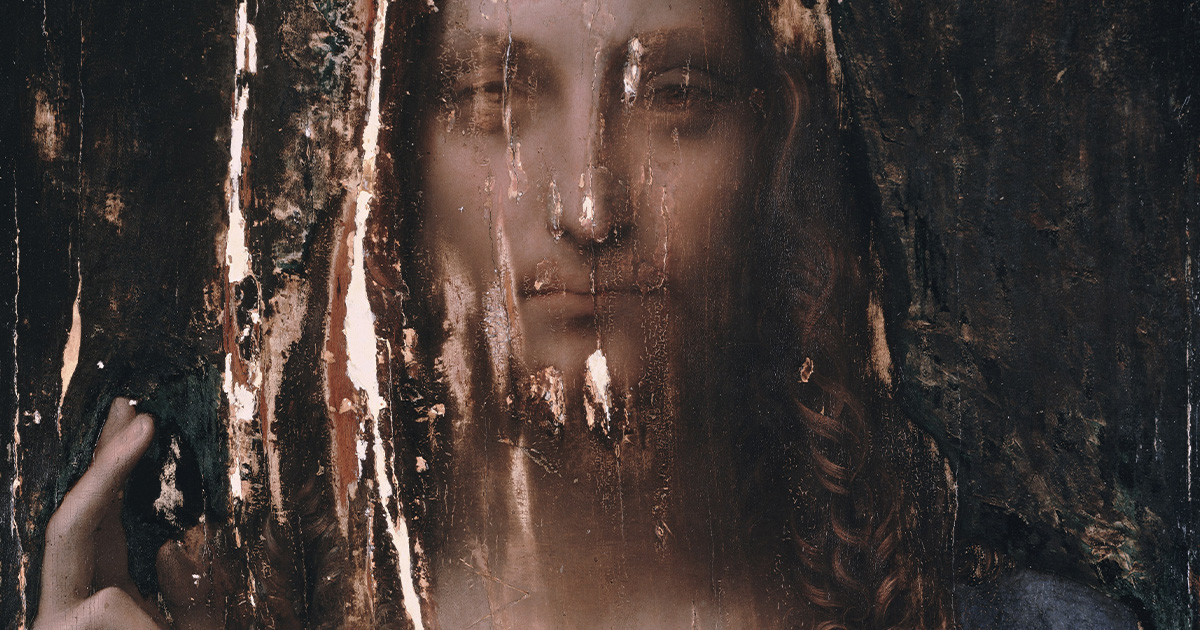
The Salvator Mundi in its damaged state—cleaned but not yet restored (Wikimedia Commons)

What a digital restoration of the most expensive painting ever sold tells us about beauty, authenticity, and the fragility of existence

I got the call late on a summer afternoon. Yanai Segal, an artist I’ve known for years, asked me whether I’d heard of the Salvator Mundi—the painting attributed to Leonardo da Vinci that was lost for more than two centuries before resurfacing in New Orleans in 2005. I told him that I’d heard something of the story but that I didn’t remember the details. He had recently undertaken a project related to the painting, he said, and wanted to tell me about it. I was eager to hear more, but first I needed to remind myself of the basic facts. We agreed to speak again soon.

Front Cover: The Atlantic Magazine – July/Aug 2023

Image

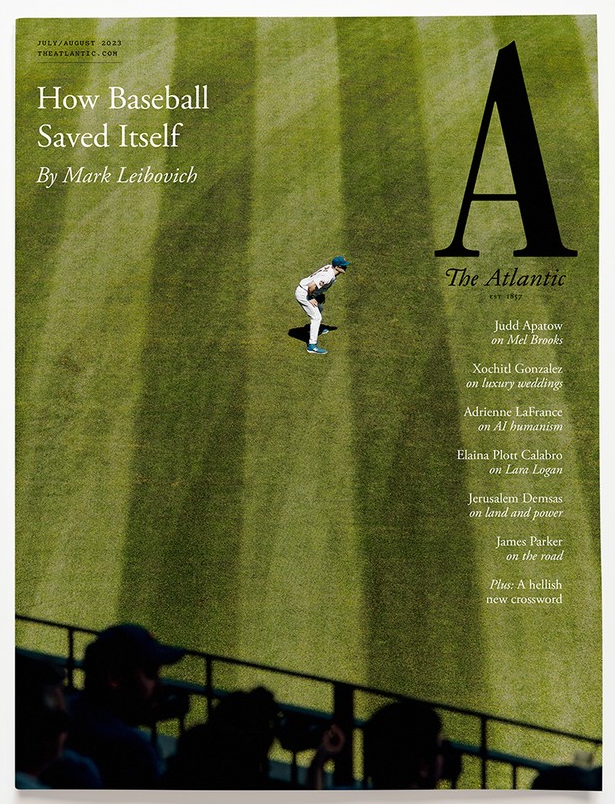
The Atlantic Magazine – July/August 2023 issue: Mark Leibovich goes inside the MLB’s desperate effort to rescue America’s pastime from irrelevance

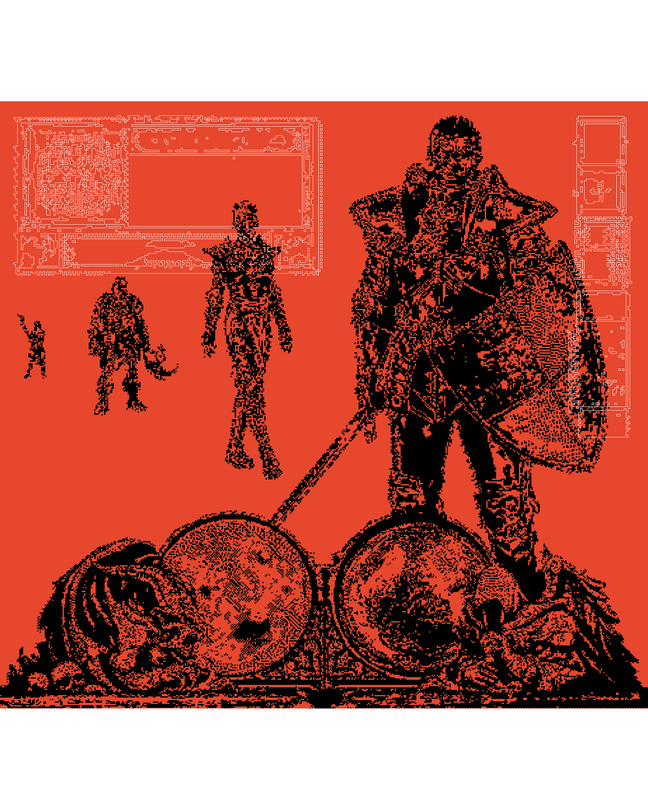
‘HELL WELCOMES ALL’

A graphic illustration of black, pixelated video-game characters on a red background.

Can hard-core gamers learn to play well with others? By Spencer Kornhaber

Playing a prerelease version of Diablo IV, the latest installment in a 26-year-old adventure series about battling the forces of hell, I faced swarms of demons that yowled and belched. My character, a sorcerer, shot them with lightning bolts, producing a jet-engine roar. 

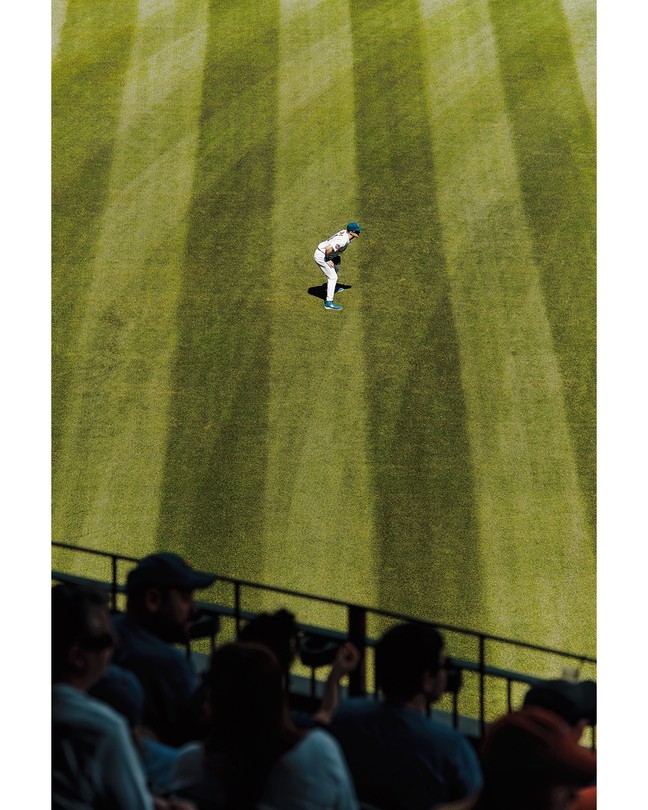
HOW BASEBALL SAVED ITSELF

Inside the desperate effort to rescue America’s pastime from irrelevance By Mark Leibovich

A photograph of a baseball outfielder on green field with fans silhouetted in the foreground.

Where in the name of human rain delays is Juan Soto?

The stud outfielder is late. Everyone keeps checking their phones—the antsy Major League Baseball officials, the San Diego Padres PR guy, the handful of reporters, and the assorted hangers-on you encounter around baseball clubhouses. Everyone is wondering when the Padres superstar will show up. He was supposed to be here half an hour ago, just after this baseball players’ sanctum opened and we were allowed to join them in their most elemental of baseball activities: waiting around.

Opinion: Global Fertility’s Crash, Scotland Populism Unravels, Bad Bunny Rises

‘Editor’s Picks’ Podcast (June 5, 2023) A selection of three essential articles read aloud from the latest issue of The Economist. This week, the economic consequences of the global collapse in fertility, Scotland’s holiday from reality (10:10) and the business of the rapper, Bad Bunny (18:10). 

Global fertility has collapsed, with profound economic consequences

What might change the world’s dire demographic trajectory?

Even as artificial intelligence (ai) leads to surging optimism in some quarters, the baby bust hangs over the future of the world economy.

Scotland has been on a ten-year holiday from reality

Populism can unravel quickly. But its effects are long-lasting

Scotland was the first part of Britain to get high on populist referendums. In 2014, two years before the Brexit vote, the Scottish independence campaign exhorted people to ignore the experts and revel in a glorious national renewal.

Bad Bunny, a superstar rapper, is good business

PHILADELPHIA, PENNSYLVANIA - SEPTEMBER 04: Bad Bunny attends Made In America Festival on September 04, 2022 in Philadelphia, Pennsylvania. (Photo by Shareif Ziyadat/WireImage)

On Spotify and Netflix Spanish seems to be taking over the world

In November Spotify crowned Bad Bunny, a rapper from Puerto Rico, its most-streamed artist for the third year in a row.

Preview: New York Times Magazine – June 4, 2023

Image

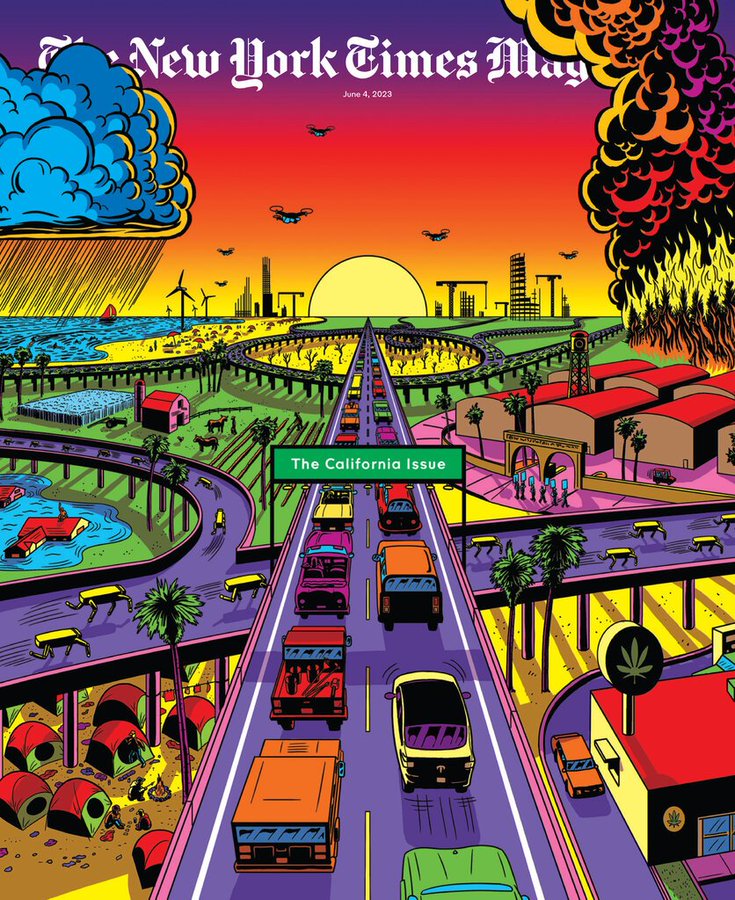
THE NEW YORK TIMES MAGAZINE (June 4, 2023) – California is the place where the future happens, for good and ill. That’s part of its magic. Read our first-ever California Issue to find out what roads the state will take us down next.

Inside: A fight over a parking lot that explains the housing crisis; the future of California’s power to shape national policy; how the state is adapting to a warming world — and more.

California Builds the Future, for Good and Bad. What’s Next?

An illustration of a California-inspired scene: wildfires, cars on a highway, the writer’s strike in Hollywood, a tent city, drones in the sky, flooding and a marijuana dispensary.

From reparations to tax revolts, the Golden State tries out new ideas all the time. What roads will its latest experiments send us down?

By Laila Lalami

I remember my first glimpse into the future. In August 1992, when I arrived in California as a student, I discovered during orientation that the university required all incoming students to have something called an email account. To access it, I had to call up a text-based mail client on Unix, using a series of line commands. If I needed a file that sat on a university computer in New York, I could use file transfer protocol to download it in Los Angeles, the whole process taking no more than a few minutes. That’s brilliant, I remember thinking.

Can the ‘California Effect’ Survive in a Hyperpartisan America?

A collage illustration showing the California capitol, the Golden Gate Bridge and a surfer hitting the waves, among other California motifs.

For decades the state has been setting policy for the whole nation. Now red states are pushing back.

By Conor Dougherty

For a while this winter, seemingly every text message that Buffy Wicks received asked if she was running for Congress. Representative Barbara Lee, of California’s 12th District, which includes Oakland, had announced that she would enter the race for Dianne Feinstein’s soon-to-be-vacated Senate seat. This decision by Lee, who is 76, created a rare opportunity for the next generation of California Democrats to vie for federal office. And Wicks — a 45-year-old State Assembly member who lives in Lee’s district and was last re-elected with 85 percent of the vote — seemed like a natural candidate.