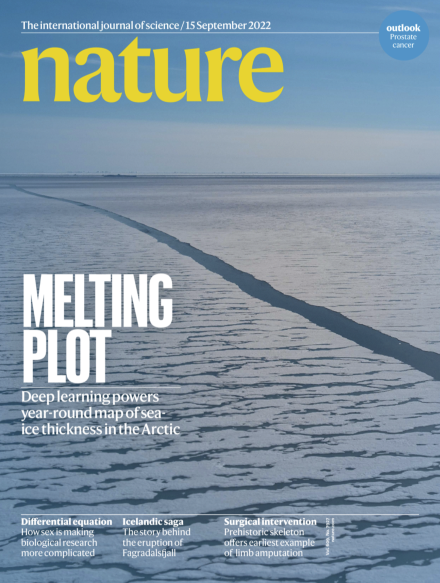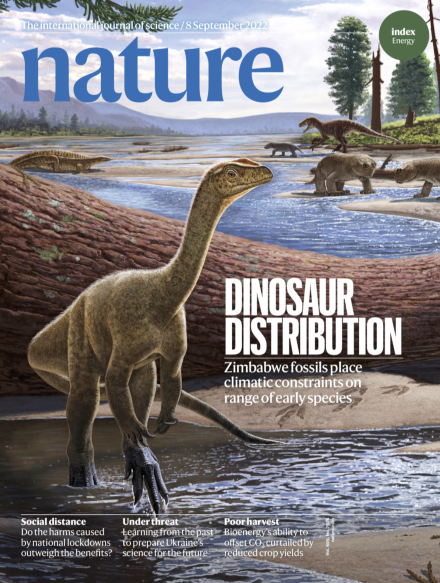
The cover shows an artist’s impression of Mbiresaurus raathi, a newly discovered species of herbivorous dinosaur found in Zimbabwe and dating to around 230 million years ago.
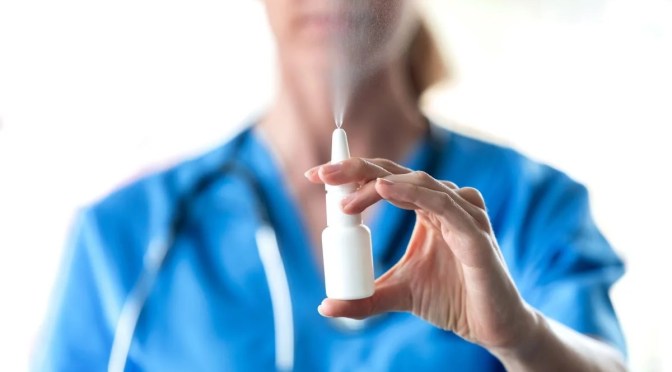
The vaccine, called Convidecia Air, changes the liquid form of the vaccine into an aerosol using a nebuilzer. The vaccine can then be inhaled through the mouth using the nebulizer machine. The needle-free vaccine “can effectively induce comprehensive immune protection in response to SARS-CoV-2 after just one breath,” Cansino said in a statement.
Fortune.com on September 5, 2022 – China’s government approved the world’s first inhaled vaccine against COVID-19, the vaccine’s maker Cansino Biologics announced on Sunday.
In July, Chinese scientists published a pre-print study showing that people who received one booster dose of Cansino’s inhaled vaccine after two doses of the inactivated jab from Chinese maker Sinovac developed more antibodies than people who received three Sinovac shots. Four weeks after receiving the inhaled booster, 92.5% of people had developed neutralizing antibodies for Omicron.
Those who got three doses on Sinovac’s jab did not demonstrate any neutralizing antibodies for Omicron, either four weeks or six months after getting a booster.
On this week’s show: The U.S. government is partnering with academics to speed up the search for more than 80,000 soldiers who went missing in action, and how humans create their own “oxidation zone” in the air around them.
First up on the podcast this week, Tess Joosse is a former news intern here at Science and is now a freelance science journalist based in Madison, Wisconsin. Tess talks with host Sarah Crespi about attempts to use environmental DNA—free-floating DNA in soil or water—to help locate the remains of soldiers lost at sea. Also featured in this segment:
University of Wisconsin, Madison, molecular biologist Bridget Ladell Woods Hole Oceanographic Institution marine biologist Kirstin Meyer-Kaiser
Also this week, Nora Zannoni, a postdoctoral researcher in the atmospheric chemistry department at the Max Planck Institute for Chemistry, talks about people’s contributions to indoor chemistry. She chats with Sarah about why it’s important to go beyond studying the health effects of cleaning chemicals and gas stoves to explore how humans add their own bodies’ chemicals and reactions to the air we breathe. In a sponsored segment from Science/AAAS Custom Publishing Office, Sean Sanders, director and senior editor for Custom Publishing, interviews Benedetto Marelli, associate professor at MIT, about winning the BioInnovation Institute & Science Prize for Innovation and how he became an entrepreneur.
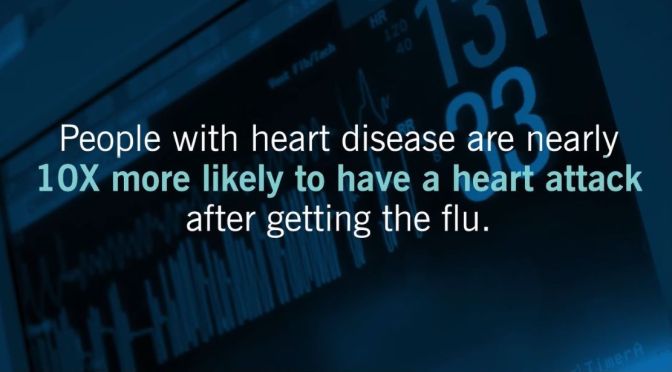
Influenza-related stress on your body can launch a negative chain of events that builds toward a heart attack. This video shares how getting a seasonal flu shot can significantly lower your risk of having a heart attack or cardiac arrest, especially if you’re in a high-risk group.
Chapters: 0:00 Can flu shots lower risk of heart attacks? 0:37 How does the flu shot lower risk of heart attacks? 1:08 Who is most at risk of having a flu related heart attack? 1:30 Why else should you get a flu shot?