Category Archives: Politics

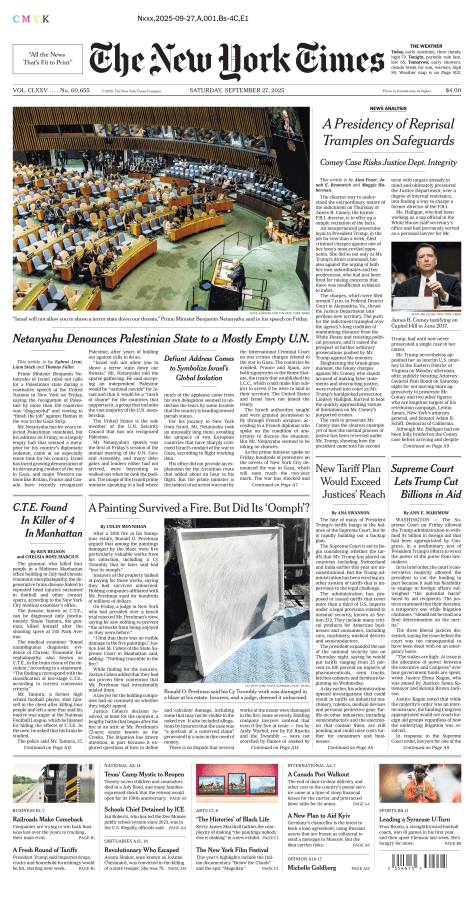
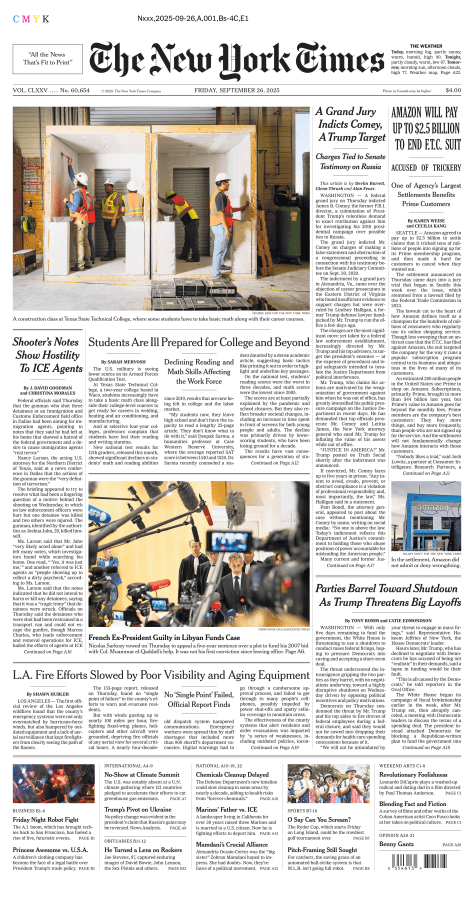
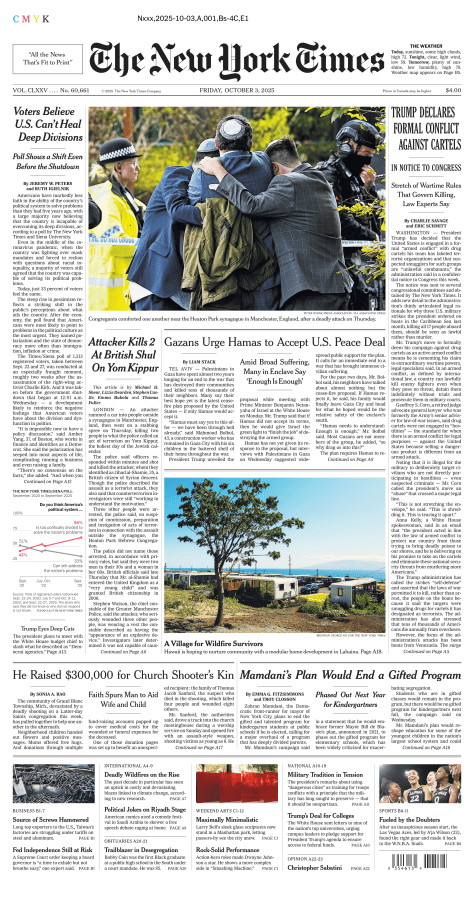
THE NEW YORK TIMES – FRIDAY, JULY 18, 2025

Conservatives Get the PBS and NPR Cuts They’ve Wanted for Decades

The cuts speak to President Trump’s grip on his party but also to the sweeping changes in the media.

Where Congress’s Cuts Threaten Access to PBS and NPR

Bondi Expected to Ask Court to Release Epstein Grand Jury Material

Pam Bondi is set to ask a judge to release grand jury testimony. But President Trump’s request falls short of calls for all the files in Jeffrey Epstein’s case.

House Republicans Hint They’re Open to Vote on Epstein Files

THE ECONOMIST MAGAZINE – JULY 19, 2025 PREVIEW

THE ECONOMIST MAGAZINE: The latest issue features ‘Winning the war on cancer’…

The world is winning the war on cancer

Progress has been remarkable. Death rates are down substantially, and are likely to fall further

Trump’s U-turn on Russia is utterly cynical—and welcome

His pivot on supplying arms could help Ukraine

To survive the AI age, the web needs a new business model

Artificial intelligence has undermined the internet’s central bargain

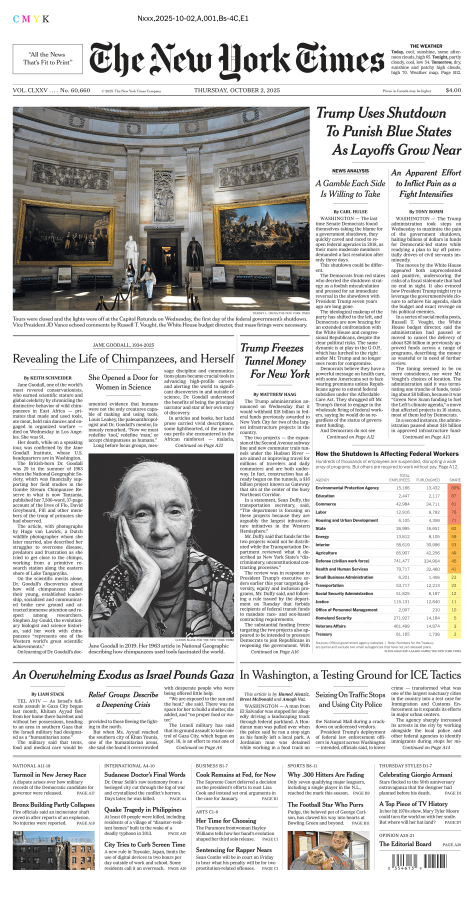
THE NEW YORK TIMES – THURSDAY, JULY 17, 2025

Senate Approves Bid to Cancel Foreign Aid and Public Broadcast Funds

The bill to claw back $9 billion in congressionally approved spending passed over the objections of Republicans who said it abdicated legislative power.

Even With Trump’s Backing, Epstein Case Leaves Bondi’s Future in Question

The sustained backlash to Attorney General Pam Bondi’s handling of the Jeffrey Epstein investigation has exposed the hazards of her focus on courting President Trump.

What Are President Trump and His Supporters Saying About the Epstein Case?

Their actions range from pressuring the administration to release more information to spinning additional conspiracy theories about Jeffrey Epstein.

President Trump Wants Lower Rates. Firing the Fed Chair Could Push Them Higher.

Investors, who control long-term rates, might demand higher returns if Jerome Powell is fired and the central bank’s independence comes into question.

Can Trump Fire Powell? He Most Likely Lacks a Case, Legal Experts Say.

HARPER’S MAGAZINE – AUGUST 2025 PREVIEW

HARPER’S MAGAZINE: The latest issue features ‘Playing Dead Or Really Dead?’ – The Democrats’ Disappearing Act…

Playing Dead

Do the Democrats really want reform? by Andrew Cockburn

Your Face Tomorrow

The puzzle of AI facial recognition by Michael W. Clune

Debt Reckoning

Has the Treasury market started to crack? by Mary Childs

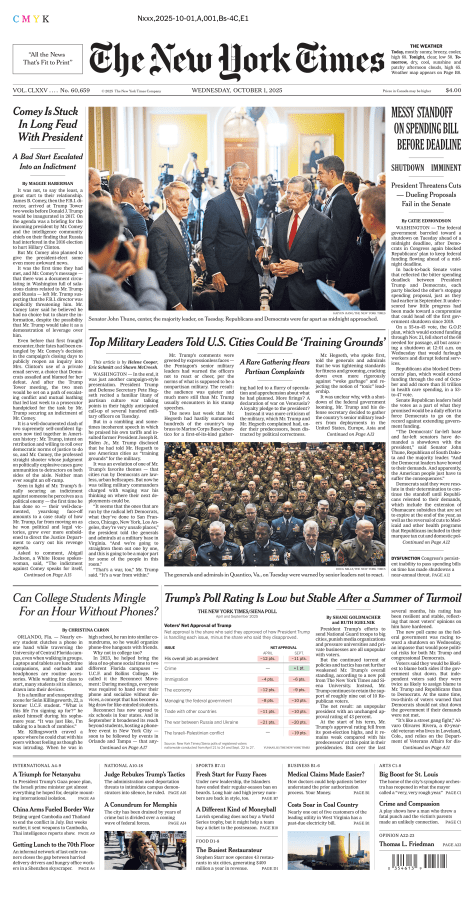
THE NEW YORK TIMES – WEDNESDAY, JULY 16, 2025

Supreme Court Keeps Ruling in Trump’s Favor, but Doesn’t Say Why

In a series of terse, unsigned orders, the court has often been giving the green light to President Trump’s agenda without a murmur of explanation.

Vance Breaks Tie as Senate Moves to Claw Back Foreign Aid and Broadcast Funds

Despite Dire Warnings, the U.S. Economy Is Holding Up. Can That Last?

Economists say it will take time for the effects of trade policies to show up in economic data — but acknowledge they aren’t sure how long.

Republicans in Congress Shift to Backing Ukraine, Matching Trump’s Reversal

After years pressing to end Ukraine aid, many Republicans have changed positions now that President Trump is supporting the country against Russian aggression.

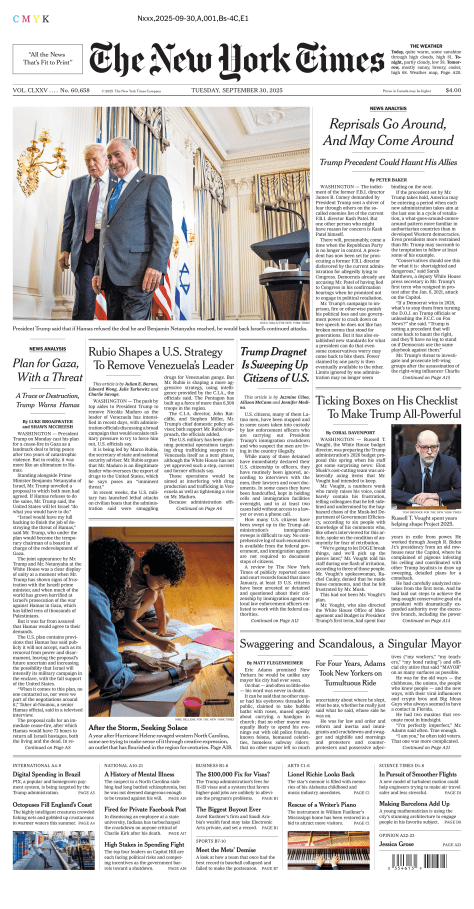
THE NEW YORK TIMES – TUESDAY, JULY 15, 2025

U.S. Inflation Accelerated in June as Trump’s Tariffs Pushed Up Prices

The Consumer Price Index rose 2.7 percent from a year ago, as the global trade war started to bite.

China’s Economy Grows Steadily Despite President Trump’s Tariffs

Official figures showed modest growth in the second quarter as exports shifted to other countries and Beijing invested in manufacturing and infrastructure.

Federal Workers’ ‘Emotional Roller Coaster’: Fired, Rehired, Fired Again

Former government employees are finding that perhaps the only thing harder than getting laid off from the federal government is staying that way.

Supreme Court Clears Way for Dismantling of Education Department

The decision allows President Trump to fire thousands of employees, functionally eliminating an agency created by Congress without legislators’ input.

Behind Trump’s Tough Russia Talk, Doubts and Missing Details

Pentagon officials said details were still being worked out, and experts doubted President Trump’s threat of huge tariffs for Russian trading partners.

Review: AI, Apathy, and the Arsenal of Democracy

Dexter Filkins is a Pulitzer Prize-winning American journalist and author, known for his extensive reporting on the wars in Afghanistan and Iraq. He is currently a staff writer for The New Yorker and the author of the book “The Forever War“, which chronicles his experiences reporting from these conflict zones. 

Is the United States truly ready for the seismic shift in modern warfare—a transformation that The New Yorker‘s veteran war correspondent describes not as evolution but as rupture? In “Is the U.S. Ready for the Next War?” (July 14, 2025), Dexter Filkins captures this tectonic realignment through a mosaic of battlefield reportage, strategic insight, and ethical reflection. His central thesis is both urgent and unsettling: that America, long mythologized for its martial supremacy, is culturally and institutionally unprepared for the emerging realities of war. The enemy is no longer just a rival state but also time itself—conflict is being rewritten in code, and the old machines can no longer keep pace.

The piece opens with a gripping image: a Ukrainian drone factory producing a thousand airborne machines daily, each costing just $500. Improvised, nimble, and devastating, these drones have inflicted disproportionate damage on Russian forces. Their success signals a paradigm shift—conflict has moved from regiments to swarms, from steel to software. Yet the deeper concern is not merely technological; it is cultural. The article is less a call to arms than a call to reimagine. Victory in future wars, it suggests, will depend not on weaponry alone, but on judgment, agility, and a conscience fit for the digital age.

Speed and Fragmentation: The Collision of Cultures

At the heart of the analysis lies a confrontation between two worldviews. On one side stands Silicon Valley—fast, improvisational, and software-driven. On the other: the Pentagon—layered, cautious, and locked in Cold War-era processes. One of the central figures is Palmer Luckey, the founder of the defense tech company Anduril, depicted as a symbol of insurgent innovation. Once a video game prodigy, he now leads teams designing autonomous weapons that can be manufactured as quickly as IKEA furniture and deployed without extensive oversight. His world thrives on rapid iteration, where warfare is treated like code—modular, scalable, and adaptive.

This approach clashes with the military’s entrenched bureaucracy. Procurement cycles stretch for years. Communication between service branches remains fractured. Even American ships and planes often operate on incompatible systems. A war simulation over Taiwan underscores this dysfunction: satellites failed to coordinate with aircraft, naval assets couldn’t link with space-based systems, and U.S. forces were paralyzed by their own institutional fragmentation. The problem wasn’t technology—it was organization.

What emerges is a portrait of a defense apparatus unable to act as a coherent whole. The fragmentation stems from a structure built for another era—one that now privileges process over flexibility. In contrast, adversaries operate with fluidity, leveraging technological agility as a force multiplier. Slowness, once a symptom of deliberation, has become a strategic liability.

The tension explored here is more than operational; it is civilizational. Can a democratic state tolerate the speed and autonomy now required in combat? Can institutions built for deliberation respond in milliseconds? These are not just questions of infrastructure, but of governance and identity. In the coming conflicts, latency may be lethal, and fragmentation fatal.

Imagination Under Pressure: Lessons from History

To frame the stakes, the essay draws on powerful historical precedents. Technological transformation has always arisen from moments of existential pressure: Prussia’s use of railways to reimagine logistics, the Gulf War’s precision missiles, and, most profoundly, the Manhattan Project. These were not the products of administrative order but of chaotic urgency, unleashed imagination, and institutional risk-taking.

During the Manhattan Project, multiple experimental paths were pursued simultaneously, protocols were bent, and innovation surged from competition. Today, however, America’s defense culture has shifted toward procedural conservatism. Risk is minimized; innovation is formalized. Bureaucracy may protect against error, but it also stifles the volatility that made American defense dynamic in the past.

This critique extends beyond the military. A broader cultural stagnation is implied: a nation that fears disruption more than defeat. If imagination is outsourced to private startups—entities beyond the reach of democratic accountability—strategic coherence may erode. Tactical agility cannot compensate for an atrophied civic center. The essay doesn’t argue for scrapping government institutions, but for reigniting their creative core. Defense must not only be efficient; it must be intellectually alive.

Machines, Morality, and the Shrinking Space for Judgment

Perhaps the most haunting dimension of the essay lies in its treatment of ethics. As autonomous systems proliferate—from loitering drones to AI-driven targeting software—the space for human judgment begins to vanish. Some militaries, like Israel’s, still preserve a “human-in-the-loop” model where a person retains final authority. But this safeguard is fragile. The march toward autonomy is relentless.

The implications are grave. When decisions to kill are handed to algorithms trained on probability and sensor data, who bears responsibility? Engineers? Programmers? Military officers? The author references DeepMind’s Demis Hassabis, who warns of the ease with which powerful systems can be repurposed for malign ends. Yet the more chilling possibility is not malevolence, but moral atrophy: a world where judgment is no longer expected or practiced.

Combat, if rendered frictionless and remote, may also become civically invisible. Democratic oversight depends on consequence—and when warfare is managed through silent systems and distant screens, that consequence becomes harder to feel. A nation that no longer confronts the human cost of its defense decisions risks sliding into apathy. Autonomy may bring tactical superiority, but also ethical drift.

Throughout, the article avoids hysteria, opting instead for measured reflection. Its central moral question is timeless: Can conscience survive velocity? In wars of machines, will there still be room for the deliberation that defines democratic life?

The Republic in the Mirror: A Final Reflection

The closing argument is not tactical, but philosophical. Readiness, the essay insists, must be measured not just by stockpiles or software, but by the moral posture of a society—its ability to govern the tools it creates. Military power divorced from democratic deliberation is not strength, but fragility. Supremacy must be earned anew, through foresight, imagination, and accountability.

The challenge ahead is not just to match adversaries in drones or data, but to uphold the principles that give those tools meaning. Institutions must be built to respond, but also to reflect. Weapons must be precise—but judgment must be present. The republic’s defense must operate at the speed of code while staying rooted in the values of a self-governing people.

The author leaves us with a final provocation: The future will not wait for consensus—but neither can it be left to systems that have forgotten how to ask questions. In this, his work becomes less a study in strategy than a meditation on civic responsibility. The real arsenal is not material—it is ethical. And readiness begins not in the factories of drones, but in the minds that decide when and why to use them.

THIS ESSAY REVIEW WAS WRITTEN BY AI AND EDITED BY INTELLICUREAN.

THE NEW YORKER MAGAZINE – JULY 21, 2025 PREVIEW

The cover of the July 21 2025 issue of The New Yorker in which an anthropomorphic sun fries a city on a stove.

THE NEW YORKER MAGAZINE: The latest issue cover features Joost Swarte’s “Sunny-Side Up” – The city fries.

Flash Floods and Climate Policy

As the death toll climbs in Texas, the Trump Administration is actively undermining the nation’s ability to predict—and to deal with—climate-related disasters. By Elizabeth Kolbert

Is the U.S. Ready for the Next War?

With global conflicts increasingly shaped by drones and A.I., the American military risks losing its dominance. By Dexter Filkins

A.I. Is About to Solve Loneliness. That’s a Problem

The discomfort of loneliness shapes us in ways we don’t recognize—and we may not like what we become without it. By Paul Bloom

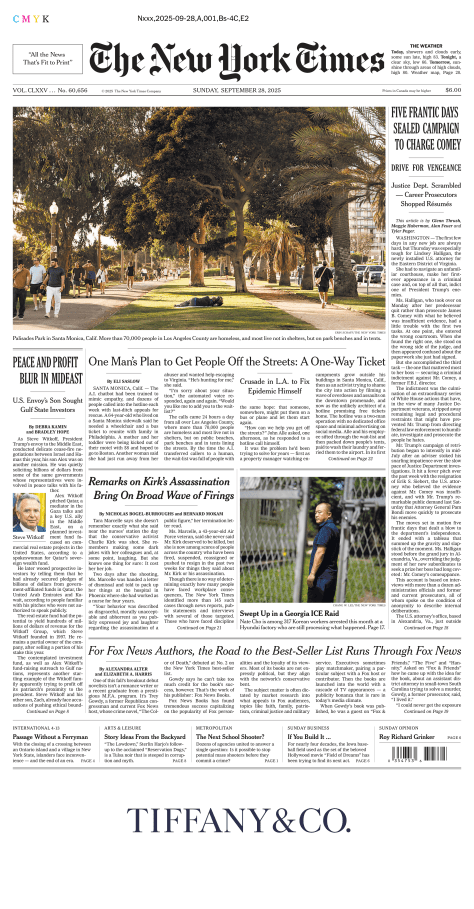
THE NEW YORK TIMES – MONDAY, JULY 14, 2025

It’s No Bluff: The Tariff Rate Is Soaring Under Trump

President Trump has earned a reputation for bluffing on tariffs. But he has steadily and dramatically raised U.S. tariffs, transforming global trade.

How Trump Changed His Tone on Vladimir Putin and the War in Ukraine

After years of lavishing praise on the Russian leader, President Trump abruptly changed his posture amid frustration with the lack of a cease-fire.

Inside the Conservative Campaign That Took Down a University President

A group of University of Virginia alumni had long called for eliminating D.E.I., without much success. Then they gained a new ally: President Trump.

Public Broadcasters Brace for Vote on Sharp Funding Cut

Birthright, Borders, And The U.S. Constitution

In the July 11, 2025 episode of Bloomberg Law’s Weekend Law podcast, the spotlight turned to the Supreme Court and one of the most urgent constitutional questions of the present era: can the federal government deny citizenship to children born in the United States based solely on their parents’ immigration status?

At the center of the discussion was a new executive order issued by the Trump administration. The order aims to withhold automatic citizenship from children born to undocumented immigrants. In response, a federal judge in New Hampshire has not only issued a temporary nationwide block on the order but also certified a class-action lawsuit that could have sweeping implications.

This development, as legal analyst and former DOJ official Leon Fresco explained, is not merely procedural—it is strategic. The case, still in its early stages, may force the Supreme Court to revisit the meaning of the Fourteenth Amendment’s Citizenship Clause.


Legal Strategy: Class Action as Constitutional Tool

Fresco’s key insight concerned how litigants are adapting to recent changes in judicial thinking. After the Supreme Court expressed skepticism toward broad nationwide injunctions, many believed such tools were effectively dead. But Fresco pointed out that class-action certification remains a viable, and perhaps more precise, alternative.

The New Hampshire judge’s ruling created a nationwide class of plaintiffs: all children born on or after February 20, 2025, to parents who are either unlawfully present or not U.S. citizens or lawful permanent residents. The judge carefully excluded parents from the class, narrowing the focus to the children’s citizenship claims. This move strengthens the class’s legal position, emphasizing a uniform constitutional harm.

Fresco characterized this approach as both narrow in structure and expansive in effect. By building the case around a specific constitutional injury—the denial of citizenship by birth—the lawsuit avoids the kinds of inconsistencies that often weaken broader claims.


The Constitutional Question: What Does “Jurisdiction” Mean?

At the heart of the dispute lies the interpretation of the Citizenship Clause of the Fourteenth Amendment: “All persons born or naturalized in the United States, and subject to the jurisdiction thereof, are citizens of the United States.”

For over a century, the courts have understood this to include virtually everyone born on U.S. soil, with only narrow exceptions. The Trump administration’s order proposes a reinterpretation—arguing that undocumented immigrants and their children are not “subject to the jurisdiction” of the United States in the full constitutional sense.

This argument is novel, but not entirely new. Versions of it have circulated in fringe legal circles for years. What is new is the attempt to enforce this interpretation through executive power. If allowed to stand, it would mark a major departure from long-established constitutional norms.


Tactical Delay: The Risk of a Judicial “Stay”

Fresco raised a more immediate concern: that the Supreme Court may avoid ruling on the merits of the case altogether—at least for now. The Court, he warned, might grant a temporary stay that would allow the executive order to take effect while the lawsuit works its way through the lower courts.

This would mirror a pattern seen in other immigration cases, such as those involving Temporary Protected Status and humanitarian parole, where short procedural rulings allowed sweeping policy shifts without a full constitutional review.

The danger of such a stay is not theoretical. If the executive order goes into effect, children born under it would enter legal limbo. Denied citizenship, they would lack basic documents and protections. Challenging their status later could take years—possibly decades. In this way, even a temporary policy can create permanent consequences.


The Role of the Court: Principle or Procedure?

A central theme of the podcast segment was the evolving role of the judiciary in overseeing executive actions. Fresco questioned how the Court could reject a class-action lawsuit like this one without also undermining the logic that allows nationwide relief in other types of cases—such as defective products that cause uniform harm across the country.

If the courts are willing to permit class certification for consumer safety, why would they deny it in a case concerning citizenship—a matter of constitutional identity?

Fresco’s analogy was sharp: the law allows national class actions over faulty cribs or pharmaceuticals; why not over a birthright denied?

His point revealed the tension between procedural restraint and constitutional responsibility. If the Court is serious about limiting nationwide injunctions, it must offer a consistent, principled rationale for where it draws the line.


The Political Climate: Avoidance Through Silence

Toward the end of the discussion, Fresco referenced former Attorney General Alberto Gonzalez, who has speculated that the Supreme Court may simply lack the votes to strike down the executive order directly. That possibility may explain the Court’s hesitancy to take up the issue.

Justice Neil Gorsuch’s past remarks—asking how the Court might “get to the merits fast”—suggest at least some justices recognize the urgency. But urgency does not always lead to clarity. If the Court allows the order to take effect temporarily, and then delays review, it could set in motion changes that are difficult to reverse.

In effect, the Court would be allowing the executive branch to reshape constitutional practice through interim decisions. That prospect, Fresco warned, is not only legally unstable but socially volatile.


The Stakes: Citizenship as Constitutional Reality

Ultimately, what this case asks is not only a legal question but a civic one: Is citizenship a stable constitutional right, or can it be redefined by policy?

The class-action strategy now moving through the courts offers one possible defense: a method of forcing judicial engagement by focusing on clear constitutional harm and avoiding broad, unwieldy claims. It is, in Fresco’s words, an effort to meet the Court on its own procedural terms.

Yet the deeper conflict remains. The very idea of birthright citizenship—once considered legally untouchable—is now on trial. Whether the courts decide quickly or delay, the consequences will be lasting.


Conclusion: The Constitution on the Line

The Bloomberg Law discussion offered more than a legal update. It revealed how quickly constitutional assumptions can be unsettled—and how creative legal strategies are now being used to hold the line.

The New Hampshire ruling, and the class it created, represent a new phase in this fight. Narrow in scope but vast in significance, the lawsuit calls on the judiciary to answer directly: Is a child born on U.S. soil a citizen, or not?

In that answer lies the future of constitutional meaning—and the measure of whether the law remains anchored to principle, or drifts with the political tide.

THIS ESSAY AND REVIEW WAS WRITTEN BY AI AND EDITED BY INTELLICUREAN