
June 4, 2023 – Monocle’s editorial director, Tyler Brûlé, Fabienne Kinzelmann and Oliver Strijbis discuss the weekend’s biggest news stories in Zürich.
Plus: we check in with our friends and correspondents in Ljubljana, Hamburg and London.

June 4, 2023 – Monocle’s editorial director, Tyler Brûlé, Fabienne Kinzelmann and Oliver Strijbis discuss the weekend’s biggest news stories in Zürich.
Plus: we check in with our friends and correspondents in Ljubljana, Hamburg and London.

Monocle on Saturday, June 3, 2023: Updates on the weekend’s culture news and current affairs with Emma Nelson.
British classical-music radio and television broadcaster Petroc Trelawny reviews the papers, French journalist Agnès Poirier discusses France’s debt and Monocle’s Monica Lillis speaks with author Beth Lewis about cults.


THE NEW YORK TIMES MAGAZINE (June 4, 2023) – California is the place where the future happens, for good and ill. That’s part of its magic. Read our first-ever California Issue to find out what roads the state will take us down next.
Inside: A fight over a parking lot that explains the housing crisis; the future of California’s power to shape national policy; how the state is adapting to a warming world — and more.

From reparations to tax revolts, the Golden State tries out new ideas all the time. What roads will its latest experiments send us down?
By Laila Lalami
I remember my first glimpse into the future. In August 1992, when I arrived in California as a student, I discovered during orientation that the university required all incoming students to have something called an email account. To access it, I had to call up a text-based mail client on Unix, using a series of line commands. If I needed a file that sat on a university computer in New York, I could use file transfer protocol to download it in Los Angeles, the whole process taking no more than a few minutes. That’s brilliant, I remember thinking.

For decades the state has been setting policy for the whole nation. Now red states are pushing back.
For a while this winter, seemingly every text message that Buffy Wicks received asked if she was running for Congress. Representative Barbara Lee, of California’s 12th District, which includes Oakland, had announced that she would enter the race for Dianne Feinstein’s soon-to-be-vacated Senate seat. This decision by Lee, who is 76, created a rare opportunity for the next generation of California Democrats to vie for federal office. And Wicks — a 45-year-old State Assembly member who lives in Lee’s district and was last re-elected with 85 percent of the vote — seemed like a natural candidate.
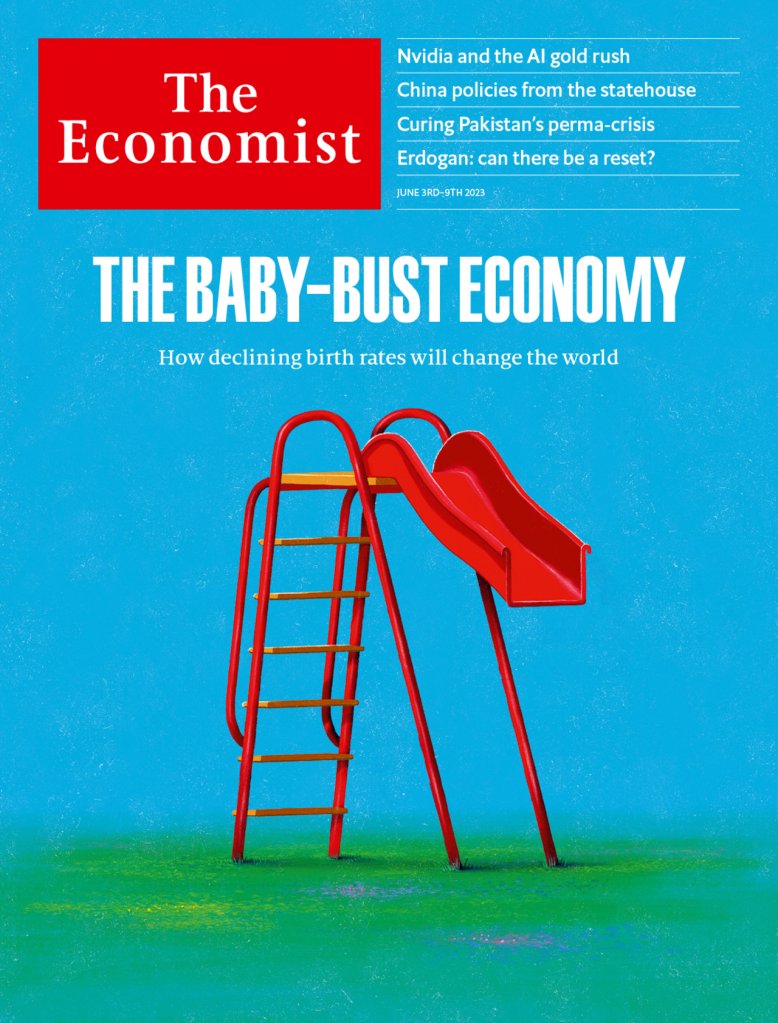


What might change the world’s dire demographic trajectory?
In the roughly 250 years since the Industrial Revolution the world’s population, like its wealth, has exploded. Before the end of this century, however, the number of people on the planet could shrink for the first time since the Black Death. The root cause is not a surge in deaths, but a slump in births. Across much of the world the fertility rate, the average number of births per woman, is collapsing. Although the trend may be familiar, its extent and its consequences are not. Even as artificial intelligence (ai) leads to surging optimism in some quarters, the baby bust hangs over the future of the world economy.

There is a chance for a partial reset
It certainly wasn’t fair. Nor was it entirely free. But, like it or not, the victory on May 28th of Recep Tayyip Erdogan in Turkey’s presidential election is a fact. For the next five years Turkey, Europe and the wider world will have to deal with a prickly and authoritarian populist. That is bad news on many fronts: economically, democratically and regionally. And yet pragmatists have a duty to search for chinks of light in the gloom.
That compounds the problems of shrinking workforces and rising bills for health care and pensions

“Adam is a special child,” says the voice-over, as the camera pans across abandoned classrooms and deserted maternity wards. “He’s the last child born in Italy.” The short film made for Plasmon, an Italian brand of baby food owned by Kraft-Heinz, a giant American firm, is set in 2050. It imagines an Italy where babies are a thing of the past. It is exaggerating for effect, of course, but not by as much as you might imagine. The number of births in Italy peaked at 1m in 1964; by 2050, the un projects, it will have shrunk by almost two-thirds, to 346,000.
The Globalist Podcast, Friday, June 2, 2023: Asia’s top security meeting, IISS Shangri-La Dialogue kicks off but China refuses to talk to the US on the sidelines.
Plus: several media groups are banned from Opec’s production meeting this weekend; we check in on how Nigeria’s new president is faring and we ask, “What is lake cow bacon?”
The Globalist Podcast, Thursday, June 1, 2023: Veteran political strategist Norm Sterzenbach unpacks Ron DeSantis’s 2024 launch.
Plus: fears that Polish democracy is under threat, secret talks between Qatar and the Taliban, and award-winning author Leila Slimani talks about her latest novel.
The Globalist Podcast, Wednesday, May 31, 2023: Russia analyst Mark Galeotti gives us the latest on the drone attacks in Moscow, the G7 issues Leaders’ Communique on trade relations with China, a look ahead at Spain’s snap election, the business news and why flip phones are making a comeback.
Tuesday, May 30, 2023: South Korea hosts Pacific Island Summit, North Korea launches first military satellite, NATO Foreign Ministers meet in Norway, and more top stories.
‘Editor’s Picks’ Podcast (May 29, 2023) – Three essential articles read aloud from the latest issue of The Economist. This week, why Donald Trump is very likely to be the Republican nominee for president, how to fix Britain’s National Health Service (09:55) and companies’ “away days” are getting unnecessarily creative (17:15).


The pop singer’s trial for copyright infringement of Marvin Gaye and Ed Townsend’s “Let’s Get It On” highlights how hard it is to draw the property lines of pop.

From Mary Wollstonecraft to Toni Morrison, getting a start meant starting over.
When the critic Joanna Biggs was thirty-two, her mother, still in her fifties, was diagnosed with Alzheimer’s. “Everything wobbled,” she recalls. Biggs was married but not sure she wanted to be, suddenly distrustful of the neat, conventional course—marriage, kids, burbs—plotted out since she met her husband, at nineteen. It was as though the disease’s rending of a maternal bond had severed her contract with the prescribed feminine itinerary. Soon enough, she and her husband were seeing other people; then he moved out, and she began making pilgrimages to visit Mary Wollstonecraft’s grave.



 Boomers Daily