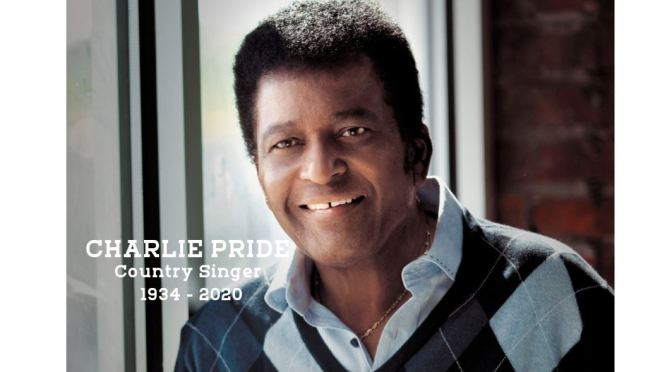
We remember Charley Pride, one of the first African Americans to become popular as a country artist. Pride died yesterday at the age of 86, of complications from COVID-19.
Charley Frank Pride (March 18, 1934 – December 12, 2020) was an American singer, guitarist, and professional baseball player. His greatest musical success came in the early to mid-1970s, when he was the best-selling performer for RCA Records since Elvis Presley.[1] During the peak years of his recording career (1966–87), he had 52 top 10 hits on the BillboardHot Country Songs chart, 30 of which made it to number one. He won the Entertainer of the Year award at the Country Music Association Awards in 1971.
While he was active in baseball, Pride had been encouraged to join the music business by country stars such as Red Sovine and Red Foley, and was working towards this career. In 1958, in Memphis, Pride visited Sun Studios and recorded some songs.[14]
He performed his music solo at clubs and with a four-piece combo called the Night Hawks during the time he lived in Montana.[11] His break came when Chet Atkins at RCA Victor heard a demonstration tape and got Pride a contract. In 1966, he released his first RCA Victor single, “The Snakes Crawl at Night”.[11] Nashville manager and agent Jack D. Johnson signed Pride. Atkins was the longtime producer at RCA Victor who had made stars out of country singers such as Jim Reeves, Skeeter Davis, and others. Pride was signed to RCA Victor in 1965. “The Snakes Crawl at Night” did not chart. On the records of this song submitted to radio stations for airplay, the singer was listed as “Country Charley Pride”. Pride disputes that the omission of a photo was deliberate; he stated that getting promoters to bring in a black country singer was a bigger problem: “people didn’t care if I was pink. RCA signed me… they knew I was colored…They decided to put the record out and let it speak for itself.”[11] While living in Montana, he continued to sing at local clubs, and in Great Falls had an additional boost to his career when he befriended local businessman Louis Allen “Al” Donohue, who owned radio stations including KMON, the first stations to play Pride’s records in Montana.[11]
Soon after the release of “The Snakes Crawl at Night”, Pride released another single called “Before I Met You”, which also did not chart. Not long afterwards, his third single, “Just Between You and Me”, was released. This song finally brought Pride success on the country charts. The song reached number nine on Hot Country Songs on February 25, 1967.[15]
According to a news item by the Associated Press, Pride made this comment in a 1992 interview: “They used to ask me how it feels to be the ‘first colored country singer’ .. Then it was ‘first Negro country singer;’ then ‘first black country singer.’ Now I’m the ‘first African-American country singer.’ That’s about the only thing that’s changed”. [16]
Career peak
“Pride’s amazing baritone—it hints at twang and melisma simultaneously, and to call it warm is to slight the brightness of its heat”
The success of “Just Between You and Me” was enormous. Pride was nominated for a Grammy Award for the song the next year. In the late summer of 1966, on the strength of his early releases, he was booked for his first large show, in Detroit‘s Olympia Stadium. Since no biographical information had been included with those singles, few of the 10,000 country fans who came to the show knew Pride was black, and only discovered the fact when he walked onto the stage, at which point the applause trickled off to silence. “I knew I’d have to get it over with sooner or later,” Pride later remembered. “I told the audience: ‘Friends, I realize it’s a little unique, me coming out here—with a permanent suntan—to sing country and western to you. But that’s the way it is.’ ”[18]
In 1971, Pride released what would become his biggest hit, “Kiss an Angel Good Mornin'”, a million-selling crossover single. The same year, he won the Country Music Association‘s entertainer of the year award, as well as its top male vocalist award in 1971 and 1972.[23]
“Kiss an Angel Good Mornin'” became Pride’s signature tune. Besides being a five-week country number one in late 1971 and early 1972, the song was also his only pop top-40 hit, hitting number 21, and reaching the top 10 of the Adult Contemporary charts, as well.
The field of psychology underwent a replication crisis and saw a sea change in scientific and publishing practices, could ecology be next? News Intern Cathleen O’Grady joins host Sarah Crespi to talk about the launch of a new society for ecologists looking to make the field more rigorous.
Sarah also talks with Andrew Storfer, a professor in the School of Biological Sciences at Washington State University, Pullman, about the fate of the Tasmanian devil. Since the end of the last century, these carnivorous marsupials have been decimated by a transmissible facial tumor. Now, it looks like—despite many predictions of extinction—the devils may be turning a corner.
U.S. nears final vaccine review as daily national deaths top 3,250, Facebook hit with antitrust lawsuits, and Florida sheriff deputies deliver meals to kids doing virtual school.
How water chemistry is shifting researchers’ thoughts on where life might have arisen, and a new model to tackle climate change equitably and economically.
In this episode:
00:46 A shallow start to life on Earth?
It’s long been thought that life on Earth first appeared in the oceans. However, the chemical complexities involved in creating biopolymers in water has led some scientists to speculate that shallow pools on land were actually the most likely location for early life.
The COVID-19 pandemic has massively shifted the scientific landscape, changing research and funding priorities across the world. While this shift was necessary for the development of things like vaccines, there are concerns that the ‘covidization’ of research could have long-term impacts on other areas of research.
The Hayabusa2 mission successfully delivers a tiny cargo of asteroid material back to Earth, and a team in China claims to have made the first definitive demonstration of computational ‘quantum advantage’.
Limiting carbon emissions is essential to tackling climate change. However, working out how to do this in a way that is fair to nations worldwide is notoriously difficult. Now, researchers have developed a model that gives some surprising insights in how to equitably limit carbon.
First person in the world given Pfizer’s vaccine, Georgia again certifies Joe Biden’s win, and here’s your guide to holiday tipping during the pandemic.
News, Views and Reviews For The Intellectually Curious














 Boomers Daily