
From Cell.com “Trends In Ecology & Evolution” (Feb 22, 2020):
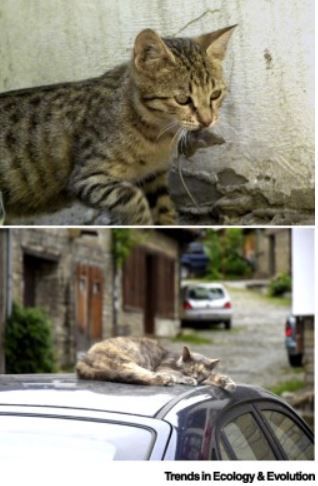 The value of domestic cats as predators-in-residence certainly played a significant part in their global spread, as they were employed for rodent control on trade ships and in the outbuildings of emerging civilisations.
They are predisposed to form attachments with people during early developmental stages, tolerate the presence of humans, other cats, and other domestic animals far better than wilder felids, and exhibit distinctive behavioural traits (including vocalisations and body language) that facilitate effective interspecies communication…
Cats share a long history with humans but are remarkable among domesticated species in largely retaining behavioural and reproductive independence from people. In many societies, the cat maintains liminal status as both a domestic and a wild animal. An adaptive push-and-pull between wild and domestic traits corresponds with dual roles as companions and pest controllers, and with conflicted treatment in husbandry, management, law, and public discourse. To move forward, we must proceed by understanding that cats are not exclusively pets or pests, but both a central component of human societies and an important, often adverse, influence on ecosystems. Developing a collaborative ‘companion animal ecology’, in which human–animal domestic relations link to ecological processes, will enable sustainable management of this wild companionship.



 Last year the Lancet published a paper on the impact of wearing gowns, surveying 928 adult patients and carrying out structured interviews with 10 patients. Over half (58%) reported wearing the gown despite feeling uncertain that it was a medical necessity. Gown design was considered inadequate, with 61% reporting that they struggled to put it on or required assistance and 67% reporting that it didn’t fit. Most worryingly, 72% felt exposed, 60% felt self-conscious, and 57% felt uncomfortable wearing the gown.
 Boomers Daily