From a New England Journal of Medicine online study release:
The findings from our approach suggest with high predictive accuracy that by 2030 nearly 1 in 2 adults will have obesity (48.9%; 95% confidence interval [CI], 47.7 to 50.1), and the prevalence will be higher than 50% in 29 states and not below 35% in any state.

Nearly 1 in 4 adults is projected to have severe obesity by 2030 (24.2%; 95% CI, 22.9 to 25.5), and the prevalence will be higher than 25% in 25 states. We predict that, nationally, severe obesity is likely to become the most common BMI category among women (27.6%; 95% CI, 26.1 to 29.2), non-Hispanic black adults (31.7%; 95% CI, 29.9 to 33.4), and low-income adults (31.7%; 95% CI, 30.2 to 33.2).
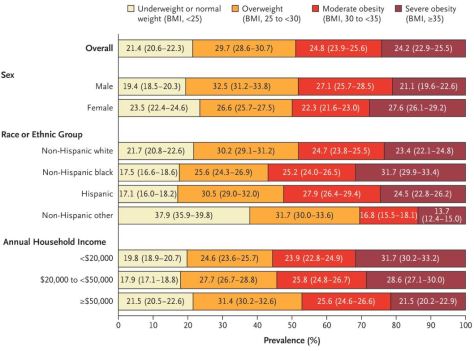
Although severe obesity was once a rare condition, our findings suggest that it will soon be the most common BMI category in the patient populations of many health care providers. Given that health professionals are often poorly prepared to treat obesity,27 this impending burden of severe obesity and associated medical complications has implications for medical practice and education.
In addition to the profound health effects, such as increased rates of chronic disease and negative consequences on life expectancy,25,28 the effect of weight stigma29 may have far-reaching implications for socioeconomic disparities as severe obesity becomes the most common BMI category among low-income adults in nearly every state.
To read more: https://www.nejm.org/doi/full/10.1056/NEJMsa1909301?query=featured_home


 Entrepreneur and 2020 Democratic candidate Andrew Yang tells NewsHour Weekend he was ‘honored and disappointed’ to be the lone candidate of color at the last debate. He joins Yamiche Alcindor to discuss his plan to give every American adult $1,000 a month, why he believes headlines about the economy are misleading, and how he would handle North Korea if he became president.

 The film’s trailer introduced Auger as: “Young. Beautiful. Trapped. Could be dangerous”.

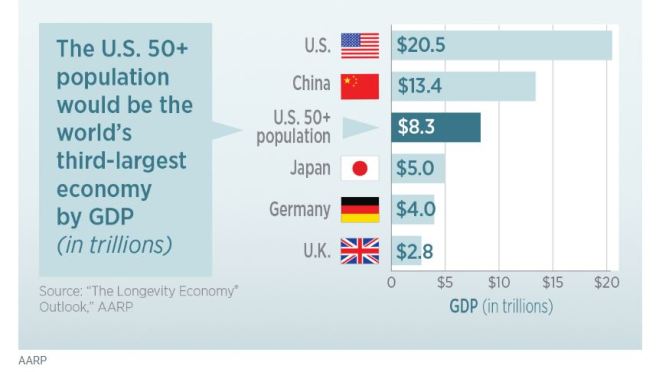
 “As the number of people over 50 grows, that age cohort is transforming markets and sparking new ideas, products and services across our economy,” AARP CEO Jo Ann Jenkins says. “And as people extend their work lives, they are fueling economic growth past the traditional retirement age.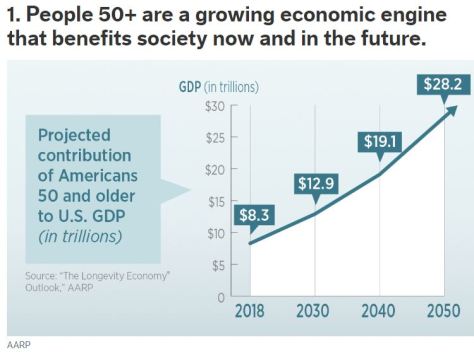

 Robotic construction company Apis Cor has used its technology to build the world’s largest 3D-printed building, a two-storey administrative office in Dubai.

 When the five sleep factors were collapsed into binary categories of low risk vs. high risk (reference group), early chronotype, adequate sleep duration, free of insomnia, and no frequent daytime sleepiness were each independently associated with incident CVD, with a 7%, 12%, 8%, and 15% lower risk, respectively (Table
 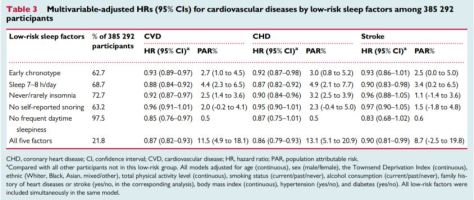 Cardiovascular disease (CVD), including coronary heart disease (CHD) and stroke, is among the leading causes of mortality globally.

 Boomers Daily