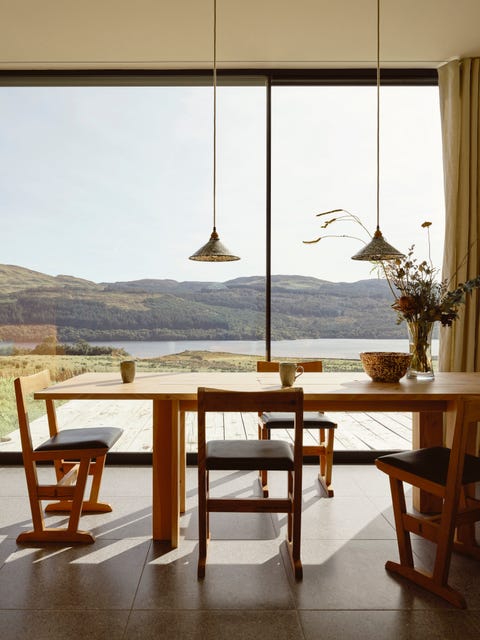
Interior designer Jill Macnair shows us around her home in the Scottish Highlands, a place of retreat that brings her a sense of peace, place and connection to the natural world.
“If there were a window into my soul, I think the view would be a rain-soaked Scottish landscape. Not, I hope, because I have a relentlessly bleak nature. My dad plotted family holidays all over the small but majestic country I grew up in, and while I didn’t greatly appreciate his efforts at the time – the walks were a bit too long, the cycles often too uphill – the colours and scenes etched into my memory from those trips are the ones that still restore me today. They form the palette that now underpins the design of my holiday home on Loch Tay, Perthshire.
A luxury getaway home settled on a unique site, Crane Lodge immerses visitors in its natural context. Designed by Secret Gardens, the landscape architecture of the home enhances the sensory experience of the outdoors.
Video timeline: 00:00 – Crane Lodge as an Experience 00:44 – The Client’s Vision 01:05 – The Garden and The Setting 01:58 – Lodged Unusually High 02:21 – The Inclusion of Amenities 02:37 – The Team Involved 03:04 – Major Site Components 03:34 – A Strong Connection to The Outdoors 03:49 – A Natural Watering Hole 04:28 – Sympathetic Materials and Beautiful Features
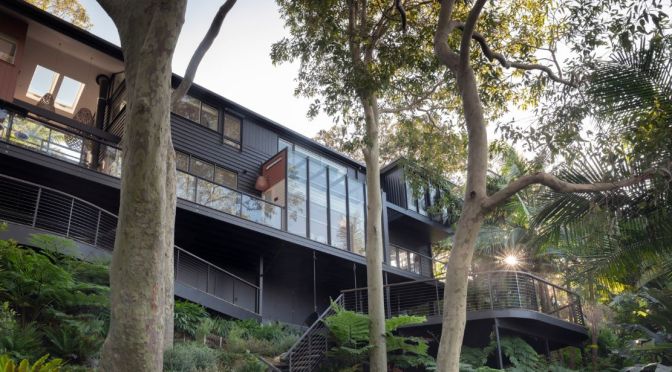
Located in the Sydney suburb of Palm Beach, Crane Lodge sits on an elevated site. The design brief for the landscape of the luxury getaway home centred on creating a sense of arrival whilst allowing access to the house across the terrain. Employing an inclinator, Secret Gardens instils the arrival process with a sense of anticipation and discovery.
Many endangered species of plant are championed in the landscape design of the luxury getaway home and are designed to appear slightly unkempt. Secret Gardens also includes indigenous plants for cooking and educational purposes. A smattering of boulders surrounds the luxury getaway home, contributing to the impressive character of its external environment.
Secret Gardens purposefully positions the swimming pool adjacent to boulders, creating the impression that the amenity emerged naturally. The materials chosen for the landscape architecture of Crane Lodge express a sympathetic approach to nature. As a result, the luxury getaway home entirely embraces its context, with a landscape design that captures the essence of a bushwalk experience.
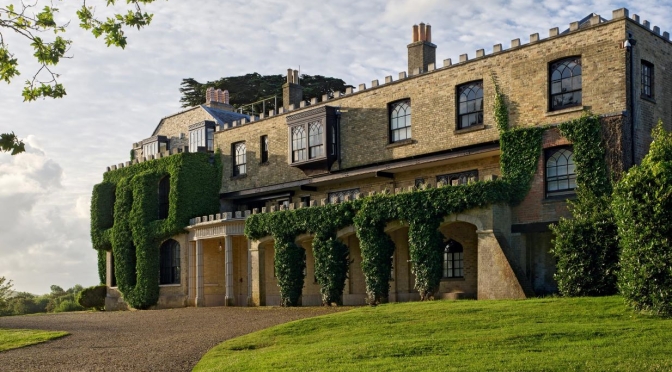
After nearly 60 years as a hotel, this former home of the poet Alfred, Lord Tennyson has been triumphantly restored as a house museum. John Goodall reports; photography by Paul Highnam.
On January 21, 1884, the poet laureate Alfred Tennyson was elevated to the peerage as Baron of Aldworth, Surrey, and of Freshwater on the Isle of Wight. As the editor of The Complete Peerage (1896) primly commented when recording this exceptional accolade, ‘the assumption of two places in different counties (more especially when the estate possessed is inconsiderable), cannot be commended’. Tennyson, however, would not have cared. Indeed, he had refused the offer of baronetcy four times and was only finally persuaded to accept it by his friend, the then Prime Minister, William Gladstone.
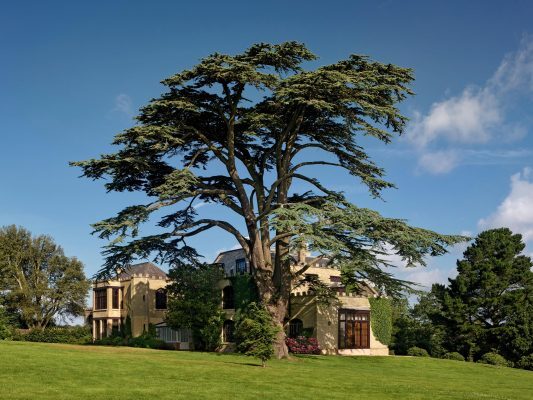
Tennyson chose this unusual title because — unconventionally for the period — he had houses in both places that he considered to be homes. Aldworth, which he generally occupied in the summer months, was a retreat from his house at Freshwater. This latter building, known as Farringford, was sold by the family in the 1940s and thereafter became a hotel. Returned back into private ownership in 2007, it has now undergone a renaissance at the hands of a Tennyson scholar, who has turned it into both a home and a house museum to the poet.
In the years immediately following his marriage in 1850, Tennyson and his wife, Emily, actively searched for a place to live. They heard from friends about a family house at Freshwater, on the north-western extreme of the Isle of Wight. Following a slightly depressing first viewing by Tennyson — then aged 44 — the couple came back together. An account of their visit in November 1853 is given in Emily’s journal. Travelling by train to Brockenhurst — where the railway line then ended — they caught an omnibus to Lymington and crossed on a still evening from the mainland in a rowing boat.
Emily was delighted by the house, which enjoyed an expansive prospect along almost the whole Hampshire coastline, and ‘looking from the drawing-room window, thought “I must have that view”, and so I said to him when alone. So accordingly we agreed… to take the place furnished for a time on trial with the option of purchasing’.
Rose Park House is a luxury house designed to create a journey of discovery. Carefully crafted by studio gram, the robust residence represents a legacy project for the clients; a home to last a lifetime and house generations to come.
Video timeline: 00:00 – The Local Project Print Publication 00:16 – Introduction to Rose Park House 00:40 – A Legacy Project 01:06 – The History of The Queen Anne Villa 01:29 – Materials and Architecture That Leave a Legacy 02:26 – A Wine Room for the Ages 03:02 – Key Components of The Extension 03:40 – Practical and Fully Accessible 04:14 – Longevity & Long Lasting Relationships 04:53
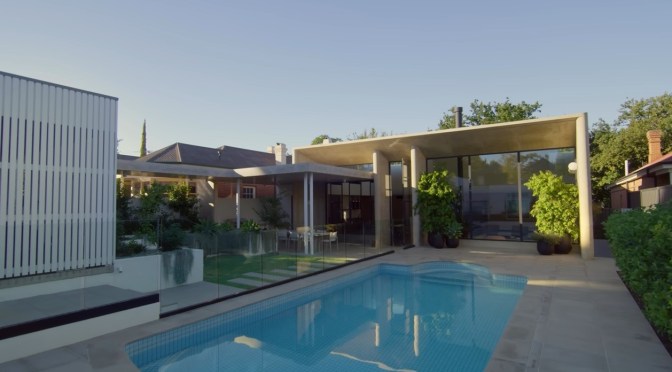
Sitting at the fringe of the Adelaide Park Lands, Rose Park House is the final architectural project to be initiated by the clients. The design brief for the luxury house entailed a structure that could stand the test of time and was a reimagination of the existing residence which was originally built in the 1900s.
Studio gram selects durable materials for Rose Park House. Dark-toned limestone and American walnut speak to a sense of longevity and visually contrast the bright natural light that fills the internal spaces. An investigation of the pre-existing home revealed architecture comprised of off-form concrete. The modern extension of the luxury house continues the materiality of the original dwelling.
Rose Park House is also designed with a focus on accessibility. Accessible ramps, flush thresholds and wide apertures are featured in consideration of occupants who use wheelchairs. Smoothly integrated into the overall scheme, the features demonstrate that in a luxury house, form and function are not necessarily conceived as competing interests.
As a luxury house, Rose Park House is imbued with a feeling that is almost ineffable; a feeling of permeating goodness and rightful being. Achieving longevity and timelessness, studio gram crafts a luxury house with a growing legacy.
Situated on a site measuring only 6 metres wide, Light Scoop House required a compelling architectural response. As is necessary when an architect designs a narrow home, Molecule Studio enables function in a compact space, crafting a serene residence well-suited to the lifestyle of the client. Understandably, when an architect designs a narrow home, access to natural sunlight is given high priority.
00:00 – The Local Project Print Publication 00:18 – Introduction to a Narrow Home That is Only 6 Meters Wide 00:47 – The Clients Original Goal 01:06 – The Architects Pre-Design Process 01:25 – Zen Vibes and Interconnected Design 02:05 – Behind the Narrowness of The Home 02:39 – Landscape Courtyards and Garden Connection 03:06 – Architectural Elements within The Home 03:37 – Central Materials and Their Links to Light 04:46 – Achievements of The Original Brief 05:54 – Subscribe to The Local Project Print Publication
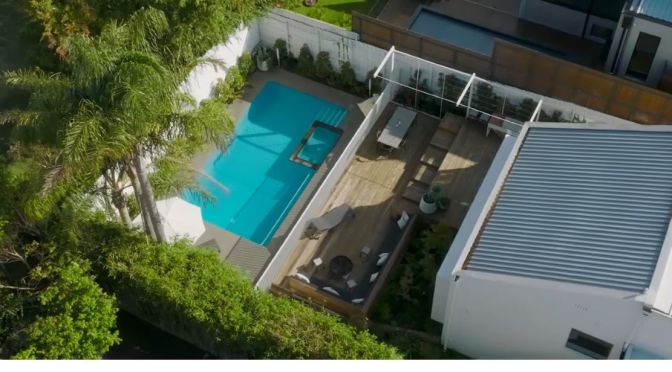
Located in the bay-side suburb of Brighton, Light Scoop House is named in reference to its tapered-edge pavilion roofs which pull natural light into the home and lift the gaze upwards. If an architect designs a narrow home without considering the lifestyle of the occupant, the design will not succeed. Molecule Studio thoroughly examines the personal likes, dislikes and daily habits of the client, producing a tranquil home that captures sunlight across its textural surfaces. Molecule Studio punctuates the spatial plan of Light Scoop House with landscaped courtyards. In doing so, the architect designs a narrow home that fosters a distinct feeling of retreat, effortlessly connecting the occupant to nature. Light Scoop House demonstrates that when an architect designs a narrow home, the outcome can exceed expectations. Using a limited materiality, Molecule Studio creates a sense of calm and careful construction that extends far beyond the demands of the brief. 00:00 – The Local Project Print Publication 00:18 – Introduction to a Narrow Home That is Only 6 Meters Wide 00:47 – The Clients Original Goal 01:06 – The Architects Pre-Design Process 01:25 – Zen Vibes and Interconnected Design 02:05 – Behind the Narrowness of The Home 02:39 – Landscape Courtyards and Garden Connection 03:06 – Architectural Elements within The Home 03:37 – Central Materials and Their Links to Light 04:46 – Achievements of The Original Brief 05:54 – Subscribe to The Local Project Print Publication
The Nunnery is — as the name suggests — a former Benedictine Nunnery that has been the recipient of years of renovation works, transforming the historic property into a breathtaking, spacious home. Penny Churchill reports.
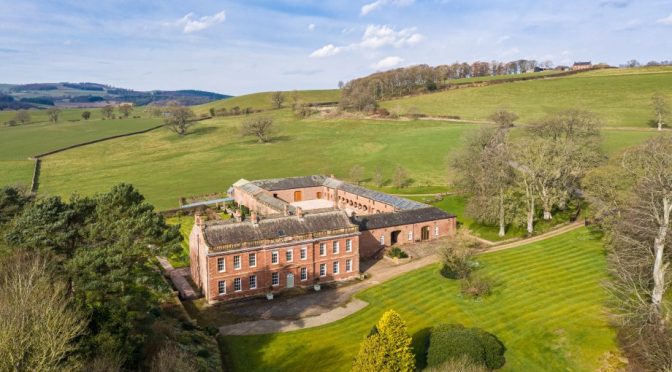
Cumbria’s glorious Eden Valley has been well-named and the setting for imposing, Grade I-listed The Nunnery at Staffield, 10 miles from Penrith, on the fringes of the Lake District National Park, is typical of the area, with traditional livestock farms and rolling grassland falling away to the River Eden, against a distant backdrop of dark, moody fells.
The former country-house hotel, set in almost 52 acres of wonderfully private park and woodland close to the village of Kirkoswald, has been beautifully renovated, remodelled and extended by its present owners who acquired it in a fairly run-down state in the early 2000s.
Although the origins of The Nunnery can be traced to a mid-13th-century Benedictine nunnery, according to Country Life (November 23, 2000), the present ‘plain but imposing red sandstone house’ was built by Henry Aglionby in 1718.
When an architect designs a house with consideration and care, dwellings such as May House emerge. Taking a playful approach to colour and materiality, Neil Architecture reimagines a 1980s home as a relaxed, modern family residence.
Video timeline: 00:00 – The Local Project’s Print Publication 00:10 – Introduction to the House 00:45 – Complementary Design 01:01 – Exterior Renovations 02:03 – 1980s Materiality 03:12 – Landscape Architecture 04:09 – A House Made for Entertaining 04:42 – Timeliness Rejuvenation 05:17 – Subscribe to The Local Project’s Print Publication
When an architect designs a house, the design brief can often stipulate a complete renovation. However, Neil Architecture recognised the value of the original 1980s construction – settled into the leafy suburb of Malvern – and decided instead to complement the home with architectural additions.
To maintain the strong and simple form of the original structure, Neil Architecture covers the pre-existing truss with a perforated screen. Off-form concrete is used to create the carport, whilst a roughcast concrete render is applied to the fence – in doing so, the architect designs a house that interacts with the local built environment. As an architect designs a house, the intent can be expressed through the finer details of the scheme.
In May House, rusty red and green tones appear in the material palette, paying homage to the colours present in 1980s interior design. May House sees a 1980s residence both celebrated and reimagined, embraced and rejuvenated. Managing the external architecture and interior detail, the architect designs a house that is imbued with a sense of warmth and continuity; a house for the future that is inspired by the past.
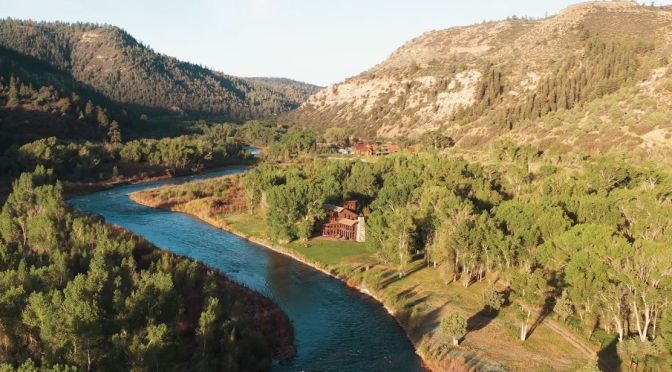
A classic “gentleman’s” property, the San Juan River Retreat offers approximately one mile of both banks of the designated “blue ribbon” San Juan River. It is rare for a smaller acreage property to offer such an abundance of the river’s main stem, control of both banks, excellent fishery for rainbows and browns, and all while offering high-grade fish habitat.
The property is complemented by a custom-built 3,100 square foot primary residence which is nicely appointed and complements the land, while not being overdone. A 3,500 square foot guest house and small shop provide room for guests and equipment storage/work area.
Water rights irrigate approximately 20 acres, and two wells provide domestic water. The land is diverse, presenting a mixture of old-growth cottonwoods lined along the river, productive irrigated meadows, mild topography, smaller areas of evergreen tree cover, and good habitat for migrating big game animals.
The San Juan River Retreat is located 16 miles south of Pagosa Springs, 30 minutes from Stevens Field FBO, and less than an hour from Wolf Creek Ski Area. https://hallhall.com/property-for-sal…
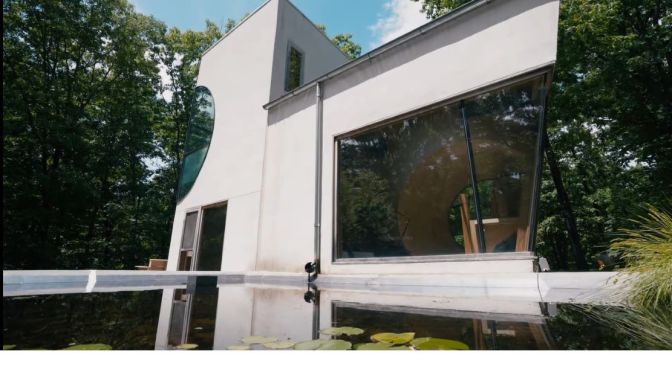
Today Architectural Digest brings you two hours north of New York City to Rhinebeck, NY for an in-depth look at a home that feels like an inhabitable work of art. Architects Steven Holl and Dimitra Tsachrelia explain the design philosophy and inspiration behind their secluded, off-grid “architectural wonder in the woods,” breaking down the intent behind each design choice and how they work together to create a uniquely meditative but stimulating space.
Harmoniously engaged with its constituent parts and context, Rose Bay Duet is a residential work by Stafford Architecture. Utilizing the interior comforts of Poliform Australia, the two modern homes propose a lifestyle of relaxed family living.
Video timeline: 00:00 – Introduction to the Modern Homes 00:55 – The Client Brief 01:27 – Using Poliform Throughout the Home 03:13 – Materiality 04:40 – The Roof Terrace 05:06 – The Master Bedroom Area 05:35 – What the Architect is Most Proud Of
Named in reference to the Sydney Opera House, Rose Bay Duet is similarly settled on the eastern side of the city. Comprised of two modern homes, the project pays homage to the idea of lyrical, architectural narrative – in particular, the project celebrates the operatic relationship between the two modern homes, the sloping site, the Opera House and the iconic Sydney Harbour Bridge.
Appointing a specific design team to each of the two modern homes, Stafford Architecture creates dual unique outcomes that share select character qualities. Whilst both houses maximise the incredible views available and feature an exterior of simple materiality, one house has feminine characteristics while the other projects a more masculine impression.
Collaborating with Poliform Australia, Stafford Architecture enjoyed a smooth creative process. With access to the entire Poliform range, seeing both modern homes benefit from elegant joinery, textures, finishes and soft furnishings. Rose Bay Duet is a well-considered and intuitive feat of interior design and architecture. Stafford Architecture applies the Poliform Australia collection with enthusiasm and intent, crafting modern homes that rejoice in a sense of connection.
News, Views and Reviews For The Intellectually Curious








 Boomers Daily