

How Chicago’s oldest exchange bet on sixty-minute markets, and what it means when certainty itself is priced like a parlay.
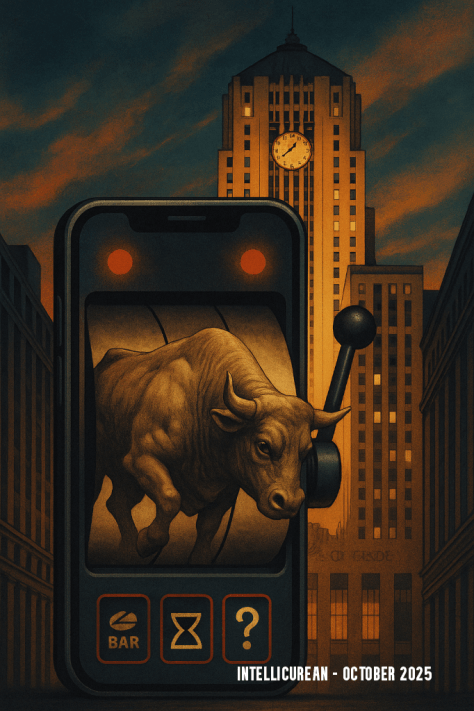
Inspired by conversations on Bloomberg’s “Odd Lots” podcast, October 2, 2025, this essay explores the collision of Chicago’s most venerable marketplace with America’s newest gambling instinct.
By Michael Cummins, Editor, October 2, 2025
Chicago declares its weather. The wind comes down LaSalle Street like a verdict, rattling the brass doors of the Chicago Mercantile Exchange (CME), the world’s largest derivatives marketplace, and Terry Duffy keeps telling the same story about the Sears Tower. Once, Sears was so secure it stamped its name onto the tallest building in the country. Then Amazon arrived and the edifice outlived the company. Duffy repeats the story because he knows it could happen to him. He is the custodian of a market built on trust and clearing, and he now presides over a future in which markets themselves have begun to resemble slot machines.
When CME announced this summer that it would partner with FanDuel to launch retail-friendly “event contracts,” the move was described, in the buttoned-down language of FIA MarketVoice, as bringing “Wall Street to Main Street.” But the reality is stranger: the nation’s most venerable exchange has chosen to build a door onto a sports-betting app. The product is stark in its simplicity—fully funded, binary contracts tied to benchmarks like the S&P 500, gold, or the monthly Consumer Price Index (CPI), each available for a dollar, each expiring in sixty minutes. “We want to attract a new generation of retail traders,” CME explained in its release, emphasizing transparency, defined risk, and the symbolic price point that even the most casual bettor can afford.
Duffy knows what it is to sell certainty. He began his career in the pits, where certainty was conjured out of chaos. To enter the pit was to descend into a human engine: men in jackets of vivid color, chalk dust in the air, sweat soaking the collars, voices rising to a roar. Each shout was a legal contract; each hand signal, a coded promise. Palm in meant buy, palm out meant sell. A quick nod sealed the trade. A look in the eye carried as much weight as a notarized document. The pit was a place where trust was physical, embodied, and enforced by reputation.
He still carries it in his cadence. His sentences are short, clipped, emphatic, relics of the pits’ staccato. A “yes” had to carry over the roar, and a “no” had to land like a gavel. He learned that a man’s word was binding; a lie meant exile. To Duffy, the roar was not noise but a symphony of accountability.
Contrast that to the FanDuel app, silent and frictionless. No shouts, no sweat, no eye contact. A bet placed with a swipe, confirmed by a vibration in the pocket. The counterparty is invisible; the clearing is algorithmic. The visceral contract of the pit has become the abstract contract of the phone. For Duffy, the gap is more than technological—it is civilizational.
His survival has always depended on bridging gaps. In 2007, he forced CME and the Chicago Board of Trade (CBOT)—longstanding rivals, territorial and proud—into a merger that saved both from decline. It was, at the time, a brutal clash of cultures. Pit traders who once hurled insults across LaSalle now shared a roof. Duffy’s achievement was to convince them that survival required sacrifice. The precedent matters now: he knows when to abandon tradition in order to preserve the institution. He has led the exchange for over two decades, long enough to embody continuity in a world addicted to rupture.
Which is why he returns, again and again, to the Sears Tower. Sears did not collapse overnight. Its decline was gradual: catalogs left unopened, trust eroded, relevance seeped away. Sears represented predictability—a known price, a tangible good. It was undone by the infinite shelf of Amazon, where everything was available, untethered from a physical catalog. Duffy fears the same for CME: that in the infinite, unregulated shelf of crypto and apps, the certainty of a clearinghouse will be forgotten. He has made himself the defender of that certainty, even as he opens the door to the FanDuel crowd.
Imagine it, then, not in Chicago but in Des Moines: a woman on her lunch break, soup cooling in its paper cup, phone buzzing with the faintly cheerful ping of a FanDuel notification. She scrolls past the Raiders’ line, taps the “markets” tab, and there it is: gold, $1,737. Above or below? Sixty minutes to decide. She glances at the chart, flickering like a slot machine, and stakes a dollar. Her coworker laughs—he’s on crude oil, betting it falls before the hour. It is a small act, private and almost whimsical. But multiply it by millions, and the cathedral of Chicago has rented space to the gamblers.
Amy Howe, FanDuel’s chief executive, prefers another framing. “By working with CME Group, we can give consumers a transparent, fully funded product with clear rules and protections,” she said in August. For her, the lunch-break wager is less a symptom of dopamine culture than an act of empowerment, bounded by disclosure and design. Later, she would describe it as “responsible innovation for a generation that already expects to engage with markets digitally.”
The phone has conditioned us to view every decision as a micro-transaction with binary payoff, a perpetual A/B test of our own lives. Swipe left or right, invest in Tesla or short its sales, like or ignore, vote or abstain. Certainty itself has become a parlay. The event contract is merely the most transparent expression of this new algorithmic certainty.
Duffy knows the critique—that he is blurring investing and gambling, putting the reputation of the world’s most trusted clearinghouse in play. He shrugs off the taxonomy. “Find me an investment without speculation,” he challenges. Speculators create liquidity; investors ride the train. The problem is not the label. The problem is whether the architecture can hold.
Once, hedging was about survival. A farmer locked in the price of corn to guarantee his family’s subsistence through drought. A grain elevator hedged to manage inventory. Futures were the sober instrument of risk management, a tool for keeping bread on tables. The retail contracts on FanDuel are different. They are not designed to secure a season’s yield but to occupy a lunch break. The hedger and the gambler both face uncertainty, but one does so to live through winter, the other to feel a flicker of dopamine.
What happens when a generation learns to price its risks in sixty-minute increments? When patience is dissolved into perpetual refresh, when civic trust is reshaped by the grammar of instant payoff? Perhaps we become more rational, disciplined consumers of risk. More likely, we become addicted to ever-shorter horizons, citizens of a republic of immediacy.
The FanDuel tie-up is not an aberration; it is the logical culmination of a broader gamification. Fitness apps turn calories into wins and losses. Dating apps transform intimacy into binary swipes. Diet apps offer daily streaks, productivity trackers chart each hour, social media doles out likes. The logic is universal: win or lose, in the money or out. Finance is simply the purest distillation of the loop. The hour-long future looks less like a radical departure than the natural endpoint of the dopamine economy.
Duffy insists that the difference lies in the architecture of the market. Here, the clearinghouse still rules. The CME Clearing division guarantees that each contract, no matter how small, will clear. This is the core trust mechanism: novation. The clearinghouse steps in as the buyer to every seller and the seller to every buyer. It guarantees performance even if a party defaults. It is the invisible institution that makes markets work, as essential as plumbing or electricity. Without clearing, a market is just a game of promises. With clearing, promises become enforceable contracts.
This is why Duffy obsesses over jurisdiction. The nickel crisis in London remains his cautionary tale. When the London Metal Exchange (LME) canceled billions in nickel trades in 2022, after a massive short squeeze threatened a major client, it violated the principle that trades, once made, must stand. In Duffy’s view, this was sacrilege. If trades can be retroactively voided, trust collapses. The nickel debacle lingers as a ghost story he tells often: what happens when clearing is not sacred, when the rules bend to expedience?
The tax code, too, becomes part of his defense. Section 1256 of the Internal Revenue Code gives futures a blended 60/40 tax treatment—sixty percent long-term, forty percent short-term—even though they expire quickly. This means that a futures trader, even in hourly event contracts, can claim a rate unavailable to sports bettors. The distinction between “future” and “security” may be arcane, but in the retail economy it could be decisive. Why place a bet on an unregulated platform with higher tax burdens when you could trade an event future inside CME’s fortress? Duffy is building his moat out of law as well as architecture.
Yet even he admits there are red lines. Political prediction markets, for instance. At first glance, they seem like an extension of the model. Why not allow bets on elections, if you can bet on CPI or jobs reports? But Duffy sees danger. Imagine a small-town school bond vote. A motivated actor buys all the “Yes” contracts, pushing the price higher, creating the illusion of inevitability. Undecided voters, reading the “market,” assume the bond will pass and vote accordingly. Speculation becomes self-fulfilling. A democracy of markets quickly becomes a market for democracy.
The Iowa Electronic Markets (IEM) were tolerated because they were small, academic, pedagogical—designed to teach students about probabilities. But scaled onto a national betting app, political contracts would cease to be an experiment and become an accelerant. Duffy resists. “Every political event is not a presidential election,” he warns. Some are small enough to be readily manipulable. And the Commodity Exchange Act is explicit: contracts cannot be.
He also resists the temptation of perpetual futures. Crypto invented them as an answer to expiry, an infinite bet that never resolves. To Duffy, they fail the laugh test. Immortal cattle cannot be delivered. Wheat cannot grow forever. A Treasury future must expire into a bond. A future without resolution is not a hedge but a hallucination.
Still, he is not afraid of arriving late. In 2017, he was mocked for waiting to list Bitcoin futures. When he did, CME became the premier venue for hedging crypto risk. His philosophy is consistent: better to be late with credibility than early with chaos. “Go when the architecture can hold,” he says, and it sounds less like a trading maxim than a worldview.
The contradiction remains: the man who built his authority in the pits, enforcing trust by the pressure of a body, is now enabling the gamification of markets by the tap of a thumb. Is he selling his integrity, or saving the concept of the market by absorbing the dopamine impulse into its ancient structure? Is CME, in joining FanDuel, protecting the house—or merely becoming one more casino in an infinite arcade?
He walks a city that remembers. The Sears Tower still stands, though its name has eroded. The ghost-hum of the pits lingers in his cadence. The wind whips down LaSalle, eternal as ever. The phones in people’s pockets glow across the country, each a miniature trading pit, silent and frictionless. A new market is trying to clear—not just trades, but trust, patience, and perhaps the architecture of democracy itself.
THIS ESSAY WAS WRITTEN AND EDITED UTILIZING AI








 Boomers Daily