
Category Archives: Essays

The Unholy Offspring of Economic Theory: The Far Right’s Neoliberal Roots

The following essay is AI -generated, edited by Intellicurean, as part of our “The Cynic & The Dandy” series, of an interview article published on July 6, 2025 on the Toynbee Prize Foundation website titled Hayek’s Bastards and the Global Origins of the Far Right: An Interview with Quinn Slobodian.

One finds oneself, much like a seasoned playgoer observing a particularly convoluted modern drama, grappling with the profound complexities of our age. The curtain, it seems, has risen on “Trump 2.0,” a performance so bewildering in its contradictions that even the most astute critics of human folly might pause for breath. This curious administration simultaneously seeks to disentangle itself from global commitments while igniting fresh international disputes; it endeavours to depreciate the dollar to boost exports whilst clinging to its status as the world’s reserve currency; and it champions a reduction in global economic reliance while striving to unilaterally dictate global economic terms. The American colossus, one might observe, appears caught in a most perplexing dance with its own identity, and the global audience watches, utterly transfixed.

It is into this very contemporary conundrum that Quinn Slobodian, a historian of capitalism whose intellectual acuity is as sharp as a well-honed epigram, strides with his latest volume: Hayek’s Bastards: Race, Gold, IQ, and the Capitalism of the Far Right (Princeton University Press, 2025). This title, one must concede, possesses a certain Wildean flourish, hinting at the delightful audacity within its pages. Slobodian, with the keen eye of a diagnostician, posits that the apparent contradiction of the Far Right simultaneously embracing pro-market liberalism and social hierarchies – facilitating the free movement of capital but not of people – is, in fact, no contradiction at all. He argues that neoliberalism has always possessed the intellectual elasticity to accommodate such a narrative.


The Unruly Offspring of Thought: “Bastards” and “Volk Capital”

Slobodian’s current work builds upon his earlier seminal analyses in Globalists: The End of Empire and the Birth of Neoliberalism (Harvard University Press, 2018) and Crack-up Capitalism: Market Radicals and the Dream of a World Without Democracy (Metropolitan, 2023). However, Hayek’s Bastards shifts its chronological focus decisively to the 1990s, illuminating this pivotal decade through the lens of figures not previously central to his explorations. If Globalists dissected the intellectual elite of the Mont Pèlerin Society, and Crack-Up Capitalism examined market radicals within the broader globalisation context, this new work turns its penetrating gaze to paleo-libertarianism. This intriguing ideological fusion, combining libertarian disdain for global governance with paleo-conservative traditionalism and isolationism (a distinct contrast to the more recent neoconservative branch of the Republican Party), forms the crux of Slobodian’s argument.

At the heart of Slobodian’s contention lies a startling conclusion: the rise of the Far Right is an acceleration, not a rejection of capitalism; a frontlash, not a backlash. He meticulously demonstrates how right-wing libertarians of the 1990s, through their convergence with paleoconservatives and their burgeoning interest in biology, IQ, and gold, inadvertently laid the intellectual foundations for our present reality.

In a recent conversation with Asensio Robles of Comillas Pontifical University, Slobodian elucidated the two primary concepts underpinning his book. The notion of “bastards,” he explains, serves as a vivid metaphor for the generations of intellectual influence, where adherents, though inspired by mentors, may diverge significantly from the original spirit and content of their masters’ work. In the case of Friedrich Hayek, Slobodian points to those who, in their pursuit of his scientific and complexity-focused ideas, veered into domains such as scientific racism or the belief in human nature as an absolute organizing principle. These, Slobodian asserts, represent the “illegitimate” heirs who strayed far enough to betray Hayek’s fundamental principles.

Friedrich Hayek, a Nobel laureate in Economics (1974) and a leading figure of the Austrian School of economics, is perhaps best known for his fervent defense of free-market capitalism and his critiques of central planning, notably articulated in his seminal 1944 work, The Road to Serfdom. Hayek argued that economic coordination arises not from central design, but from a “spontaneous order” – the result of millions of individuals making decisions based on dispersed, localized knowledge communicated primarily through the price system. He believed that any attempt by the state to centrally plan the economy would inevitably lead to a loss of individual liberty and, ultimately, totalitarianism, because such planners could never possess the vast, tacit knowledge embedded within a decentralized market.

The second crucial concept is “Volk capital.” Slobodian critiques the common, overly generalized understanding of neoliberalism as simply advocating for the commodification of all things and the reduction of all humans to an interchangeable substance. By adopting a narrower, more historically precise definition, focusing on a discrete group of thinkers (including those within the Mont Pèlerin Society, which Hayek co-founded in 1947), he reveals a significant inflection point in the 1960s and 1970s. This period saw a shift in neoliberal thought towards an emphasis on human difference, rather than equality.

Slobodian argues that the universalizing concept of human capital became “re-grounded” in specific genetic populations or cultural groups. He observes the re-emergence of 19th-century notions of the “Volk”—the idea of an essential character of a kinship group—fused with economic categories. This, he contends, transforms “human capital” into “Volk capital,” demonstrating how an ideology often associated with abstract market principles could regress to antiquated distinctions. For instance, by the 1980s, Hayek himself, often considered a progenitor of neoliberalism, suggested a unique quality of the Western world in producing an “optimal economic actor.”


A “Frontlash” Unveiled: Beyond the “Left-Behinds” Narrative

Slobodian further clarifies the genesis of these two books, revealing they were initially conceived as a single grand volume. The political shocks of 2016-2017 – the election of Donald Trump, the Brexit “Leave” vote, and the rise of parties like Alternative for Germany – prompted his inquiry. He expresses dissatisfaction with mainstream interpretations that viewed these developments as a revolt against neoliberal capitalism by those “left behind” by globalisation. This narrative, he argues, incorrectly positioned figures like Trump and Boris Johnson as unexpected challengers to the neoliberal consensus.

To counter this, Slobodian first introduced the concept of the “zone” in Crack-up Capitalism. This refers to more fluid spaces for investor capital within nations, such as freeports in the United Kingdom or the proliferation of Special Economic Zones in countries like China and India. He notes that in 2017-2018, much of the apparent economic nationalism was, in fact, about creating these spaces for capital mobility. For example, as of 2023, there were over 7,000 Special Economic Zones globally, employing tens of millions of people and contributing significantly to trade and investment, illustrating this practical application of “zones.”

He then sought to integrate the observation that many within the alt-right in 2016 originated from the paleo-libertarian camp. These individuals, skeptical of both global and national governments, sought a fracturing of the state system. The “grand narrative” of bundling these ideas proved “quixotic,” leading to the separate publication of Crack-up Capitalism and Hayek’s Bastards, the latter focusing on the paleo-alliance between dissident right-wing figures and the neoliberal movement.


The Unseen Hand of Difference: Chronology and Community

The chronological alignment between the two books is evident. In Hayek’s Bastards, the post-Cold War period is presented as a moment of reckoning for neoliberals, who questioned whether they had truly “won” or if “state spending and socialism” persisted in new guises, such as environmentalism or feminism. Similarly, in Crack-up Capitalism, the 1990s marked a breakthrough for zones, representing a form of globalisation that fostered “diversities across territory” rather than uniform regulatory spaces. The fundamental thread uniting both narratives, Slobodian suggests, is the “use of difference, politically or economically.” This challenges the widely held assumption that the 1990s and 2000s were periods of increasing uniformity, arguing instead that they were also times when “irreconcilable differences” were intensified and leveraged for new political agendas.

Slobodian also tackles the pervasive assumption that neoliberalism is solely a celebration of individualism. He argues that while individualism is indeed a focus, neoliberals are intensely concerned with the conditions under which it can be realized. When the traditional “republican tradition” – based on an impartial state providing space for individual expression – is discarded, a new framework for community must be forged. This is particularly true for the “subgenre of neoliberal thought” that advocates for the dissolution of the state.

In this context, the necessity arises to constitute communities that can function and allow for individual expression without uniform regulations from a representative state. This leads to an interest in factors like the role of ethnic homogeneity in decreasing transaction costs and fostering trust, thereby allowing communities to self-perpetuate. It also involves examining the importance of the “social contract” as a literal set of terms for participation in smaller communities, and questions of social reproduction – specifically, the necessary gender orders to ensure sufficient population in a “closed-border model of political organization.” This, he notes, is where anarcho-capitalists and conservatives find common ground, the former seeking abstract individual freedom but recognizing the need for parameters, and the latter striving to preserve existing moral and cultural orders.

A striking observation from Slobodian’s research is the neoliberal fear that the Cold War might have been “lost” despite the Soviet Union’s collapse, due to persistent high state spending. The end of the Cold War, Slobodian reveals, raised the possibility of completely dismantling the social state, which in turn brought forth new questions about how a post-redistributive order could be anchored. This, he asserts, directly relates to the current moment in the United States, where campaigns to significantly cut the federal budget, such as proposals to reduce it by one-third (as seen in certain fiscal proposals from conservative groups, often citing a need to return to pre-expansion levels of spending), would necessitate the dismantling of the existing social state. This scenario, he suggests, brings to mind the ominous question posed by Charles Murray regarding the aftermath of the welfare state’s disappearance – whether it would lead to anarchy, organic self-organization, or a segment of the population perishing. The “vexed triumphalism” following the Cold War, Slobodian concludes, thus set the stage for the “apocalyptic forms of politics” now all too familiar.


The Historical Lens: Unveiling Hidden Cleavages

Slobodian highlights the remarkable absence of significant sectarian splits within neoliberalism between the 1940s and 1980s. The clear ideological battle lines drawn between the “free, liberal, capitalist” world and the “planned command economies” of the communist bloc maintained a cohesive front. However, with the abrupt erasure of this divide in the 1990s, two paths emerged: either assume inevitable global convergence and the end of meaningful political divisions, or contend that divisions persisted, merely migrating to previously overlooked domains. The global Right, he observes, opted for the latter.

The 1990s became a period of “restless search for a new enemy” for the Right. This sometimes involved resurrecting older tropes, such as the anti-Semitic portrayal of George Soros as a conspiratorial figure, a narrative prominently used by figures like Viktor Orbán. Neoliberals, too, participated in this search, ultimately identifying their new adversary in the Left’s “march through the institutions” – specifically, movements advocating for gender and racial equality and a “politically correct” discourse. Slobodian emphasizes that this framing of issues like affirmative action and state-led efforts to redress inequality began remarkably early – some 35 years ago. He argues that the Left, too focused on internal critiques of a more mainstream neoliberalism (like that associated with Bill Clinton or Barack Obama), was often “caught off guard” by the “disruptive politics of the last decade,” failing to recognize the emerging “villain” that would ultimately manifest in today’s culture wars.

Slobodian’s methodological approach, as noted by Robles, is characterized by his commitment to “reading against the grain.” He consistently challenges conventional wisdom: if neoliberalism is thought to strive for state dissolution, Globalists shows its reliance on state intervention; if it promotes a borderless society, Crack-up Capitalism highlights its attention to “human separation”; and if the alt-right is seen as a backlash, Hayek’s Bastards frames it as a “frontlash,” an acceleration of the ideology. This “counterintuitive position” is, for Slobodian, a means to explore the profound revelations found within such contradictions. His advice to students – to begin a paper with “We think it’s like this, but it’s actually like that, and I’m going to show you why” – underscores his dedication to empirical evidence and intellectual revision.

He also draws a strong correlation between the 1990s and the 1960s, suggesting that understanding paleo-libertarian interests in hard borders, IQ, and gold necessitates examining earlier debates surrounding the 1965 Immigration Act, 1960s evolutionary psychology, or monetary reform post-Bretton Woods. These two decades, both periods of relative prosperity, represented moments where attempts were made to reconfigure societal settlements. Slobodian contends that the Left’s focus on criticizing a “progressive neoliberalism” (e.g., of the Clinton or Obama era) that paid “lip service” to 1960s social movements while blunting their critical edge meant they were “caught off guard” in 2016. He suggests that identifying what neoliberals “worried about” in a given decade, such as environmental demands disrupting growth models in the 1970s and 1990s, could reveal “vulnerability in the economic system” and “soft spots” for counter-movements to exploit.


Future Horizons: AI, Animals, and the Unseen Hand of Technology

Regarding future inquiries, Robles points to the absence of cryptocurrencies and AI in Hayek’s Bastards. Slobodian confirms these will be explored in his forthcoming book, Muskism, co-authored with Ben Tarnoff, which will delve into AI, effective altruism, and superintelligence. This work is slated for release next year.

However, Slobodian maintains a critical stance on cryptocurrencies, viewing them as “parasitical on a functioning traditional monetary system” and primarily “a hedge-speculative asset” or “plaything for a small number of libertarians and more recently large investors.” He believes his skepticism has been “a wise bet,” as the number of “true believers” in blockchain as a political template remains small, with most investors using crypto like any other growth sector.

Intriguingly, Slobodian’s other new research direction looks not to the digital future, but to a historical “backward” step: the changes in the human sciences in the postwar decades, specifically “How humans became animals at Harvard.” This project will explore the world of figures like Richard Herrnstein (a student of B. F. Skinner) and E. O. Wilson in the 1960s and 1970s, examining how humans were increasingly “analogized to animals.”

In Hayek’s Bastards, Quinn Slobodian has, with surgical precision, woven a compelling and unsettling thread through the tapestry of intellectual history. He compels us to confront the uncomfortable truths about the origins of our present predicament, reminding us that the seemingly spontaneous outbursts of populism are, in fact, the meticulously cultivated fruits of a long and complex intellectual lineage. One leaves his analysis with a renewed sense of vigilance, a heightened awareness of the subtle, often insidious, ways in which ideas, like the most potent of poisons, can mutate and proliferate, shaping our world in ways we are only now beginning to comprehend. Indeed, the stage is set for future acts in this ongoing drama, and one eagerly awaits Slobodian’s next intellectual curtain call.

“The Cynic & The Dandy” is an AI-generated essay series based on a hypothetical collaboration between Oscar Wilde and George Bernard Shaw.
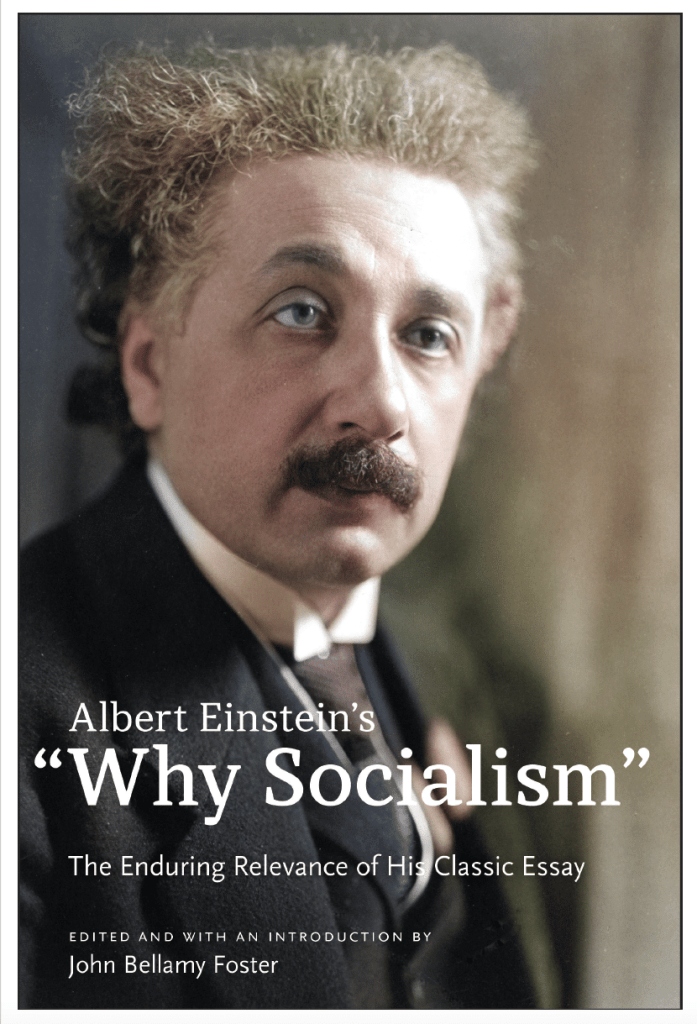
“Why Socialism”: Albert Einstein’s Resplendent Impertinence of Genius

The following essay was written by ChatGPT, and edited by Intellicurean, through the creative filter of Oscar Wilde’s barbed wit and George Bernard Shaw’s moral seriousness, of a review of John Bellamy Foster’s “Albert Einstein’s ‘Why Socialism?’: The Enduring Legacy of His Classic Essay” as it would appear in an esteemed magazine or journal.

In an era where celebrity chatter often drowns out meaningful discourse—ephemeral as the pixels that transmit it—it is both refreshing and necessary to recall that Albert Einstein was not merely a demigod of science, floating above the affairs of humankind. He was a thinker with moral conviction and intellectual courage. John Bellamy Foster’s timely volume, Albert Einstein’s “Why Socialism?”: The Enduring Legacy of His Classic Essay (Monthly Review, July 2025), excavates an overlooked manifesto whose radical clarity remains provocatively undiminished by time.


Unpacking Einstein’s Socialist Vision

More than seventy-five years have passed since Einstein contributed his essay Why Socialism? to the inaugural issue of Monthly Review in May 1949—right in the throes of America’s Red Scare. In that climate of ideological hysteria, even reason itself was suspect. Yet Einstein, with characteristic directness, named capitalism as the source of modern spiritual and economic malaise. “The economic anarchy of capitalist society,” he wrote, “is, in my opinion, the real source of the evil.”

This was no armchair abstraction. It was an act of moral and intellectual defiance in an era of conformity. Rather than tempering his critique to placate the political climate, Einstein diagnosed capitalism as a system that cripples the individual, erodes social cohesion, and mistakes profit for purpose. His socialism, then, was not bureaucratic dogma, but a humane vision: a call for solidarity, responsibility, and human dignity.

Foster’s introduction accomplishes three critical feats. First, it confirms Einstein’s consistent—if unfashionable—commitment to socialist ideals. Second, it situates Why Socialism? within a contemporary moment of deepening ecological and geopolitical crisis, not unlike the postwar anxieties Einstein addressed. Third, and most compellingly, Foster refuses to treat Einstein’s words as nostalgic artifacts. Instead, he reads them as instruments of moral interrogation for the present.


Einstein’s Moral Urgency in a Cynical Age

A powerful moment recounted in Foster’s commentary draws from a recently unearthed interview transcript titled, YES, ALBERT EINSTEIN WAS A SOCIALIST. In it, Einstein recounts a chilling conversation: a friend, contemplating nuclear annihilation, casually asks why Einstein is so concerned about humanity’s extinction. The question is as nihilistic as it is sincere—eerily prefiguring today’s fatalism disguised as realism.

Einstein’s response was telling. He saw this resignation not as philosophical sophistication, but as a symptom of capitalism’s emotional deadening. A world driven by profit, he argued, had alienated people not only from one another but from their very capacity to find joy. “The naive, simple and unsophisticated enjoyment of life,” he mourned, had become a casualty. The resulting solitude, he observed, was not noble introspection but a prison built of egotism and insecurity.

In Why Socialism?, Einstein extends this observation: “Man is, at one and the same time, a solitary being and a social being… As a social being, he seeks to gain the recognition and affection of his fellow human beings… and to improve their conditions of life.” The essay thus offers not just an economic critique, but a portrait of the spiritual crisis induced by capitalism.


A Socialism of Decency, Not Dogma

Einstein did not envision socialism as the rigid apparatus of state control feared by his critics. Instead, he imagined a cultural and moral transformation—one that would replace competition with cooperation, and empty success with meaningful contribution. “In addition to promoting his own innate abilities,” he wrote, “education would attempt to develop in [the individual] a sense of responsibility for his fellow man in place of the glorification of power and success in our present society.”

This human-centered socialism bears more resemblance to George Bernard Shaw’s ethical idealism than to any centralized Leninist command structure. It’s a socialism that asks not only how society is organized, but what kind of people it produces.


Economic Insecurity and the Specter of Waste

Foster’s commentary reaches its most powerful moments when it highlights the relevance of Einstein’s critique in light of today’s contradictions. Technological progress has not delivered leisure or security—it has exacerbated anxiety. “The worker is constantly in fear of losing his job,” Einstein observed. “Technological progress frequently results in more unemployment rather than an easing of the burden of work for all.”

The implications are strikingly modern. The rise of AI, automation, and gig economies has done little to stabilize human life. Meanwhile, the grotesque spectacle of billionaires launching vanity rockets while basic needs go unmet seems to fulfill Einstein’s warning: “Private capital tends to become concentrated in few hands… at the expense of smaller ones.”

Einstein’s insights cut deeper than economics. He warned that unbridled competition produces “a huge waste of labor and… crippling of the social consciousness of individuals.” Foster echoes this, showing how the very mechanisms that promise efficiency often produce alienation and redundancy. In a world where millions remain hungry while supply chains overflow, the diagnosis of “planned chaos” is tragically apt.


The Courage to Imagine a Better World

To Foster’s credit, the book does not shy away from the difficulties of implementing socialism. It acknowledges Einstein’s own candor: that centralized systems can create new forms of domination. “How can the rights of the individual be protected,” he asked, “and therewith a democratic counterweight to the power of bureaucracy be assured?”

Foster does not offer easy answers, nor does he romanticize Einstein’s views. But what he recovers is the philosopher’s refusal to retreat into cynicism. Einstein, like Shaw, understood that history does not advance through comfort or caution. It advances through the courage to propose—and live by—dangerous ideals.

This moral clarity is what makes Why Socialism? enduring. In an era when capitalism insists that no alternatives exist, Einstein reminds us that alternatives are always possible—so long as we preserve the moral imagination to conceive them.


No Middle Ground—And That’s the Point

If one criticism can be leveled at Foster’s approach, it is that he leaves little room for ambiguity. This is no quiet meditation on gradual reform. It is a call to judgment. In a time when readers often seek the past as comfort, Foster compels us to read it as confrontation. The result is not a nostalgic ode to Einstein’s politics but a provocation: What kind of civilization do we want?

Einstein wrote, “I am convinced there is only one way to eliminate these grave evils, namely through the establishment of a socialist economy, accompanied by an educational system which would be oriented towards social goals.” The boldness of that sentence still stings in a society that treats cooperation as utopian and hoarding as genius.

Foster’s restraint is notable throughout—he avoids both hagiography and polemic. He invites the reader to wrestle with Einstein’s ideas, not worship them. The book’s greatest achievement is that it makes us take Einstein seriously—not just as a physicist, but as a moral thinker who challenged the logic of his time and, perhaps, still ours.


Conclusion: A Dangerous Hope

To read Why Socialism? in 2025 is to hear a still-resonant signal from a thinker who refused to let go of the future. Einstein’s socialism was never about bureaucracies—it was about the possibility of decency, of cooperation, of lives lived without fear. And if that vision sounds naive today, then perhaps the problem lies not in the vision, but in the world that has taught us to dismiss it.

As Foster’s book makes clear, the choice remains what it was in 1949: between solidarity and atomization, between a society built on care or one cannibalized by competition. It is, at bottom, a choice between life and extinction.

One imagines Einstein, ever the pragmatist with a poet’s soul, would have approved.

Literary Essay: “Infinite Interiors – On the Twenty Best Novels of All Time”

The following essay was written by ChatGPT and edited by Intellicurean from an article titled “The 20 best novels of all time” written by Claire Allfree and published in The Telegraph book section on July 6, 2025.

When a culture attempts to consecrate a definitive list of its greatest novels, it risks both an admirable arrogance and a kind of elegiac futility. The recent selection of The 20 Best Novels of All Time, published by The Telegraph, seems at once a celebration of the novel’s inexhaustible possibility and an implicit acknowledgment of our own waning capacity for reading with genuine urgency. It is as though we assemble these canons less to instruct our descendants than to reassure ourselves that we have not entirely forgotten how literature once moved the soul.

One cannot help but admire the breadth and seriousness of this catalogue. It stretches from the dreamlike elegance of The Tale of Genji—a work whose thousand-year distance intensifies its immediacy—to the compulsive self-dissection of Knausgaard’s My Struggle, a testament to our age’s faith that self-disclosure can substitute for narrative shape. What holds these disparate texts together is not merely their historical significance but their shared aspiration to render life in all its unmastered perplexity.

If Harold Bloom were to begin here, he might call attention to The Tale of Genji as an early demonstration of what he once termed the “internalization of romance.” It is a book that transcends its courtly gossip to become an inexhaustible study in desire’s transformations, a mirror to the reader’s own fluctuations of attachment and estrangement. We encounter Genji’s erotic restlessness as both scandalous and poignantly familiar, for the novel’s true subject is the incommensurability between longing and fulfillment—an incommensurability that modern fiction has inherited as its principal obsession.

James Wood, by contrast, might focus on Middlemarch as the novelistic apogee of moral realism. Eliot’s genius lay in her refusal to reduce her characters to mere emblems of ideology or historical process. Instead, she endowed them with what Wood has called “free indirect style’s psychic oscillation,” a prose capable of inhabiting and exposing consciousness in the same instant. It is a book that dares to be both panoramic and exquisitely local, to weigh the ambitions of a nation against the disappointments of a single marriage bed. If there is a single argument to be made for the continued relevance of the realist novel, it is that Middlemarch remains more acute about our interiority than any contemporary memoir.

And yet one cannot ignore how this list gestures toward the novel’s capacity for formal subversion. Ulysses, with its irreverent transformations of the Homeric epic into the trivial routines of Dublin, still feels scandalous in its abundance. Joyce’s genius is not only in his linguistic pyrotechnics but in his suspicion that consciousness itself can never be adequately represented. His prose, that shifting mosaic of styles and registers, offers no comfort to the reader who seeks transparency. Instead, it confronts us with the knowledge that the novel’s greatest power may reside in its refusal to cohere.

This refusal—to simplify, to console, to moralize—animates many of the twenty selections. Invisible Man is less a conventional narrative than a hallucinatory initiation into the American underworld of racial invisibility. Ellison’s rhetorical bravado, his blending of surrealism and jeremiad, still outpaces the efforts of more contemporary chroniclers of identity. To read Invisible Man today is to recognize how easily literary radicalism becomes cultural commonplace, but also to remember how singular its achievement remains.

Nor does the list shy from novels that embrace the uncanny. Bulgakov’s The Master and Margarita may be the most exuberant refutation of realist pieties ever composed. Its supernatural comedy is both a rebuke to Stalinist orthodoxy and a reminder that the imagination is an inherently seditious faculty. If much of the 20th-century novel sought to dismantle the illusions of bourgeois life, Bulgakov’s masterpiece demonstrates that irony and enchantment can be revolutionary forces.

Yet if Bloom were to caution us, he would do so against the temptation to read these novels exclusively as instruments of social critique. Literature endures precisely because it exceeds its momentary political applications. War and Peace is indeed an anatomy of the Napoleonic Wars, but it is more crucially a demonstration of how historical consciousness itself can become an object of artistic inquiry. Tolstoy’s genius was to discover that the novelist’s truest fidelity is not to facts but to the felt perplexity of lived experience.

It is striking how Robinson Crusoe stands at the inception of the English novel, bearing within it the seeds of many later contradictions. Defoe’s narrative is, on the surface, a hymn to industry and resourcefulness. But the same story—of a man claiming dominion over an island—also encodes the imperial impulse, the confidence that the world exists to be measured, catalogued, and possessed. What once seemed the purest adventure has become, to modern readers, an uneasy parable of conquest.

One also encounters here the severe naturalism of Thérèse Raquin, a work whose lurid determinism feels almost an affront to Victorian piety. Zola’s lovers are not tragic in any redemptive sense; they are specimens trapped in an experiment of their own appetites. And yet there is a perverse grandeur in the novel’s refusal to pretend that desire leads anywhere but into the pit.

New Grub Street too is a novel about entrapment—this time not by passion but by commerce. Gissing’s weary chronicling of literary London feels uncannily prophetic, as if he anticipated the rise of every ghostwritten bestseller and every writer forced to commodify a persona. What is most unsettling is that he offers no counterexample: no heroic idealist who transcends the marketplace, no unspoiled domain of “pure” art. In this sense, the book remains an indispensable autopsy of cultural production.

If Zola and Gissing reveal the suffocating material conditions of life, Moby-Dick reveals the existential abyss. No novel is more saturated with the terror of cosmic indifference. Melville’s prose—sometimes biblical, sometimes madcap—collapses the distance between metaphysics and anatomy, making the whale not merely an animal but an emblem of the universe’s mute resistance to comprehension. In Bloom’s phrase, it is the American epic that devours all interpretations, a text that renders the critic humble before its incommensurate ambition.

One finds a different kind of ambition in Party Going, where Henry Green distills modernist unease into something almost glacial. Its stranded revellers, imprisoned in their own frivolity while fog swallows the city below, seem to embody an entire civilization’s failure to apprehend its own decline. The novel is both slight in incident and inexhaustible in implication—a reminder that the modernist fascination with stasis can be as provocative as any narrative pyrotechnics.

Proust’s In Search of Lost Time remains the most exhaustive testimony to literature’s faith in consciousness as a world unto itself. No novel before or since has so patiently mapped the minute inflections of memory, the subtle humiliations and triumphs of social life. It is a book that tests the limits of our attention but also rewards it with an intimacy that becomes, paradoxically, universal.

The Great Gatsby, meanwhile, retains its status as a parable of aspiration’s inevitable corrosion. Fitzgerald’s sentences are so lapidary that their loveliness can almost distract from the novel’s acrid judgment. Gatsby’s dream—at once romantic and predatory—has become the template for American self-mythology. That the dream collapses under the weight of its illusions is precisely what grants it the force of prophecy.

It is striking, too, how many of these novels seek to articulate the experience of cultures in collision. Things Fall Apart is the most lucid demonstration of Achebe’s conviction that narrative authority must be reclaimed by those whom empire has consigned to silence. Okonkwo’s tragedy is not only that he fails to adapt but that his story has been written over by the conqueror’s language. Achebe’s triumph is to create a form that both inhabits and transforms that language.

Closer to our own era, The Country Girls quietly ignited a literary insurrection. O’Brien’s candid portrayal of female desire and disillusionment, so scandalous in 1960s Ireland, now seems almost decorous in its gentleness. Yet its influence remains incalculable. It taught a generation of writers that the domestic could be radical, that the most private confessions might unsettle entire cultures.

No less ambitious, though in a different register, is The Golden Notebook. Lessing’s formal fragmentation enacts the very psychic disintegration it describes. Anna Wulf’s notebooks—political, personal, artistic—refuse to reconcile into any coherent identity. In this refusal, Lessing anticipates the confessional experiments of Knausgaard and the autofiction that now dominates so much literary discourse.

The Rings of Saturn, by W.G. Sebald, is a late testament to literature’s capacity to hover between genres—memoir, travelogue, essay—and to become, in that ambiguity, something more resonant than any of them alone. Sebald’s melancholy is not performative but almost geological: the sorrow of civilizations grinding into dust, of memory dissolving into rumor.

If Sebald writes out of mourning, Knausgaard writes out of a hunger so relentless it often seems pathological. My Struggle is both monument and provocation: an assertion that the granular details of ordinary life deserve the same attention Proust once gave to aristocratic salons. Whether this is a triumph of honesty or a capitulation to narcissism is a question the reader must answer alone.

And then there is Conversations with Friends, whose subdued prose and emotional diffidence reflect an era uneasy with grandeur. Rooney’s novel is not so much plotted as observed: a record of glancing attachments, tentative betrayals, and the provisional negotiations of millennial intimacy. Some will dismiss it as slight, but its cool detachment has a disquieting relevance. It suggests that the novel no longer needs epic ambition to be significant; it need only be exact.


A Closing Reflection

Surveying these twenty novels, we see not a single tradition but a plurality of experiments—each one extending the novel’s reach. To read them is to join a conversation that has never ended, in which each new book answers its predecessors with admiration, dissent, or surpassing ambition. Perhaps that is the most heartening lesson: that literature, in all its contradictions, remains the most durable form we possess for contemplating the inexhaustible strangeness of being alive.

A LIST OF THE BOOKS FROM THE ESSAY AND REVIEW IS BELOW:

  1. The Tale of Genji (1021) – Murasaki Shikibu
    Often called the first novel ever written, this thousand-year-old Japanese masterpiece recounts the romantic adventures of Prince Genji and the inner lives of the women he pursues, offering an exquisite portrayal of courtly love and social intrigue.
  2. The Pilgrim’s Progress (1678) – John Bunyan
    A religious allegory composed in prison, telling the story of Christian’s perilous journey to the Celestial City. Simultaneously quest narrative, moral parable, and spiritual confession, it became one of English literature’s most influential texts.
  3. Robinson Crusoe (1719) – Daniel Defoe
    A castaway narrative presented as a true account, blending adventure and colonial ideology. Crusoe’s survival on an island and mastery over his domain has sparked both admiration and fierce debates over its imperialist assumptions.
  4. Moby-Dick (1851) – Herman Melville
    Captain Ahab’s vengeful pursuit of the white whale becomes an existential epic exploring obsession, fate, and humanity’s place in the cosmos. Famous for its lyrical prose and encyclopedic digressions on whales and whaling.
  5. Thérèse Raquin (1867) – Émile Zola
    A grim study of adultery and guilt, depicting the murderous passion between Thérèse and her lover, Laurent. Their crime leads to psychological disintegration and ghostly hauntings in this early work of French naturalism.
  6. War and Peace (1867) – Leo Tolstoy
    Tolstoy’s sprawling saga of Russian aristocrats during the Napoleonic Wars interweaves personal transformation with sweeping history, offering a masterful portrait of love, fate, and the forces that shape nations.
  7. Middlemarch (1871) – George Eliot
    Set in a provincial English town, this realist masterpiece follows the intellectual and emotional struggles of Dorothea Brooke and other characters as they confront marriage, ambition, and disappointment.
  8. New Grub Street (1891) – George Gissing
    An unflinching look at the late-Victorian literary marketplace, chronicling the rivalry between idealistic writers and pragmatic hacks, and exploring the compromises required to survive as a professional author.
  9. Ulysses (1922) – James Joyce
    A modernist reimagining of Homer’s Odyssey, set over a single day in Dublin. Famous for its stream-of-consciousness style, linguistic experimentation, and celebration of ordinary life’s hidden richness.
  10. In Search of Lost Time (1913–1927) – Marcel Proust
    A monumental seven-volume exploration of memory, time, and desire, chronicling the narrator’s life and the decline of French aristocracy with lush psychological and social detail.
  11. The Great Gatsby (1925) – F. Scott Fitzgerald
    A glittering tragedy of the Jazz Age, centering on the mysterious Jay Gatsby’s doomed pursuit of wealth and love, and exposing the hollowness of the American Dream.
  12. Party Going (1939) – Henry Green
    A surreal, modernist novel about a group of privileged young people stranded in a railway hotel, whose trivial gossip masks a pervasive sense of dread as Europe hovers on the brink of war.
  13. Invisible Man (1952) – Ralph Ellison
    An unnamed Black narrator journeys through racism and disillusionment in America, blending surreal episodes, biting satire, and profound reflections on identity and invisibility.
  14. Things Fall Apart (1958) – Chinua Achebe
    Set in a 19th-century Igbo village, this landmark postcolonial novel traces the cultural collision between indigenous African traditions and British missionaries, through the tragic story of Okonkwo.
  15. The Country Girls (1960) – Edna O’Brien
    The coming-of-age story of two Irish girls escaping their repressive Catholic upbringing, whose quest for independence transformed Irish literature and scandalized conservative audiences.
  16. The Golden Notebook (1962) – Doris Lessing
    An ambitious, formally fragmented narrative about a woman writer dividing her life into separate notebooks—political, personal, creative—and attempting to reconcile them during a breakdown.
  17. The Master and Margarita (1966) – Mikhail Bulgakov
    A satirical fantasy in which the Devil arrives in Stalinist Moscow with a retinue that includes a giant talking cat, exposing the absurdity and cruelty of totalitarian society.
  18. The Rings of Saturn (1995) – W.G. Sebald
    A genre-defying meditation combining travelogue, memoir, history, and philosophy, as a narrator’s walk along the English coast sparks digressions on decay, memory, and loss.
  19. My Struggle (2009–2011) – Karl Ove Knausgaard
    A six-volume autofiction epic chronicling the author’s life in exhaustive detail, from childhood to fatherhood, redefining confessional writing and stirring controversy over privacy and truth.
  20. Conversations with Friends (2017) – Sally Rooney
    A millennial love story about a young Dublin student entangled in an affair with an older married man, written in Rooney’s lucid, understated style that captures the textures of contemporary intimacy.

REVIEW: “A BIG, BEAUTIFUL BILL AND AN EVEN BIGGER DEBT: THREE PERSPECTIVES”

The following is an in-depth analysis of President Trump’s “One Big Beautiful Bill Act” written by ChatGPT from important, bi-partisan fiscal, economic and political sources, all listed below:

If there is one unassailable truth in American political life, it is that no grand legislative gesture arrives without the promise of prosperity—and the prospect of unintended consequences. Donald Trump’s “One Big Beautiful Bill,” signed into law on July 4th, stands as a monument to this dynamic: a sprawling package of permanent tax cuts, entitlement retrenchments, and fresh spending, all wrapped in a populist bow and accompanied by the familiar refrain that the deficits will somehow pay for themselves.

To understand the bill’s import—and its likely fallout—it helps to consider three vantage points. The first is that of Milton Friedman, who would see in these provisions a laboratory for the free market, tempered by fiscal illusions. The second is Paul Krugman’s, for whom this is a brazen experiment in upward redistribution. The third is David Stockman’s, whose uniquely jaundiced eye discerns an unholy alliance of crony capitalism and debt-fueled political theatre.

Friedman, the Nobel laureate and evangelist of free enterprise, might first commend the bill’s unapologetic tax relief. A permanent extension of the 2017 tax cuts is precisely the sort of measure he once called “a way to restore incentives, reduce distortions, and reward enterprise.” For Friedman, a tax system ought to be predictable, broad-based, and minimally intrusive. In this sense, the bill’s elimination of taxes on tips and overtime income, coupled with higher thresholds for the estate tax, will likely increase the incentive to work, save, and invest.

Yet Friedman would be quick to warn that no tax cut exists in a vacuum. The real test of fiscal virtue, he always argued, is not in slashing tax rates but in restraining spending. This bill, by combining aggressive tax cuts with continued defense expansions and only partial reductions to social spending, falls short of the discipline he prescribed. The result, Friedman would say, is a structural deficit that will eventually require either inflation or future tax hikes. “There is no such thing as a free lunch,” he liked to remind audiences. This is a lunch billed to generations unborn.

Krugman, viewing the same legislation, would perceive not a triumph of market freedom but an egregious abdication of public responsibility. He has long argued that the most misleading idea in modern politics is the notion that tax cuts inevitably pay for themselves. As the Congressional Budget Office’s scoring shows, the bill is likely to add over $3 trillion to the national debt in the next decade, even after accounting for higher GDP. Krugman would note that the permanent nature of the cuts deprives lawmakers of future leverage and crowds out investments in education, infrastructure, and health.

More pointedly, Krugman would argue that the bill’s distributional impact is regressive by design. Expanded deductions for capital gains and estates, the restoration of a higher SALT cap, and corporate incentives all tilt the benefits toward the affluent, while Medicaid cuts and SNAP work requirements fall hardest on those with the least. In Krugman’s view, this is not simply poor economics but a moral failing: a return to what he calls “the era of Dickensian inequality, dressed up in the rhetoric of growth.”

Yet the critique most likely to sting is the one that David Stockman would deliver. Unlike Krugman, Stockman began as a champion of supply-side tax reform. But he has since become its most unflinching critic. To him, the “Big Beautiful Bill” represents the final stage of a fiscal derangement decades in the making: a bipartisan addiction to borrowing and a refusal to reckon with arithmetic. “This is not capitalism,” Stockman might write, “it’s a simulacrum of capitalism—an endless auction of political favors financed by the Fed’s printing press.”

Stockman would remind readers that when he served as Reagan’s budget director, the expectation was that tax cuts would be offset by deep spending restraint. Instead, deficits ballooned and discipline eroded. The new bill, with its eye-watering cost and lack of credible offsets, is an even more flamboyant departure from any pretense of balance. Stockman would likely deride the Republican celebration as a form of magical thinking, no more credible than the illusions peddled by Democrats. In his telling, the bill is both symptom and accelerant of a broader collapse of fiscal sanity.

All three perspectives converge on a single point: the bill’s enormous impact on the debt trajectory. According to estimates from the Committee for a Responsible Federal Budget, the legislation could push the U.S. debt-to-GDP ratio past 145% by 2050—an unprecedented level for a peacetime economy. While proponents insist that higher growth will mitigate the burden, the Tax Foundation’s dynamic scoring suggests the additional output will cover only a fraction of the revenue loss.

Friedman would insist that economic growth requires both lower taxes and leaner government. Krugman would counter that social stability and productivity demand sustained public investment. Stockman would argue that the entire paradigm—borrowing trillions to finance giveaways—has become a bipartisan racket. Despite their ideological divergences, all three would agree that the arithmetic is merciless. Eventually, debts must be serviced, entitlements must be funded, and the dollar’s credibility must be defended.

What remains is the question of public memory. In the years ahead, as interest payments rise and fiscal constraints tighten, politicians will doubtless blame one another for the bill’s consequences. The narrative will fracture along familiar lines: Republicans will claim the tax cuts were sabotaged by spending; Democrats will argue the spending was hobbled by tax cuts. Independents will declare that neither side ever intended to balance the books. But the numbers, as Friedman and Krugman and Stockman all understood in their own ways, are immune to spin.

There is an old line, attributed variously to Keynes and to an anonymous Treasury mandarin, that the markets can remain irrational longer than you can remain solvent. Perhaps, in this case, Washington can remain irrational longer than the public can remain attentive. But eventually, the bill will come due—not only the legislation signed on Independence Day, but the larger bill for decades of self-deception.

A big, beautiful bill indeed. And perhaps, in the fullness of time, an even bigger, less beautiful reckoning.

Key Elements of the Bill

  • Permanent tax cuts (≈ $4.5 trillion): Extends nearly all parts of Trump’s 2017 Tax Cuts and Jobs Act, including individual rate brackets, expanded standard deduction, plus new deductions—no taxes on tips/overtime (through 2028), boosted SALT deduction ($40k cap for five years), larger child/senior credits, plus expansions like auto loan interest write-offs and “Trump Accounts” for parents apnews.com+15ft.com+15crfb.org+15.
  • Major spending cuts: $1–1.2 trillion in savings via Medicaid cuts (work requirements, provider taxes), SNAP/state cost-shifts, rollback of clean energy incentives .
  • Increased enforcement and defense: $150 B added to defense, another $150 B+ for border/ICE enhancements; ICE funding grows tenfold – now largest federal law enforcement budget .
  • Debt-ceiling hike: Allows a $4–$5 trillion statutory increase in borrowing authority as.com+3en.wikipedia.org+3reuters.com+3.

📊 Economic & Fiscal Outlook

🏛️ Congressional Budget Office (CBO)

🏦 CRFB & Budget Advocates

  • Committee for a Responsible Federal Budget (CRFB) puts the Senate’s reconciliation version at $4.1 trillion added debt through 2034—and warns a permanent version could add $5.3–5.5 trillion en.wikipedia.org.
  • CRFB also flags that Social Security and Medicare’s projected insolvency deadlines are now accelerated by roughly one year .

🧮 Tax Foundation

  • Estimates that permanent tax measures could yield a +1.2% GDP boost over the long run, but also slash federal revenue by $4 trillion (dynamically)—meaning growth would only cover ~19% of the revenue loss en.wikipedia.org+15en.wikipedia.org+15reuters.com+15.
  • Shorter-term growth boost around +0.6% by 2027, but turns mildly negative (–0.1%) by 2034 once fiscal constraints bite taxfoundation.org.

🌍 International Outlook (Moody’s, Reuters)

💬 Media & Policy Experts

  • Reuters warns of a “debt spiral,” with rising interest costs jeopardizing Fed independence .
  • FTWashington PostThe GuardianThe Economist describe it as the largest GOP tax/deficit expansion since Reagan, dubbing it a “reverse Robin Hood”—favoring corporations and wealthy over vulnerable groups .
  • Economists at Yale, Penn warn severe health-care cuts could increase preventable mortality and financial distress en.wikipedia.org+1ft.com+1.

🔍 Bottom Line Summary

MetricEstimate
Deficit Increase (2025–34)$3.3–4.1 T (CBO: ≈ $3.4T; CRFB Senate: ≈ $4.1T)
Debt-to-GDP TrajectoryRising, potentially 145–200% by 2050
GDP Growth Impact+0.6% by 2027, fading to –0.1% by 2034
Revenue Loss~$4–5 T over a decade (dynamic)
Insured Loss & Social Costs~11 M fewer insured; Medicaid/SNAP and health impacts significant
  • Neutral consensus: Deficit historians, nonpartisan agencies agree debt will balloon sharply in absence of offsetting revenues or spending reversals.
  • Growth trade-off: While tax relief offers modest short-term growth, it does not offset long-run fiscal burdens.
  • Debt consequences: Higher mandatory interest costs, credit rating erosion, pressure on policy flexibility, and future tax hikes or spending cuts loom.

🧠 Final Take

Trump’s “One Big Beautiful Bill” delivers sweeping tax cuts, spending reductions in social safety nets, and major border/defense expansions—all rolled into one 940-page, $4–5 trillion fiscal package. Bipartisan institutions like the CBO, CRFB, Tax Foundation, and independent watchdogs align on its massive impact:

  1. Adds trillions to the deficit, sharply escalating national debt.
  2. Offers modest, short-term output gains, but risks longer-term economic drag.
  3. Amplifies fiscal risk, stokes interest burden, and could strain future budgets.
  4. Contains explicit regressive elements—favoring higher-income households and corporations over lower-income families and health-care access.

Here are the three writers whose vantage points are considered:

1️⃣ Conservative / Republican

Milton Friedman

Why he stands out:

  • Nobel Prize–winning economist and prolific writer whose work shaped modern conservative and libertarian economic thought.
  • Champion of free markets, limited government, and monetarism (the idea that controlling the money supply is key to managing the economy).
  • His books and columns influenced Ronald Reagan and Margaret Thatcher and remain foundational in debates about taxes, deficits, and regulation.
    Major Works:
  • Capitalism and Freedom (1962) – argued that economic freedom underpins political freedom.
  • Free to Choose (1980, with Rose Friedman) – a best-selling defense of deregulation, school vouchers, and lower taxes.
  • Columns for Newsweek and extensive public outreach (including the PBS series Free to Choose).

2️⃣ Liberal / Progressive

Paul Krugman

Why he stands out:

  • Nobel Prize–winning economist and prominent columnist who shaped liberal economic commentary from the 1990s onward.
  • A sharp critic of supply-side tax cuts, deregulation, and austerity.
  • Influential in Democratic policy debates on stimulus spending, inequality, and health care.
    Major Works:
  • The Conscience of a Liberal (2007) – traced the rise of inequality and made a moral case for progressive taxation and social insurance.
  • End This Depression Now! (2012) – argued forcefully for Keynesian stimulus after the Great Recession.
  • Columns in The New York Times, where he has been one of the most-read voices on economic policy.

3️⃣ Independent / Centrist

David Stockman

Why he stands out:

  • Former Reagan budget director who later became an iconoclastic critic of both parties’ fiscal excesses.
  • He helped design the Reagan tax cuts, but later turned against supply-side orthodoxy and big deficits.
  • His writings blend libertarian skepticism of big government with scathing critiques of Wall Street bailouts and crony capitalism.
    Major Works:
  • The Triumph of Politics: Why the Reagan Revolution Failed (1986) – a landmark insider account of budget battles and exploding deficits.
  • The Great Deformation: The Corruption of Capitalism in America (2013) – an encyclopedic denunciation of central banking, stimulus, and fiscal irresponsibility.
  • Regular commentary and op-eds across financial and political publications (The New York TimesZero HedgeThe Atlantic).

REVIEW: “Donald Trump, Zohran Mamdani, and Posting as Politics”

An AI Review: “Donald Trump, Zohran Mamdani, and Posting as Politics”

In The New Yorker essay “Donald Trump, Zohran Mamdani, and Posting as Politics,” Kyle Chayka explores how social media has become not merely a communication tool for political figures but the primary arena in which politics itself now unfolds. The piece contrasts the digital personas of Donald Trump and Zohran Mamdani to illustrate how posting has evolved into a core exercise of power and a new form of political identity.

Chayka begins by chronicling former President Trump’s frenetic use of Truth Social, the platform he created after leaving Twitter. Trump does not merely announce decisions online; he appears to make them there. For instance, in June 2025, Trump unilaterally declared and publicized a ceasefire between Israel and Iran on Truth Social after having ordered strikes on Iranian nuclear facilities only days earlier. He issued warnings and taunts in the same all-caps style he once used to brag about the size of his nuclear arsenal compared to Kim Jong Un’s. The essay argues that this real-time posting has compressed world-shaking events into casual, ephemeral updates, trivializing violence and policy into the equivalent of viral content.

Yet Trump is not alone in harnessing the power of constant broadcasting. Chayka turns to Zohran Mamdani, a 33-year-old New York State assembly member and Democratic nominee for New York City mayor, who embodies a different approach to digital politics. Where Trump’s style is bombastic and combative, Mamdani’s presence on TikTok and Instagram is more polished and warm. His short-form videos—some produced by the creative agency Melted Solids—blend documentary realism with the aesthetics of viral influencer content. Clips of Mamdani walking through Manhattan or spontaneously greeting his filmmaker mother, Mira Nair, have garnered millions of views. His collaborations with high-profile digital creators like the Kid Mero and Emily Ratajkowski reflect an understanding that modern campaigns are not only about policy but about generating a steady stream of engaging material.

Chayka underscores that both politicians are symptoms of the same phenomenon: social media has swallowed the traditional infrastructure of political communication. No longer is there a clear boundary between a politician’s private musings and official pronouncements. The medium has become the message—and often the entire substance. Even memes have turned into flash points of political conflict. The article recounts how U.S. border officials detained a Norwegian tourist, Mads Mikkelsen, who carried a satirical meme of Vice President J.D. Vance on his phone, suggesting that political images have acquired the power to implicate their holders in ideological battles.

This transformation, Chayka argues, has significant consequences. Trump’s unfiltered posts, once viewed as a sideshow, have become a primary instrument of governance, with the potential to inflame conflicts or disrupt alliances. Meanwhile, Mamdani’s refined authenticity—crafted through video diaries and collaborations—illustrates how even progressive candidates must adopt the same always-online posture to cultivate a political following. While Mamdani’s style is less aggressive than Trump’s, it similarly depends on projecting a version of authenticity that is inseparable from performance.

The essay closes by reflecting on the future of American politics in this environment. The Democratic Party has struggled to counter Trump’s cultural dominance, as shown by tone-deaf spectacles like a Pride concert at the Kennedy Center with anti-Trump parodies of Les Misérables. In contrast, Mamdani’s campaign has generated genuine enthusiasm. Yet Chayka raises an open question: can the idealistic energy of this new digital-first politics survive the compromises of actual governance? If online performance has become the main credential for leadership, it is unclear whether any politician—no matter their ideology—can avoid the pressures of perpetual self-promotion.

In the end, Chayka’s essay offers a clear warning: social media has transformed politics into a theater of the immediate, where every post carries the weight of policy and every meme can become an instrument of power. Whether this dynamic can be reconciled with the demands of responsible government remains the central challenge of the digital age.

Strengths of the Essay

  1. Compelling Illustrations of Digital-First Governance
    • The article effectively juxtaposes Trump’s all-caps proclamations with Mamdani’s handheld videos.
    • Vivid examples: Trump’s posts about Iranian bombings feel almost satirical in their triviality—like “food grams”—yet they are deadly serious.
    • The Vance meme incident (Norwegian tourist Mikkelsen denied entry partly over a meme) underscores how digital artifacts can become politically consequential.
  2. Clear Argument
    • Chayka convincingly demonstrates that posting is no longer merely a marketing tactic—it is a form of exercising power.
    • The phrase “influencer-in-chief” encapsulates this new paradigm succinctly.
  3. Timeliness and Relevance
    • The piece captures the unsettling normalcy of this phenomenon—how we now expect statecraft to be conducted via apps.
    • It connects to broader anxieties about the erosion of institutional boundaries between governance and entertainment.
  4. Balanced Comparison
    • The contrast between Trump’s aggression and Mamdani’s optimism avoids simple equivalence.
    • The essay suggests that while style differs, both are beholden to the same dynamics: immediacy, spectacle, and performative authenticity.

Areas For Further Exploration

  1. A Critique of Consequences
    • While Chayka notes the trivialization of serious decisions (e.g., bombings posted like selfies), he stops short of examining the systemic dangers—the erosion of deliberative processes, the collapse of public trust, and the incentivizing of extremism.
    • A deeper dive into why social media rewards such maximalist performances—and how this affects democracy—would have been valuable.
  2. An Exploration of Audience Complicity
    • The essay portrays politicians as the main actors, but it could interrogate how audiences co-produce this environment: what are the incentives to consume, share, and reward this content?
    • Do voters really want “authenticity,” or simply entertainment masquerading as politics?
  3. Further developed Historical Context
    • While the piece references Trump’s first term, it could have drawn richer parallels with earlier media transformations:
      • Roosevelt’s radio “Fireside Chats”
      • Kennedy’s TV charisma
      • Obama’s early social media campaigns
    • This would help readers situate today’s moment within a longer trajectory.

Broader Implications

The essay ultimately raises unsettling questions:

  • If the performance of authenticity is now the primary qualification for political power, how do policy substance and institutional competence survive?
  • Is there any way for governance to reassert seriousness, or will the logic of virality always prevail?
  • What happens when online theater collides with offline consequences—wars, economies, civic life?

These questions feel especially urgent given that the piece suggests this dynamic is not limited to Trump’s right-wing populism but has also infiltrated progressive candidates.

*THIS ESSAY WAS WRITTEN BY CHAT GPT AND EDITED BY INTELLICUREAN.

LOS ANGELES REVIEW OF BOOKS – SUMMER 2025

LOS ANGELES REVIEW OF BOOKS (June 19, 2025): The latest issue of LARB features ‘Submission’ – all new essays, interviews, short fiction, poetry, and art reexamining the complex conditions of power (or a lack thereof).

Emmeline Clein finds pockets of faith in feminist writer Shulamith Firestone’s ostensibly airless spaces;

Jack Lubin examines the relationship between rap and supervised release;

Charley Burlock interrogates the myths surrounding wildfires, grief, and California’s supposed “gasoline trees”;

Cory Bradshaw describes the art and agony involved in making amateur porn;

Nathan Crompton and Andrew Witt discuss the documentary form and photographing Los Angeles

Become a member for all of that and more—including essays and features by Alexander Chee, Elizabeth Rush, and Tal Rosenberg; interviews with Samual Rutter and Abdulrazak Gurnah;

Plus, an excerpt from Yvan Algabé’s Misery of Love; fiction by Erin Taylor, Devin Thomas O’Shea, and A. Cerisse Cohen

Poetry by Farnoosh Fathi, Paula Bohince, John James, Caitlyn Klum, Sawako Nakayasu, and Harryette Mullen;

And art by Carla Williams and Talia Chetrit.

Harper’s Magazine ——- July 2025 Preview

Image

HARPER’S MAGAZINE (June 18, 2025): The July issue includes Andrew Kay’s report on how OCD came to haunt American life, Lewis Hyde’s essay on deep time and climate change, Pete McKenzie’s investigation into how a band of island nations in the South Pacific became Israel’s staunchest defenders, Alex Reisner’s annotation of the system prompt for Elon Musk’s AI Grok, Lydia Davis’s essay on the art of observation, Charlie Lee’s review of Harry Crews’s oeuvre, fiction from C. Mallon, and more.

Shadow of a Doubt

How OCD came to haunt American life by Andrew Kay

Lost Tribes of the South Pacific

How a band of island nations became Israel’s staunchest defenders by Pete McKenzie

The Geological Sublime

Butterflies, deep time, and climate change by Lewis Hyde

THE ATLANTIC MAGAZINE – JULY 2025 PREVIEW

THE ATLANTIC MAGAZINE (June 17, 2025): The latest issue features ‘Witness’ – Elizabeth Bruenig’s “Witness,” on Sin and Redemption in America’s Death Chambers

Inside America’s Death Chambers

What years of witnessing executions taught me about sin, mercy, and the possibility of redemption by Elizabeth Bruenig

Inside the Exclusive, Obsessive, Surprisingly Litigious World of Luxury Fitness

How Tracy Anderson built an exercise empire by Xochitl Gonzalez

The Talented Mr. Vance

J. D. Vance could have brought the country’s conflicting strands together. Instead, he took a divisive path to the peak of power. by George Packer

THE NEW ATLANTIS — SUMMER 2025 ISSUE

Image

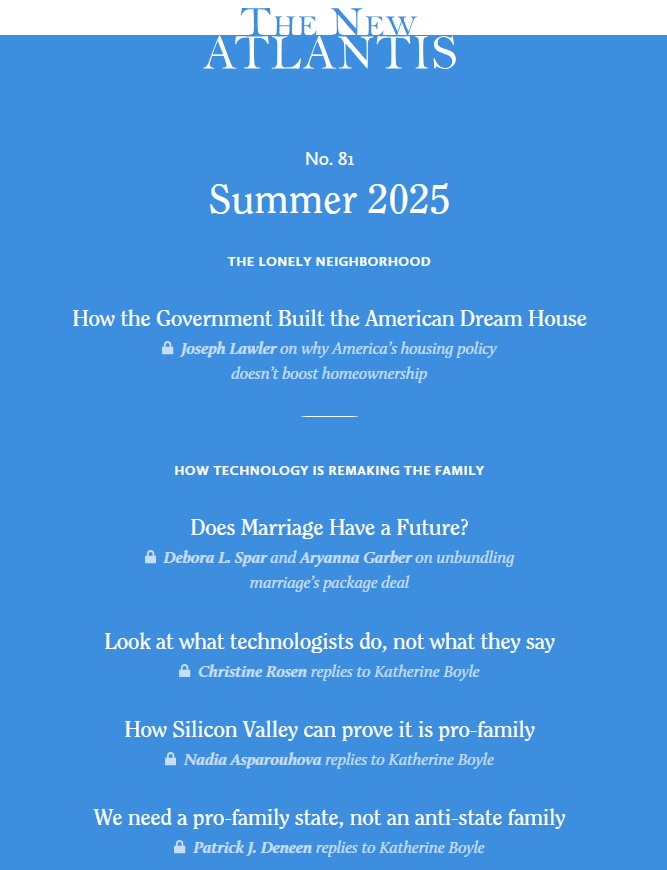
THE NEW ATLANTIS MAGAZINE (June 16, 2025): The latest issue features ‘The Lonely Neighborhood’…

How the Government Built the American Dream House

U.S. housing policy claims to promote homeownership. Instead, it encourages high prices, sprawl, and NIMBYism.

Does Marriage Have a Future?

From the Industrial Revolution to the pill to AI girlfriends, technology is unbundling what used to be marriage’s package deal.

Look at what technologists do, not what they say

A new alliance between tech and the family?

The Atlantic Magazine – June 2025 Preview

THE ATLANTIC MAGAZINE (April 28, 2025): The latest issue features “I Run The Country and The World” – Donald Trump explains his victory and his plan…

1. “I run the country and the world”

Asked how his second term so far differed from his first, Trump said: “The first time, I had two things to do — run the country and survive; I had all these crooked guys.”

  • “And the second time, I run the country and the world,” he added.
  • “I’m having a lot of fun, considering what I do … You know, what I do is such serious stuff.”

2. A third term “would be a big shattering”

Of a potential 2028 run, Trump told the magazine it “would be a big shattering.”

  • He continued, “Well, maybe I’m just trying to shatter.” But Trump added, “It’s not something that I’m looking to do. And I think it would be a very hard thing to do.”
  • That follows his comments from last month, when said he is “not joking” about a third term,

Reality check: Trump launching a bid for a third term wouldn’t just shatter norms — it would violate the 22nd amendment.

  • Meanwhile, the Trump Organization has started selling “Trump 2028” hats.

3. The billionaire class’ “higher level of respect”

The billionaire class has largely bowed to Trump in his second term. He described the mega-rich taking a friendlier posture as “just a higher level of respect.”

  • “I don’t know … Maybe they didn’t know me at the beginning, and they know me now,” he continued.