Category Archives: Business

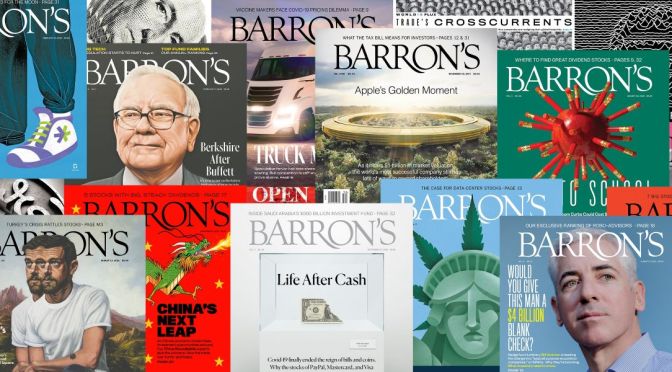
Barron’s Magazine —- January 27, 2025 Preview

Magazine - Latest Issue - Barron's

BARRON’S MAGAZINE (January 25, 2025): The latest issue features ‘The Trump Effect’ – Bond prices could fall further. Why that’s bad for borrowers…

High Interest Rates Are Hammering Investors. What Lies Ahead Could Be Worse.

Rising rates would be bad news for bondholders and borrowers of all stripes, particularly the U.S. government. They cast a shadow over stocks, too.

Worried About Social Security Under Trump? What to Know About Claiming Early.

The program’s finances could take another hit if some of the president’s tax proposals are passed. What to know about claiming early.

Alphabet, Uber, Applied Materials, and 19 Other Picks From the Barron’s Roundtable

Four of our panelists discuss their favorite investments in the final installment of our 2025 stock-picking confab.

The Agony and the Ecstasy: A Look at Barron’s 2024 Stock-Pick

While our overall report card is disappointing, our best picks revealed our strength in digging into complicated situations.

The Economist Magazine – January 25, 2025 Preview

The Economist | Independent journalism

THE ECONOMIST MAGAZINE (January 23, 2025): The latest issue features ‘Project 1897’ – The Imperial Presidency….

America has an imperial presidency

And in Donald Trump, an imperialist president for the first time in over a century

Chinese AI is catching up, posing a dilemma for Donald Trump

The success of cheap Chinese models threatens America’s technological lead

Tariffs will harm America, not induce a manufacturing rebirth

Donald Trump’s pursuit of tariffs will make the world poorer—and America, too 

To make electricity cheaper and greener, connect the world’s grids

Less than 3% of the world’s power is internationally traded—a huge wasted opportunity

Barron’s Magazine —- January 13, 2025 Preview

Barron's | Financial and Investment News

BARRON’S MAGAZINE (January 11, 2025): The latest issue features ‘The 2025 Roundtable’…

The Stock Market’s New Year Is Off to a Tough Start. What Lies Ahead, According to Our Roundtable Pros.

The 2025 Barron’s Roundtable featured a large group of bearish panelists and a smaller but equally committed cadre of bulls.

California Fires Have Caused Billions of Dollars in Losses. Why Insurance Stocks Have a Brighter Future.

California Fires Have Caused Billions of Dollars in Losses. Why Insurance Stocks Have a Brighter Future.

The insurance industry has been thriving as climate change increases the demand for coverage.

How to Make the Most of the New ‘Super Catch-Ups’ for 401(k)s

Workers in their early 60s can contribute nearly $35,000 to a 401(k) in 2025. It raises new tax questions, though.

These Stock Funds Crushed the Market in 2024. What They’re Buying Now.

In a tough year for stockpickers, a handful of funds managed to trounce the market. Here’s how they did it—and what they like for 2025.

The Economist Magazine – January 4, 2025 Preview

THE ECONOMIST (January 3, 2025): The latest issue features The fight over America’s economy

Tech is coming to Washington. Prepare for a clash of cultures

Out of Trumpian chaos and contradiction, something good might just emerge

Finland’s seizure of a tanker shows how to fight Russian sabotage

The growing threat to undersea cables demands a robust response

To see what European business could become, look to the Nordics

The region produces an impressive number o

Barron’s Magazine – December 30, 2024

Magazine - Latest Issue - Barron's

BARRON’S MAGAZINE (December 28, 2024): The latest issue features ‘The Real Drone Invasion’….

Watch Out, Amazon and UPS: The Race Is On for Drone Delivery

There’s more to drones than mysterious lights. A multibillion-dollar drone delivery market is taking shape. The rewards could be massive.

UnitedHealth and CVS Received Millions in Opioid Rebates Through Medicare

As the U.S. opioid crisis deepened, Medicare plans administered by UnitedHealth and CVS Health were a top source of OxyContin sales, a Barron’s investigation found.

Welcome to Middle Age, Millennials. Here’s How to Get Your Retirement Savings on Track.

AI Is Reshuffling the Ranks of Utilities Stocks. Here Are the Likely Winners.

Once known as safety plays, shares of electricity suppliers are getting a jolt from AI data centers.

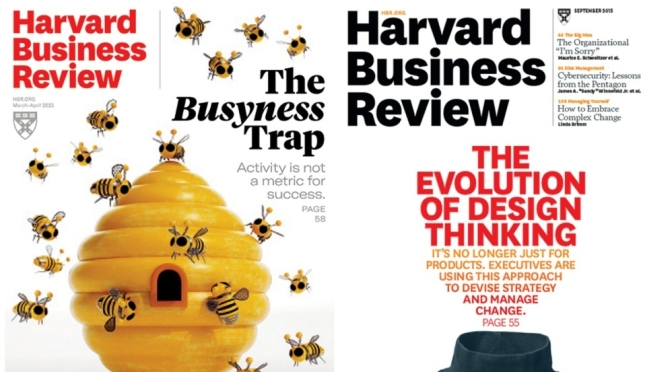
Harvard Business Review – November/December 2024

November–December 2024

Harvard Business Review (October 22, 2024) – The latest issue features:

Why Employees Quit

New research points to some surprising answers. 

Summary.   

The so-called war for talent is still raging. But in that fight, employers continue to rely on the same hiring and retention strategies they’ve been using for decades. Why? Because they’ve been so focused on challenges such as poaching by industry rivals, competing in tight labor markets, and responding to relentless cost-cutting pressures that they haven’t addressed a more fundamental problem: the widespread failure to provide sustainable work experiences. To stick around and give their best, people need meaningful work, managers and colleagues who value and trust them, and opportunities to advance in their careers, the authors say. By supporting employees in their individual quests for progress while also meeting the organization’s needs, managers can create employee experiences that are mutually beneficial and sustaining.

Personalization Done Right

The five dimensions to consider—and how AI can help

Summary.   

More than 80% of respondents in a BCG survey of 5,000 global consumers say they want and expect personalized experiences. But two-thirds have experienced personalization that is inappropriate, inaccurate, or invasive. That’s because most companies lack a clear guidepost for what great personalization should look like.

Authors Mark Abraham and David C. Edelman remedy that in this article, which is adapted from Personalized: Customer Strategy in the Age of AI (Harvard Business Review Press, 2024). Drawing on decades of work consulting on the personalization efforts of hundreds of large companies, they have built the defining metric to quantify personalization maturity: the Personalization Index. It is a single score from 0 to 100 that measures how well companies deliver on the five promises they implicitly make to customers when they personalize an interaction.

The authors argue that personalization will be the most exciting and most profitable outcome of the emerging AI boom. They describe how companies can use AI to create and continually refine personalized experiences at scale—empowering customers to get what they want faster, cheaper, or more easily. And they show readers how to assess their own business’s index score.

Design Products That Won’t Become Obsolete

Photography: How Kodak Invented The ‘Snapshot’


Vox (September 20, 2024): In 1888, Eastman Kodak patented roll film, and the company’s business model of selling film, and then processing and printing the photos taken on that film for their consumers, made photography available to the masses for the first time.

Before the Kodak No. 1 box camera debuted, photography was a complicated process involving chemistry and expertise on big, bulky equipment. When Kodak introduced the Brownie and sold it for a dollar in 1900, photography went fully mainstream. The company dominated the film sales and development market during the 20th century and successfully marketed its automatic cameras as crucial to capturing fleeting moments — at home and on vacation.

But digital camera sales began to outpace film camera sales in the early 2000s, and Kodak failed to keep up. They filed for bankruptcy in 2012 but do still exist and sell film, albeit to a much smaller market.

Music: Selmer Saxophones History & Craftsmanship

Insider Business (September 6, 2024) – Henri Selmer Saxophones was founded in Paris in 1885. Today, the company is synonymous with high-end saxophones. The most popular saxophone it sells, the Series II alto, starts at about $7,000, but a Selmer can cost you as much as $30,000, depending on the customization and finishes like gold plating.

John Coltrane, one of the most influential jazz musicians of all time, used Selmer saxophones in his performances. He recorded his magnum opus, “A Love Supreme,” on a Mark VI. One of his Mark VI tenor saxophones is on display at the Smithsonian’s National Museum of American History.

Musicians are willing to pay for a Selmer for a variety of reasons: the familiar sound, the history behind the brand, the craftsmanship and attention to detail, and the playability.

Views: America’s Domestic Shift To Wine Production

CBS Mornings (August 17, 2024): The United States is the largest wine importer by volume and value, with most bottles in the country imported from European countries. But there’s a domestic shift underway, with regions around the U.S. growing in size and prestige to produce more local varieties. Nancy Chen has more.

Harvard Business Review – September/October 2024

September–October 2024

Harvard Business Review (August 12, 2024) – The latest issue features Embracing Gen AI at Work: How to get what you need from this new technology…

Tom Brady on the Art of Leading Teammates

In this article, NFL great Tom Brady and Nitin Nohria, of Harvard Business School, present a set of principles that people in any realm can apply to help teams successfully work together toward common goals.close

When our society talks about success, we tend to focus on individual success. We obsess about who is the “greatest of all time,” who is most responsible for a win, or what players or coaches a team might add next season to become even better.

Where Data-Driven Decision-Making Can Go Wrong

Let’s say you’re leading a meeting about the hourly pay of your company’s warehouse employees. For several years it has automatically been increased by small amounts to keep up with inflation. Citing a study of a large company that found that higher pay improved productivity so much that it boosted profits, someone on your team advocates for a different approach: a substantial raise of $2 an hour for all workers in the warehouse. What would you do?

AI Won’t Give You a New Sustainable Advantage

History has shown that technological innovation can profoundly change how business is conducted. The steam engine in the 1700s, the electric motor in the 1800s, the personal computer in the 1970s—each transformed many sectors of the economy, unlocking enormous value in the process. But relatively few of these and other technologies went on to become direct sources of sustained competitive advantage for the companies that deployed them, precisely because their effects were so profound and so widespread that virtually every enterprise was compelled to adopt them. Moreover, in many cases they eliminated the advantages that incumbents had enjoyed, allowing new competitors to enter previously stable markets.