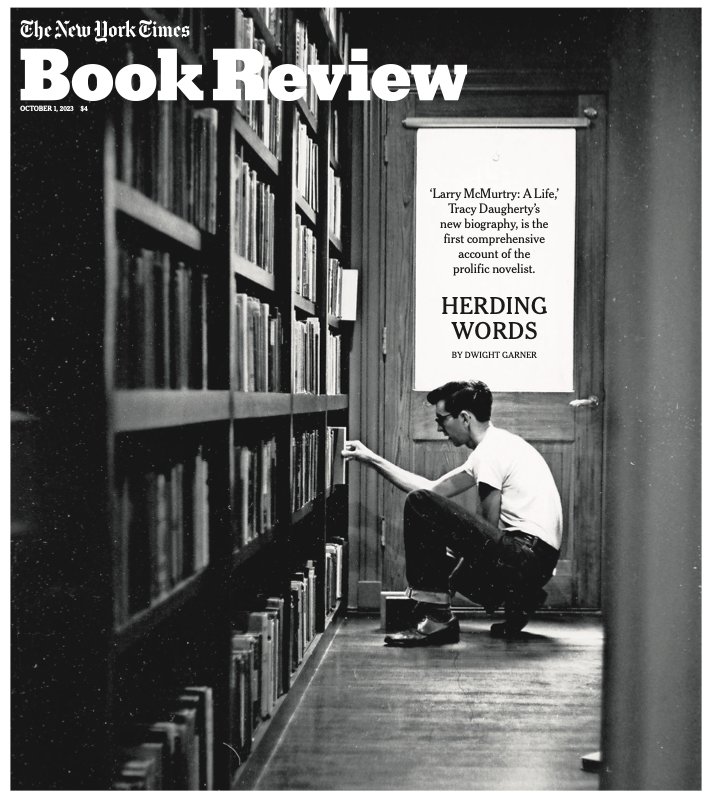

THE NEW YORK TIMES BOOK REVIEW – August 20, 2023: The issue features “never before told” narrative histories including a tale of the female botanists who surveyed the Grand Canyon in 1938, a recent biography of the 19th-century “abortionist of Fifth Avenue” and the book on this week’s cover: Prudence Peiffer’s “The Slip,” which brings into focus a thriving artistic community that existed at the southernmost tip of Manhattan in the 1950s and ’60s.
In Melissa Sevigny’s “Brave the Wild River,” we meet the two scientists who explored unknown terrain — and broke barriers.
BRAVE THE WILD RIVER: The Untold Story of Two Women Who Mapped the Botany of the Grand Canyon, by Melissa L. Sevigny
Let’s start this story on a sun-blistered evening in August 1938. A small band of adventurers had just concluded a 43-day journey from Utah to Nevada — although perhaps “journey” is too tame a description for a trip that had required weeks of small wooden boats tumbling down more than 600 miles of rock-strewn rivers. The goal was twofold. First, to simply survive. And then, to chart the plants building homes along the serrated walls of the Grand Canyon.
Times Literary Supplement (August 18 & 25, 2023): Theatre of war – How Susan Sontag brought Beckett to Sarajevo; Mina Loy; Madmen in the White House; Grieving for a child; Through the looking-glass again; Women artists unleashed and more…
THE NEW YORK TIMES BOOK REVIEW – August 13, 2023: The annual thrillers issue features – a tense murder mystery set aboard a cruise ship; a heist novel involving rough diamonds, crooked lawyers and masters of the double cross; and an especially creepy serial-killer novel, to name just a few.
In “Flirting With Danger,” Janet Wallach tells the story of Marguerite Harrison, who traded a life of privilege to become America’s first international female spy.
By Chloe Malle
FLIRTING WITH DANGER: The Mysterious Life of Marguerite Harrison, Socialite Spy, by Janet Wallach
Anyone complaining about a canceled Delta flight would do well to channel Marguerite Harrison. The United States’ first international female spy, Harrison crisscrossed the globe by rickshaw, propeller plane, camel, inflated goatskin raft and rail freight car and once brightly described a trans-Siberian voyage, in which she was wedged between sacks of tea and oats on the back of a troika in a blizzard, as “a rare and delightful experience.”
From left: John Fairfax; Tom McCleanCredit…From left: Daily Mail/Shutterstock; Tom McClean
In “Completely Mad,” James Hansen tells the stories of two men who in 1969 vied to be the first to row solo across the Atlantic Ocean.
COMPLETELY MAD: Tom McClean, John Fairfax, and the Epic Race to Row Solo Across the Atlantic, by James R. Hansen
The day before the Apollo mission landed two men on the moon, a British man named John Fairfax waded into Hollywood Beach, Fla., greeted by masses of cheering fans, having been the first person to row solo across the Atlantic Ocean. Eight days later, another Briton, Tom McClean, pulled his dory up a deserted beach in Blacksod Bay, Ireland, having rowed solo across the Atlantic in the opposite direction. While Fairfax was acclaimed and feted, McClean walked to the closest pub, alone.
I adored Niklas Natt och Dag’s brilliantly cynical debut, The Wolf and the Watchman, and The City Between the Bridges is just full of filth and cynicism, the perfect combination for depicting the late 18th century and its terrible iniquities. The watchman of The Wolf and the Watchman returns to solve a new crime, this one the brutal murder of a tenant’s daughter on the eve of her wedding to a seemingly sensitive nobleman. Natt och Dag is particularly adept at savagely ripping the notion of a “civilized age” apart and showing the raw suffering underneath. As a side note, I’ve long believed that historical fiction is only to be trusted when the author is willing to describe bad smells to set the scene, and this book is full of truly disgusting odors.
Set in the dying colonial era, Kevin Jared Hosein’s searing debut examines race, class, and decolonization through the lens of two families, one white and wealthy, the other Black and disenfranchised, as their lives become ever more entwined after the disappearance of the white family’s patriarch. Like the best historical fiction, Hungry Ghosts is immersed in the ideas and complexities of its’ shifting time period, for a triumph of well-researched storytelling.
In one of those amazing life twists that feels as bizarre as it is inspiring, Tara Ison, the writer of the cult hit Don’t Tell Mom The Babysitter’s Dead has crafted one of the best tales of collaboration ever written. In Between the Hour of Dog and Wolf, Tara Ison takes us into the mind of an adolescent Jewish girl being hidden with a French family during WWII. She spends so much time pretending to align with the ideals of the occupiers that she finds herself beginning to agree with them, in what reads as a Jewish version of Lacombe, Lucien. Perhaps it’s not such a twist—both book and film are about the ways we assume new roles when necessary to survival, whether that’s taking a job as a fashion consultant to feed siblings and putting on a batshit fashion show (a la Babysitter) or pretending to be a fascist to to protect from others knowing that you are Jewish. Okay, maybe that last comparison is a bit of a stretch, but still, everyone should read this book and also everyone should should rewatch that movie.
Bret Easton Ellis is back, this time with a new serial killer novel that brings together all the best aspects of Less Than Zero and American Psycho. It’s 1981, Missing Persons is playing on the stereo, and future writer Bret is doing bumps with his prep-school friends by the poolside, dressed sharply in Ralph Lauren, as a killer makes his way closer and closer to their wealthy enclave. Ellis’ teenage emotional truths collide with violent fictional set-pieces for an epic tale of Southern Californian sins.
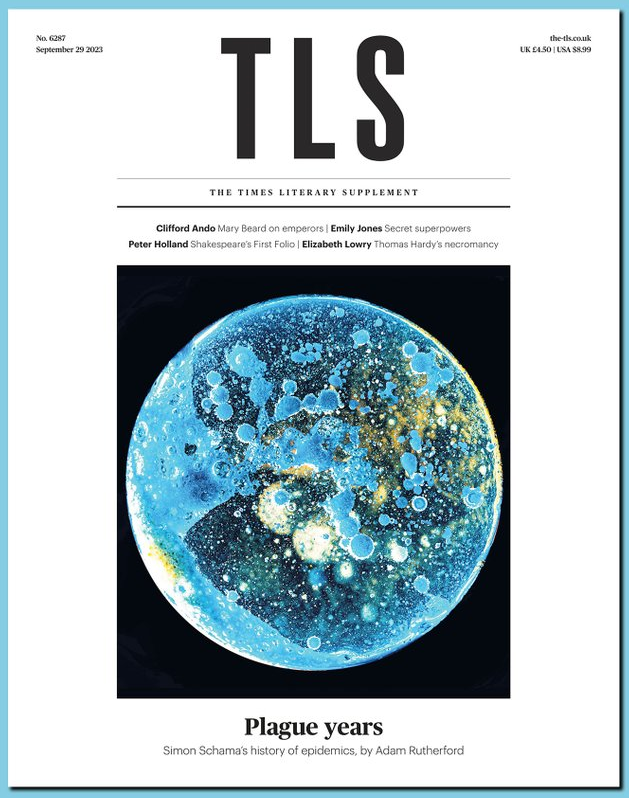
Times Literary Supplement (August 11, 2023): – Race today and yesterday – The Black and Asian British experience; Orwell’s political pilgrimage; Germany via Scotland; Adam Mars-Jones trilogy and the Grenfell play…
Literary Review of Canada – September 2023: The September issue features Michael Taube on Jason Kenney, the life of Jack Austin, the legacy of a horse racing dynasty, our tenacious statistics bureau, memories of melmac, and Vincent Lam’s latest—with a cover from Alexander MacAskill.
The question is asked all the time, usually in unpoetic moments; it’s an occupational hazard of teaching literature. There I’ll be at the clinic, sinuses on fire, when sure enough the doctor asks, “What’s your favourite book?” My practised answer, no hemming and hawing, is Moby-Dick. Everyone’s heard of it, and it sounds reassuringly substantial. (No one wants to hear a professor say Twilight.) “Oh, Time, Strength, Cash, and Patience,” I’ll mumble to myself as I walk out with my prescription.
‘A novelist is condemned to produce a succession of novelties, new names for characters, new incidents for his plots, new scenery,’ reflects the beleaguered hero of The Ordeal of Gilbert Pinfold, Evelyn Waugh’s portrait of the artist as a middle-aged car crash.
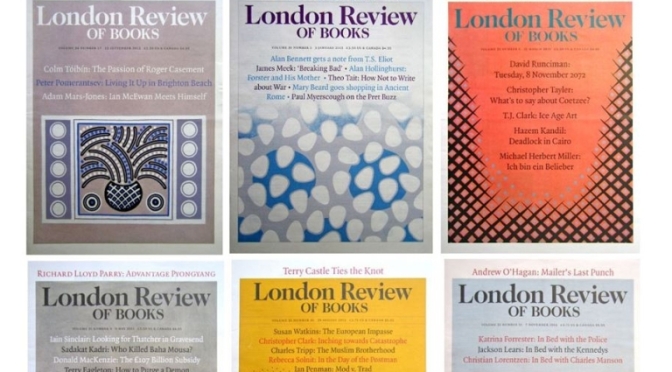
London Review of Books (LRB – August 5, 2023) – But really, as Pinfold goes on to say, ‘most men harbour the germs of one or two books only; all else is professional trickery of which the most daemonic of the masters – Dickens and Balzac even – were flagrantly guilty.’ Pinfold is by admission a self-portrait, so Waugh must have expected readers to speculate on how this observation applied to his own career, and whether he was a one or a two-book man himself.
In 1958, a Cambridge don called Frederick J. Stopp produced a study of Waugh – uniquely, Waugh himself gave ‘generous assistance’ – which warmly endorsed the idea that he had basically ‘two books in his armoury’, the first featuring the ‘contrast between sanity and insanity’ and the second ‘sanity venturing out into the surrounding sphere of insanity, and defeating it at its own game’.
Whether this particular dualism had Waugh’s approval is unclear, but either way it doesn’t seem entirely satisfactory since the two alternatives look like variants of the same thing. Less well-disposed readers have thought that Waugh’s books divided on much more rudimentary lines: the good ones, which are funny, and the bad ones, which are pious.
There is the string of brilliant, brittle social comedies in the 1930s, and then there is whatever started happening with the publication in 1945 of Brideshead Revisited. Stopp reported, presumably with his master’s sanction, that ‘Mr Waugh’s reputation among the critics has hardly yet recovered from the blow.’ Brigid Brophy had the best joke: ‘In literary calendars, 1945 is marked as the year Waugh ended.’
In marine biology, a whale fall is the body of a dead whale that has slowly descended to the bottom of the ocean. Scavengers strip its flesh, crustaceans and other creatures colonize its skeleton and its decaying bones help sustain countless organisms for years to come, part of the delicate balance of the undersea ecosystem.
While Billy Wilder’s 1957 film adaptation portrays Ariane (played by Audrey Hepburn) as a doe-eyed ingénue, Claude Anet’s original character is considerably more enigmatic. Credit…Allied Artists/Getty Images
Reading Claude Anet’s provocative 1920 novel “Ariane: A Russian Girl,” the reader may yearn for a little less conversation.
By Gemma Sieff
It would be nice if we had put to bed, so to speak, witless and reductive double standards about female promiscuity. Have you heard the one that goes, “A key that opens many locks is a master key, yet a lock that is opened by many keys” is … unprintably bad? Me neither — until I saw it on TikTok.
When constructing monumental tombs thousands of years ago, “the Egyptians built up” — with their pyramids — whereas “the Chinese built down”, writes sinologist Jessica Rawson. The geology of China’s dry Loess Plateau permitted the excavation of shafts more than 10 metres deep. These tombs were filled with objects for the afterlife. Rawson’s majestic history explores 11 such monuments and one large sacrificial deposit, dating from 5,000 years ago to the third century bc, with the First Emperor’s protective Terracotta Army.
The World of Sugar
Ulbe Bosma
Sugar’s societal dominance is a recent development. Granulated sugar was eaten from the sixth century bc in India, but refined sugar became widely available in Europe only in the nineteenth century. Its history is both a story of progress and a bitter-sweet tale of “exploitation, racism, obesity, and environmental destruction”, writes historian Ulbe Bosma in his authoritative, highly readable study — the first to be truly global. Of 12.5 million Africans kidnapped in the Atlantic slave trade, between half and two-thirds were enslaved on sugar plantations.
The Seven Measures of the World
Piero Martin (transl. Gregory Conti)
The great civilizations of the ancient world could use precise measurements — witness the Egyptian pyramids. But their units differed. Not until 1960 was the international system of measurement (SI) introduced, defining the metre, second, kilogram, ampere, kelvin and candela — then the mole in 1971. Each gets a chapter in this concise, anecdotal history by experimental physicist Piero Martin. He stresses the subjective aspect of measurement, such as the idea that the quality of scientific publications matters more than their quantity.
Unearthing the Underworld
By Ken McNamara
Earth scientist Ken McNamara focuses on palaeontology and evolution. His appealing book about rocks and their lessons — illustrated with fine photographs of fossils — leaves aside igneous and metamorphic rocks, and the wonders of mineralogy. It concentrates instead on sedimentary rocks: mudstones, siltstones, sandstones and limestones, scattered over three-quarters of Earth’s surface in “endless piles”. As he jokily advises: “Ignore rocks at your peril.” But then surely continental drift deserved proper discussion?
In Light-Years There’s No Hurry
Marjolijn van Heemstra (transl. Jonathan Reeder)
Dutch space reporter Marjolijn van Heemstra is also a poet, novelist and playwright. This translation of her highly personal meditation on the Universe reflects lyrically on the fact that the atmosphere “signifies a boundary”, whereas space “appeals to our notion of boundlessness”. She notes a growing difference of opinion between those who see space exploration as irresponsible because our planet is in deep trouble — environmental and otherwise — and those who regard space as a potential refuge from Earth.
Times Literary Supplement (August 4, 2023): The twilight zone – Joyce Carol Oates on the novellas of Rachel Ingalls; J.L Austin, philosopher-spy; Adam Thirlwell’s historical fantasy; Hollywood blockbusters; Poverty in the U.S. and more…
News, Views and Reviews For The Intellectually Curious